


Summer Safety
August 28, 2012
As we have been considering changes for in-season football practice rules that are more in step with recent recommendations of the National Athletic Trainers Association, the American Academy of Pediatrics and the National Federation of State High School Associations, as well as the actions of several of our counterpart state organizations across the U.S., we have also been looking at the rules that apply out of season to assure they do not work against the preparation of students for a safe experience.
Except during the school’s designated summer dead period of at least seven consecutive days, football coaches may interact with any number of players in voluntary weight training and conditioning sessions as frequently as they desire. Introduce footballs and helmets, and the coach can still work with any number of students on the sideline and up to seven players at a time for any number of days. Add competition, and the coach can still work with up to seven players at a time for a maximum of seven days. In addition, football coaches may participate for a maximum of ten days at bona fide football camps where any number of their players are participating.
Plenty of time for coaches to teach, and even more time for players to train. During this time, the rules permit students to wear helmets, which protect against accidental collisions during drills; but the rules prohibit other pads that would allow activities to escalate to the point where contact is expected, leading to increased blows to the head at a time when the objective from the pros to Pop Warner is to reduce blows to the head.
When the brief preseason down time begins Aug. 1, the coach continues to be able to work with any number of players in conditioning and weight training. The down time prohibits those activities that could be a disguise for practice prior to the earliest allowed practice date – open gyms, camps, clinics and competition. The down time puts the emphasis where it’s most needed for a healthy student experience when practice actually begins: that’s weight training and conditioning.
Some critics may focus on what they can’t do in the summer; but clearly, there’s much they can do, and it’s all designed to help players improve and excel in a safe environment.
Finals Four: Ithaca Adds to Title Streak
November 29, 2013
By Geoff Kimmerly
Second Half editor
DETROIT – As the final seconds ticked down in Friday’s Division 6 Final, Ithaca’s players predictably began throwing four fingers into the air – signifying their fourth straight MHSAA title.
But the Yellowjackets could’ve chosen instead to press a thumb and fingertip together and form a zero – as in how many times they’ve lost during this greatest run in state football history.
Ithaca re-claimed a tie with Iowa City Regina (Iowa) for the nation’s longest active winning streak of 56 straight by climbing back from an early deficit to beat Clinton 41-22 at Ford Field.
The Yellowjackets’ run of perfection also is the longest in MHSAA history to occur entirely during the playoff era. Only Hudson, with 72 straight wins between 1968-75, put together a longer streak – and the Tigers’ included only one playoff win before they fell in the first-ever MHSAA Class C Final.
Also, only two teams have won more consecutive titles than Ithaca; East Grand Rapids and Farmington Hills Harrison achieved five straight apiece.
“We have a huge target on our back, and we all know that. As a team, we handle it pretty well,” said Ithaca senior quarterback Travis Smith, who finished his career 41-0 as a starter and as the only player who dressed for all four Finals wins.
“We left the whole winning streak for our community to play with. We don’t really think about it too much. We just focus on the task at hand, which is what our coaching staff says all the time. And I’m just so proud of my team and my friends.”
Despite the convincing final score, Ithaca did trail Clinton into the third quarter. Amazingly, the Yellowjackets trailed in all of the final four playoff games this fall.
Coach Terry Hessbrook, in his 10th season running the program and a former Ithaca standout himself, called three of the running backs his team faced during the run – Maple City Glen Lake’s Trevor Apsey, Negaunee’s Tyler LaJoie and Clinton junior Collin Poore – among the best Ithaca has ever faced. Then there was the more sizable Montrose, which provided the season’s greatest scare before falling to the Yellowjackets by a point in the Semifinal.
 “We’ve been behind four playoff weeks in a row. It just does not seem to faze them,” Hessbrook said of his players. “With the big heavy weight, burden, on their shoulders and the bulls eye and the winning streak and all that kind of stuff, I’ve got to believe that a lot of high school kids would crumble under that kind of pressure.
“These guys are going to go on to do amazing things in life because they’re special people.”
But it was Clinton (13-1) that appeared early to be special enough to end Ithaca’s streak. The Redskins capped their best season ever by making their first MHSAA Final.
“I came last year to watch Ithaca play. Just coming to play the game is totally different,” Clinton senior quarterback T.J. Baker said. “I knew I was nervous right when I stepped on the first. It was just crazy to play in this game. But at the same time, it was fun. Our community has never been here before, and it was just a fun game to play in.”
After Ithaca jumped to a 14-0 lead, Clinton bounced back with a Poore 18-yard touchdown run and an 86-yard punt return score by sophomore Mathew Sexton.
That seemed to nudge Ithaca’s offense – which finished this season with 710 points, third most in MHSAA history. Smith threw the second of his four touchdown passes to give Ithaca back the lead heading into halftime, and followed another Poore score at the start of the third quarter with two more scoring passes and a scoring run.
Smith also returned an interception 30 yards for a touchdown during the first quarter, giving him a hand in all six Ithaca scores. He finished his high school career with an MHSAA record 104 touchdown passes, and in this game 123 yards rushing and 247 passing.
“He lived up to his billing,” Clinton coach Scott McNitt said. “We did the best we could against him. And for two and a half quarters, we felt we were right there. And then it just got away from us a bit, and the momentum changed.
“I couldn’t be more proud of a group of young men who overcame a lot of adversity. To make it to the state finals, it’s unheard of where we come from.”
Hessbrook said everything he feared about Clinton seemed to go wrong for his team during the first half. Poore finished with 125 yards rushing and the team as a whole had 254, taking advantage of its perimeter speed to get around the corner on pitch sweeps and other similar runs for 208 of those yards during the first half.
But the Yellowjackets made the necessary adjustments during the third quarter, taking away that edge while bringing more pressure – Ithaca finished with 13 tackles for losses including seven sacks.
Senior Josh Hafner caught two of the scoring passes from Smith, and senior Eli Villalobos had six catches for 82 yards and a score. Senior Logan Hessbrook also had six catches, for 93 yards and a score, to follow last season’s performance when he stepped in for an injured Smith at quarterback and led the team to the title.
“You’re playing with your best friends you’ve grown up with your whole life. It’s the best group of friends I’ve ever had and could ask for,” said Hessbrook, who also is the coach’s nephew. “And the coaching staff and the community, it’s amazing.
“Ithaca’s a special place. Coach says that; everyone says that. And when I get out of college, I’m going to try to come right back to Ithaca, because it’s amazing to live there.”
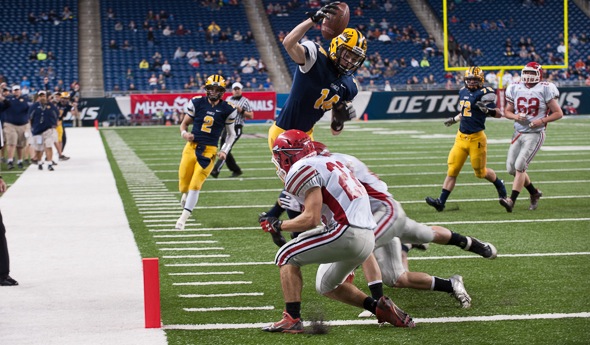
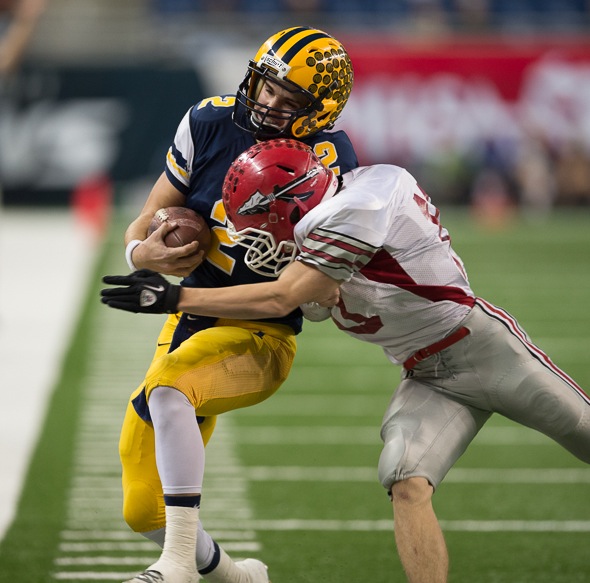
PHOTOS: (Top) Ithaca senior Josh Hafner (14) leaps over two Clinton defenders on the way to one of his two touchdowns. (Middle) Ithaca quarterback Travis Smith holds tight to the ball after a big hit from Clinton’s Mathew Sexton. (Click to see more from Terry McNamara Photography.)