


Summer Safety
August 28, 2012
As we have been considering changes for in-season football practice rules that are more in step with recent recommendations of the National Athletic Trainers Association, the American Academy of Pediatrics and the National Federation of State High School Associations, as well as the actions of several of our counterpart state organizations across the U.S., we have also been looking at the rules that apply out of season to assure they do not work against the preparation of students for a safe experience.
Except during the school’s designated summer dead period of at least seven consecutive days, football coaches may interact with any number of players in voluntary weight training and conditioning sessions as frequently as they desire. Introduce footballs and helmets, and the coach can still work with any number of students on the sideline and up to seven players at a time for any number of days. Add competition, and the coach can still work with up to seven players at a time for a maximum of seven days. In addition, football coaches may participate for a maximum of ten days at bona fide football camps where any number of their players are participating.
Plenty of time for coaches to teach, and even more time for players to train. During this time, the rules permit students to wear helmets, which protect against accidental collisions during drills; but the rules prohibit other pads that would allow activities to escalate to the point where contact is expected, leading to increased blows to the head at a time when the objective from the pros to Pop Warner is to reduce blows to the head.
When the brief preseason down time begins Aug. 1, the coach continues to be able to work with any number of players in conditioning and weight training. The down time prohibits those activities that could be a disguise for practice prior to the earliest allowed practice date – open gyms, camps, clinics and competition. The down time puts the emphasis where it’s most needed for a healthy student experience when practice actually begins: that’s weight training and conditioning.
Some critics may focus on what they can’t do in the summer; but clearly, there’s much they can do, and it’s all designed to help players improve and excel in a safe environment.
Wounded Warrior Project: DeWitt vs Portland
December 16, 2011
DEWITT -- The meeting of two state-ranked teams always will ratchet up a typical football night. Both communities, naturally, want to see which is better on the field.
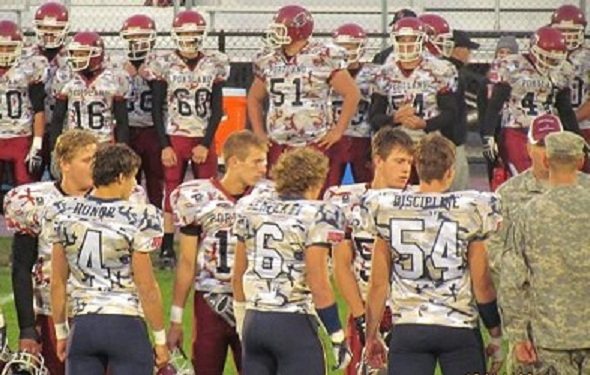
But during the hour before the opening kickoff Oct. 14 of DeWitt’s game against Portland, those teams and their supporters together recognized a grander cause. The night was dedicated to the Wounded Warrior Project, which aids U.S. soldiers (and their families) who have suffered service-related injuries and illnesses.
Rain washed out some planned attractions, but the evening certainly was memorable. Both teams wore camouflage jerseys and each sent its captains to the pre-game coin toss with an honorary captain representing the military. A number of other service personnel were involved – including a local color guard that presented a 30-foot flag for the national anthem.
It’s understandable if people’s visions of wars and our military are focused an ocean away. But connections hit close to home. DeWitt’s honorary captain, Lansing’s U.S. Army Spc. Jacob Shumway, recently returned from a deployment and has been in the service for two and a half years. He’s a 2003 Lansing Everett graduate, and his mother Susan Land is the principal at Lansing Eastern. His cousins Ethan and Collin Rennaker start for DeWitt, and he walked alongside them for the pregame flip. Shumway plans to attend Lansing Community College and study digital graphic design.
Both teams are considered contenders for their respective state titles next month; DeWitt is ranked No. 7 in Division 3, while Portland is No. 4 in Division 5. And they played like it – Portland prevailed 22-20 in overtime.
A great game, no question. But similarly significant was a preliminary figure of more than $11,000 raised for the WWP.
For more about the Wounded Warrior Project visit http://www.woundedwarriorproject.org.