


Summer Safety
August 28, 2012
As we have been considering changes for in-season football practice rules that are more in step with recent recommendations of the National Athletic Trainers Association, the American Academy of Pediatrics and the National Federation of State High School Associations, as well as the actions of several of our counterpart state organizations across the U.S., we have also been looking at the rules that apply out of season to assure they do not work against the preparation of students for a safe experience.
Except during the school’s designated summer dead period of at least seven consecutive days, football coaches may interact with any number of players in voluntary weight training and conditioning sessions as frequently as they desire. Introduce footballs and helmets, and the coach can still work with any number of students on the sideline and up to seven players at a time for any number of days. Add competition, and the coach can still work with up to seven players at a time for a maximum of seven days. In addition, football coaches may participate for a maximum of ten days at bona fide football camps where any number of their players are participating.
Plenty of time for coaches to teach, and even more time for players to train. During this time, the rules permit students to wear helmets, which protect against accidental collisions during drills; but the rules prohibit other pads that would allow activities to escalate to the point where contact is expected, leading to increased blows to the head at a time when the objective from the pros to Pop Warner is to reduce blows to the head.
When the brief preseason down time begins Aug. 1, the coach continues to be able to work with any number of players in conditioning and weight training. The down time prohibits those activities that could be a disguise for practice prior to the earliest allowed practice date – open gyms, camps, clinics and competition. The down time puts the emphasis where it’s most needed for a healthy student experience when practice actually begins: that’s weight training and conditioning.
Some critics may focus on what they can’t do in the summer; but clearly, there’s much they can do, and it’s all designed to help players improve and excel in a safe environment.
Performance of the Week: Colon's Justin Wickey
October 27, 2022
 Justin Wickey ♦ Colon
Football ♦ Senior
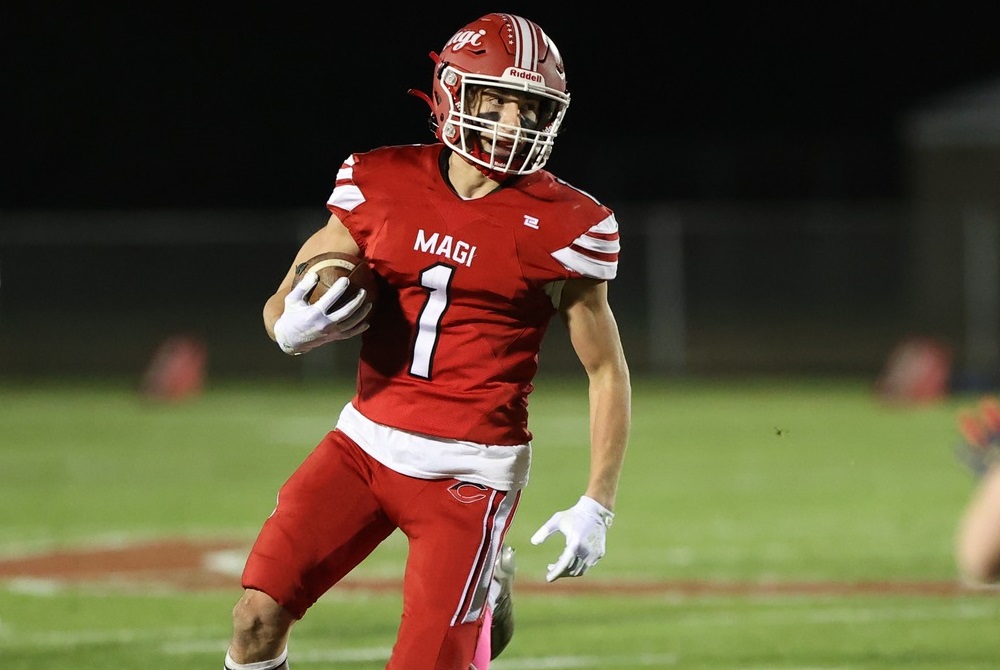
Wickey caught 10 passes for 138 yards and five touchdowns as Colon finished an undefeated regular season with a 60-14 win over Tekonsha. In the process, the senior receiver set two more MHSAA 8-player records, for 31 receiving touchdowns to break the previous single-season record of 27 set by Lawrence’s Matthew Cammire in 2013. Wickey also is up to 55 career receiving touchdowns over the last two seasons, which broke Cammire’s record of 53 set from 2013-14.
Those are just the most recent records Wickey has broken this season. He’s up to 90 catches for 1,569 yards this fall – the 90 catches easily setting a record and the yardage ranking second all-time, 129 from tying the record in that category. His 3,076 career receiving yards in another record, as are his 154 career catches – and his 18 catches against Adrian Lenawee Christian set a single-game 8-player record. That 40-24 win over Lenawee Christian on Sept. 16 ended the Cougars’ 27-game winning streak.
@mhsaasports 🏈POW: Justin Wickey #performanceoftheweek #football #8playerfb #record #touchdown #impressive #colon #magi #MHSAA #highschoolsports #tiktalk #interview #TikTok #mistudentaid #fyp ♬ Beat Automotivo Tan Tan Tan Viral - WZ Beat
Follow the MHSAA on TikTok.

MHSAA.com's "Performance of the Week" features are powered by MI Student Aid, a part of the Office of Postsecondary Financial Planning located within the Michigan Department of Treasury. MI Student Aid encourages students to pursue postsecondary education by providing access to student financial resources and information. MI Student Aid administers the state’s 529 college savings programs (MET/MESP), as well as scholarship and grant programs that help make college Accessible, Affordable and Attainable for you. Connect with MI Student Aid at www.michigan.gov/mistudentaid and find more information on Facebook and Twitter @mistudentaid.
2022-23 Honorees
Oct. 20: Owen DeMuth, Bloomfield Hills Cranbrook Kingswood tennis - Report
Oct. 13: Mia Melendez, Ann Arbor Greenhills golf - Report
Oct. 6: Shawn Foster, Grand Ledge football - Report
Sept. 30: Hannah Smith, Temperance Bedford swimming - Report
Sept. 22: Helen Sachs, Holland West Ottawa cross country - Report
Sept. 15: Nina Horning, Lake Orion volleyball - Report
Sept 8: Arturo Romero, Muskegon Oakridge soccer - Report
Sept. 1: Austin King, Midland Dow tennis - Report
Aug. 25: Olivia Hemmila, Troy Athens golf - Report
(Photos courtesy of the Colon athletic department.)