

Surge Becoming Storied as Boyne City Continues Memorable Playoff March
By
Tom Spencer
Special for MHSAA.com
November 22, 2024
Not many would say Boyne City’s football team followed the script this season.
After the way the Ramblers started this fall, only a scriptwriter could have envisioned the season they’ve enjoyed.
Boyne City started with just 17 varsity players in August. After moving up some from the JV squad and losing their opener to Standish-Sterling 33-14, the Ramblers picked up a couple of wins. They then fell in Week 4 to Kingsley, last year’s Division 6 champion, 26-20.
But that’s where the losses stopped. Boyne City is on an eight-game winning streak – which included a 21-15 victory over Kingsley in the District Final two weeks ago.
And when the Ramblers found themselves down 14-0 to Reed City midway through the second quarter last week in their Division 6 Regional Final, nobody would have blamed them for abandoning the script.
But if there is one, it called junior Owen Hewitt’s number. He took over, scoring four touchdowns to lead Boyne to a 35-28 win that advanced the Ramblers to Saturday’s Semifinal against Lansing Catholic.
“It wasn’t a dire situation,” said Boyne City coach Dave Suttle. “Our quarterback Drew Neer all year long has run our offense very well, and when we need a big play he’s always there. We threw a little curl, dig route over the middle to Owen and he went 63 yards for the score and kind of rejuvenated our team.”
Neer, also a junior, has connected with Hewitt and senior Jaden Alger the most this season. Hewitt’s first TD came with 1:22 left in the first half. Hewitt’s second was Boyne’s first offensive play of the second half and tied the game at 14-14.
It may have been Suttle scripting Hewitt’s performance.
Suttle expected Reed City to focus on stopping senior running back Ryan Spade, who has nearly 1,800 yards on the ground this season.
“Owen looked too good in practice last week, and we knew Owen was going to have a game,” Suttle said. “They were keying so hard on Ryan. We figured this was going to be the week, and we put some things in the game plan for him.”
Hewitt was extremely fired up coming out of halftime break, the sixth-year coach noted.
“Owen’s been our big-play guy all year,” said Suttle. “He’s got probably 600 yards receiving, and I think he’s scored 15 touchdowns between receiving and rushing. He’s been there but hadn’t had that wow game yet, that ‘Hey, who is this kid?’ And that was his game.”
The tough times this season from the small numbers to early losses united the team and created success, their coach proudly noted.
“From football specifically, we have made lifelong friends,” Suttle said. “We’ve learned how to help other people and depend on each other. The boys keep throwing out there they truly feel like they are all one family now. There’s all kinds of kids in this group. They have each other’s back. They’re not looking to blame anybody or point fingers. They’re just a solid group of gritty kids.”
Defensively, the Ramblers also have been led by Spate. He’s been involved in nearly 100 tackles. Sophomore Hyker McKinney has been involved in more than 70 tackles and Alger, junior Thomas Ager, senior Ryan Chapp, Hewitt and sophomore Ben Stanek are right behind them in solo tackles and assists.
Chapp and senior Leon Xiong have anchored the defensive line for the third straight year, Suttle pointed out.
“They’ve really stepped up this year, and they have pretty good stats,” Suttle said. “They are big-time leaders.”
The offensive line, in particular seniors Wiley Belcher and Zach Herrick, also continue to impress.
“They keep getting better every week and just keep pushing on,” Suttle said.
Win or lose this week or next, this team’s legacy already is solidified.
“I want this group to be remembered as the group that may have been counted out by a lot of other people or may have been overlooked,” Shuttle indicated. “We have a pretty good tradition of having a winning program, and we’ll make the playoffs and things like this, but this team sticks together and gets through the rough times and just never gives up.”
Tom Spencer is a longtime MHSAA-registered basketball and soccer official, and former softball and baseball official, and he also has coached in the northern Lower Peninsula area. He previously has written for the Saginaw News, Bay County Sports Page and Midland Daily News. He can be reached at [email protected] with story ideas for Manistee, Wexford, Missaukee, Roscommon, Ogemaw, Iosco, Alcona, Oscoda, Crawford, Kalkaska, Grand Traverse, Benzie, Leelanau, Antrim, Otsego, Montmorency, Alpena, Presque Isle, Cheboygan, Charlevoix and Emmet counties.
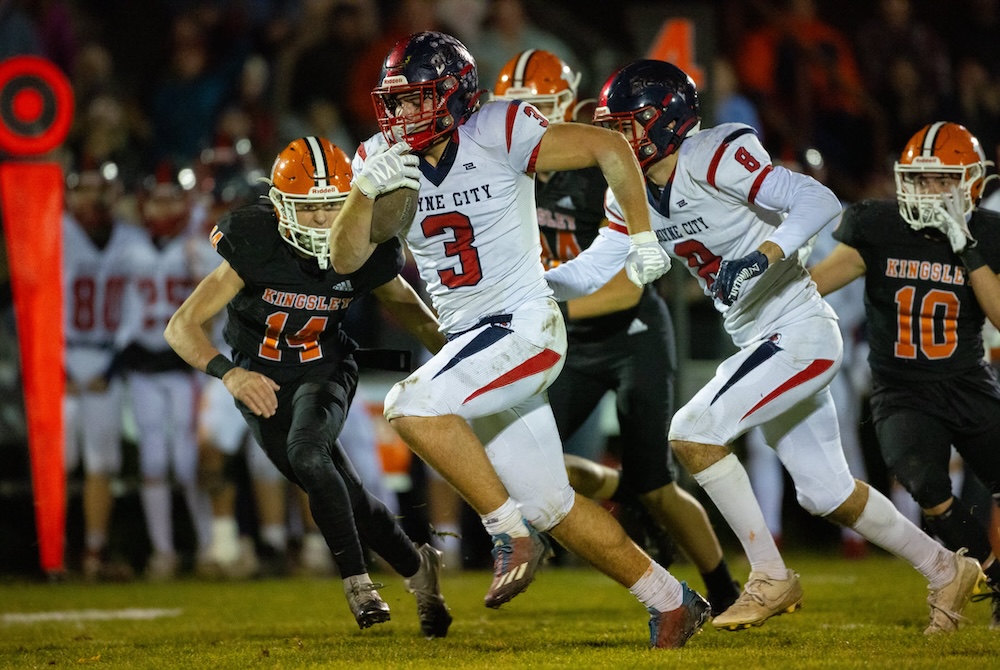
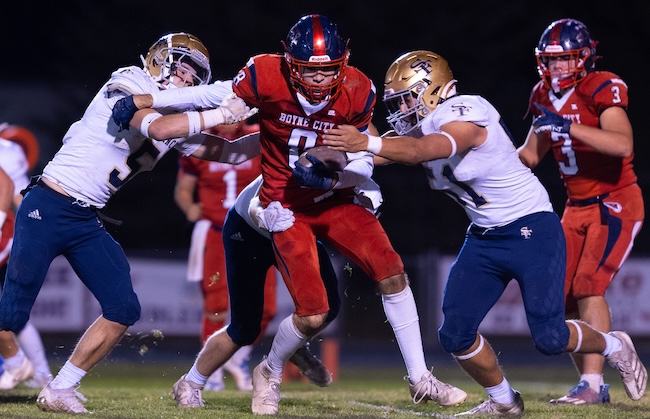
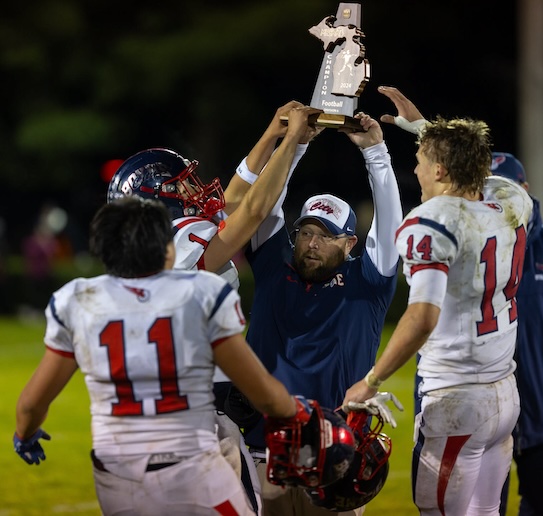
PHOTOS (Top) Boyne City’s Ryan Spade (3) breaks into the open during his team’s 21-15 District Final win over Kingsley. (Middle) Ben Stanek (8) works to break free from a pair of Traverse City St. Francis defenders during a 23-20 Week 9 win over Traverse City St. Francis. (Below) Ramblers coach Dave Suttle, middle, raises the District championship trophy with senior Leon Xiong (11) and junior Owen Hewitt (14). (Photos by Brandon Kish.)
Undefeated Contenders Make Claims as 1925 High School Football Champion
By
Ron Pesch
MHSAA historian
November 14, 2025
It was another football season without an official postseason, just as they all were prior to 1975 in Michigan.
Well – that’s not exactly true – but we will detail that story on another day.
In the Great Lakes State, the 1925 prep season – now 100 years ago - provides a beautiful illustration of the fun, fascination, and frustration in proclaiming gridiron championships in Michigan before the arrival of the MHSAA playoffs.
“The Roaring Twenties” – built in the age of prosperity that followed the end of World War I – were an age of excess, an era of more, and a time where anything seemed possible.
The Twenties are also known as the Golden Age of College Football, and excitement for the sport certainly trickled down to the high school level. The need or desire to open or break ground on impressively bigger and better stadiums hit schools around the nation. The 1925 season marked the opening of the University of Pittsburgh’s Pitt Stadium, with potential seating for 70,000. In Michigan, just upriver on Saginaw Bay in Bay City, the town’s Central High School unveiled a facility with a capacity of 7,100. That season marked the end of college careers for University of Illinois’ legend Harold “Red” Grange, Dartmouth’s Andy Oberlander, and Stanford’s Ernie Nevers. It was also the first varsity season at University of Michigan for Muskegon High School’s Bennie Oosterbaan, who became the school’s first three-time football All-American.
With a lack of lighted fields in Michigan, prep contests were mostly played on Saturdays, and the kickoff to seasons began around mid-September. Scheduled games generally ended in late November, with a few schools around the state closing their slate with a traditional Thanksgiving Day game.
Call it what you will – bragging rights, statewide acclaim, untethered validation, or an unsatisfied heart – but the regular season did not end the fascination and desire to name a state champion. While the state’s governing body did not sponsor championships, that did not stop cities, schools, the media, and the fan base from attempts to assign bragging rights to teams with unbeaten records. That was pretty much the case since the start of the prep game, dating back to 1888.
The era was often filled with “post season” challenges for games between teams to crystalize a claim on a championship. In general, they seldom came to fruition.
The MHSAA
The recently-created Michigan High School Athletic Association established three classes based on hard student enrollment numbers, with Class A – comprised of the state’s largest schools, each with a minimum of 500 students – Class B with between 175 and 499 enrolled, and Class C for schools with fewer than 175 pupils. Back then, the classifications were not segmented with an equal number of schools in each Class, as they are in today’s Division format. Rather, there were many more schools that fell into Class B and Class C than Class A. (Additional subdividing, adding Class D, and Class E, would come later).
Spurred on by fans and sportswriters, schools who wanted a share of the spotlight saw those classifications conveniently offering a means to segment claims on a state title. Acknowledging that they could seldom compete successfully against the larger schools in football, there was nothing to stop unbeaten teams from declaring themselves Class B or Class C gridiron champions.
The Fall of '25
Following the results of mid-November games across the state, just two prep teams in Michigan’s emerged as possible claimants to the title in Class A. Both Flint Central and Grand Rapids Union were unbeaten and untied. Flint would play Bay City Central at home on Saturday, Nov. 21, then square off for a Thanksgiving game with Ann Arbor in the university city.
Union would complete its regular season in a showdown with crosstown rival Grand Rapids South on Nov. 21. Unbeaten in 1924, South had shared that season’s mythical state title with Flint Central.
Just days before kickoff however, a third school emerged, making lots of noise.
Port Huron Times-Herald reporter Ray Bouslog penned an article that appeared in the Tuesday, Nov. 17 edition.
“Comparing Port Huron with the other two undefeated teams, the locals appear to have just as good a record as their rivals,” he noted. Comparing scores of games among the three schools against common opponents, and opponent’s common opponents – a common practice among fans and sportswriters then and now – he felt the local school was among the state’s best regardless of class.
Two days later, in the same paper, Port Huron’s athletic director and head coach Melvin J. Myers, acknowledging they had two more games on their schedule, was quoted by Bouslog:
“Having gone through the schedule unbeaten, untied, and unscored on, we consider that we have as much a claim (on the state title) as either Grand Rapids Union or Flint Central. But unlike the situation in former years, when the teams were unable to agree on terms of the post season battle, we are willing to play either of these schools at home or away.”
It was a bold statement. Port Huron was classified as a Class B school by the MHSAA. Five of its eight wins had come against Class B or Class C competition. While its goal line had not been crossed, Port Huron had scored 151 points – an average of just under 19 per contest.
Port Huron also had scheduled a Turkey Day game with Richmond, a Class C opponent. Myers considered the contest “only a workout for the team,” with victory by a large margin expected. But Saturday’s contest was on the road against a University of Detroit High School squad – no pushover. Port Huron, of course, would fall out of the race with a defeat in either contest.
On Friday, the Flint Daily Journal, in an Extra edition, acknowledged the Myers’ challenge: “(T)he recognized leader in Class B having no blemish on her record ... Port Huron is willing to step out of her class (and) has hurled challenges at both Flint and Union, provided they are untied and unbeaten.”
Since Union did not have a scheduled Thanksgiving Day contest, Myers stated he was willing to reschedule the Richmond game and meet Union, in Grand Rapids, on the holiday. The move would set up a “playoff” for an undisputed championship.
Union coach John Truesdale responded in the Grand Rapids Press, stating “This is no time to talk such stuff. The proper time for serious entertainment of such ideas is after the South game is played. If we win Saturday we talk. If we lose, and that is not impossible, then we will be in a position to consider such things.”
Union brushed off Coach Myers’ desire for a game on Thanksgiving. Truesdale indicated he was willing to listen to proposals from either Flint or Port Huron – not Thanksgiving Day – but on Saturday, Nov. 28, and no later.
Flint coach Charles Bassett was blunt with his response to the talk: “It is absolutely out of the question for Flint to even think of playing Union or any other team on Nov 28. We have a regularly scheduled game with Ann Arbor only two days before that time. It would be physically impossible for the boys to play two games in three days.”
Emphasizing that his two remaining games had been scheduled over a year ago, he stated, “Union knows our schedule and so does every other school in Michigan. I have no intention whatever of trying to change it. … If Union or Port Huron desire to play at some later date, after my boys have had a suitable rest, I shall be glad to listen to their proposals.”
Stage is Nearly Set
All three schools won their game on Saturday, Nov. 21. Rocky Parsaca nailed three out of four drop-kicks as Union topped South, 9-0, while Port Huron slipped past U of D High, 6-0, on a fourth-quarter TD by senior fullback Cecil Turner. Flint crushed Bay City Central, 32-0, to set the stage.
With that win, on the Wednesday before Thanksgiving, Bassett told the Journal, “If Central is successful against Ann Arbor tomorrow, we stand ready and willing to play either Port Huron or Grand Rapids Union for the undisputed state championship. This should settle all doubts as to our sincerity in believing we have the best team in the state. We are willing to test it on any neutral field.”
By then, however, negotiations for a three-way series involving Union had broken down and the news had reached the paper. In the same edition, it was noted that Union had packed up for the fall. Without a game on Thanksgiving or the Saturday following, Truesdale stated Union could not carry its squad for two full weeks without a game. On Monday, Nov. 24, the Press had announced that Union had closed out its football season and was now focused on basketball.
With that bit of news, the Flint paper stated, “It is probable that Flint and Port Huron will arrange a game for Saturday, Dec 5.”
Thanksgiving
Played on Ann Arbor’s high school field, located just three blocks from University of Michigan’s Ferry Field, Flint had its hands full, downing the hosts, 6-3, on a second-quarter touchdown by senior captain Lloyd Brazil, before 5,000 fans. A future star, and later head coach at the University of Detroit, Brazil intercepted an Ann Arbor pass during the closing minutes, capping a scoreless second half and sealing the win.
As expected, Port Huron trounced Richmond, 55-0.
Talk about a game with Flint to be played at Michigan State College at the new State stadium hit the papers. But discussions failed, and by the weekend, Port Huron and Flint Central also closed out their seasons.
With that, multiple schools laid claim to the crown proving, once again, football championships from the era are valid, but “mythical.”
Check back next week for a second installment on the 1925 football “championship” race.
PHOTOS (Top) From left, Port Huron standout Cecil Turner, Grand Rapids Union football coach John Truesdale, Flint Central players huddling and Central’s Lloyd Brazil. (Middle) The 1925 Flint Central team. (Below) The 1925 Port Huron team. (Photos gathered by Ron Pesch.)