

Suttons Bay Succeeding at Football Numbers Game
By
Tom Spencer
Special for MHSAA.com
December 3, 2021
Suttons Bay is, well, playing the numbers game.
 Not by choice. It’s been by necessity — since a painful football decision was made in September 2016. Many of Michigan’s smaller schools have made a similar decision.
Most of the numbers, the Norsemen can use just one hand to count. Some take two hands. Others you can’t use your hands. We’re not talking illegal use of the hands either.
The first number is 11, the healthy and available Norsemen for their third game of 2016, their last season of 11-man football.
Hand counting starts now with 1. The 2016 quarterback and only football player to join the soccer team, Jack Pasche, actually kicked off to start of the Norsemen’s homecoming game win that season against Glen Lake. Suttons Bay, known as NorthBay through a co-op with Northport and Leelanau St. Mary’s, beat Glen Lake 4-0 as the soccer match took center stage for homecoming due to the tough decision to forfeit the remaining seven games on the 2016 football schedule.
Move on to the number 8. The Norseman started competing in 8-player football in 2017 and went the playoffs, losing to eventual champion Central Lake. Fast forward to 4. Garrick Opie took over the head coaching duties and just completed his fourth season.
Now to 5. Suttons Bay, which also co-ops with Leelanau St. Mary’s for football, has lost only five games total over Opie’s four seasons. Back to one … just one loss in regular season. The other four came during the MHSAA Playoffs.
Before getting to 3 – perhaps the most notable number – count to 14. That’s the number of players on the 2021 Suttons Bay football roster – and six of them were seniors.
“We’re going to have to fill some shoes on defense especially,” said assistant coach Stan Pasch. ‘We’ve got some good offensive lineman coming back. We’ve got to fill some shoes on our offensive ends too.”
Hand counting becomes more challenging now, starting with 47.
Pasch has coached football for 47 years. He has a long history with Suttons Bay and Leelanau St. Mary, including providing guidance in basketball, volleyball and track. He’s also been on the sidelines for Beal City and Traverse City St. Francis.
He’s had long stints as an assistant for legendary coaches Larry Sellers of St. Francis and Joe Trudeau of Suttons Bay. He was with St. Francis when they won the Class C championship in 1992.
Among those coached by Pasch on that ‘92 Gladiators team was Mark Bramer, a four-year letterman with St. Francis and the father of Shawn Bramer. The younger Bramer scored the game-tying touchdown in Suttons Bay’s 42-36 overtime win against Rudyard in the Division 1 Semifinal three weeks ago.
The junior running back Bramer, who attends St. Mary, was one of three Norsemen named first-team all-state. The other two were wide receiver Brayden Opie and defensive lineman Cam Alberts.
Mark Bramer has been thrilled to have his son play under his former coach and enjoy the playoff runs the past three seasons.
 “Coach Pasch still has the passion and the spark and everything,” Mark Bramer said. “He hasn’t really changed, and it’s a good thing.
“I know the excitement as an athlete and now watch it as a parent – it is a great community thing,” he continued. “As a player back then, you never really knew that side of it, and now on the flip side you get to see the excitement of the community.”
Pasch came back to the Suttons Bay coaching staff in 2000 and has been there since. He credits Opie’s leadership for the Norsemen reaching championship games each of the last three seasons.
“Garrick does a great job of leading the team,” Pasch said. “He has really worked hard to solidly the passing game with the kids and getting the kids to believe in themselves.
“He has done a lot of good things and really opened up the offense,” Pasch continued. “When you need a big play – which the kids have done quite a bit – the kids pull it off because they had fun with it in practice.”
Opie, who previously coached all his players in Pop Warner football, has compiled a 43-5 record at Suttons Bay. He too is thrilled to have Pasch and his experience on the sidelines with him.
“I can’t do it without Stan,” he said. “Not only is he my right-hand man … he brings so much experience from his St. Francis days and his 260-plus games with Suttons Bay.
“His experience and way he deals with young men … Stan is invaluable.”
Now back to the number 3. The head coach’s sons Bryce, Braden and Grayson, have all played for Suttons Bay during playoff runs. Grayson will be back next year as the Norsemen strive to make another.
Football fans know the history of John Elway losing his first three Super Bowls, and the Buffalo Bills losing their four straight from 1991-94. But the Norsemen players aren’t really aware of it.
“They’d be lucky if they remember Brett Favre,” joked the Mark Bramer. “I have to tell them about Barry Sanders!”
Opie can laugh about it too as he knows the Norseman can rebuild again. Mike Lodish, a personal friend of Opie and former all-state player with Birmingham Brother Rice, held the record for most Super Bowl appearances with six until Tom Brady broke it. Lodish played his first four with the Bills and then won two with Elway. He played five years with the Bills under coach Marv Levy, and six with the Broncos.
“You can call me Marv Levy,” Opie said with a laugh. “You can call me whatever you want as far as that’s concerned.
“Every year it is our intentions to get to the state finals and win one,” he continued. “Is it a prediction? No. I never do that.”
Opie and Pasch will work in the offseason that number 1. They’ll use a familiar formula.
“I never make any assumptions about any season no matter what players we have,” Opie said. “We’ve had a lot of talent, but we’ve also been able to place kids in the spots (where) they will best succeed.
“We never want to put them in a spot where they will fail,” he went on. “Our goal is to find where each young man can succeed, and we’ve been very fortunate we’ve been right many of the times the last four years.”
 Tom Spencer is a longtime MHSAA-registered basketball and soccer official, and former softball and baseball official, and he also has coached in the northern Lower Peninsula area. He previously has written for the Saginaw News, Bay County Sports Page and Midland Daily News. He can be reached at [email protected] with story ideas for Manistee, Wexford, Missaukee, Roscommon, Ogemaw, Iosco, Alcona, Oscoda, Crawford, Kalkaska, Grand Traverse, Benzie, Leelanau, Antrim, Otsego, Montmorency, Alpena, Presque Isle, Cheboygan, Charlevoix and Emmet counties.
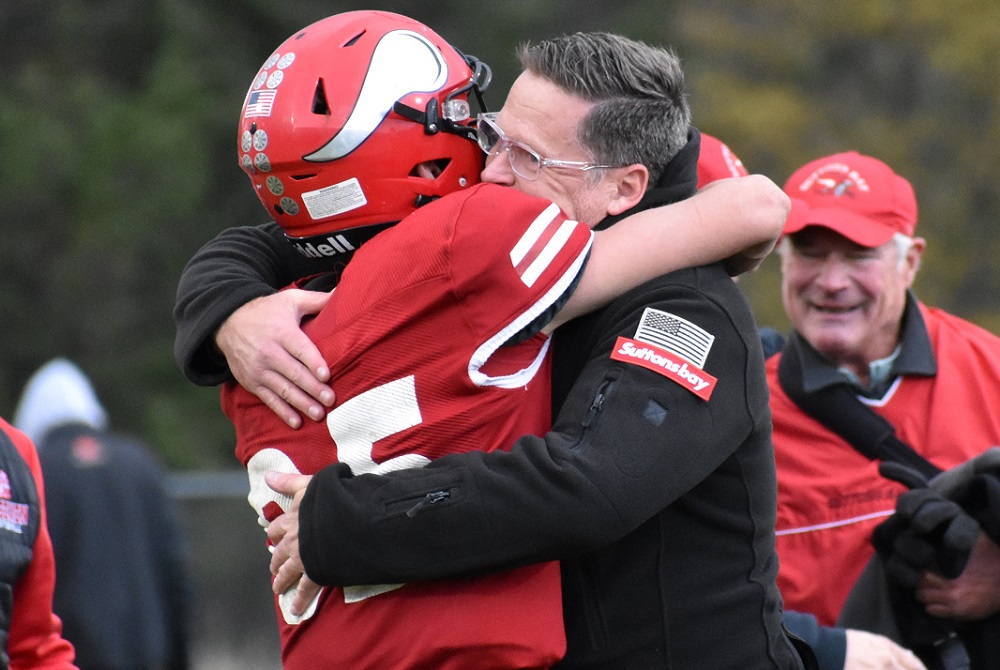
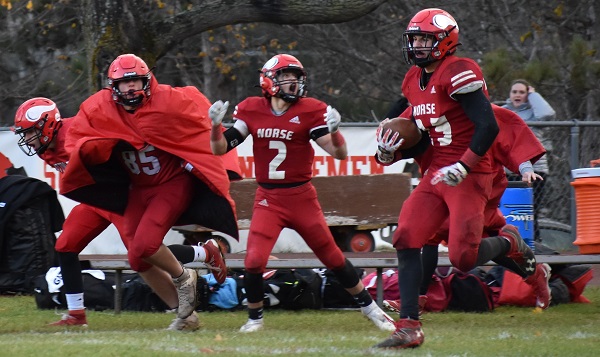
PHOTOS (Top) Suttons Bay coach Garrick Opie hugs his son Brayden at midfield after Brayden caught the game-winning touchdown pass in the Semifinal. (Middle) Shawn Bramer outruns his stunned teammates on his way to the game-tying score during the final seconds of regulation against Rudyard. (Photos by Mike Spencer.)
Generations of Jonesville Reunite to Say Good-Bye to Old Field, Await New
By
Doug Donnelly
Special for MHSAA.com
November 11, 2025
As the old saying, and more recent song lyric goes, "Every new beginning comes from some other beginning's end."
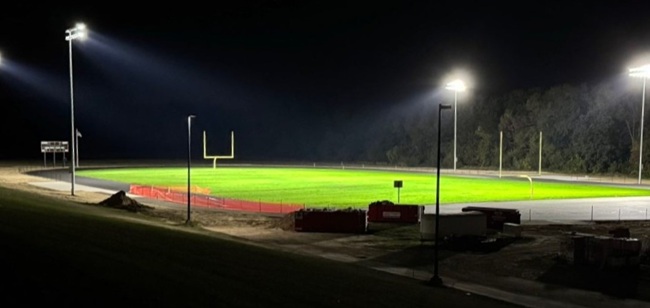
 A new era of Jonesville football will begin next fall when the Comets begin playing on a new field at a new sports complex on the high school campus.
It’s a new beginning. But, before that new era was launched, the Comets had one final game on its old football field this fall – a nearly 75-year-old relic that sits just outside Jonesville Middle School.
“I have a lot of memories of playing on that field,” said Comets football coach Frank Keller. “It’s been home to a lot of big games, good times.”
The final home game on the field was Week 8 against Vandercook Lake. Keller temporarily relinquished his play-calling duties when his former head coach – and recent Michigan High School Football Coaches Association Hall of Fame inductee – Greg Morrison came to the sidelines for a series after some convincing from his former player.
Morrison showed he hadn’t lost his touch. The third and final play he called – “tight end delay” – went for a touchdown.
“It was one of his favorite plays,” Keller said. “He called it, and we scored. It couldn’t have gone any better. He got to call the last touchdown on the old field.”
About a year ago, an anonymous donor gave a $4 million donation to the school to build a new track and football field, along with an accompanying concession stand and restrooms. The field is in a picturesque spot, tucked among trees.
 The donation came from a Jonesville family that has had four generations of athletes play sports for the Comets. Athletic director Jeff Turner said the family stepped forward when it became apparent it would be difficult for the district to pass a bond issue or a new tax to fund such a large-scale project.
"We are certainly grateful for them coming forward," Turner said. "We couldn't have done this without them. They wanted to help the school district and the community, and we are fortunate that we are able to build such a nice facility."
The track will be ready for events this spring. Sod was laid on the football field, inside the track, this fall and has been mowed a few times. New bleachers were constructed on both sides of the field recently, and the concession building is almost ready for business.
It’s a dramatic change for the district.
The current football field has been in use for decades and was home to league championship teams, playoff games and more great Jonesville memories.
“Growing up as a kid I always watched football games, there and I played there,” Keller said. “I have mixed feelings about it. It’s great to get a new facility, but sad to see the old one go.”
Morrison recalled a game during his coaching tenure when the opposing team hid in the nearby woods, and then just before kickoff came running onto the field.
Jonesville won by several touchdowns. Clearly the ploy didn’t exactly work out as intended.
“It was a great field to play,” Morrison said. “It was unique.”
These days, Jonesville is a Division 7 football school with an enrollment of 299 students. The Comets play in the Cascades Conference West and went 6-4 this season, falling in the first round of the playoffs.
 The football team has been in the playoffs four of the past seven seasons, went 9-0 during the regular season in 2019 and has 16 playoff appearances.
Keller graduated from Jonesville in 1999. He was on the Comets varsity for three seasons, from 1996-1998. Turner is a Jonesville graduate as well. He said several past players, cheerleaders and band members returned to the field for its final game, stirring a lot of memories.
“I don’t know how much of the game I got to watch that night,” Turner said. “It was great to catch up with a lot of people I may not have seen in quite a while. It was great.”
Turner said the athletic complex will be great for the district.
“It looks wonderful,” he said. “Our kids are excited about running track this spring and playing on the new field. Everyone is excited about it.”
As with any new facility, the complex is creating a buzz around athletics at Jonesville.
“We’re hoping we get more kids out just because they want to play on the new field, maybe even get new kids to the school,” Keller said. “We’re hoping it helps bring in more kids. Track looks awesome. The whole facility looks great.
“For us to get a new facility like that is unbelievable.”
 Doug Donnelly has served as a news and sports reporter at the Adrian Daily Telegram and the Monroe News for 30 years, including 10 years as city editor in Monroe. He's written a book on high school basketball in Monroe County and compiles record books for various schools in southeast Michigan. He is now publisher and editor of The Blissfield Advance, a weekly newspaper. E-mail him at [email protected] with story ideas for Jackson, Washtenaw, Hillsdale, Lenawee and Monroe counties.
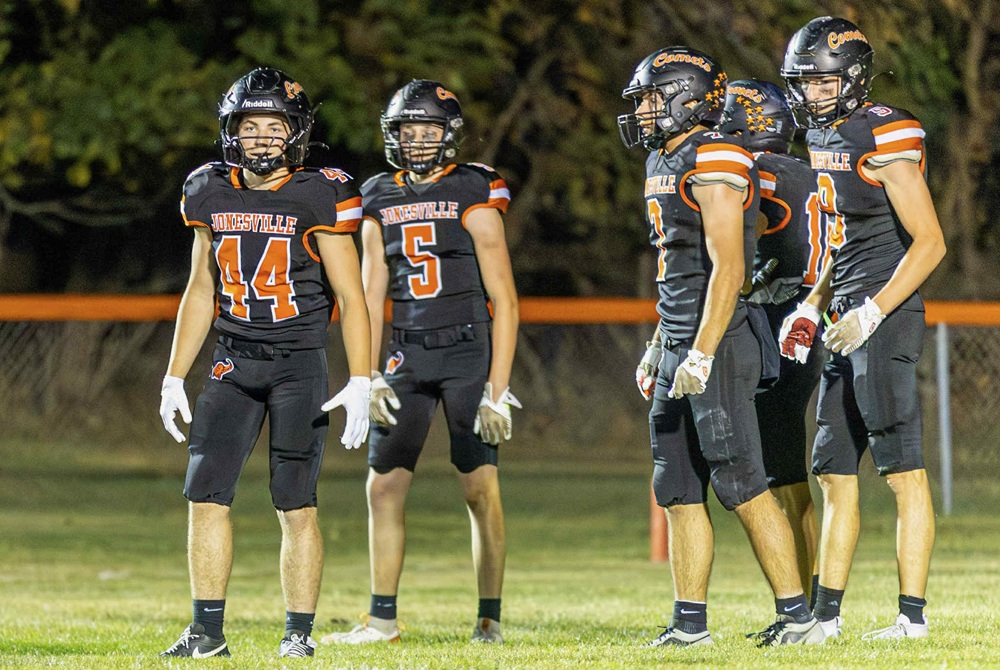
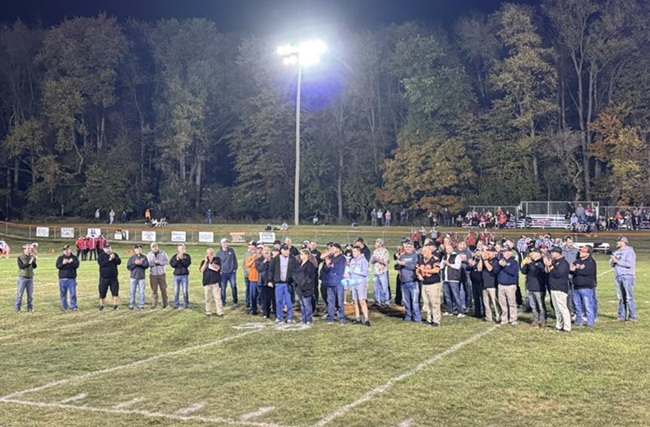
PHOTOS (Top) Jonesville players take the field for their final home game last month at their now former field. (Middle) Past Jonesville players line up with retired coach Greg Morrison during the final game. (Below) Jonesville’s new stadium sits under the lights and will be ready for the spring track & field season. (Photos courtesy of the Jonesville football program.)