


Tales of the Tape from Bygone Days
September 10, 2014
By Rob Kaminski
MHSAA benchmarks editor
How’s this for a new reality/espionage TV series? Participants have just hours to exchange valuable video to counter-intelligence representatives at random drop points along state highways, then return to home base, study the footage and devise an action plan that same day.
Oh, and there are no cell phones or any other form of portable communication should plans go awry en route.
For longtime Escanaba High School football coach Dan Flynn, it’d be like watching reruns of his days as an assistant coach for the Eskymos. As one of the largest schools in the Upper Peninsula, Escanaba’s road through the MHSAA Playoffs almost always meant facing opponents from below the bridge, which made film exchange a challenge to say the least.
“I’ve logged thousands of miles, maybe more than anyone ever, exchanging film, tapes and DVDs with our opponents during the MHSAA Playoffs,” Flynn said.
“Being in Region 1 geographically, we knew we’d travel,” Flynn added. “And you couldn’t afford to just look at anyone and everyone that you might play. You had to do your homework to narrow down possible opponents if you wanted to go and scout.”
Today, with the MHSAA publishing Football Playoff Points on a weekly basis following Week 4, much of the guesswork as to potential first-round opponents has disappeared.
Additionally, most schools upload game footage to the web within 24 hours following each contest. On Selection Sunday, within minutes after a school’s Pre-District foe is announced, a coaching staff and players can be watching video of their opponent.
“We’d started calling coaches or they’d call me in Week 8 or 9, looking at possible matchups and also planning a place to meet to exchange film,” Flynn said.
Plans had to be firm and communications had to be clear, because once hitting the road, there was no way to contact one another.
“This was before cell phones,” Flynn explained. “I had one of first cell phones, which actually was an old bag phone. I’d accumulate outrageous rates for roaming charges going tower to tower.”
Old-school video exchange might be a thing of the past, but a generation of high school football coaches will never forget gas stations, fast-food joints and 24-hour stores nestled off exit ramps across Michigan.
“On that Sunday night, I’d get in the car, and typically drive to Gaylord, or maybe Grayling. In Gaylord it would be the McDonald’s. In Grayling, it’d be Glen’s Food Market. You’d try to arrange to meet at a place that was open 24 hours,” Flynn recalled. “I always got in the car understanding the meeting would be below the (Mackinac) Bridge. Sometimes we’d get lucky and the meeting place would be the Shell gas station just below the bridge on the Mackinaw City side.”
The 200-mile drive to Gaylord routinely took four hours. The further Escanaba advanced in the playoffs, the more times Flynn wore down the tread on his tires. He specifically recalls a hectic weekend in 1979, when Escanaba traveled to Lansing Sexton and defeated Livonia Stevenson in the MHSAA Semifinals to earn a berth in the Finals the following weekend vs. Detroit Catholic Central. Part of the reward for Flynn was another trip to McDonald’s.
“We came from behind in that Semifinal, and we were thrilled that we were going to the Finals. We got back home late Saturday night, then I got in the car the next morning to meet the Catholic Central coaches at 1 p.m.,” Flynn said.
“Coach (head coach Jerry) Cvengros had a meeting set for 5 or 6 that night. I made it back in time, but our guys were still feeling good about the win, so I suggested we hold off a day before showing them the CC film (16 mm film, by the way). Those guys were pretty good.”
Indeed they were, winning the Class A title the following weekend. The Eskymos, however, would return to the Final in 1981, winning the crown, 16-6 over Fraser, as Flynn no doubt logged more miles in preparation.
The most pressing concern today might be quality of the online video, lighting at the fields, or angle of the camera.
Back in the day, just getting a tape felt like victory.
“One year, I traveled all the way to the southeast part of the state, and the opposing coach simply wouldn’t exchange,” said Flynn, explaining that playoff film exchange at the time was only a recommendation, not a regulation. “I learned later that the coach had video of us from a friend who lived in Escanaba. I left on Saturday morning and came back Sunday night. We did eventually get some film later in the week. We lost by two points, but as coaches we didn’t make it a big vendetta and were up front with our kids.”
The MHSAA Representative Council, which included Flynn at the time, upgraded film exchange from a recommendation to a playoff policy in 1990, when schools were required to supply one another with the two most recent game films.
Even so, and as 16 mm film evolved to VHS tapes and then DVDs, coaching delegates still had to make itineraries for October and November weekends. Sometimes twice in the same weekend.
“Even with advancements in technology as we progressed from DVDs to digital, you still need people to operate the devices,” Flynn said. “I met another coach at the Shell station at the Bridge, but he said our software wasn’t compatible with theirs. I drove back the next day, pushed a button, and it worked. I drove all that way to push a button; 16 mm film would have been better.”
Today’s coaches might be a bit more well-versed in technology than those of Flynn’s era, and it’s a good thing. They likely need MapQuest and a GPS to traverse the regions in Northern Michigan that Flynn and his cohorts knew like the back of their hands.
1st & Goal: 2024 Playoffs Week 3 Preview
By
Geoff Kimmerly
MHSAA.com senior editor
November 14, 2024
Winter practices have started, and high school hockey teams actually began games this week.
 But for 72 schools across the state, it’s still football season – and they’d like to continue playing as many November games as possible.
This third week of MHSAA Playoffs features four Semifinals in 8-player – and we switch up the “1st & Goal” format to feature those games first below. We also have 32 11-Player Regional Finals, with winners this weekend needing just one more to book trips to Ford Field.
Games are tonight unless noted. Tickets for 11-Player Regional Finals are $9, and $10 for 8-player Semifinals, and more than 35 of the 36 games to be played will be streamed live on the NFHS Network. Scores and pairings will be updated all weekend at MHSAA.com.
8-Player Division 1
Indian River Inland Lakes (11-0) at Pickford (11-0), 1 p.m. Saturday
This is rematch from a year ago, when Inland Lakes won 12-0 on the way to finishing Division 1 runner-up. The Bulldogs have had only two single-digit games all season, including defeating Alcona 32-26 last week. Senior quarterback Aiden Fenstermaker is leading the march again, running for 1,463 yards and 22 touchdowns and throwing for 831 and 19, respectively. Pickford is seeking to make the Finals for the first time since 2019 and hasn’t played a game closer than 28 points. Senior quarterback Tommy Storey also is a two-way force, running for 1,341 yards and 24 TDs and throwing for 898 and 16 scores.
Mendon (10-1) at Deckerville (11-0), 1 p.m. Saturday
Mendon is just two years removed from playing for the Division 2 title, and avenged its only loss this fall by downing Climax-Scotts to open the playoffs. Junior Owen Gorham has run for 2,114 yards and 42 touchdowns – the rushing TDs already ranking third all-time in MHSAA history – and junior JT Lux follows with 1,160 yards and 14 scores on the ground. Deckerville is playing in its second-straight Semifinal and looking to make its first Final since 2017. The Eagles are averaging 49 points per game and haven’t scored fewer than 30.
8-Player Division 2
Onekama (10-1) at Crystal Falls Forest Park (10-1), Noon Saturday
Forest Park also avenged its lone loss during the playoffs, downing Powers North Central 34-12 last week, and the Trojans also are playing to get back to a championship game for the first time since 2017. Running back Dax Huuki is just a sophomore but leads the rushing attack with 1,267 yards and 18 touchdowns. Onekama won a combined eight games over the past four seasons before bouncing back big to reach the Semifinals for the first time since 2018, when the Portagers finished Division 2 runner-up. Junior quarterback Luke Bradford stands tall at 6-foot-5 and has thrown for 1,175 yards and 11 TDs and run for nine scores. Onekama fell to Marion in Week 2 but defeated the Eagles to open the postseason.
Morrice (10-1) at Britton Deerfield (10-1), 1 p.m. Saturday
Britton Deerfield is another fascinating comeback story, having finished 2-7 a year ago. The Patriots are in their fourth season of 8-player football and playing in their first Semifinal in either format since the school formed from its predecessors in 2011. They’ve run for 4,140 yards this fall, led by senior Luke Wiser with 1,549 with 27 touchdowns. Morrice will play in its third Semifinal over the last six seasons seeking to reach the championship game for the first time since winning Division 1 in 2018. The Orioles too have avenged their lone loss this fall, to Portland St. Patrick, and get it done with a defense giving up only 11.4 points per game and a pair of senior 1,000-yard rushers in Joel Fisher (1,464/18 TDs) and Wyatt Cartier (1,253/24).
11-Player Division 1
Belleville (10-1) at Detroit Catholic Central (11-0)
Even with Belleville’s loss to Howell in Week 9, this has remained one of the most anticipated matchups in the state all season as it’s been assumed these two powers would meet at some point. The last time, Belleville defeated DCC in a 2022 Regional Final, 33-10. After facing seven playoff teams plus an Ohio state title contender, the Shamrocks shouldn’t be daunted by Belleville’s success and star power. But that said, the Tigers are striding coming off their best win this fall, 42-7 last week over Saline.
Other Regional Finals FRIDAY Grand Blanc (9-2) at Rochester Adams (9-2), Detroit Cass Tech (9-2) at Macomb Dakota (10-1). SATURDAY Hudsonville (10-1) at Howell (11-0).
11-Player Division 2
Warren De La Salle Collegiate (8-2) at Birmingham Groves (11-0)
De La Salle has finished at Ford Field seven of the last 10 seasons, and two of the last six years did so after defeating Groves in Semifinals – including 43-15 in 2022. Groves is playing to reach a championship game for the first time, and the Falcons have never been in better position taking on the Pilots after tying their program record for wins last week. Groves hasn’t been challenged in a while, but does have victories over Harper Woods and West Bloomfield this fall. De La Salle is coming off handing Grosse Pointe South its only loss this season and will attempt a repeat performance tonight.
Other Regional Finals FRIDAY Portage Central (8-3) at Byron Center (10-1), Saginaw Heritage (8-3) at East Lansing (8-3), Orchard Lake St. Mary’s (8-3) at Gibraltar Carlson (10-1).
11-Player Division 3
Petoskey (11-0) at DeWitt (11-0)
Petoskey also has set a record for wins this season and will play in a Regional Final for the third time and first since 2014. The Northmen have navigated only two single-digit games this fall and prepped for this run in part with a 41-21 win over Clare in Week 9 – notable as Clare also was a league champion. DeWitt presents arguably their mightiest challenge as the Panthers are undefeated this late for the first time since their Division 3 championship season of 2020 and putting up 55.6 points per game despite a schedule that has three opponents also playing for Regional titles.
Other Regional Finals FRIDAY Grand Rapids Forest Hills Central (9-2) at Zeeland West (10-1), Mason (9-2) at Walled Lake Western (11-0), River Rouge (6-4) at Detroit Martin Luther King (8-3).
11-Player Division 4
Portland (11-0) at Niles (10-1)
For the second-straight season, Portland is undefeated playing Niles for a Regional championship, and last year advanced with a 21-14 win over the Vikings. The Raiders actually have played an identical playoff schedule as 2023 so far, and Niles has enjoyed plenty of familiarity as well with District wins over a pair of regular-season opponents from the Wolverine Conference. The Vikings’ shutout of Edwardsburg last week was their third in four weeks and sixth of the season, providing an intriguing challenge for a Raiders offense almost keeping pace with last year’s scoring at 41.5 points per game.
Other Regional Finals FRIDAY Grand Rapids South Christian (7-4) at Whitehall (8-3), Haslett (8-3) at Goodrich (10-1), Macomb Lutheran North (10-1) at Harper Woods (8-3).
11-Player Division 5
Kalamazoo United (9-2) at Grand Rapids Catholic Central (7-4)
This will be the fourth time United will play for a Regional title over the last seven seasons, and if the Titans are to advance for the first time they’ll have to deal with a GRCC program that has reached Ford Field six of the last eight years. After ending the regular season on a three-game skid but with all three defeats by single digits, the Cougars have impressed in the playoffs including squeaking past Grand Rapids West Catholic 21-18 last week. The Titans have won two rematches to open this postseason and faced playoff teams their last six games, losing only to Jackson Lumen Christi (39-21 in Week 9) along the way.
Other Regional Finals FRIDAY Gladwin (8-3) at Frankenmuth (11-0), Armada (10-1) at Pontiac Notre Dame Prep (9-1), Ann Arbor Father Gabriel Richard (7-4) at Flat Rock (9-2).
11-Player Division 6
Detroit Central (8-3) at Marine City (9-2)
Only three weeks ago, Marine City closed the regular season with a 37-15 win over Central. But as we’ve seen over the first two rounds of the playoffs, rematches can flip quickly, and the Mariners surely won’t be looking past this one as they pursue what would be a first Regional title since 2021. That first matchup arrived with Central coming off a close win over Detroit Denby for a Detroit Public School League City championship, and since that defeat the Trailblazers have won their playoff games by a combined 69-24. Marine City has picked up momentum as well, especially with last week’s 38-28 win over Warren Michigan Collegiate.
Other Regional Finals FRIDAY Boyne City (9-2) at Reed City (9-2). SATURDAY Lansing Catholic (8-3) at Newaygo (9-2), Constantine (8-3) at Jackson Lumen Christi (10-1).
11-Player Division 7
Schoolcraft (10-1) at Hudson (10-1)
The eight teams remaining in Division 7 have a combined seven losses, making all four matchups among the most intriguing as a group. These two are meeting for the first time since facing off in a 2001 Division 6 Semifinal, Hudson on a 10-game winning streak this season and Schoolcraft losing only in Week 3 by two points to Division 6 Constantine. Defense may dominate; the Eagles are giving up 9.9 points per game and just shut out a Lawton offense that averaged 35, while Hudson is giving up 8.4 ppg and hasn’t allowed more than seven since the first weekend in October.
Other Regional Finals FRIDAY Leslie (10-1) at Monroe St. Mary Catholic Central (11-0). SATURDAY North Muskegon (10-1) at Menominee (10-1), Pewamo-Westphalia (9-2) at Millington (10-0).
11-Player Division 8
Harbor Beach (11-0) at Fowler (11-0), Saturday
While featuring two of the state’s smallest 11-player schools, this might draw an above-proportion amount of attention as one of only two matchups of undefeated contenders in any 11-player bracket. Harbor Beach is seeking its first Regional title since 2018, and Fowler its first since 2019. Fowler finished the regular season third in Division 8 playoff-point average, and Harbor Beach downed top-ranked Clarkston Everest Collegiate 37-7 last week. The Eagles’ best three wins were against Division 7 teams, including two still playing.
Other Regional Finals FRIDAY Detroit Loyola (5-6) at Riverview Gabriel Richard (9-1). SATURDAY Beal City (9-2) at Iron Mountain (11-0), Reading (7-4) at Decatur (10-1).
MHSAA.com's weekly “1st & Goal” previews and reviews are powered by MI Student Aid, a division within the Department of Lifelong Education, Advancement, and Potential (MiLEAP). MI Student Aid encourages students to pursue postsecondary education by providing access to student financial resources and information. MI Student Aid administers the state’s scholarship and grant programs that help make college Accessible, Affordable and Attainable for you. Click to connect with MI Student Aid and find more information on Facebook and Twitter @mistudentaid.
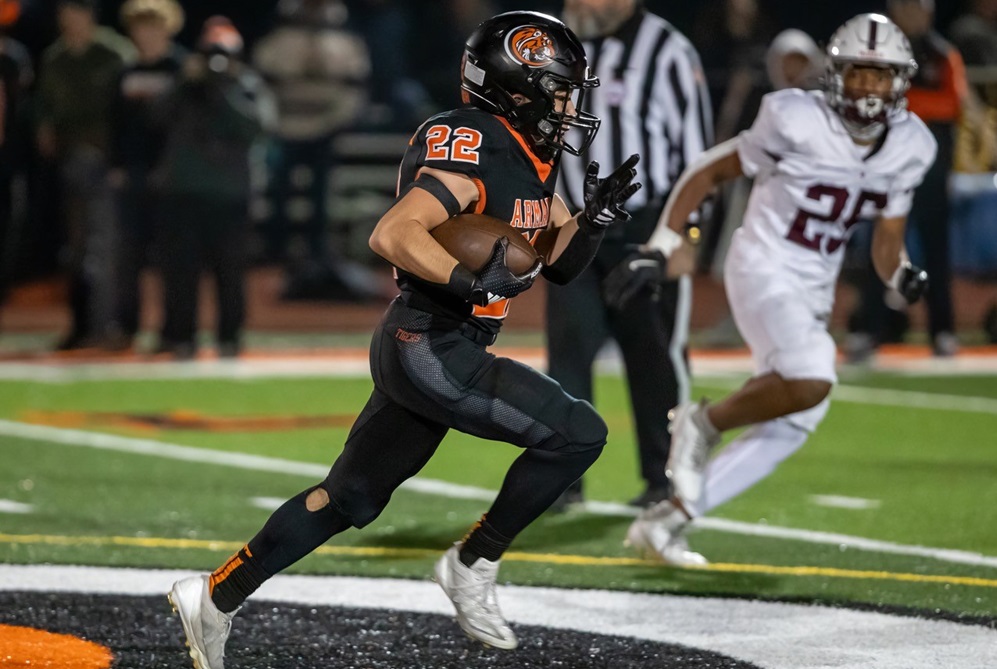
PHOTO Armada’s Jackson Malburg breaks into the open during last week’s District Final win over Hazel Park. (Photo by Adam Sheehan Photography.)