


Tales of the Tape from Bygone Days
September 10, 2014
By Rob Kaminski
MHSAA benchmarks editor
How’s this for a new reality/espionage TV series? Participants have just hours to exchange valuable video to counter-intelligence representatives at random drop points along state highways, then return to home base, study the footage and devise an action plan that same day.
Oh, and there are no cell phones or any other form of portable communication should plans go awry en route.
For longtime Escanaba High School football coach Dan Flynn, it’d be like watching reruns of his days as an assistant coach for the Eskymos. As one of the largest schools in the Upper Peninsula, Escanaba’s road through the MHSAA Playoffs almost always meant facing opponents from below the bridge, which made film exchange a challenge to say the least.
“I’ve logged thousands of miles, maybe more than anyone ever, exchanging film, tapes and DVDs with our opponents during the MHSAA Playoffs,” Flynn said.
“Being in Region 1 geographically, we knew we’d travel,” Flynn added. “And you couldn’t afford to just look at anyone and everyone that you might play. You had to do your homework to narrow down possible opponents if you wanted to go and scout.”
Today, with the MHSAA publishing Football Playoff Points on a weekly basis following Week 4, much of the guesswork as to potential first-round opponents has disappeared.
Additionally, most schools upload game footage to the web within 24 hours following each contest. On Selection Sunday, within minutes after a school’s Pre-District foe is announced, a coaching staff and players can be watching video of their opponent.
“We’d started calling coaches or they’d call me in Week 8 or 9, looking at possible matchups and also planning a place to meet to exchange film,” Flynn said.
Plans had to be firm and communications had to be clear, because once hitting the road, there was no way to contact one another.
“This was before cell phones,” Flynn explained. “I had one of first cell phones, which actually was an old bag phone. I’d accumulate outrageous rates for roaming charges going tower to tower.”
Old-school video exchange might be a thing of the past, but a generation of high school football coaches will never forget gas stations, fast-food joints and 24-hour stores nestled off exit ramps across Michigan.
“On that Sunday night, I’d get in the car, and typically drive to Gaylord, or maybe Grayling. In Gaylord it would be the McDonald’s. In Grayling, it’d be Glen’s Food Market. You’d try to arrange to meet at a place that was open 24 hours,” Flynn recalled. “I always got in the car understanding the meeting would be below the (Mackinac) Bridge. Sometimes we’d get lucky and the meeting place would be the Shell gas station just below the bridge on the Mackinaw City side.”
The 200-mile drive to Gaylord routinely took four hours. The further Escanaba advanced in the playoffs, the more times Flynn wore down the tread on his tires. He specifically recalls a hectic weekend in 1979, when Escanaba traveled to Lansing Sexton and defeated Livonia Stevenson in the MHSAA Semifinals to earn a berth in the Finals the following weekend vs. Detroit Catholic Central. Part of the reward for Flynn was another trip to McDonald’s.
“We came from behind in that Semifinal, and we were thrilled that we were going to the Finals. We got back home late Saturday night, then I got in the car the next morning to meet the Catholic Central coaches at 1 p.m.,” Flynn said.
“Coach (head coach Jerry) Cvengros had a meeting set for 5 or 6 that night. I made it back in time, but our guys were still feeling good about the win, so I suggested we hold off a day before showing them the CC film (16 mm film, by the way). Those guys were pretty good.”
Indeed they were, winning the Class A title the following weekend. The Eskymos, however, would return to the Final in 1981, winning the crown, 16-6 over Fraser, as Flynn no doubt logged more miles in preparation.
The most pressing concern today might be quality of the online video, lighting at the fields, or angle of the camera.
Back in the day, just getting a tape felt like victory.
“One year, I traveled all the way to the southeast part of the state, and the opposing coach simply wouldn’t exchange,” said Flynn, explaining that playoff film exchange at the time was only a recommendation, not a regulation. “I learned later that the coach had video of us from a friend who lived in Escanaba. I left on Saturday morning and came back Sunday night. We did eventually get some film later in the week. We lost by two points, but as coaches we didn’t make it a big vendetta and were up front with our kids.”
The MHSAA Representative Council, which included Flynn at the time, upgraded film exchange from a recommendation to a playoff policy in 1990, when schools were required to supply one another with the two most recent game films.
Even so, and as 16 mm film evolved to VHS tapes and then DVDs, coaching delegates still had to make itineraries for October and November weekends. Sometimes twice in the same weekend.
“Even with advancements in technology as we progressed from DVDs to digital, you still need people to operate the devices,” Flynn said. “I met another coach at the Shell station at the Bridge, but he said our software wasn’t compatible with theirs. I drove back the next day, pushed a button, and it worked. I drove all that way to push a button; 16 mm film would have been better.”
Today’s coaches might be a bit more well-versed in technology than those of Flynn’s era, and it’s a good thing. They likely need MapQuest and a GPS to traverse the regions in Northern Michigan that Flynn and his cohorts knew like the back of their hands.
With Seasoned Seniors in Lead, Deckerville Set to Begin Another Title Pursuit
By
Paul Costanzo
Special for MHSAA.com
October 30, 2024
Preston Holman was an eighth grader when his family moved to Deckerville from the west side of the state, but it didn’t take long for him to realize how much football meant to the community.
 “Instantly, it was all clear to me that Deckerville was a powerhouse program around here, and if you’re going to play for them and Coach (Bill) Brown, you needed to be the best version of yourself,” said Holman, now a senior and all-state two-way lineman for the Eagles. “It was really cool. I remember my eighth-grade year, Deckerville lost to Mayville on Homecoming. I remember how upset the players were. I could tell in the atmosphere that Deckerville does not like to lose. But it was really cool to see how the community supported the program.”
Holman and the Eagles have set themselves up to have that support through the 8-Player Division 1 Semifinals, should they keep winning, as the highest-rated team by playoff points in the bracket.
Deckerville, which finished a 9-0 regular season with a win over previous No. 1 Alcona in Week 9, will open the postseason at home Friday night against Bay City All Saints.
“It’s been great,” senior quarterback Hunter Garza said. “We’ve been taking it one game at a time and preparing all season for this, and I think the hard work is showing and paying off. This started three years ago, when we were all sophomores and freshmen, and the hard work is all paying off.”
When Garza and Holman were sophomores, they were part of a core group in that class who were playing key roles on the varsity. That group went 7-4 and won a playoff game in 2022, and Brown was starting to see the potential for something special in the future.
 A run to an 8-Player Division 2 Semifinal the next year proved him right.
“We have six kids that started when they were sophomores that are now seniors, and last year, our defense was one freshman, three sophomores and four juniors, so our whole defense is back,” Brown said. “So we knew we had a lot of potential there. We knew we had something going on, even back then. We knew when they were sophomores, even though they were pretty young. The next year, we got halfway through the season, and they were juniors that were starting to play like seniors.”
Knowing what he had coming back, and what a Deckerville crowd could bring during a playoff run, Brown set out to build a schedule that could guarantee the Eagles homefield advantage through the first three weeks of the postseason. That meant scheduling All Saints in Week 1 and Alcona in Week 9. Even had the Eagles lost those games, the benefit of playing a tougher schedule would have been a net positive. Of course, they won them, getting the best of both worlds.
“We play some tough competition in our conference,” Brown said. “But to get to 9-0, that’s pretty special.”
The Eagles outscored opponents, on average, 49-14 on their way to the program’s first unbeaten season since 2019, and fifth in Brown’s 32 years as head coach.
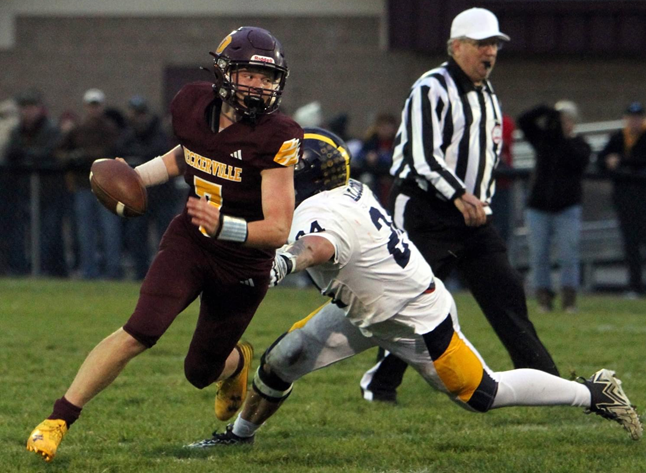
“I think we’ve played very good defense,” Brown said. “Last week (a 50-42 win against Alcona) was tough, but we were playing one of the best teams in the state. Sometimes you have to outscore someone. I think, defensively, we match up and are able to defend a lot of people. Then, being able to turn around and Hunter Garza is having a great year at quarterback – he can run, and he can throw – so I think we’re a little more diverse offensively.”
Garza has rushed for 1,134 yards and 21 touchdowns on 104 carries this season, leading an Eagles’ offense that is averaging 304.9 yards per game on the ground. Senior Parker Merriman had added 859 yards and 11 TDs.
 Garza also has thrown for 747 yards and nine touchdowns on just 76 pass attempts.
Defensively, the Eagles specialize in getting teams out of sync, as they have recorded 42 tackles for loss as a team, led by Holman’s 17. He also has nine sacks, while sophomore Brandon Halowitz leads the team with 83 tackles, including 13 for loss and five sacks.
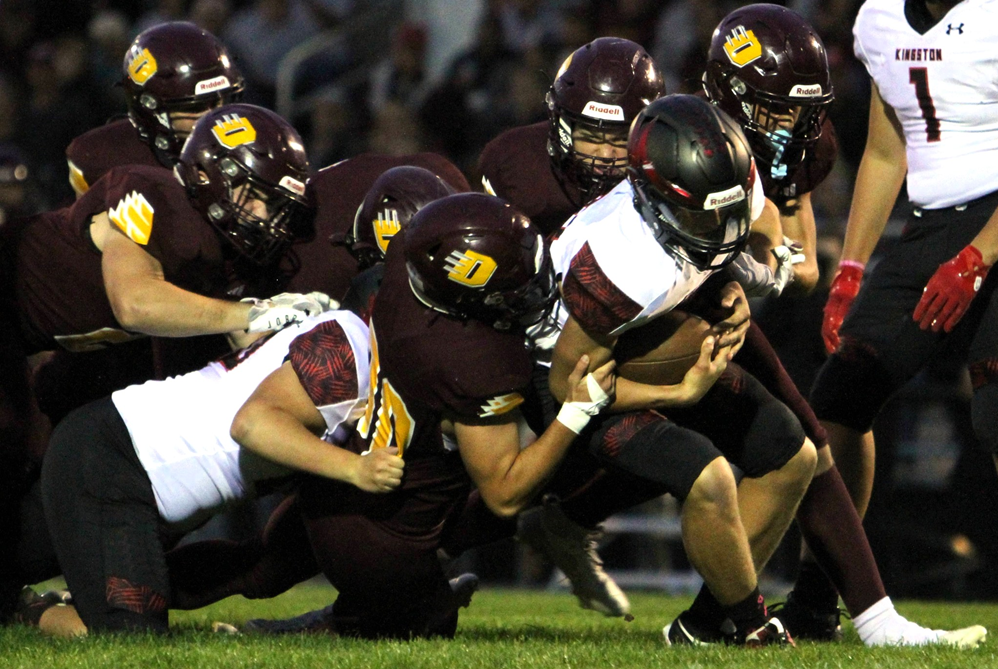
Being a defensive stalwart is nothing new for the Eagles. When they joined the 8-player ranks in 2012, they brought a smashmouth style to what had been a wide-open division, and won a Finals title. The score of that championship game against Bellaire: 14-12.
They’ve made the postseason in each of the 12 years since, advancing to Finals in 2016 and 2017.
“Our goal each year is to win the state championship,” Brown said. “Maybe those seem like lofty goals for many, but I think you have to do that. And, as it goes, right now we’re peaking at it. Last year, nobody would have thought we were going to make a run and get to the Semifinal. I would say the expectations are high for us, and I think that gives our team the drive to always be better than the team that did it before.”
Managing to chase those goals while remaining grounded in the day-to-day work necessary to reach them can be tough. But with senior leaders like Garza and Holman, Brown is confident his team will stay on the right path.
“Deckerville has such a good winning tradition, that it does put a lot of pressure on us, but Coach always says, ‘Just because you’re Deckerville, you’re not guaranteed to make the playoffs,’” Garza said. “Just because you wear the D, doesn’t mean you’re going to make a run in the playoffs. You gotta go out and work for it. You have to go out and win it.”
 Paul Costanzo served as a sportswriter at The Port Huron Times Herald from 2006-15, including three years as lead sportswriter, and prior to that as sports editor at the Hillsdale Daily News from 2005-06. He can be reached at [email protected] with story ideas for Genesee, Lapeer, St. Clair, Sanilac, Huron, Tuscola, Saginaw, Bay, Arenac, Midland and Gladwin counties.
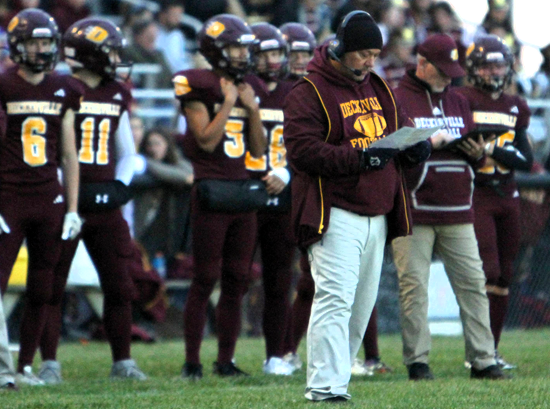
PHOTOS (Top) The Deckerville defense converges on a Kingston ball carrier during this season’s 44-0 victory. (Middle) Hunter Garza eludes an Alcona defender last week. (Below) Eagles coach Bill Brown, in headset, checks his chart on the sideline. (Photos by Mike Gallagher/Saranac County News.)