

Tales of the Tape from Bygone Days
September 10, 2014
By Rob Kaminski
MHSAA benchmarks editor
How’s this for a new reality/espionage TV series? Participants have just hours to exchange valuable video to counter-intelligence representatives at random drop points along state highways, then return to home base, study the footage and devise an action plan that same day.
Oh, and there are no cell phones or any other form of portable communication should plans go awry en route.
For longtime Escanaba High School football coach Dan Flynn, it’d be like watching reruns of his days as an assistant coach for the Eskymos. As one of the largest schools in the Upper Peninsula, Escanaba’s road through the MHSAA Playoffs almost always meant facing opponents from below the bridge, which made film exchange a challenge to say the least.
“I’ve logged thousands of miles, maybe more than anyone ever, exchanging film, tapes and DVDs with our opponents during the MHSAA Playoffs,” Flynn said.
“Being in Region 1 geographically, we knew we’d travel,” Flynn added. “And you couldn’t afford to just look at anyone and everyone that you might play. You had to do your homework to narrow down possible opponents if you wanted to go and scout.”
Today, with the MHSAA publishing Football Playoff Points on a weekly basis following Week 4, much of the guesswork as to potential first-round opponents has disappeared.
Additionally, most schools upload game footage to the web within 24 hours following each contest. On Selection Sunday, within minutes after a school’s Pre-District foe is announced, a coaching staff and players can be watching video of their opponent.
“We’d started calling coaches or they’d call me in Week 8 or 9, looking at possible matchups and also planning a place to meet to exchange film,” Flynn said.
Plans had to be firm and communications had to be clear, because once hitting the road, there was no way to contact one another.
“This was before cell phones,” Flynn explained. “I had one of first cell phones, which actually was an old bag phone. I’d accumulate outrageous rates for roaming charges going tower to tower.”
Old-school video exchange might be a thing of the past, but a generation of high school football coaches will never forget gas stations, fast-food joints and 24-hour stores nestled off exit ramps across Michigan.
“On that Sunday night, I’d get in the car, and typically drive to Gaylord, or maybe Grayling. In Gaylord it would be the McDonald’s. In Grayling, it’d be Glen’s Food Market. You’d try to arrange to meet at a place that was open 24 hours,” Flynn recalled. “I always got in the car understanding the meeting would be below the (Mackinac) Bridge. Sometimes we’d get lucky and the meeting place would be the Shell gas station just below the bridge on the Mackinaw City side.”
The 200-mile drive to Gaylord routinely took four hours. The further Escanaba advanced in the playoffs, the more times Flynn wore down the tread on his tires. He specifically recalls a hectic weekend in 1979, when Escanaba traveled to Lansing Sexton and defeated Livonia Stevenson in the MHSAA Semifinals to earn a berth in the Finals the following weekend vs. Detroit Catholic Central. Part of the reward for Flynn was another trip to McDonald’s.
“We came from behind in that Semifinal, and we were thrilled that we were going to the Finals. We got back home late Saturday night, then I got in the car the next morning to meet the Catholic Central coaches at 1 p.m.,” Flynn said.
“Coach (head coach Jerry) Cvengros had a meeting set for 5 or 6 that night. I made it back in time, but our guys were still feeling good about the win, so I suggested we hold off a day before showing them the CC film (16 mm film, by the way). Those guys were pretty good.”
Indeed they were, winning the Class A title the following weekend. The Eskymos, however, would return to the Final in 1981, winning the crown, 16-6 over Fraser, as Flynn no doubt logged more miles in preparation.
The most pressing concern today might be quality of the online video, lighting at the fields, or angle of the camera.
Back in the day, just getting a tape felt like victory.
“One year, I traveled all the way to the southeast part of the state, and the opposing coach simply wouldn’t exchange,” said Flynn, explaining that playoff film exchange at the time was only a recommendation, not a regulation. “I learned later that the coach had video of us from a friend who lived in Escanaba. I left on Saturday morning and came back Sunday night. We did eventually get some film later in the week. We lost by two points, but as coaches we didn’t make it a big vendetta and were up front with our kids.”
The MHSAA Representative Council, which included Flynn at the time, upgraded film exchange from a recommendation to a playoff policy in 1990, when schools were required to supply one another with the two most recent game films.
Even so, and as 16 mm film evolved to VHS tapes and then DVDs, coaching delegates still had to make itineraries for October and November weekends. Sometimes twice in the same weekend.
“Even with advancements in technology as we progressed from DVDs to digital, you still need people to operate the devices,” Flynn said. “I met another coach at the Shell station at the Bridge, but he said our software wasn’t compatible with theirs. I drove back the next day, pushed a button, and it worked. I drove all that way to push a button; 16 mm film would have been better.”
Today’s coaches might be a bit more well-versed in technology than those of Flynn’s era, and it’s a good thing. They likely need MapQuest and a GPS to traverse the regions in Northern Michigan that Flynn and his cohorts knew like the back of their hands.
'Wakers' Continue Marching Together
November 5, 2019
By Geoff Kimmerly
Second Half editor
First the local media picked it up, which made sense – it was a great story, and easy to appreciate whether you’ve heard of Maple City or could find Fife Lake on the map.
In what was still perhaps surprising but a logical next step, The Associated Press and then Detroit Free Press and MLive took the story statewide. But then CNN and NPR told the rest of the U.S. – which was followed by interest from The Kelly Clarkson Show and a Skype interview with one of Ellen DeGeneres’ representatives.
There is no way Maple City Glen Lake athletic director Mark Mattson could’ve foreseen any of that publicity as he prepped for his football team’s home game Sept. 27. All he knew was that his high school didn’t have a marching band, and Fife Lake Forest Area – at least this season – didn’t have a varsity football team.
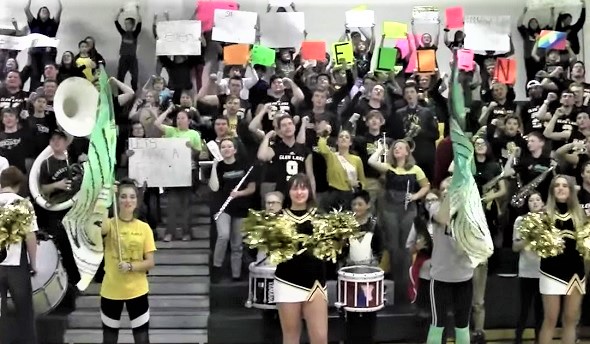
If you pay attention to high school sports in general or statewide news casually, you’ve probably heard some of the rest of this story. Mattson invited Forest Area director Brandon Deike and his band to play at Glen Lake’s game that night against Gladstone. A week later, after their story had been told all over the country, the schools combined for a “Marching for Ellen” spirit video hoping to land on the show.
Things have quieted back down substantially for the two small northern Lower Peninsula communities. But their march together continues.
“We don’t want it to end,” Mattson said. “Sometimes you see these initiatives begin, and it’s really cool, and they fizzle out. We want to work with our kids and their kids and Brandon over there to make cool things happen as we support each other – and at the end of the day to make his program grow and make our program grow over here.”
Glen Lake's athletic director said the Warrior marching band is welcome back anytime.https://t.co/RPXSNueHIx
— upnorthlive.com (@upnorthlive) September 29, 2019
A little background: Forest Area’s high school and Glen Lake’s are 45 miles away, or about an hour’s drive whether traveling through or around Traverse City. Glen Lake has nearly 250 students in its high school, and Forest Area has about 175.
Glen Lake’s football team is 9-1 and hosts Harrison on Friday in a Division 6 District Final. Forest Area started this fall playing 8-player football, and won its first game against Brethren 64-44. But the Warriors had started with a small roster that got smaller as the season got going – and by Week 3 didn’t have enough players to finish the season, so they canceled the rest of their games.
Meanwhile, Forest Area’s band has rebuilt mightily since the school’s music program was cut in 2011 – while Glen Lake’s band began this school year with one high schooler playing with a 10-member middle school group. In fact, Mattson asked his school’s football players and cheerleaders the last time they were at a home game where there was a band – and they couldn’t remember one.
So the Sept. 27 game happens, and all of the feel-good fanfare that came with it. With a few weeks, the statewide and national attention slowed way down – but the relationship between the schools was just beginning to grow.
A week later after the Gladstone game, Glen Lake hosted Elk Rapids on the night that was supposed to be Forest Area Homecoming – so during that school day, a group of Glen Lake football players and cheerleaders went over for Forest Area’s pep assembly, at first to be part of the “Marching for Ellen” video but then sticking around to take part in the Warriors’ festivities.
Then on a Monday night, Oct. 14, Mattson took a group of students to Traverse City to support Forest Area during the area’s band expo at Thirlby Field. There was some hope the schools might unite their forces again for Glen Lake’s final regular-season home game Oct. 25. But although that didn’t completely pan out, Forest Area did sent over 20 members of its band, who sat in bleachers on the track with Glen Lake’s student section, band and choir – and cheered on the now growing Glen Lake band, which included Mattson on the saxophone he’d stopped playing in sixth grade.
“One of the Forest Area kids called over from the bleachers, ‘Mr. Mattson, come here. I think we need to call our schools ‘Wakers,’” Mattson said (with the student referring to a combination of the mascot names Warriors and Lakers). “It really had gone from literally about zero to what we’ve got, and it’s a really collaborative partnership here."
“This isn’t their band director or myself making it happen. This is by and large kid driven. Our kids keep asking, ‘Are they coming for the game Friday night?’ Or their kids talk to Mr. Deike and say, ‘Can they come to our pep assembly?’ They know they’re welcome back to play with us any time.”
Mattson has recently taken over as administrator as well of Glen Lake’s fine arts department, and rebuilding the school’s band is a high priority. Glen Lake has brought in retired Traverse City West band directors Pat Brumbaugh and Flournoy Humphreys as “artists in residence” to revive the program. They’re teaching a two-day-a-week Intro to Band class, and Mattson said there are about 35 fifth and sixth-graders signed up.
Mattson also noted how the Forest Area band has opened up the perspective of his school’s football players, who have gained a real appreciation for all of the groups – cheerleaders and band especially – who join the players on the field in making for a great football night.
“What started from one simple gesture to help a school out and vice versa turned into, and I think Brandon would echo it, turned into valuable lessons for our society about teamwork and collaboration, and that kindness matters,” Mattson said. “When it’s driven by young people and really executed by our young people, how does it get better than that? They’re the next generation of leaders. To take it from simply, ‘Yeah, that sounds cool,’ to go and play at Glen Lake, to what it’s become, it’s a great lesson for all of us. That when these kids take the initiative and make it their own, special things happen – and that has happened.”