


Tales of the Tape from Bygone Days
September 10, 2014
By Rob Kaminski
MHSAA benchmarks editor
How’s this for a new reality/espionage TV series? Participants have just hours to exchange valuable video to counter-intelligence representatives at random drop points along state highways, then return to home base, study the footage and devise an action plan that same day.
Oh, and there are no cell phones or any other form of portable communication should plans go awry en route.
For longtime Escanaba High School football coach Dan Flynn, it’d be like watching reruns of his days as an assistant coach for the Eskymos. As one of the largest schools in the Upper Peninsula, Escanaba’s road through the MHSAA Playoffs almost always meant facing opponents from below the bridge, which made film exchange a challenge to say the least.
“I’ve logged thousands of miles, maybe more than anyone ever, exchanging film, tapes and DVDs with our opponents during the MHSAA Playoffs,” Flynn said.
“Being in Region 1 geographically, we knew we’d travel,” Flynn added. “And you couldn’t afford to just look at anyone and everyone that you might play. You had to do your homework to narrow down possible opponents if you wanted to go and scout.”
Today, with the MHSAA publishing Football Playoff Points on a weekly basis following Week 4, much of the guesswork as to potential first-round opponents has disappeared.
Additionally, most schools upload game footage to the web within 24 hours following each contest. On Selection Sunday, within minutes after a school’s Pre-District foe is announced, a coaching staff and players can be watching video of their opponent.
“We’d started calling coaches or they’d call me in Week 8 or 9, looking at possible matchups and also planning a place to meet to exchange film,” Flynn said.
Plans had to be firm and communications had to be clear, because once hitting the road, there was no way to contact one another.
“This was before cell phones,” Flynn explained. “I had one of first cell phones, which actually was an old bag phone. I’d accumulate outrageous rates for roaming charges going tower to tower.”
Old-school video exchange might be a thing of the past, but a generation of high school football coaches will never forget gas stations, fast-food joints and 24-hour stores nestled off exit ramps across Michigan.
“On that Sunday night, I’d get in the car, and typically drive to Gaylord, or maybe Grayling. In Gaylord it would be the McDonald’s. In Grayling, it’d be Glen’s Food Market. You’d try to arrange to meet at a place that was open 24 hours,” Flynn recalled. “I always got in the car understanding the meeting would be below the (Mackinac) Bridge. Sometimes we’d get lucky and the meeting place would be the Shell gas station just below the bridge on the Mackinaw City side.”
The 200-mile drive to Gaylord routinely took four hours. The further Escanaba advanced in the playoffs, the more times Flynn wore down the tread on his tires. He specifically recalls a hectic weekend in 1979, when Escanaba traveled to Lansing Sexton and defeated Livonia Stevenson in the MHSAA Semifinals to earn a berth in the Finals the following weekend vs. Detroit Catholic Central. Part of the reward for Flynn was another trip to McDonald’s.
“We came from behind in that Semifinal, and we were thrilled that we were going to the Finals. We got back home late Saturday night, then I got in the car the next morning to meet the Catholic Central coaches at 1 p.m.,” Flynn said.
“Coach (head coach Jerry) Cvengros had a meeting set for 5 or 6 that night. I made it back in time, but our guys were still feeling good about the win, so I suggested we hold off a day before showing them the CC film (16 mm film, by the way). Those guys were pretty good.”
Indeed they were, winning the Class A title the following weekend. The Eskymos, however, would return to the Final in 1981, winning the crown, 16-6 over Fraser, as Flynn no doubt logged more miles in preparation.
The most pressing concern today might be quality of the online video, lighting at the fields, or angle of the camera.
Back in the day, just getting a tape felt like victory.
“One year, I traveled all the way to the southeast part of the state, and the opposing coach simply wouldn’t exchange,” said Flynn, explaining that playoff film exchange at the time was only a recommendation, not a regulation. “I learned later that the coach had video of us from a friend who lived in Escanaba. I left on Saturday morning and came back Sunday night. We did eventually get some film later in the week. We lost by two points, but as coaches we didn’t make it a big vendetta and were up front with our kids.”
The MHSAA Representative Council, which included Flynn at the time, upgraded film exchange from a recommendation to a playoff policy in 1990, when schools were required to supply one another with the two most recent game films.
Even so, and as 16 mm film evolved to VHS tapes and then DVDs, coaching delegates still had to make itineraries for October and November weekends. Sometimes twice in the same weekend.
“Even with advancements in technology as we progressed from DVDs to digital, you still need people to operate the devices,” Flynn said. “I met another coach at the Shell station at the Bridge, but he said our software wasn’t compatible with theirs. I drove back the next day, pushed a button, and it worked. I drove all that way to push a button; 16 mm film would have been better.”
Today’s coaches might be a bit more well-versed in technology than those of Flynn’s era, and it’s a good thing. They likely need MapQuest and a GPS to traverse the regions in Northern Michigan that Flynn and his cohorts knew like the back of their hands.
Capac Ends 14-Year Postseason Drought, Eager to Begin 8-Player Playoff Run
By
Paul Costanzo
Special for MHSAA.com
October 29, 2025
Not having the option to qualify for the 8-player postseason wasn’t something the Capac football concerned itself with the past three seasons.
 Enrollment was too high at the school to be included in the MHSAA playoff field, and while the 2024 team most certainly would have made it, co-coach Troy Schneider said that since there was nothing that could be done about it, the players weren’t really concerned with it.
But this year, with the opportunity finally there, it lit a fire under the Chiefs.
“It was very motivating for us,” Capac senior quarterback Brody Tesnow said. “All summer, we had decent numbers show up to workouts. Our senior group was really pushing everyone. Our coaches have been on us all year, telling us this is our year that we can do this. I mean, really, we had a decent season last year, and I just feel like that pushed me more to come back this year and be even better.”
Capac is back in the playoffs for the first time since 2011, and at 7-2 is coming off its best regular season since 2001.
That year, the Chiefs advanced to the Division 5 Semifinals. This year’s run will start Friday night with a matchup at Brown City in 8-Player Division 1. A win would be the program’s first in the postseason since 2009.
“I’d love that,” Tesnow said. “That would be a great feeling for us, all the seniors. I remember that win over Deckerville (in Week 8), that was a surreal feeling. I could only imagine what a playoff win would feel like, especially after 14 years of not being in the playoffs.”
It’s been a long road for Capac, which has now had its first back-to-back winning seasons since running off four straight from 2008-11.
Enrollment at the school was near its height back then, peaking at 613 in 2008 before starting a steady decline. It first dipped below 400 in 2015, and by 2020 it was under 300.
That, naturally, led to a decline in football participation as well, and the team was unable to complete the 2020 season, a year where nearly everyone was granted access to the postseason because of the COVID-19 pandemic.
After a 1-8 run in 2021, with a total school enrollment of 211, Capac made the decision to switch from 11-player to 8-player. In each of its first three seasons under the new format, Capac was over the 215-student limit for competing in the postseason. This year, the school is at 203.
 “I didn’t have any decision in that, but our numbers had dropped steadily for a number of years in the school,” said Schneider, who had coached at Capac in 2000s, and took over as varsity coach with Bill Nestle in 2024. “When we came out of the (Blue Water Area Conference), we were a small school, and we were getting pretty well destroyed. Once we moved into the other conference (Greater Thumb), we were with Ubly and Harbor Beach, and I wasn’t coaching at the time, but those are some really good teams, too. There were quite a few people who did not want to make a move to 8-man, but the writing was on the wall with the numbers at the school and the numbers in the football program. It’s been a good move for us. Obviously, a lot of schools have gone to that in the last five years.”
When the program moved to 8-player in 2022, the current senior class was entering high school. Schneider and Nestle had been coaching that group in middle school, and it had shown quite a bit of promise.
There are currently 15 seniors on the varsity team, and while there are only 18 players total on the roster, the junior varsity and middle school programs are thriving, which has people in the high school program optimistic about a future that was pretty uncertain not long ago.
“We’ve got some potential coming up – things are looking pretty good,” Schneider said. “The junior group is small, so they’re going to have small numbers next year as seniors, but the three juniors we have are starters. The next three to four years, it should stay steady and we should be solid.”
But there’s still plenty of work to be done this year, and Capac is confident heading into the postseason despite the fact it lost to Brown City 61-22 in Week 3.
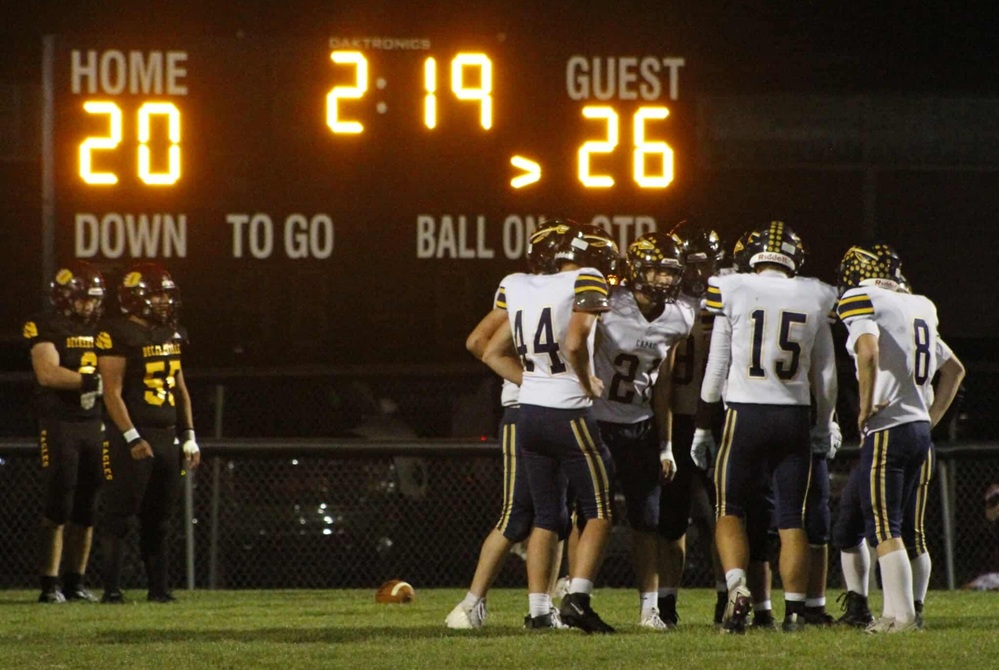
Much of that confidence comes from that Week 8 win against 2024 8-Player Division 1 champion Deckerville. The 28-20 triumph ended Deckerville’s 20-game win streak, as it had not lost since the 2023 Semifinals. It was the first regular-season loss for the Eagles since Sept. 29, 2023.
“Starting the season we went kind of slow, but beating Deckerville told us that we were on that top tier,” senior defensive end and tight end Wiley Roose said. “I mean, after that game, it was crazy. To me, it was definitely the highlight of my sports career in high school. The whole team really came around.”
Beating Deckerville is an accomplishment in its own right, but the fact the Eagles had this season defeated Brown City and Kingston – which delivered Capac’s two losses – was another boost of confidence for the Chiefs, who are ready to show how far they’ve come this fall.
“We watched some film from the game (against Brown City) earlier in the season, and we were just comparing what we were then to how we are now,” Tesnow said. “It’s a huge difference. I’m pumped. We’re proving everyone wrong, and I love that feeling of being the underdog and surprising people.”
Tesnow and his teammates are hoping to continue doing that, but what they’ve done already to get the Capac program back on the right track is a massive accomplishment in itself.
“Coach Nestle and I care about all our players, but seeing these kids develop for five years, go through school, go through some of the losing seasons early in middle school then slowly build and get better – I can think of a number of kids and how they improved with being more aggressive, being tougher and taking the next step,” Schneider said. “It’s really nice to see the kids develop through the program. It’s been sweet. It’s that much better because it’s a great group of kids. They’re wonderful.”
 Paul Costanzo served as a sportswriter at The Port Huron Times Herald from 2006-15, including three years as lead sportswriter, and prior to that as sports editor at the Hillsdale Daily News from 2005-06. He can be reached at [email protected] with story ideas for Genesee, Lapeer, St. Clair, Sanilac, Huron, Tuscola, Saginaw, Bay, Arenac, Midland and Gladwin counties.
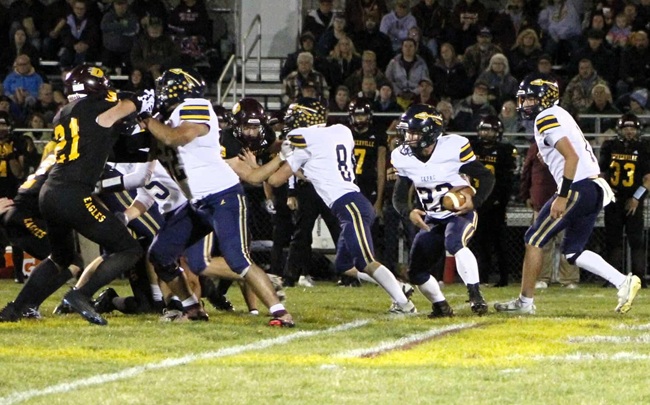
PHOTOS (Top) Capac huddles up during the closing minutes of its Week 8 win over Deckerville. (Middle) Sam Schneider (22) carries the ball and follows his Chiefs blockers as they attempt to create an opening against the Eagles. (Photos courtesy of the Capac football program.)