


Tales of the Tape from Bygone Days
September 10, 2014
By Rob Kaminski
MHSAA benchmarks editor
How’s this for a new reality/espionage TV series? Participants have just hours to exchange valuable video to counter-intelligence representatives at random drop points along state highways, then return to home base, study the footage and devise an action plan that same day.
Oh, and there are no cell phones or any other form of portable communication should plans go awry en route.
For longtime Escanaba High School football coach Dan Flynn, it’d be like watching reruns of his days as an assistant coach for the Eskymos. As one of the largest schools in the Upper Peninsula, Escanaba’s road through the MHSAA Playoffs almost always meant facing opponents from below the bridge, which made film exchange a challenge to say the least.
“I’ve logged thousands of miles, maybe more than anyone ever, exchanging film, tapes and DVDs with our opponents during the MHSAA Playoffs,” Flynn said.
“Being in Region 1 geographically, we knew we’d travel,” Flynn added. “And you couldn’t afford to just look at anyone and everyone that you might play. You had to do your homework to narrow down possible opponents if you wanted to go and scout.”
Today, with the MHSAA publishing Football Playoff Points on a weekly basis following Week 4, much of the guesswork as to potential first-round opponents has disappeared.
Additionally, most schools upload game footage to the web within 24 hours following each contest. On Selection Sunday, within minutes after a school’s Pre-District foe is announced, a coaching staff and players can be watching video of their opponent.
“We’d started calling coaches or they’d call me in Week 8 or 9, looking at possible matchups and also planning a place to meet to exchange film,” Flynn said.
Plans had to be firm and communications had to be clear, because once hitting the road, there was no way to contact one another.
“This was before cell phones,” Flynn explained. “I had one of first cell phones, which actually was an old bag phone. I’d accumulate outrageous rates for roaming charges going tower to tower.”
Old-school video exchange might be a thing of the past, but a generation of high school football coaches will never forget gas stations, fast-food joints and 24-hour stores nestled off exit ramps across Michigan.
“On that Sunday night, I’d get in the car, and typically drive to Gaylord, or maybe Grayling. In Gaylord it would be the McDonald’s. In Grayling, it’d be Glen’s Food Market. You’d try to arrange to meet at a place that was open 24 hours,” Flynn recalled. “I always got in the car understanding the meeting would be below the (Mackinac) Bridge. Sometimes we’d get lucky and the meeting place would be the Shell gas station just below the bridge on the Mackinaw City side.”
The 200-mile drive to Gaylord routinely took four hours. The further Escanaba advanced in the playoffs, the more times Flynn wore down the tread on his tires. He specifically recalls a hectic weekend in 1979, when Escanaba traveled to Lansing Sexton and defeated Livonia Stevenson in the MHSAA Semifinals to earn a berth in the Finals the following weekend vs. Detroit Catholic Central. Part of the reward for Flynn was another trip to McDonald’s.
“We came from behind in that Semifinal, and we were thrilled that we were going to the Finals. We got back home late Saturday night, then I got in the car the next morning to meet the Catholic Central coaches at 1 p.m.,” Flynn said.
“Coach (head coach Jerry) Cvengros had a meeting set for 5 or 6 that night. I made it back in time, but our guys were still feeling good about the win, so I suggested we hold off a day before showing them the CC film (16 mm film, by the way). Those guys were pretty good.”
Indeed they were, winning the Class A title the following weekend. The Eskymos, however, would return to the Final in 1981, winning the crown, 16-6 over Fraser, as Flynn no doubt logged more miles in preparation.
The most pressing concern today might be quality of the online video, lighting at the fields, or angle of the camera.
Back in the day, just getting a tape felt like victory.
“One year, I traveled all the way to the southeast part of the state, and the opposing coach simply wouldn’t exchange,” said Flynn, explaining that playoff film exchange at the time was only a recommendation, not a regulation. “I learned later that the coach had video of us from a friend who lived in Escanaba. I left on Saturday morning and came back Sunday night. We did eventually get some film later in the week. We lost by two points, but as coaches we didn’t make it a big vendetta and were up front with our kids.”
The MHSAA Representative Council, which included Flynn at the time, upgraded film exchange from a recommendation to a playoff policy in 1990, when schools were required to supply one another with the two most recent game films.
Even so, and as 16 mm film evolved to VHS tapes and then DVDs, coaching delegates still had to make itineraries for October and November weekends. Sometimes twice in the same weekend.
“Even with advancements in technology as we progressed from DVDs to digital, you still need people to operate the devices,” Flynn said. “I met another coach at the Shell station at the Bridge, but he said our software wasn’t compatible with theirs. I drove back the next day, pushed a button, and it worked. I drove all that way to push a button; 16 mm film would have been better.”
Today’s coaches might be a bit more well-versed in technology than those of Flynn’s era, and it’s a good thing. They likely need MapQuest and a GPS to traverse the regions in Northern Michigan that Flynn and his cohorts knew like the back of their hands.
Performance: GR Catholic Central's Nolan Fugate
October 13, 2017
 Nolan Fugate
Grand Rapids Catholic Central senior – Football
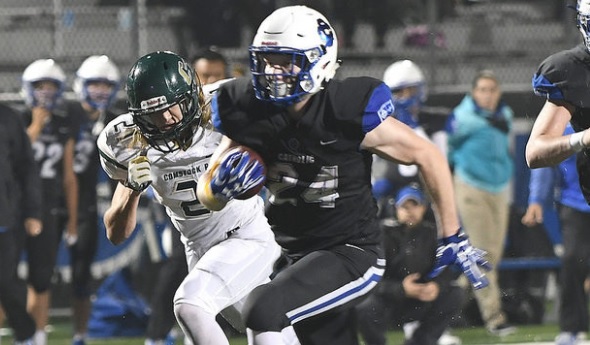
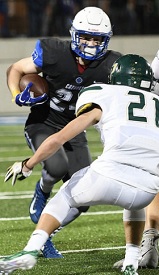
Fugate, a 6-foot-1, 210-pound running back, ran 37 times for 477 yards and five touchdowns in GRCC’s 57-50 win over Comstock Park on Oct. 6. His rushing yardage ranked fourth-most in MHSAA history for one game and second-most in the state since 1990, earning Fugate the Michigan Army National Guard “Performance of the Week.”
Also the leading rusher on last season’s team that won the Division 4 championship, Fugate has carried the ball 111 times for 1,137 yards and 13 touchdowns this fall – averaging 10 yards per carry. He's amassed those numbers despite limited attempts in four running clock games this fall. After coming up for the playoffs but seeing little action as a sophomore, and then moving into a prominent role the last two seasons, Fugate is fourth in GRCC history with 335 career carries, second with 2,537 career yards, tied for second with 27 career rushing touchdowns and fifth with a career average of 7.6 yards per carry. And like any good back, he knows to credit those clearing the way – Fugate follows an outstanding line led by 6-5, 270-pound Jalen Mayfield, who has committed to sign with University of Michigan.
 Fugate also ran track last season for the first time in high school and plans to do so again this spring. He hopes to return to the basketball program as well – he played subvarsity his first two years before taking last season off. He’s aiming to continue his football career after high school and has interest from many of the state’s top Division II programs plus a few at the Division I mid-major and NAIA levels. Fugate is planning to study business and carries a 3.2 grade-point average. Wherever he goes, that program will get a proven winner – GRCC is 7-0 this fall heading into tonight’s Ottawa-Kent Conference Blue title-deciding matchup with reigning Division 5 champion Grand Rapids West Catholic, and the Cougars are 21-2 with Fugate on the roster.
Coach Todd Kolster said: "I think the world of Nolan. He is a very self-motivated young man. He is very mentally tough and has worked extremely hard to help lead our team. He is a great teammate and a high-character person. He's is a great competitor. ... He is one of the best tailbacks in the state of Michigan; he rushed for over 1,600 yards and 21 touchdowns a year ago. He could have very gaudy statistics and surpassed those totals already if I played him in those other (running clock) weeks."
Performance Point: “We had a good gameplan coming in, and I think we executed really well and our line blocked really well and it was just a good night offensively,” Fugate said of the Comstock Park win. “I knew I was having a pretty good night. I knew I had some big runs, and I was just following my blocks, but I didn’t know the exact yards I had. I was actually pretty surprised (at the yardage total). I had some big runs the first possession, and I could see our offensive line executing their blocks well so I was figuring I would have a pretty big night. The first play we had the ball in the second half, I broke a 72-yard run. That was my favorite run because I broke out into the open and I just ran past everyone and I could hear the crowd screaming.”
Following Jalen: “He’s my best friend too, and it’s pretty special. You don’t get a chance to run behind the best lineman in the state very often, so I’m pretty fortunate. We shared a moment when we talked about how good of a night it was, and it was just a really special night overall.”
 Great expectations: “We’ve just been listening to the coaching staff, and whatever they’ve asked we’ve been executing to the best of our ability. And we’ve been staying focused throughout the week trying to have the best practices we could have. We realize the expectations are high, so we just have to stay focused on each game and play united and just get better each day. You’ve just got to worry about one thing at a time and for that (opponent), and you can’t look ahead to the playoffs. … We knew the expectations were high, but I had faith. We definitely had more talent last year, but I feel like we’ve executed a lot better this year up to this point. I knew we could be special, and if we just keep working out each day and bringing it every day I think it will turn out really well.”
Running like “All Day” Adrian: “My favorite running back is probably (the Phoenix Cardinals’) Adrian Peterson, so growing up I always watched him. He’s a strong, explosive, physical runner. I like how he runs downhill and he’s always physical, and when he gets an opening he’s very explosive.”
Hooping like a football player: “A kid I grew up with (point guard Austin Braun) has been talking to me about (playing basketball). I was thinking about it, and I think I’m just going to do it. I think our team will do really well this year, so it would be fun to be a part of it. I’ll probably play really physical. I’ll probably be like the sixth man, bring intensity and defense and rebounding. That’ll probably be my job."
- Geoff Kimmerly, Second Half editor
Every week during the 2017-18 school year, Second Half and the Michigan Army National Guard will recognize a “Performance of the Week" from among the MHSAA's 750 member high schools.
The Michigan Army National Guard provides trained and ready forces in support of the National Military Strategy, and responds as needed to state, local, and regional emergencies to ensure peace, order, and public safety. The Guard adds value to our communities through continuous interaction. National Guard soldiers are part of the local community. Guardsmen typically train one weekend per month and two weeks in the summer. This training maintains readiness when needed, be it either to defend our nation's freedom or protect lives and property of Michigan citizens during a local natural disaster.
Previous 2017-18 honorees:
October 5: Marissa Ackerman, Munising tennis - Read
September 28: Minh Le, Portage Central soccer - Read
September 21: Olivia Theis, Lansing Catholic cross country - Read
September 14: Maddy Chinn, Pontiac Notre Dame Prep volleyball - Read
PHOTOS: (Top) Grand Rapids Catholic Central’s Nolan Fugate runs away from the Comstock Park defense during last week’s 57-50 win. (Middle) Fugate prepares to take on a Comstock Park defender. (Photos by Murray Sports Photography.)