


Tales of the Tape from Bygone Days
September 10, 2014
By Rob Kaminski
MHSAA benchmarks editor
How’s this for a new reality/espionage TV series? Participants have just hours to exchange valuable video to counter-intelligence representatives at random drop points along state highways, then return to home base, study the footage and devise an action plan that same day.
Oh, and there are no cell phones or any other form of portable communication should plans go awry en route.
For longtime Escanaba High School football coach Dan Flynn, it’d be like watching reruns of his days as an assistant coach for the Eskymos. As one of the largest schools in the Upper Peninsula, Escanaba’s road through the MHSAA Playoffs almost always meant facing opponents from below the bridge, which made film exchange a challenge to say the least.
“I’ve logged thousands of miles, maybe more than anyone ever, exchanging film, tapes and DVDs with our opponents during the MHSAA Playoffs,” Flynn said.
“Being in Region 1 geographically, we knew we’d travel,” Flynn added. “And you couldn’t afford to just look at anyone and everyone that you might play. You had to do your homework to narrow down possible opponents if you wanted to go and scout.”
Today, with the MHSAA publishing Football Playoff Points on a weekly basis following Week 4, much of the guesswork as to potential first-round opponents has disappeared.
Additionally, most schools upload game footage to the web within 24 hours following each contest. On Selection Sunday, within minutes after a school’s Pre-District foe is announced, a coaching staff and players can be watching video of their opponent.
“We’d started calling coaches or they’d call me in Week 8 or 9, looking at possible matchups and also planning a place to meet to exchange film,” Flynn said.
Plans had to be firm and communications had to be clear, because once hitting the road, there was no way to contact one another.
“This was before cell phones,” Flynn explained. “I had one of first cell phones, which actually was an old bag phone. I’d accumulate outrageous rates for roaming charges going tower to tower.”
Old-school video exchange might be a thing of the past, but a generation of high school football coaches will never forget gas stations, fast-food joints and 24-hour stores nestled off exit ramps across Michigan.
“On that Sunday night, I’d get in the car, and typically drive to Gaylord, or maybe Grayling. In Gaylord it would be the McDonald’s. In Grayling, it’d be Glen’s Food Market. You’d try to arrange to meet at a place that was open 24 hours,” Flynn recalled. “I always got in the car understanding the meeting would be below the (Mackinac) Bridge. Sometimes we’d get lucky and the meeting place would be the Shell gas station just below the bridge on the Mackinaw City side.”
The 200-mile drive to Gaylord routinely took four hours. The further Escanaba advanced in the playoffs, the more times Flynn wore down the tread on his tires. He specifically recalls a hectic weekend in 1979, when Escanaba traveled to Lansing Sexton and defeated Livonia Stevenson in the MHSAA Semifinals to earn a berth in the Finals the following weekend vs. Detroit Catholic Central. Part of the reward for Flynn was another trip to McDonald’s.
“We came from behind in that Semifinal, and we were thrilled that we were going to the Finals. We got back home late Saturday night, then I got in the car the next morning to meet the Catholic Central coaches at 1 p.m.,” Flynn said.
“Coach (head coach Jerry) Cvengros had a meeting set for 5 or 6 that night. I made it back in time, but our guys were still feeling good about the win, so I suggested we hold off a day before showing them the CC film (16 mm film, by the way). Those guys were pretty good.”
Indeed they were, winning the Class A title the following weekend. The Eskymos, however, would return to the Final in 1981, winning the crown, 16-6 over Fraser, as Flynn no doubt logged more miles in preparation.
The most pressing concern today might be quality of the online video, lighting at the fields, or angle of the camera.
Back in the day, just getting a tape felt like victory.
“One year, I traveled all the way to the southeast part of the state, and the opposing coach simply wouldn’t exchange,” said Flynn, explaining that playoff film exchange at the time was only a recommendation, not a regulation. “I learned later that the coach had video of us from a friend who lived in Escanaba. I left on Saturday morning and came back Sunday night. We did eventually get some film later in the week. We lost by two points, but as coaches we didn’t make it a big vendetta and were up front with our kids.”
The MHSAA Representative Council, which included Flynn at the time, upgraded film exchange from a recommendation to a playoff policy in 1990, when schools were required to supply one another with the two most recent game films.
Even so, and as 16 mm film evolved to VHS tapes and then DVDs, coaching delegates still had to make itineraries for October and November weekends. Sometimes twice in the same weekend.
“Even with advancements in technology as we progressed from DVDs to digital, you still need people to operate the devices,” Flynn said. “I met another coach at the Shell station at the Bridge, but he said our software wasn’t compatible with theirs. I drove back the next day, pushed a button, and it worked. I drove all that way to push a button; 16 mm film would have been better.”
Today’s coaches might be a bit more well-versed in technology than those of Flynn’s era, and it’s a good thing. They likely need MapQuest and a GPS to traverse the regions in Northern Michigan that Flynn and his cohorts knew like the back of their hands.
8-Player Takes Flight in Upper Peninsula
September 28, 2017
By Dennis Grall
Special for Second Half
ESCANABA – Three yards and a cloud of dust. That was the highly successful version of football applied by veteran Ohio State coach Woody Hayes as big bruisers dominated the game.
 It certainly is not the preferred style on the fields of 8-player football. Nope, this version is much more open-field and definitely more exciting, full of big plays and a ton of scoring.
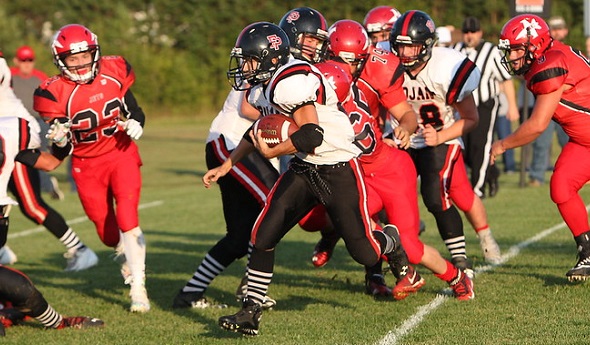
Take Powers North Central as the prime example. The Jets have won the last two 8-player MHSAA championships with back-to-back 13-0 seasons, piling up yards and points in their first two seasons in the 8-player game with a large group of skilled athletes.
Their winning streak ended at 27 games earlier this season, but the style they displayed with exceptional athleticism led by Jason Whitens and Bobby Kleiman has caught on with many other programs.
The Upper Peninsula, at the forefront of the 8-player game due largely to decreasing enrollments, has been lighting up the scoreboards this year. Teams like Pickford and Cedarville, Rapid River and Stephenson, Ontonagon and Crystal Falls Forest Park are progressing with the same formula as North Central by featuring explosive offenses.
Citing some 8-player detractors who don't think the game is real football, veteran Cedarville coach Scott Barr said, "I don't think anyone can argue that it (8-player) has not been healthy for football. It has been healthy."
The game is thriving in small schools because the 8-player version simply has allowed football to remain in the athletic program despite shrinking enrollments across the state.
"It has allowed us to keep football," said veteran coach Steve Ostrenga of Rapid River, who led the Rockets into 8-player Finals in 2011 and 2013 and into the playoffs every season since making the switch after going 1-7 in 11-player in 2010.
"We did it out of necessity. We may have waited too long," added Ostrenga, recalling that last year of 11-player football when only one sub was available at several games.
Veteran Pickford skipper Josh Rader has an idea why the 8-player game has met approval at so many small schools. "It is a high-octane game. It is a lot of fun to watch," he said. "It puts a lot of pressure on defenses because it is such a wide open game. It makes it exciting for the fans."
No longer do fans have to squint and squirm in their seats to see what is happening among the goliaths in the line. Now the football is visible in the wide open spaces as skilled athletes display dazzling moves, whether the team favors the extremely popular spread offense or uses the more familiar run-oriented approach.
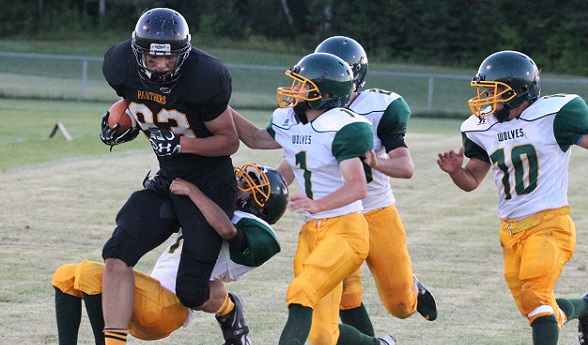 "It is more a one-on-one oriented game now," said coach Ben Mayer of Ontonagon, whose program has consolidated with neighboring Ewen-Trout Creek, which yearly battled small player turnouts just to keep the game alive. Fifteen E-TC students are playing football at Ontonagon, with six on the varsity, highlighted by 6-foot-7 receiver Jacob Witt, who caught MHSAA 8-player record 24 touchdown passes last season.
"Without 8-player, we would have gone under a while back," said Mayer, who played for U.P. Sports Hall of Fame coach Bob "Cubby" Carlson at Ontonagon. He said the Gladiators were forced to use four freshmen and had 130-pound athletes on the line in past years.
"Football has changed a lot in the last four years," he said of the time since the Gladiators moved to the 8-player game. "The ball is in the air. It is fun to watch.”
Mayer said 8-player also enables his program to offer junior varsity football to younger students, instead of having them compete against older, bigger and stronger players with the potential to increase injuries.
"There is not as much violence between the tight ends now because we don't play in those tight spaces," said Mayer.
He also recalls putting "wildly undersized kids in the line against bigger schools with monsters from legitimate programs, with kids getting stepped on and squashed on.
"You do have a lot of choices in 8-man. I can put smaller kids somewhere and they will be all right, and we can still play football."
Ostrenga said it seems injuries, especially of the serious variety, have also seemed to decrease. "We used to hit a lot more in practice. Now we do a lot of teaching and drill work and conditioning," he said, adding MHSAA officials have been in the forefront of trying to reduce injuries with new regulations.
Ostrenga said in the 11-player version, many times it came down to "men playing against boys."
He did say, however, that under the 8-player game coaches "can tend to overuse a player. You get a really good athlete and use him as a crutch in a game."
Ostrenga said it took time to support the change to 8-player football. "I was against 8-man football at first. Now it has made me more open-minded and allowed me to become more understanding." He said 8-player athletes need to have speed, strength, balance and shiftiness.
"Some big guys can't move that well," he said, indicating this version of football requires more agile and nimble athletes to cover the wide-open spaces. "The big thing is understanding you have to get your athletes on the field. You just have eight guys on the field and you are (more) exposed. In 11-man you can hide someone. In 8-man, coaches will find your weaknesses."
Rader agreed, noting, "It puts a lot of pressure on the defense because the game is so wide open. There is a little different strategy. It is a disadvantage for the defense because (the field) is so wide open and there is not a lot of help. You want to take the advantage your offense has over the defense in one-on-ones.
"We like to run the ball and throw the ball, so our athletes can utilize the open field.”
Barr said 8-player quarterbacks are more difficult to contain than typical pocket passers. "They are more elusive," he said, recalling how the 6-foot-4 Whitens could take the direct snap, survey the field and decide whether to throw or run the ball himself.
In the 2016 MHSAA title game, Whitens ran 17 times for a record 352 yards and six touchdowns as the Jets beat Deckerville 58-22. The Jets ran for 469 yards that night.
"You rarely see teams ground and pound," Barr said of the8-man game, noting he began to rely on the spread offense in 11-player football as he tried to figure out how to match up with the over-powering tailback-oriented rushing attack of perennial power Forest Park, which began playing 8-player football in 2016.
Barr said the kicking game is of vital importance now and that secondary tackling is a tough transition because of the explosive offense athletes.
He said "the hybrid player who has size and speed" is featured in 8-player "and it can eliminate the real big kids," which he said are seldom a factor for small schools anyway.
Another plus for the 8-player game comes in scheduling, where Class D schools no longer have to face larger Class C programs and can also find opponents in northern Wisconsin, which also has declining enrollments.
Bark River-Harris and Lake Linden-Hubbell are the only Class D schools still fielding 11-player football teams in the Upper Peninsula. Three other schools, Class D Wakefield-Marenisco and Bessemer and Class C Ironwood have formed a cooperative program, Gogebic Miners, for football purposes.
 Denny Grall retired in 2012 after 39 years at the Escanaba Daily Press and four at the Green Bay Press-Gazette, plus 15 months for WLST radio in Escanaba; he served as the Daily Press sports editor from 1970-80 and again from 1984-2012. Grall was inducted into the Upper Peninsula Sports Hall of Fame in 2002 and serves as its executive secretary. E-mail him at [email protected] with story ideas for the Upper Peninsula.
PHOTOS: (Top) Crystal Falls Forest Park downed Powers North Central 66-58 in Week 2 as the teams combined to score more than 100 points for the third time in two seasons. (Middle) Ewen-Trout Creek’s Jacob Witt, here against Carney-Nadeau last season, caught 24 touchdown passes in 2016 and is playing as part of a co-op team with Ontonagon this fall. (Photos by Paul Gerard.)