


Tales of the Tape from Bygone Days
September 10, 2014
By Rob Kaminski
MHSAA benchmarks editor
How’s this for a new reality/espionage TV series? Participants have just hours to exchange valuable video to counter-intelligence representatives at random drop points along state highways, then return to home base, study the footage and devise an action plan that same day.
Oh, and there are no cell phones or any other form of portable communication should plans go awry en route.
For longtime Escanaba High School football coach Dan Flynn, it’d be like watching reruns of his days as an assistant coach for the Eskymos. As one of the largest schools in the Upper Peninsula, Escanaba’s road through the MHSAA Playoffs almost always meant facing opponents from below the bridge, which made film exchange a challenge to say the least.
“I’ve logged thousands of miles, maybe more than anyone ever, exchanging film, tapes and DVDs with our opponents during the MHSAA Playoffs,” Flynn said.
“Being in Region 1 geographically, we knew we’d travel,” Flynn added. “And you couldn’t afford to just look at anyone and everyone that you might play. You had to do your homework to narrow down possible opponents if you wanted to go and scout.”
Today, with the MHSAA publishing Football Playoff Points on a weekly basis following Week 4, much of the guesswork as to potential first-round opponents has disappeared.
Additionally, most schools upload game footage to the web within 24 hours following each contest. On Selection Sunday, within minutes after a school’s Pre-District foe is announced, a coaching staff and players can be watching video of their opponent.
“We’d started calling coaches or they’d call me in Week 8 or 9, looking at possible matchups and also planning a place to meet to exchange film,” Flynn said.
Plans had to be firm and communications had to be clear, because once hitting the road, there was no way to contact one another.
“This was before cell phones,” Flynn explained. “I had one of first cell phones, which actually was an old bag phone. I’d accumulate outrageous rates for roaming charges going tower to tower.”
Old-school video exchange might be a thing of the past, but a generation of high school football coaches will never forget gas stations, fast-food joints and 24-hour stores nestled off exit ramps across Michigan.
“On that Sunday night, I’d get in the car, and typically drive to Gaylord, or maybe Grayling. In Gaylord it would be the McDonald’s. In Grayling, it’d be Glen’s Food Market. You’d try to arrange to meet at a place that was open 24 hours,” Flynn recalled. “I always got in the car understanding the meeting would be below the (Mackinac) Bridge. Sometimes we’d get lucky and the meeting place would be the Shell gas station just below the bridge on the Mackinaw City side.”
The 200-mile drive to Gaylord routinely took four hours. The further Escanaba advanced in the playoffs, the more times Flynn wore down the tread on his tires. He specifically recalls a hectic weekend in 1979, when Escanaba traveled to Lansing Sexton and defeated Livonia Stevenson in the MHSAA Semifinals to earn a berth in the Finals the following weekend vs. Detroit Catholic Central. Part of the reward for Flynn was another trip to McDonald’s.
“We came from behind in that Semifinal, and we were thrilled that we were going to the Finals. We got back home late Saturday night, then I got in the car the next morning to meet the Catholic Central coaches at 1 p.m.,” Flynn said.
“Coach (head coach Jerry) Cvengros had a meeting set for 5 or 6 that night. I made it back in time, but our guys were still feeling good about the win, so I suggested we hold off a day before showing them the CC film (16 mm film, by the way). Those guys were pretty good.”
Indeed they were, winning the Class A title the following weekend. The Eskymos, however, would return to the Final in 1981, winning the crown, 16-6 over Fraser, as Flynn no doubt logged more miles in preparation.
The most pressing concern today might be quality of the online video, lighting at the fields, or angle of the camera.
Back in the day, just getting a tape felt like victory.
“One year, I traveled all the way to the southeast part of the state, and the opposing coach simply wouldn’t exchange,” said Flynn, explaining that playoff film exchange at the time was only a recommendation, not a regulation. “I learned later that the coach had video of us from a friend who lived in Escanaba. I left on Saturday morning and came back Sunday night. We did eventually get some film later in the week. We lost by two points, but as coaches we didn’t make it a big vendetta and were up front with our kids.”
The MHSAA Representative Council, which included Flynn at the time, upgraded film exchange from a recommendation to a playoff policy in 1990, when schools were required to supply one another with the two most recent game films.
Even so, and as 16 mm film evolved to VHS tapes and then DVDs, coaching delegates still had to make itineraries for October and November weekends. Sometimes twice in the same weekend.
“Even with advancements in technology as we progressed from DVDs to digital, you still need people to operate the devices,” Flynn said. “I met another coach at the Shell station at the Bridge, but he said our software wasn’t compatible with theirs. I drove back the next day, pushed a button, and it worked. I drove all that way to push a button; 16 mm film would have been better.”
Today’s coaches might be a bit more well-versed in technology than those of Flynn’s era, and it’s a good thing. They likely need MapQuest and a GPS to traverse the regions in Northern Michigan that Flynn and his cohorts knew like the back of their hands.
Kalkaska Climbs Under 'Famed' Alum
September 28, 2016
By Dennis Chase
Special for Second Half
KALKASKA – It was a whirlwind weekend for Jeremy Wilkinson.
 The Kalkaska football coach led his unbeaten Blazers to a 35-0 victory over Cheboygan last Thursday. Then, 24 hours later, Wilkinson was inducted into the Northern Michigan University Sports Hall of Fame as part of the school’s Homecoming festivities.
“It’s a great honor,” the Kalkaska High School graduate said. “I remember 22 years ago looking at all the Hall of Fame plaques (in the Superior Dome) and thinking how cool it would be to be on that wall, too.”
Wilkinson, a wide receiver at Northern Michigan, still holds the career records for receiving yards (3,367) and touchdowns (35).
“This is a small town,” Kalkaska senior quarterback Hunter Suydam said. “Not too many (college) players come out of here, (certainly) not Hall of Famers. It’s pretty special.
“But he doesn’t really talk about it. It’s mainly, ‘Yeah, I played college football. Now, let’s get back to work.’”
That was Wilkinson’s mindset Monday as the Blazers began preparations for a big road task Friday at Boyne City.
With its 5-0 record, Kalkaska’s best start since the 1981 team went 9-0, the team’s generated quite a buzz in the community. But a difficult second half schedule includes games with Boyne City (3-2), Traverse City St. Francis (5-0) and Grayling (3-2).
It’s a stretch that promises to define the Blazers’ season.
“To be 5-0 is great, but our goal is the playoffs and we’ve got a tough schedule ahead of us,” Suydam said. “We need to focus on that. It doesn’t matter if you’re 5-0, if you can’t finish it off.”
Wilkinson has turned the program around since taking over in 2009. The Blazers are in the midst of a fourth winning season in five years – and a possible third playoff appearance during that span. One more win assures that.
“We know it takes one more win to make it into the playoffs,” Wilkinson said, ‘but we also know it’s not going to be easy. The next four weeks will be tough. We have quality opponents. We definitely have to clean up some mistakes we’ve been making the last couple weeks.”
 Wilkinson is not surprised by the 5-0 start, which includes a 21-18 win over Leroy Pine River, a 4-1 squad that is ranked No. 9 in this week’s Associated Press Division 6 rankings. After all, the Blazers finished 5-4 a year ago and returned several players with at least three years of varsity experience.
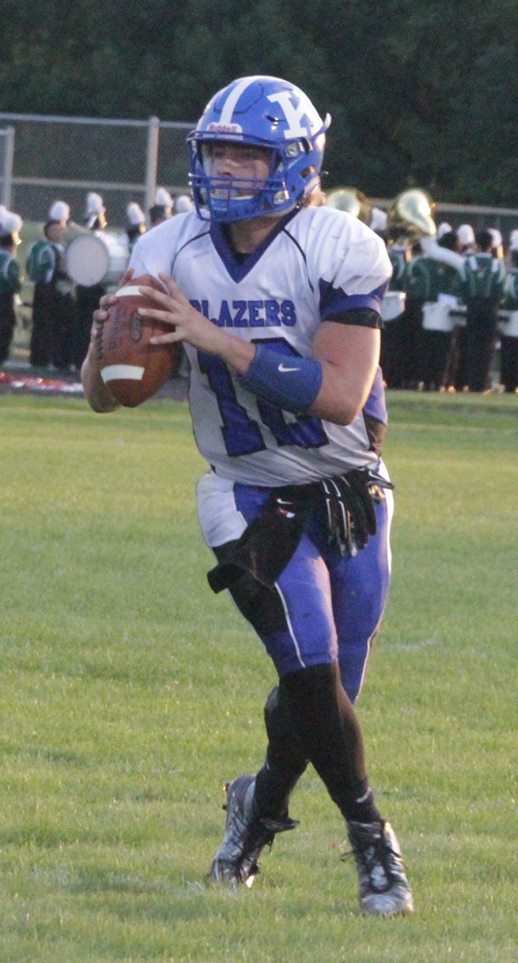
One key returner was Suydam, who has completed 36 of 69 passes for 636 yards and 10 touchdowns in four games (the Blazers won one game by forfeit). Two weeks ago, he threw for 292 yards and five touchdowns in a 40-21 triumph over Elk Rapids. He was 7 of 11 for 103 yards and two more scores against Cheboygan.
“Over the past few years we haven’t thrown the ball a ton,” Wilkinson said, “but this year we’ve opened it up a little more because of the speed and athleticism of our skills guys and the size in our line. It’s nice to be able to throw because it takes defenses out of their comfort zone. Now they’ve got to drop back and try to cover instead of loading seven to eight players in the box. “
Suydam, now in his second year at quarterback, is still learning the position as far as reads, Wilkinson said.
“But he’s starting to put it together,” the coach added.
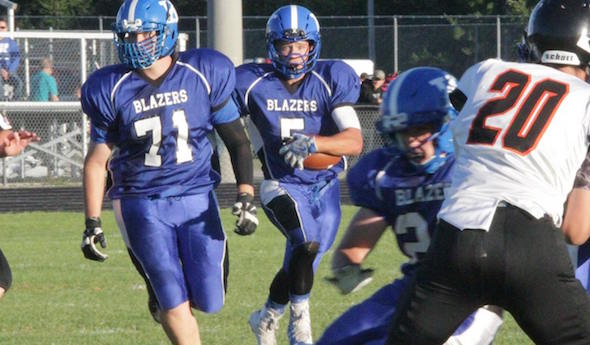
Wilkinson is quick to credit Suydam’s receivers as well as a line that includes tackles Luke Sexton and Seth Riddle, guards Jake Disbrow and Brad Berger and center Ed Davidson. Nolan Mitchell is the leading receiver with 15 catches for 265 yards and four scores. Hayden Zimmerman has added 10 receptions for 301 yards and three touchdowns while tight end Jake Kies has contributed five receptions for 51 yards and two touchdowns.
“Our line has played well and our receivers are getting open,” Wilkinson said. “Once the ball is in their hands, they’re making plays. The last two weeks we’ve had plays where we’ve caught the ball within five to eight yards of the line of scrimmage and taken it 60, 70, 80 yards for touchdowns.’
Mitchell’s the leading rusher with 258 yards and three scores.
 Defensively, the Blazers are paced by linebacker Gavin Peterson, who has a team-high 32 tackles. Mitchell and Disbrow are next with 23 and 21 stops, respectively. Kies, a defensive end, has four sacks.
“Our defense has been playing great and that’s because they’re playing aggressively,” Wilkinson said. “They’re flying around. They want to hit.”
The Blazers’ roster features 18 seniors.
“Fifteen were on varsity as sophomores,” Suydam said. “Yes, we were 2-7 (two years ago), but that year of experience helped us.”
One of the seniors, receiver-linebacker Jacob Shier, broke his fibula early in the opening game. Shier, who has been on the varsity since his freshman season, still attends practice regularly to be around his teammates.
“I want to be here for the guys,” he said. “This class has been working together since third grade and it’s clicking right now. There’s a lot of talent on this team, more so than we’ve had in a long time. It’s looking good. Everybody’s buying in.”
The experience bleeds down into the junior class. Four juniors are in their third year on varsity.
“What we’re seeing on the football field is a credit to the program as a whole,” athletic director Justin Thorington said. “It starts at the top with the coaches creating a program that our student-athletes are really engaged and interested in, and working hard at.
“Plus, we have a giant senior class, which is always good.”
There are 29 players on varsity, 25 on JV.
“Those are good numbers for a school our size,” Thorington said. “But our participation numbers in general are pretty big. This year we added a JV soccer team, which, as far as I know, is the first time that’s happened here.”
Kalkaska coaches also participated this summer in a training program through Michigan State called Spartan Performance. The program, according to the school’s website, is designed to enhance athletic development and sports performance through a multidisciplinary approach that includes physical training, recovery, nutrition, mental skills and athletic health.
Michigan State conducted a two-day in-service with the coaching staff, then came back for a follow-up.
“It’s collegiate-level training based on research,” Thorington said. “It’s more than just strength training, it’s speed and agility, nutrition, sports psychology. They did training with our female sports coaches on ACL strength and tear prevention. We’re hitting all the facets.
“Our football staff really spearheaded it and ran with it. We only had a couple weeks to implement it, but this offseason we’ll have the entire year to do it. We’re always thinking of ways to get a competitive advantage.”
That said, Thorington added that wins and losses are not the only way to gauge success.
“Our slogan for this year (in the athletic department) is ‘Embrace the Process,’” he said. “We’re not going to concentrate on the results, the wins and losses. That’s not why we’re here. Instead of worrying about championships, we’re going to worry about developing champions.”
One can lead to the other, though, and that’s what the Blazers are hoping.
And as Thorington alluded, it all starts at the top with Wilkinson, who is all about team.
That was evident over the weekend when he first saw his Hall of Fame plaque that listed his individual accomplishments.
“It took a lot of people to make it happen – teammates, coaches, family, friends,” he said. “I didn’t do all the work myself. It’s (induction) an individual honor, but it doesn’t take into account that I had the MIFC Player of the Year at quarterback (Matt Hoard) in 1996. We also had the Defensive Player of the Year (Jovan Dewitt). A lot of people played a huge role in this.”
 Dennis Chase worked 32 years as a sportswriter at the Traverse City Record-Eagle, including as sports editor from 2000-14. He can be reached at [email protected] with story ideas for Manistee, Wexford, Missaukee, Roscommon, Ogemaw, Iosco, Alcona, Oscoda, Crawford, Kalkaska, Grand Traverse, Benzie, Leelanau, Antrim, Otsego, Montmorency, Alpena, Presque Isle, Cheboygan, Charlevoix and Emmet counties.
PHOTOS: (Top) Kalkaska junior Nolan Mitchell (5) looks for a hole against Elk Rapids this season, with Luke Sexton blocking. (Middle) Kalkaska football coach Jeremy Wilkinson. (Below) Senior quarterback Hunter Suydam rolls left looking for a receiver against Leroy Pine River. (Photos by Greg Fast.)