


Tales of the Tape from Bygone Days
September 10, 2014
By Rob Kaminski
MHSAA benchmarks editor
How’s this for a new reality/espionage TV series? Participants have just hours to exchange valuable video to counter-intelligence representatives at random drop points along state highways, then return to home base, study the footage and devise an action plan that same day.
Oh, and there are no cell phones or any other form of portable communication should plans go awry en route.
For longtime Escanaba High School football coach Dan Flynn, it’d be like watching reruns of his days as an assistant coach for the Eskymos. As one of the largest schools in the Upper Peninsula, Escanaba’s road through the MHSAA Playoffs almost always meant facing opponents from below the bridge, which made film exchange a challenge to say the least.
“I’ve logged thousands of miles, maybe more than anyone ever, exchanging film, tapes and DVDs with our opponents during the MHSAA Playoffs,” Flynn said.
“Being in Region 1 geographically, we knew we’d travel,” Flynn added. “And you couldn’t afford to just look at anyone and everyone that you might play. You had to do your homework to narrow down possible opponents if you wanted to go and scout.”
Today, with the MHSAA publishing Football Playoff Points on a weekly basis following Week 4, much of the guesswork as to potential first-round opponents has disappeared.
Additionally, most schools upload game footage to the web within 24 hours following each contest. On Selection Sunday, within minutes after a school’s Pre-District foe is announced, a coaching staff and players can be watching video of their opponent.
“We’d started calling coaches or they’d call me in Week 8 or 9, looking at possible matchups and also planning a place to meet to exchange film,” Flynn said.
Plans had to be firm and communications had to be clear, because once hitting the road, there was no way to contact one another.
“This was before cell phones,” Flynn explained. “I had one of first cell phones, which actually was an old bag phone. I’d accumulate outrageous rates for roaming charges going tower to tower.”
Old-school video exchange might be a thing of the past, but a generation of high school football coaches will never forget gas stations, fast-food joints and 24-hour stores nestled off exit ramps across Michigan.
“On that Sunday night, I’d get in the car, and typically drive to Gaylord, or maybe Grayling. In Gaylord it would be the McDonald’s. In Grayling, it’d be Glen’s Food Market. You’d try to arrange to meet at a place that was open 24 hours,” Flynn recalled. “I always got in the car understanding the meeting would be below the (Mackinac) Bridge. Sometimes we’d get lucky and the meeting place would be the Shell gas station just below the bridge on the Mackinaw City side.”
The 200-mile drive to Gaylord routinely took four hours. The further Escanaba advanced in the playoffs, the more times Flynn wore down the tread on his tires. He specifically recalls a hectic weekend in 1979, when Escanaba traveled to Lansing Sexton and defeated Livonia Stevenson in the MHSAA Semifinals to earn a berth in the Finals the following weekend vs. Detroit Catholic Central. Part of the reward for Flynn was another trip to McDonald’s.
“We came from behind in that Semifinal, and we were thrilled that we were going to the Finals. We got back home late Saturday night, then I got in the car the next morning to meet the Catholic Central coaches at 1 p.m.,” Flynn said.
“Coach (head coach Jerry) Cvengros had a meeting set for 5 or 6 that night. I made it back in time, but our guys were still feeling good about the win, so I suggested we hold off a day before showing them the CC film (16 mm film, by the way). Those guys were pretty good.”
Indeed they were, winning the Class A title the following weekend. The Eskymos, however, would return to the Final in 1981, winning the crown, 16-6 over Fraser, as Flynn no doubt logged more miles in preparation.
The most pressing concern today might be quality of the online video, lighting at the fields, or angle of the camera.
Back in the day, just getting a tape felt like victory.
“One year, I traveled all the way to the southeast part of the state, and the opposing coach simply wouldn’t exchange,” said Flynn, explaining that playoff film exchange at the time was only a recommendation, not a regulation. “I learned later that the coach had video of us from a friend who lived in Escanaba. I left on Saturday morning and came back Sunday night. We did eventually get some film later in the week. We lost by two points, but as coaches we didn’t make it a big vendetta and were up front with our kids.”
The MHSAA Representative Council, which included Flynn at the time, upgraded film exchange from a recommendation to a playoff policy in 1990, when schools were required to supply one another with the two most recent game films.
Even so, and as 16 mm film evolved to VHS tapes and then DVDs, coaching delegates still had to make itineraries for October and November weekends. Sometimes twice in the same weekend.
“Even with advancements in technology as we progressed from DVDs to digital, you still need people to operate the devices,” Flynn said. “I met another coach at the Shell station at the Bridge, but he said our software wasn’t compatible with theirs. I drove back the next day, pushed a button, and it worked. I drove all that way to push a button; 16 mm film would have been better.”
Today’s coaches might be a bit more well-versed in technology than those of Flynn’s era, and it’s a good thing. They likely need MapQuest and a GPS to traverse the regions in Northern Michigan that Flynn and his cohorts knew like the back of their hands.
Drive for Detroit: Week 2 Preview
August 31, 2016
By Geoff Kimmerly
Second Half editor
After an opening weekend highlighted by showcases in the Detroit and Ann Arbor areas, Michigan high school football fans should look west, north and really far north for the most colossal matchups of Week 2.
 Arguably the top teams in the Lansing and Grand Rapids areas and all of 8-player football will face off as the most intriguing games of this week’s Drive for Detroit, powered by MI Student Aid. A number of leagues also begin play, with matchups in at least three conferences likely playing a part in which favorite eventually is crowned champion.
Check out our previews below – and visit the MHSAA.com Score Center tonight and all weekend for scores as they are reported and links to updated schedules and standings.
Bay & Thumb
Almont (1-0) at Algonac (1-0)
The water should be boiling for this Blue Water Area Conference opener. Rewind to Week 6 of last season, when upstart Algonac broke reigning league champ Almont’s 16-game BWAC winning streak with a 21-7 victory. Algonac went on share the league title with Richmond (with Almont a win short of also sharing), then beat Almont again, 13-0, in their Division 5 District Final. Both earned impressive victories last week, Algonac over Marine City and Almont over Saginaw Michigan Lutheran Seminary.
Others that caught my eye: Chesaning (1-0) at Freeland (1-0), Midland Dow (1-0) at Bay City Central (1-0), Harbor Beach (1-0) at Beaverton (1-0), Flint Powers Catholic (0-1) at Saginaw Heritage (1-0).
Greater Detroit
Allen Park (1-0) at Wyandotte Roosevelt (1-0)
Allen Park shared the Downriver League championship last season by winning its final seven regular-season games after falling to Roosevelt 23-14 in Week 2. The Bears, meanwhile, ended up missing out on any share of the league title by going on to lose two games by a combined four points. Roosevelt has won seven of eight meetings against Allen Park – including once in the playoffs – since the two became league foes in 2009.
Others that caught my eye: Walled Lake Western (1-0) at Canton (0-1), Utica Eisenhower (1-0) at Macomb Dakota (1-0), Clinton Township Chippewa Valley (1-0) at Romeo (0-1), Orchard Lake St. Mary’s (0-1) at Detroit Loyola (1-0) on Friday.
Mid-Michigan
DeWitt (1-0) at Grand Ledge (0-1)
Lansing-area fans have been anticipating this matchup not just since schedules were announced for this season, but for many years. These two have been the most successful programs in the Capital Area Activities Conference for most over the last two decades and nearly are neighbors, although Grand Ledge has about 700 more students. The Comets made the Division 1 Semifinals a year ago; DeWitt’s most recent of five MHSAA Finals appearances came in 2013. Both are led by standout quarterbacks – DeWitt by Will Nagel and the Comets by Nolan Bird – although playmakers JD Ross and Antonio Rush, respectively, could be the difference-makers for those teams on offense. DeWitt dominated at Linden last week, while Grand Ledge fell a score short at Hudsonville.
Others that caught my eye: Lansing Catholic (1-0) at Lansing Everett (0-1), Dansville (1-0) at Pewamo-Westphalia (1-0), Hillsdale (1-0) at Portland (1-0), Davison (1-0) at Mount Pleasant (0-1) on Friday.
Northern Lower Peninsula
Maple City Glen Lake (1-0) at Traverse City St. Francis (1-0) on Friday
St. Francis is fresh off a trip to the Upper Peninsula and a 40-14 win over frequent playoff team Marquette. Glen Lake certainly is a more familiar opponent – the teams were in the same division of the Northern Michigan Football Conference during the league’s first two seasons, although they are in different divisions this fall. Glen Lake made headway in its two matchups with St. Francis last season, coming off a 41-7 Week 7 loss to fall only 21-3 in a Division 6 playoff opener. A four-touchdown win over Kingsley last week should be a good sign of things to come for the Lakers.
Others that caught my eye: Charlevoix (1-0) at Boyne City (0-1), Lincoln Alcona (0-1) at Hillman (0-1), Whittemore-Prescott (1-0) at Tawas (1-0), Central Lake (1-0) at Frankfort (1-0).
Southwest Corridor
Edwardsburg (1-0) at Vicksburg (1-0)
Although Edwardsburg won this matchup 58-25 a year ago, the fact remains that Vicksburg is still the only team to hand the Eddies a regular-season loss over the last three seasons – winning 16-14 in 2014. That’s enough to make this intriguing. But add in a solid 17-7 win for the Bulldogs over Dowagiac last week, and it appears they’re up to the task of challenging the Wolverine Conference frontrunners again.
Others that caught my eye: Marshall (0-1) at Coldwater (1-0), Schoolcraft (1-0) at Watervliet (1-0), Niles (1-0) at Mattawan (0-1), Kalamazoo Central (0-1) at Stevensville Lakeshore (1-0).
Southeast & Border
Morenci (1-0) at Hudson (1-0)
An early key moment in Morenci’s turnaround over the last three seasons was a 2014 win over the rival Tigers, who had mostly dominated their annual game over the previous decade and a half. Morenci made it two straight on Hudson by winning 26-20 last year and is coming off a solid 34-7 win over 2015 playoff qualifier Pittsford. The Tigers are coming off their first sub-.500 finish last year since 2006 and have plenty to prove – and also to benefit from by winning this one with an increasingly tough Lenawee County Athletic Association schedule ahead.
Others that caught my eye: New Haven (1-0) at Ida (1-0), Milan (1-0) at Flat Rock (1-0) on Friday, New Boston Huron (1-0) at Carleton Airport (1-0) on Friday, Ypsilanti Community (0-0) at Monroe (0-1) on Friday.
West Michigan
Lowell (1-0) at Rockford (0-1) on Friday
After three seasons off, these Grand Rapids-area powers will face off again; Lowell won both the 2011 and 2012 meetings when the teams first brought this matchup back after nearly four decades. Aside from these being two of the best-known programs in the state, last week’s events should draw a few more statewide eyes west. Lowell, the reigning Division 2 runner-up thanks to a last-play touchdown in the 2015 Final by Detroit Martin Luther King, blazed out of the gates with a 36-19 win over Warren DeLaSalle. Rockford, meanwhile, was forced to forfeit to Saline last week because an illness sidelined a good portion of the team. The Rams made the Division 1 Regional Finals last fall.
Others that caught my eye: Benton Harbor (1-0) at Grand Rapids South Christian (1-0), at Hudsonville; St. Ignace (1-0) at Muskegon Catholic Central (1-0), Zeeland West (1-0) at Muskegon Mona Shores (1-0), Caledonia (1-0) at Grand Rapids Christian (1-0) on Friday
Upper Peninsula
Negaunee (1-0) at Calumet (1-0)
Calumet is one of the most consistently solid teams on either peninsula, with seven or more wins nine of the last 11 seasons. And the Copper Kings broke through one of their toughest annual obstacles at the end of last fall, downing Negaunee 24-14 in a Division 6 playoff opener after losing all five of the teams’ recent meetings. Still, the Miners’ 7-3 finish last fall was similarly solid but a little deceptive – those three losses came over the final four weeks and by a combined 17 points. This could be a statement win for a team looking to take those next small steps back to elite.
Others that caught my eye: Petoskey (0-1) at Escanaba (1-0), Gwinn (1-0) at Iron Mountain (1-0), Bessemer Gogebic (1-0) at Bark River-Harris (1-0) on Friday, Newberry (1-0) at Munising (0-1) on Friday.
8-Player
Powers North Central (1-0) at Crystal Falls Forest Park (1-0) on Friday
Forest Park, 11-player until this fall, has taken a deep dive immediately into 8-player football, opening up last week against annual power Rapid River (and winning 64-22) and now hosting reigning champion Powers North Central. The Jets opened last week just as explosively as they played all of last season, putting up 60 on Luck, Wis. This one could be telling in how the Western Eight Conference standings eventually shake out – and also indicate where Forest Park sits in relation to the 8-player elite.
Others that caught my eye: Posen (1-0) at Cedarville (1-0), Lawrence (1-0) at Morrice (1-0).
Second Half’s weekly “Drive for Detroit” previews are powered by MI Student Aid, a part of the Student Financial Services Bureau located within the Michigan Department of Treasury. MI Student Aid encourages students to pursue postsecondary education by providing access to student financial resources and information, including various student financial assistance programs to help make college more affordable for Michigan students. MI Student Aid administers the state’s 529 savings programs (MET/MESP) and eight additional aid programs within its Student Scholarships and Grants division. Click for more information and connect with MI Student Aid on Facebook and Twitter @mistudentaid.
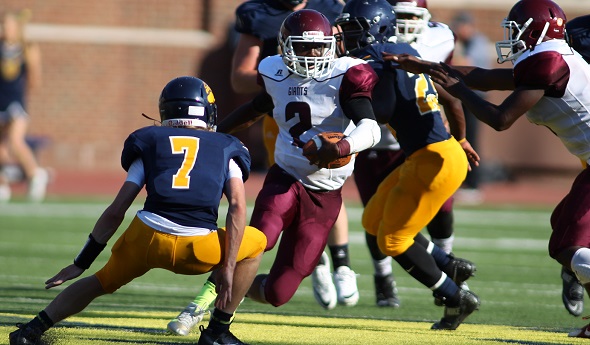
PHOTO: Kalamazoo Central, here on offense against St. Joseph last week at Michigan Stadium, will face Stevensville Lakeshore seeking its first win this season. (Click to see more from HighSchoolSportsScene.com.)