

Talking Practice: Texas, Illinois Revise Policies
December 20, 2013
By Rob Kaminski
MHSAA benchmarks editor
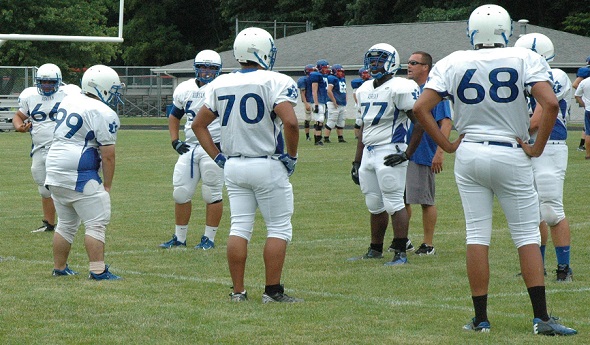
Coaches and players in Texas and Illinois adapted to new football practice limitations this fall, with the Texas policy focusing on contact, and the Illinois regulation emphasizing length of preseason practices.
Following are the main changes those states put in place heading into the 2013-14 season:
The University Interscholastic League, which governs school sports in Texas, put into writing that, “During the regular season and postseason, no football player is allowed to participate in more than ninety (90) minutes of full contact practice per week,” effective with the first day of practice this fall.
The complete policy follows:
For the purposes of the of rule, "full contact" is defined as football drills or live game simulations where "live action" occurs. Live action, as defined by USA Football, is contact at game speed where players execute full tackles at a competitive pace taking players to the ground. A team may continue to dress in full pads for practice, but may only participate in live action drills and game time simulations no more than ninety minutes per athlete per week. It is assumed that when players are in shells (shorts, shoulder pads, and helmets) no live action drills or simulations will occur. This rule is intended to limit live action drills and simulations and not the number of practices a team may participate in full pads. A team may participate in "air," "bags," "wrap," and "thud" drills and simulations at any point. These contact levels are defined below:
• Air - Players should run unopposed without bags or any opposition
• Bags - activity is executed against a bag, shield or pad to allow for a soft-contact surface, with or without the resistance of a teammate or coach standing behind the bag.
• Wrap - Drills run at full speed until contact, which is above the waist with the players remaining on their feet.
• Thud - Same as wrap but tempo is competitive with no pre-determined winner and the players are not tackling to the ground.
 The rule came to the UIL Legislative Council as a recommendation from the UIL Medical Advisory Committee, a permanent advisory committee to the Legislative Council which meets twice each year to discuss and review safety policies for UIL participants. The committee, which is made up of leading medical professionals in various specialties and includes representatives from the Texas High School Coaches Association, the Texas Girls Coaches Association, and the Texas State Athletic Trainer Association, unanimously recommended this limitation in full-contact football practice.
The rule formulates into a formal policy the existing actions of the majority of coaches across Texas, and most coaches have had to make few adjustments, if any. In fact, according to a story on statesman.com, the proposal caused more of an uproar on social media than from coaches.
“It’s not going to affect us in anyway,” Vandegrift HS coach Drew Sanders said in the story. “Most good coaches were way below that 90-minute amount already. Prior to legislation we still monitored it ourselves – the only change is now we have to keep up a log more publicly.”
Illinois put standards in place for its first 14 days of football practices, known as the state’s Preseason Football Acclimatization Practice Period. At the core of the policy is a three-hour practice limit for the first five days, during which teams can also conduct a one-hour walk-through.
 Teams must observe a minimum two hours rest between the practices and walk-throughs. Players may wear helmets only on the first two days, then helmets and shoulder pads for the next three. From days seven through 14 of the acclimatization period, schools may practice for a maximum of five hours per day, as long as that day is followed by a three-hour day, or an off day. During the five-hour days, no session can last more than three hours and must include a two-hour break between practices. Full pads may be worn for the final seven dates leading up to the first contest.
“This policy was the result of a collaborative effort between the IHSA Sports Medicine Advisory Committee and the Football Advisory Committee,” said SMAC committee member and University of Illinois Associate Professor of Orthopedic Surgery Dr. Preston M. Wolin. “The guidelines are based on the most recent scientific evidence, as well as the expertise of the coaches who will help implement them. Both committees believe the guidelines represent a significant positive contribution to the health of our athletes.”
“This new policy undoubtedly changes the way we, as coaches, approach preseason practice,” said Metamora HS coach Pat Ryan, who is a member of the FAC and a past President of the Illinois High School Football Coaches Association. “Coaches have to get more creative with when and how they schedule practices, as well what they do with their time. The proposals were strongly supported by both committees. It is a crucial final step to the process of being able to effectively prepare our teams in a safe manner. Change is always difficult, but the game is changing and we need to adapt to continue to put the safety of our players first.”
The IHSA offered multiple interactive online webinar meetings for high school coaches leading up to the start of practice where questions were answered, along with further clarifications on the policy and the science behind it.
“I think most coaches understood that changes were on the horizon,” said IHSA Executive Director Marty Hickman. “We wanted to be in a position to give our coaches as much information as possible to make sure they are comfortable with the new policy. Their input will be critical moving forward as we develop educational materials, like a best practices presentation. I commend our committees on a policy that is supported by medical experts, football coaches and school administrators.”
Drive for Detroit: Week 5 in Review
September 24, 2012
By Geoff Kimmerly
Second Half editor
Fall officially is upon us. And so is the home stretch of another MHSAA football regular season.
Four weeks remain before the playoffs begin, and that allows us to crunch some numbers all 596 11-player teams surely are following with interest.
So far, one team has qualified for the postseason. Another 73 can do so with a victory this week.
And that's only part of the excitement, as many still have chances at league championships hanging in the balance.
Many are mentioned below in this week's Drive for Detroit report.
Greater Detroit
Livonia Churchill 43, Canton 40
Churchill took a major stride toward its first league title since 1979. Although the teams combined for nearly 1,000 yards in total offense, the Chargers made a last stand to improve to 5-0 and 3-0 in the Kensington Lakes Activities Association South. For Canton, it’s been some tough luck – its two losses are by a combined four points. Click to read more from Mlive Detroit.
Also noted:
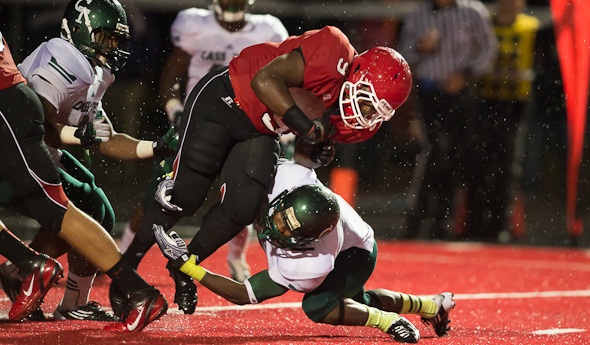
Orchard Lake St. Mary 13, Detroit Cass Tech 6 – Cass Tech has appeared invincible, but this victory by the reigning MHSAA Division 3 champion over the reigning champ in Division 1 re-opens the debate over the best in Michigan overall this fall.
Detroit University Prep 28, Warren Michigan Collegiate 26 – After winning one game in the Charter School Conference in 2011, University Prep is one win from clinching at least a share of the title and also equaling its most ever.
Oak Park 20, Farmington 15 – At 5-0, Oak Park has won its most games since 2007 and is off to its best start since 1998.
Milan 35, Monroe St. Mary Catholic 20 – The Big Reds are in the midst of one of the biggest turnarounds in the state this fall, now 5-0 after going 1-8 in 2011 and losing their last four to Monroe St. Mary.
West Michigan
Grand Rapids Forest Hills Central 43, East Grand Rapids 17
This was played in a baseball stadium, Fifth Third Ballpark, but hardly looked like a baseball game on the scoreboard. Forest Hills Central scored all 43 points in the first half and continued on what is shaping up as a special season despite the competition in the ultra strong O-K White. The Rangers improved to 4-1 and had lost seven straight to the Pioneers dating back to 2001. Click to read more from the Grand Rapids Press.
Also noted:
Grand Rapids Christian 38, Caledonia 21 – This is another one that dictates some order in the O-K White, with both of these teams still 4-1 despite the Eagles’ one-game league advantage.
Comstock Park 38, Belding 31 – The Panthers outlasted the Redskins to remain one of only two 2-0 teams atop the O-K Blue.
Montague 9, Whitehall 3 – Make that six straight wins for Montague in the battle for the “Bell” that has raged more than a century.
Muskegon Mona Shores 41, Grand Rapids Union 6 – Every week seems to bring another accomplishment for the Sailors, who are 4-1 for the first time since 1989.
Upper Peninsula
Kingsford 14, Menominee 13
Overlooked accidentally in Friday’s pregame report, this ended up as the best this weekend in the entire peninsula. Both entered 4-0 after the first week of Great Northern Upper Peninsula Conference play and with little to spare. The league again looks like a gauntlet after three of five teams made the playoffs in 2011 and a fourth finished 5-4. Click to read more from the Iron Mountain Daily News.
Also noted:
Marquette 35, Gladstone 14 – Also in the GNUPC, this keeps Marquette just a game back of the co-leaders and two from making the playoffs.
Rapid River 60, Engadine 40 – Rapid River was one of three undefeated teams atop the Bridge 8-Man Football Alliance heading into the week; now there are two.
Cedarville 42, Eben Junction Superior Central 12 – These were the other two B8FA teams that came in 4-0; Cedarville continues to look like possibly the best team in all of 8-player this fall.
Iron Mountain North Dickinson 40, Bark River-Harris 0 – The Nordics became the first team to earn an MHSAA playoff berth; they are 5-0 playing only eight regular-season games this fall.
Southwest and Border
Edwardsburg 49, Three Rivers 41
These Wolverine B Conference South foes seem to be tailor-made for the rain that fell all over the Lower Peninsula on Friday. On a night of offensive firepower, Edwardsburg supplied a little bit more by running for 485 yards and seven touchdowns. The win sets up the Eddies as Dowagiac’s biggest competition for the league title. Click to read more from the Kalamazoo Gazette.
Also noted:
Watervliet 41, Hartford 29 – The separation has begun in the Southwestern Athletic Conference South, and Watervliet moved to 5-0 overall.
Paw Paw 24, Vicksburg 13 – The Redskins also moved to 5-0 overall and are tied with Plainwell now atop the Wolverine B Conference North.
Portage Central 33, St. Joseph 23 – The best of the strong Southwestern Michigan Athletic Conference West keep beating up on each other, with the Mustangs now just a game behind the leaders.
Stevensville Lakeshore 37, Niles 21 – Similar story from this SMAC West game, but Lakeshore is sharing first place with Mattawan, a win ahead of Central and Portage Northern.
Lower Up North
Traverse City Central 49, West Branch Ogemaw Heights 21
There’s plenty to tout with the surging Trojans. They’re 4-1, tying last season’s win total. They’re tied with crosstown rival Traverse City West atop the Big North Conference. They’re off to their best start since 1991, when the schools were still combined. And they’ve got the Titans next in arguably the biggest game of this rivalry since they split in 1997. Click to read more from the Traverse City Record Eagle.
Also noted:
Traverse City West 40, Cadillac 11 – The Titans couldn’t afford a trip-up heading into this week’s game with Central that could eventually be the decider in the Big North Conference.
Traverse City Christian 60, Big Rapids Crossroads 48 – These teams have only one win combined between them, but Christian set a school record for points and Crossroads scored its third-most ever.
Kingsley 12, Frankfort 6 – After a four-point loss to Frankfort in 2011, the Stags turned the tables to keep atop the Northwest Conference.
Boyne City 29, Traverse City St. Francis 13 – The Ramblers had lost 10 straight to St. Francis, including 28-0 in 2011.
Thumb and Bay
Lapeer West 13, Linden 10
A 23-yard field goal with five seconds to play earned Lapeer West coach Mike Smith his 100th win and handed Linden its first loss of the season. Both Flint Metro League teams have a loss and are chasing first-place Swartz Creek. Click to read more from the Flint Journal.
Also noted:
Freeland 16, Saginaw Swan Valley 14 – Another week, another Tri-Valley Conference Central re-mix at the top; now it’s Hemlock in first with these two tied for second.
Midland 41, Mount Pleasant 34 – The Chemics keep churning through close ones; they improved to 5-0 with their third win of seven or fewer points this fall.
Reese 23, Vassar 0 – This wasn’t as close as billed, perhaps, but Reese now is the sure frontrunner (again) in the Greater Thumb Conference West.
Richmond 35, Armada 33 – While Croswell-Lexington has a firm hold on first in the Blue Water Area Conference, five more teams (these two included) are either 3-2 or 2-3 overall and working toward that magic number of six wins.
Mid-Michigan
Charlotte 35, Mason 3
On one hand, it was a little early to put so much pressure on a young Mason team that indeed started 4-0, but against opponents that have combined for only two wins so far. On the other hand, few in mid-Michigan gave Charlotte much of a chance in this one – and the Orioles no doubt took that to heart. Charlotte is 3-2 and looks good to win at least three more and earn its first playoff berth since 2008. Click to read more from the Lansing State Journal.
Also noted:
Holt 21, East Lansing 14 – Despite a couple of tough losses to elite teams, Holt isn’t going away; the Rams are 3-2 and look good to double that win total after handing the Trojans their first loss this fall.
Springport 26, Union City 25 – Three losses by a combined 21 points led to a tough start this fall for the Spartans, but this helps after they lost to Union City 47-8 in 2011.
DeWitt 34, St. Johns 20 – The Panthers look like they’ve found another quarterback in Jacob Heath, and need just one more win in the Capital Area Activities Conference Red for a share of the title.
Portland 40, Williamston 7 – This sets up the CAAC White as a two-team race between the Raiders and Lansing Catholic.
Trophy Games
Each week, the MHSAA highlights trophy games around the state. Here's another to go with the Montague/Whitehall battle for "The Bell" mentioned above.
- Iosco County News-Herald and Oscoda Press (News-Press) Trophy: Oscoda hosted Tawas in this 58th meeting dating back to 1954, and won its seventh straight of the series. Final: Oscoda 22, Tawas 18.
PHOTO: Orchard Lake St. Mary junior fullback Jeff Robinson rumbles through the Detroit Cass Tech defensive during Friday's win by the Eaglets. (Click to see more at Terry McNamara Photography.)