

Talking Practice: Texas, Illinois Revise Policies
December 20, 2013
By Rob Kaminski
MHSAA benchmarks editor
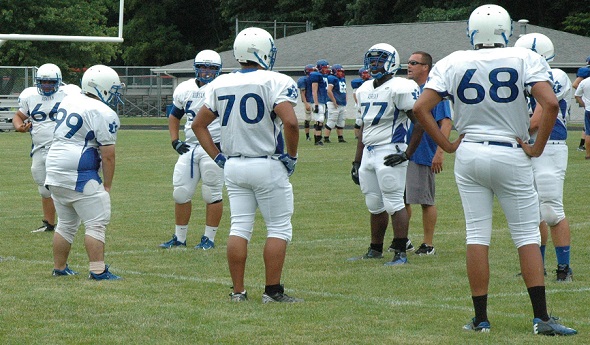
Coaches and players in Texas and Illinois adapted to new football practice limitations this fall, with the Texas policy focusing on contact, and the Illinois regulation emphasizing length of preseason practices.
Following are the main changes those states put in place heading into the 2013-14 season:
The University Interscholastic League, which governs school sports in Texas, put into writing that, “During the regular season and postseason, no football player is allowed to participate in more than ninety (90) minutes of full contact practice per week,” effective with the first day of practice this fall.
The complete policy follows:
For the purposes of the of rule, "full contact" is defined as football drills or live game simulations where "live action" occurs. Live action, as defined by USA Football, is contact at game speed where players execute full tackles at a competitive pace taking players to the ground. A team may continue to dress in full pads for practice, but may only participate in live action drills and game time simulations no more than ninety minutes per athlete per week. It is assumed that when players are in shells (shorts, shoulder pads, and helmets) no live action drills or simulations will occur. This rule is intended to limit live action drills and simulations and not the number of practices a team may participate in full pads. A team may participate in "air," "bags," "wrap," and "thud" drills and simulations at any point. These contact levels are defined below:
• Air - Players should run unopposed without bags or any opposition
• Bags - activity is executed against a bag, shield or pad to allow for a soft-contact surface, with or without the resistance of a teammate or coach standing behind the bag.
• Wrap - Drills run at full speed until contact, which is above the waist with the players remaining on their feet.
• Thud - Same as wrap but tempo is competitive with no pre-determined winner and the players are not tackling to the ground.
 The rule came to the UIL Legislative Council as a recommendation from the UIL Medical Advisory Committee, a permanent advisory committee to the Legislative Council which meets twice each year to discuss and review safety policies for UIL participants. The committee, which is made up of leading medical professionals in various specialties and includes representatives from the Texas High School Coaches Association, the Texas Girls Coaches Association, and the Texas State Athletic Trainer Association, unanimously recommended this limitation in full-contact football practice.
The rule formulates into a formal policy the existing actions of the majority of coaches across Texas, and most coaches have had to make few adjustments, if any. In fact, according to a story on statesman.com, the proposal caused more of an uproar on social media than from coaches.
“It’s not going to affect us in anyway,” Vandegrift HS coach Drew Sanders said in the story. “Most good coaches were way below that 90-minute amount already. Prior to legislation we still monitored it ourselves – the only change is now we have to keep up a log more publicly.”
Illinois put standards in place for its first 14 days of football practices, known as the state’s Preseason Football Acclimatization Practice Period. At the core of the policy is a three-hour practice limit for the first five days, during which teams can also conduct a one-hour walk-through.
 Teams must observe a minimum two hours rest between the practices and walk-throughs. Players may wear helmets only on the first two days, then helmets and shoulder pads for the next three. From days seven through 14 of the acclimatization period, schools may practice for a maximum of five hours per day, as long as that day is followed by a three-hour day, or an off day. During the five-hour days, no session can last more than three hours and must include a two-hour break between practices. Full pads may be worn for the final seven dates leading up to the first contest.
“This policy was the result of a collaborative effort between the IHSA Sports Medicine Advisory Committee and the Football Advisory Committee,” said SMAC committee member and University of Illinois Associate Professor of Orthopedic Surgery Dr. Preston M. Wolin. “The guidelines are based on the most recent scientific evidence, as well as the expertise of the coaches who will help implement them. Both committees believe the guidelines represent a significant positive contribution to the health of our athletes.”
“This new policy undoubtedly changes the way we, as coaches, approach preseason practice,” said Metamora HS coach Pat Ryan, who is a member of the FAC and a past President of the Illinois High School Football Coaches Association. “Coaches have to get more creative with when and how they schedule practices, as well what they do with their time. The proposals were strongly supported by both committees. It is a crucial final step to the process of being able to effectively prepare our teams in a safe manner. Change is always difficult, but the game is changing and we need to adapt to continue to put the safety of our players first.”
The IHSA offered multiple interactive online webinar meetings for high school coaches leading up to the start of practice where questions were answered, along with further clarifications on the policy and the science behind it.
“I think most coaches understood that changes were on the horizon,” said IHSA Executive Director Marty Hickman. “We wanted to be in a position to give our coaches as much information as possible to make sure they are comfortable with the new policy. Their input will be critical moving forward as we develop educational materials, like a best practices presentation. I commend our committees on a policy that is supported by medical experts, football coaches and school administrators.”
Grand Haven Playmakers Rising to Challenge After Loss of Senior Standout
By
Tom Kendra
Special for MHSAA.com
September 9, 2026
Grand Haven was expected to have one of the state’s best backfield duos this season in seniors Andrew Willemsen and KV Korenstra.
 That duo became singular in July, when Willemsen tore his ACL for the second-consecutive year, a gut-punch both for him and the Buccaneers’ coaching staff – which was planning on handing the ball to Willemsen 20-plus times per game.
Despite that emotional setback, Haven is off to its first 2-0 start since 2018, as the team’s many other offensive standouts – notably Korenstra and senior quarterback Easton Hintz – have stepped up their games.
“We all feel so bad for Andrew, and it just makes us appreciate things so much more,” said Korenstra, a Ferris State commit who rushed for 519 yards and caught 26 passes for 291 yards last fall.
“It’s good for our morale to be 2-0, but we all know that we can play so much better and that we have to play so much better, especially on offense.”
Grand Haven (2-0) heads into the gauntlet of its schedule the next three weeks, starting with Friday night’s Ottawa-Kent Conference Red opener at defending league champion Hudsonville, followed by East Kentwood at home and at Rockford.
The Bucs have found a way to win two tight games, a 35-34, triple-overtime thriller over visiting Spring Lake in the opener and then a hard-fought, 17-14 road win at Muskegon Reeths-Puffer last week.
“It hasn’t always been pretty, but we have been able to finish games out, which hasn’t been the case in the past,” said fourth-year Grand Haven coach Andrew Biedenbender, a Mount Pleasant native who played offensive line at Grand Valley State. “We can’t puff our chests out. We understand what’s ahead of us, but going into it with the confidence we now have is big.”
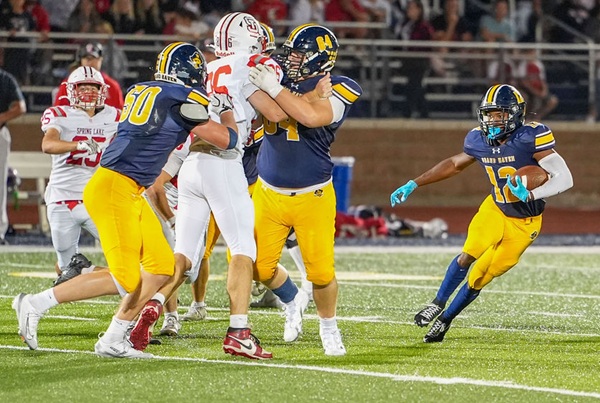 Senior quarterback Easton Hintz has been the catalyst, completing 28-of-42 passes (67 percent) for 359 yards and four touchdowns, with no interceptions. The dual-threat playmaker also has rushed for 168 yards and a score.
Hintz employs a variety of receiving options, starting with 6-foot-2 wideout Amani Frierson, another Ferris State commit, who has 11 catches for 151 yards and a touchdown.
An emerging weapon for the Bucs is junior tight end Grayam Beyer (6-6, 225), who had a breakout game against Spring Lake with four catches for 43 yards, including two TDs. Beyer already has five Division I college offers and visited Ohio State last Saturday.
If those weapons draw excessive attention, Hintz often hooks up with shifty junior slot receivers Lennon Jorgensen and Drew Hammerle.
Korenstra has been solid, if not spectacular, with 157 rushing yards and two TDs through two games. Korenstra, who finished third at the Lower Peninsula Division 1 Finals in the 100-meter dash last spring (10.79), has been slowed by a sprained ankle which he suffered early in the opening game.
“If you saw him early last week, you would have never thought he could play a football game,” said Biedenbender of the senior speedster, who was clocked at 4.28 seconds in the 40-yard dash this summer.
“So he has been fighting that ankle but still has hit a couple of 15- or 20-yard runs, but we’re waiting for him to break off a couple of 40- or 50-yarders.”
While he waits for Korenstra to get back up to full speed, Biedenbender occasionally allows himself to imagine what might have been this fall if Willemsen had stayed healthy.
The three-sport standout and athletic freak burst onto the scene as a sophomore with 1,321 yards and 11 TDs. He missed his entire junior year after tearing his ACL during summer workouts but came all the way back and was part of two school-record sprint relay teams in track this spring.
 His recovery was so impressive (running a 4.3 40-yard dash and squatting almost 500 pounds early this summer) that he was offered a scholarship at Grand Valley. Willemsen was working out at GVSU in July when the unthinkable happened – a full tear of his other ACL.
“It’s like having a sports car in your garage that you never had a chance to drive,” said Biedenbender, whose main assistants are Matt Naber (offensive coordinator) and Eric Rozema (defensive coordinator). “He’s one of the best athletes ever at Grand Haven that no one’s going to know about. He has some great football ahead of him but, unfortunately, it won’t be for us.”
The Buccaneers still possess a variety of weapons that other teams would love to have, with an experienced senior quarterback in Hintz directing the show. Hintz (6-0, 185) threw for 975 yards last fall despite missing about one-third of the season with an injury, but is now on pace to easily eclipse the 1,000-yard passing plateau.
Haven’s 2-0 start also has put the team in position to make some noise in the conference race and compete for five wins and the school’s first playoff berth since 2019.
The quick start is a continuation of success at Grand Haven, which won the Division 1 boys volleyball title in the spring, to go along with a Finals appearance in softball and a fifth-place team finish in boys track.
“So much of it comes down to belief,” said Hintz, a crafty left-hander who is just as comfortable throwing on the run as he is in the pocket. “Our aiming point is making it to the playoffs and then winning a playoff game, which is something that hasn’t been done at this school in a long time. I believe we have the team to do it.”
 Tom Kendra worked 23 years at The Muskegon Chronicle, including five as assistant sports editor and the final six as sports editor through 2011. E-mail him at [email protected] with story ideas for Muskegon, Oceana, Mason, Lake, Oceola, Mecosta and Newaygo counties.
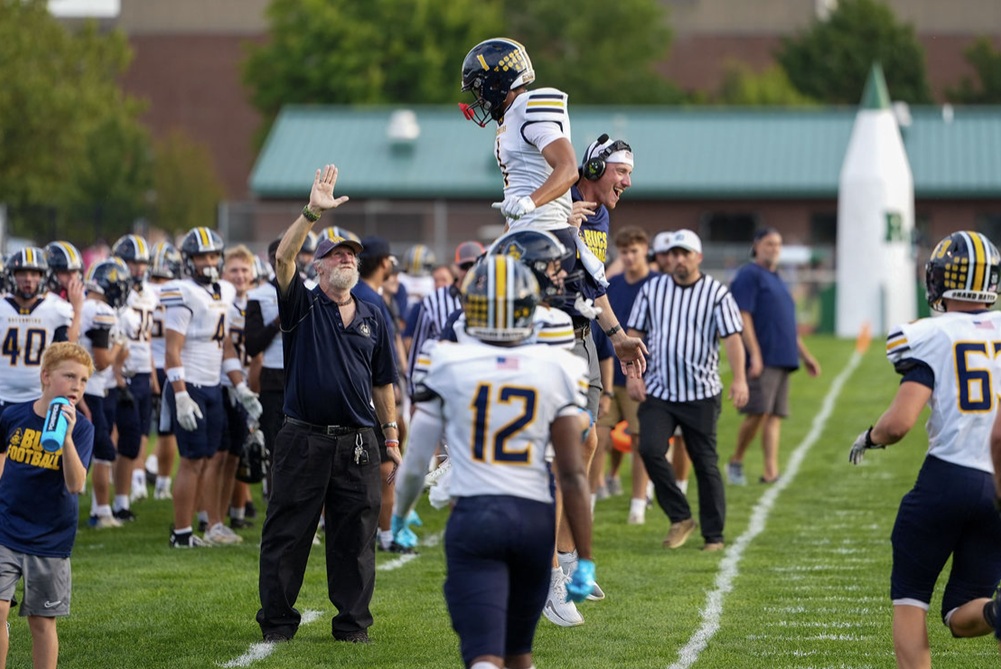
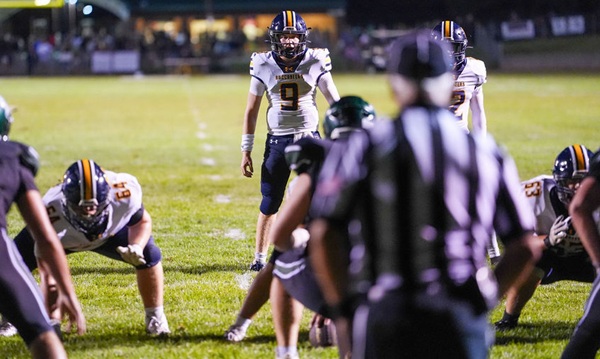
PHOTOS (Top) Fourth-year Grand Haven coach Andrew Biedenbender celebrates with wideout Amani Frierson (1) during last week’s victory over Muskegon Reeths-Puffer. (Middle) KV Korenstra (12) follows his blockers against Spring Lake. (Below) Senior quarterback Easton Hintz (9) prepares to take a snap against Reeths-Puffer. (Photos by Josh Walters/JWaltVisuals.)