

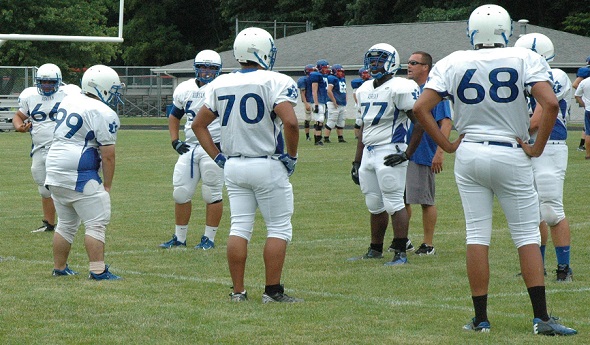
Talking Practice: Texas, Illinois Revise Policies
December 20, 2013
By Rob Kaminski
MHSAA benchmarks editor
Coaches and players in Texas and Illinois adapted to new football practice limitations this fall, with the Texas policy focusing on contact, and the Illinois regulation emphasizing length of preseason practices.
Following are the main changes those states put in place heading into the 2013-14 season:
The University Interscholastic League, which governs school sports in Texas, put into writing that, “During the regular season and postseason, no football player is allowed to participate in more than ninety (90) minutes of full contact practice per week,” effective with the first day of practice this fall.
The complete policy follows:
For the purposes of the of rule, "full contact" is defined as football drills or live game simulations where "live action" occurs. Live action, as defined by USA Football, is contact at game speed where players execute full tackles at a competitive pace taking players to the ground. A team may continue to dress in full pads for practice, but may only participate in live action drills and game time simulations no more than ninety minutes per athlete per week. It is assumed that when players are in shells (shorts, shoulder pads, and helmets) no live action drills or simulations will occur. This rule is intended to limit live action drills and simulations and not the number of practices a team may participate in full pads. A team may participate in "air," "bags," "wrap," and "thud" drills and simulations at any point. These contact levels are defined below:
• Air - Players should run unopposed without bags or any opposition
• Bags - activity is executed against a bag, shield or pad to allow for a soft-contact surface, with or without the resistance of a teammate or coach standing behind the bag.
• Wrap - Drills run at full speed until contact, which is above the waist with the players remaining on their feet.
• Thud - Same as wrap but tempo is competitive with no pre-determined winner and the players are not tackling to the ground.
 The rule came to the UIL Legislative Council as a recommendation from the UIL Medical Advisory Committee, a permanent advisory committee to the Legislative Council which meets twice each year to discuss and review safety policies for UIL participants. The committee, which is made up of leading medical professionals in various specialties and includes representatives from the Texas High School Coaches Association, the Texas Girls Coaches Association, and the Texas State Athletic Trainer Association, unanimously recommended this limitation in full-contact football practice.
The rule formulates into a formal policy the existing actions of the majority of coaches across Texas, and most coaches have had to make few adjustments, if any. In fact, according to a story on statesman.com, the proposal caused more of an uproar on social media than from coaches.
“It’s not going to affect us in anyway,” Vandegrift HS coach Drew Sanders said in the story. “Most good coaches were way below that 90-minute amount already. Prior to legislation we still monitored it ourselves – the only change is now we have to keep up a log more publicly.”
Illinois put standards in place for its first 14 days of football practices, known as the state’s Preseason Football Acclimatization Practice Period. At the core of the policy is a three-hour practice limit for the first five days, during which teams can also conduct a one-hour walk-through.
 Teams must observe a minimum two hours rest between the practices and walk-throughs. Players may wear helmets only on the first two days, then helmets and shoulder pads for the next three. From days seven through 14 of the acclimatization period, schools may practice for a maximum of five hours per day, as long as that day is followed by a three-hour day, or an off day. During the five-hour days, no session can last more than three hours and must include a two-hour break between practices. Full pads may be worn for the final seven dates leading up to the first contest.
“This policy was the result of a collaborative effort between the IHSA Sports Medicine Advisory Committee and the Football Advisory Committee,” said SMAC committee member and University of Illinois Associate Professor of Orthopedic Surgery Dr. Preston M. Wolin. “The guidelines are based on the most recent scientific evidence, as well as the expertise of the coaches who will help implement them. Both committees believe the guidelines represent a significant positive contribution to the health of our athletes.”
“This new policy undoubtedly changes the way we, as coaches, approach preseason practice,” said Metamora HS coach Pat Ryan, who is a member of the FAC and a past President of the Illinois High School Football Coaches Association. “Coaches have to get more creative with when and how they schedule practices, as well what they do with their time. The proposals were strongly supported by both committees. It is a crucial final step to the process of being able to effectively prepare our teams in a safe manner. Change is always difficult, but the game is changing and we need to adapt to continue to put the safety of our players first.”
The IHSA offered multiple interactive online webinar meetings for high school coaches leading up to the start of practice where questions were answered, along with further clarifications on the policy and the science behind it.
“I think most coaches understood that changes were on the horizon,” said IHSA Executive Director Marty Hickman. “We wanted to be in a position to give our coaches as much information as possible to make sure they are comfortable with the new policy. Their input will be critical moving forward as we develop educational materials, like a best practices presentation. I commend our committees on a policy that is supported by medical experts, football coaches and school administrators.”

1st & Goal: Playoff Week 1 Preview
October 29, 2020
By Geoff Kimmerly
Second Half editor
During a football season full of new and different this fall, this weekend will be right up there for first-time opportunities.
With the regular season shortened to six games because of COVID-19 precautions, tonight begins the first MHSAA Playoffs with nearly every team in the state taking part. And with more playoff games than ever before, this first round will see 15 games played Thursday night.
The 11-player bracket kicks off with District First Round games, while 8-player begins in the Regional First Round. Click for links to all 10 brackets and monitor the MHSAA Score Center all weekend for scores as they come in.
Spectator limits remain in effect (check with your local school for purchasing information). So if you can’t attend in person, check out one or more of 87 games being broadcast on MHSAA.tv or FOX Sports Detroit.
Let’s take a glance at a game that jumps out from each division this opening weekend. Games below are Friday unless noted.
11-Player
DIVISION 1
Lake Orion (3-2) at Grand Blanc (5-1)
The Bobcats haven’t reached the second round of the playoffs since 2012, but have seemed on the verge of taking a step – and last week’s 14-13 win over previously-undefeated Saline provided an indication the time may be now. Lake Orion had trouble with league rivals Clarkston and West Bloomfield this fall, but has to be one of the stronger five seeds – this District is topped by three undefeated teams.
Keep an eye on these FRIDAY Lapeer (3-3) at Davison (6-0), Utica Eisenhower (2-4) at Clinton Township Chippewa Valley (2-3). SATURDAY East Kentwood (2-3) at Hudsonville (4-2), Detroit Western (5-1) at Dearborn Fordson (4-2).
DIVISION 2
Grand Rapids Forest Hills Northern (4-2) vs. Grand Rapids Forest Hills Central (5-1) at Forest Hills Eastern
Everything looks to be going the Rangers’ way heading into this rematch, as they’ve won all five recent meetings with Forest Hills Northern – including 28-13 in Week 5 – and picked up a share of the Ottawa-Kent Conference White championship with Friday’s win over Lowell. But the Huskies are on a roll too; they’ve won their last four games, all by double digits, and also including a victory over the Red Arrows.
Keep an eye on these FRIDAY Lowell (3-3) at Byron Center (5-1), Warren De La Salle Collegiate (2-4) at Roseville (4-2), Ypsilanti Community (3-3) at Dearborn Heights Crestwood (5-1), Birmingham Groves (3-3) at Auburn Hills Avondale (3-3).
DIVISION 3
Trenton (3-3) at Allen Park (4-2)
These Downriver League rivals also have met in the playoffs the last two seasons. Allen Park won both of those games and also this regular season’s opener, 29-7. But that’s only half the history. Before this fall’s first meeting, Trenton had taken the last three during the regular season. Semi-related, both played Brownstown Woodhaven to nearly matching one-score losses over the last five weeks.
Keep an eye on these FRIDAY Parma Western (4-2) at Battle Creek Harper Creek (4-2), Sturgis (3-3) at Coldwater (4-2), Garden City (3-3) at South Lyon East (4-2), Gibraltar Carlson (4-2) at River Rouge (4-1).
DIVISION 4
Imlay City (4-2) at Croswell-Lexington (5-1)
This is a rematch of a season opener, won by the Pioneers 54-12. But the Spartans have gone on to guarantee their second-straight winning finish (after a string of mostly sub-.500 seasons over the last decade). That said, Croswell-Lexington was a seven-point loss to North Branch from a perfect regular season and league title – also a good improvement story after finishing 4-5 a year ago.
Keep an eye on these FRIDAY Ada Forest Hills Eastern (3-3) at Allendale (3-3), Plainwell (3-2) at Vicksburg (4-2), Armada (3-3) at Goodrich (5-1), Detroit Henry Ford (3-3) at Detroit Country Day (3-2).
DIVISION 5
Belding (5-1) at Hopkins (5-1), Saturday
This is among the most surprising first-round matchups, as these two played for the O-K Silver championship just three weeks ago. Chalk it up to being in a District that includes an unbeaten team and four at 5-1. The Vikings’ got the best of their first meeting with Belding, 34-28, but are coming back off a week off while the Black Knights went on to win their last two games by a combined 108-3.
Keep an eye on these FRIDAY Lake Odessa Lakewood (3-3) at Portland (5-1), South Haven (4-2) at Dowagiac (3-3), Hillsdale (4-2) at Olivet (5-1). SATURDAY Ogemaw Heights (3-3) at Kingsford (3-2).
DIVISION 6
Kent City (5-1) at Clare (6-0)
This is another big-time matchup for the first round, with third-seeded Clare the Jack Pine Conference champion and sixth-seeded Kent City the winner of the Central State Activities Association Silver title. The Eagles’ lone loss came in last week’s finale, 26-20 to Muskegon Orchard View, and they’ll surely be revved up play spoiler this time. But they’ll have to figure out a Pioneers defense giving up only 9.3 points per game in what could be a low-scoring one – Kent City gives up just 8.8 on average.
Keep an eye on these FRIDAY Negaunee (3-3) at Gladstone (2-3), Harrison (4-2) at Sanford Meridian (4-2), Comstock (3-3) at Niles Brandywine (3-3). SATURDAY Flint Hamady (3-3) at Detroit Pershing (3-3).
DIVISION 7
Houghton Lake (4-2) at Evart (4-2)
In just six games, Evart tied its win total from a year ago and best season since 2016. After opening 0-2, the Wildcats got rolling with a 29-22 win over Houghton Lake and now are seeking their first playoff win since 2012. The Bobcats are coming off a loss to undefeated Oscoda but still guaranteed to end with their third winning season in four years. Whoever comes out on top in this rematch will see Highland Conference champ McBain next week.
Keep an eye on these FRIDAY Morley Stanwood (4-2) at Ravenna (3-3), Hesperia (4-2) at Pewamo-Westphalia (5-1), Delton Kellogg (3-3) at Bronson (3-2), Jackson Lumen Christi (2-4) at Hanover-Horton (4-2).
DIVISION 8
Gwinn (3-3) at East Jordan (3-3)
One of these teams will end the night celebrating its first playoff win since 1999 – both are seeking to break a two-decade drought. After a fast start, East Jordan has had some troubles especially on offense the last two weeks – but with one more win, the Red Devils would equal their total from last season. Gwinn is a tough read because two wins came by forfeit. But a 22-14 loss two weeks ago to undefeated West Iron County is an indication the Modeltowners will be up for this challenge.
Keep an eye on these FRIDAY Frankfort (3-3) at Saginaw Nouvel (4-2), Marlette (3-3) at Unionville-Sebewaing (4-2), Saugatuck (3-3) at White Pigeon (3-2). SATURDAY Saginaw Michigan Lutheran Seminary (2-4) at Harbor Beach (3-3).
8-Player
DIVISION 1
Deckerville (4-2) at Merrill (5-1), Saturday
Deckerville had a few stumbles against the co-champions in its league, but few programs have done the playoffs better over the last decade – Deckerville is 16-7 during the postseason since moving to 8-player in 2012. Merrill is the latest new force in 8-player, not entirely surprising after back-to-back 6-4 finishes in 11-player the last two seasons, and will be looking to extend the run into its first playoff win since 2010.
Keep an eye on these THURSDAY Genesee (4-2) at Mayville (6-0). SATURDAY Newberry (3-3) at Onaway (6-0), International Academy of Flint (3-3) at Adrian Lenawee Christian (6-0), Camden-Frontier (2-4) at New Buffalo (3-3).
DIVISION 2
Lake Linden-Hubbell (3-3) at Crystal Falls Forest Park (4-1), Saturday
These longtime league and occasional playoff rivals in 11-player will face off for the first time in 8-player – and first time at all since 2015 since Lake Linden-Hubbell made the format switch this fall. The Lakes are 3-1 on the field and gave undefeated Powers North Central easily its closest game, falling 34-22 two weeks ago. Forest Park has played two games on the field, but both were wins over teams that entered the postseason with .500 records.
Keep an eye on these THURSDAY Rudyard (3-3) at Rapid River (5-1), Climax-Scotts (3-3) at Colon (5-1). SATURDAY Ashley (3-3) at Peck (3-3), Waldron (4-2) at Tekonsha (4-2).
PHOTO by Robert Batzloff.