

Talking Practice: Texas, Illinois Revise Policies
December 20, 2013
By Rob Kaminski
MHSAA benchmarks editor
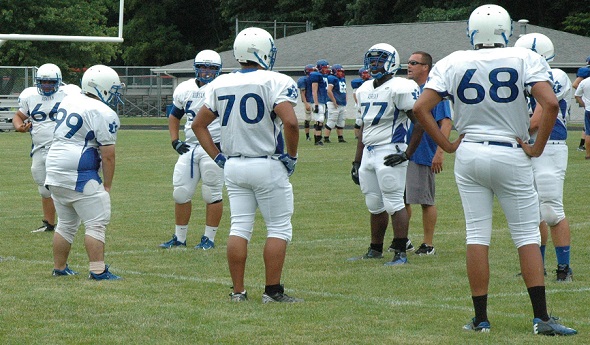
Coaches and players in Texas and Illinois adapted to new football practice limitations this fall, with the Texas policy focusing on contact, and the Illinois regulation emphasizing length of preseason practices.
Following are the main changes those states put in place heading into the 2013-14 season:
The University Interscholastic League, which governs school sports in Texas, put into writing that, “During the regular season and postseason, no football player is allowed to participate in more than ninety (90) minutes of full contact practice per week,” effective with the first day of practice this fall.
The complete policy follows:
For the purposes of the of rule, "full contact" is defined as football drills or live game simulations where "live action" occurs. Live action, as defined by USA Football, is contact at game speed where players execute full tackles at a competitive pace taking players to the ground. A team may continue to dress in full pads for practice, but may only participate in live action drills and game time simulations no more than ninety minutes per athlete per week. It is assumed that when players are in shells (shorts, shoulder pads, and helmets) no live action drills or simulations will occur. This rule is intended to limit live action drills and simulations and not the number of practices a team may participate in full pads. A team may participate in "air," "bags," "wrap," and "thud" drills and simulations at any point. These contact levels are defined below:
• Air - Players should run unopposed without bags or any opposition
• Bags - activity is executed against a bag, shield or pad to allow for a soft-contact surface, with or without the resistance of a teammate or coach standing behind the bag.
• Wrap - Drills run at full speed until contact, which is above the waist with the players remaining on their feet.
• Thud - Same as wrap but tempo is competitive with no pre-determined winner and the players are not tackling to the ground.
 The rule came to the UIL Legislative Council as a recommendation from the UIL Medical Advisory Committee, a permanent advisory committee to the Legislative Council which meets twice each year to discuss and review safety policies for UIL participants. The committee, which is made up of leading medical professionals in various specialties and includes representatives from the Texas High School Coaches Association, the Texas Girls Coaches Association, and the Texas State Athletic Trainer Association, unanimously recommended this limitation in full-contact football practice.
The rule formulates into a formal policy the existing actions of the majority of coaches across Texas, and most coaches have had to make few adjustments, if any. In fact, according to a story on statesman.com, the proposal caused more of an uproar on social media than from coaches.
“It’s not going to affect us in anyway,” Vandegrift HS coach Drew Sanders said in the story. “Most good coaches were way below that 90-minute amount already. Prior to legislation we still monitored it ourselves – the only change is now we have to keep up a log more publicly.”
Illinois put standards in place for its first 14 days of football practices, known as the state’s Preseason Football Acclimatization Practice Period. At the core of the policy is a three-hour practice limit for the first five days, during which teams can also conduct a one-hour walk-through.
 Teams must observe a minimum two hours rest between the practices and walk-throughs. Players may wear helmets only on the first two days, then helmets and shoulder pads for the next three. From days seven through 14 of the acclimatization period, schools may practice for a maximum of five hours per day, as long as that day is followed by a three-hour day, or an off day. During the five-hour days, no session can last more than three hours and must include a two-hour break between practices. Full pads may be worn for the final seven dates leading up to the first contest.
“This policy was the result of a collaborative effort between the IHSA Sports Medicine Advisory Committee and the Football Advisory Committee,” said SMAC committee member and University of Illinois Associate Professor of Orthopedic Surgery Dr. Preston M. Wolin. “The guidelines are based on the most recent scientific evidence, as well as the expertise of the coaches who will help implement them. Both committees believe the guidelines represent a significant positive contribution to the health of our athletes.”
“This new policy undoubtedly changes the way we, as coaches, approach preseason practice,” said Metamora HS coach Pat Ryan, who is a member of the FAC and a past President of the Illinois High School Football Coaches Association. “Coaches have to get more creative with when and how they schedule practices, as well what they do with their time. The proposals were strongly supported by both committees. It is a crucial final step to the process of being able to effectively prepare our teams in a safe manner. Change is always difficult, but the game is changing and we need to adapt to continue to put the safety of our players first.”
The IHSA offered multiple interactive online webinar meetings for high school coaches leading up to the start of practice where questions were answered, along with further clarifications on the policy and the science behind it.
“I think most coaches understood that changes were on the horizon,” said IHSA Executive Director Marty Hickman. “We wanted to be in a position to give our coaches as much information as possible to make sure they are comfortable with the new policy. Their input will be critical moving forward as we develop educational materials, like a best practices presentation. I commend our committees on a policy that is supported by medical experts, football coaches and school administrators.”
Drive for Detroit: 11-Player Finals Preview
November 27, 2019
By Geoff Kimmerly
Second Half editor
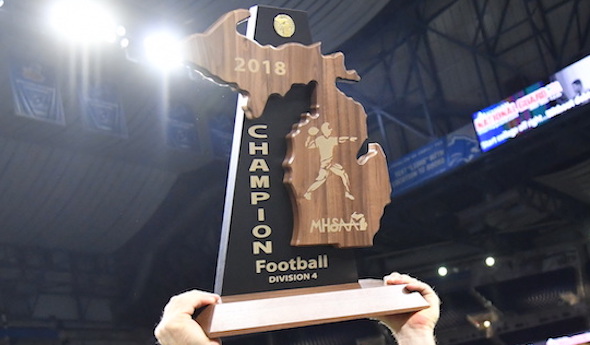
There will be no appetizers for this weekend’s MHSAA 11-Player Football Finals at Ford Field.
 Show up early and stay late – every game both days has a story, ranging from two first-time finalists playing for the Division 1 title to two of the most successful programs of this decade matching up for the first time in the Division 7 championship game.
Total, five teams will travel to Ford Field this weekend looking to finish as a champion for the first time. Joining hopefuls Brighton and Davison in Division 1 are Muskegon Mona Shores in Division 2, River Rouge in Division 3 and Almont in Division 5 – Brighton, Davison and Almont also playing in Finals for the first time.
Mona Shores and neighbor Muskegon High also will be returning to Ford Field after finishing as Finals runners-up a year ago, while three reigning champions will seek to win again – Reading for the second-straight season in Division 8, Detroit Martin Luther King in Division 2 after winning Division 3 in 2018 and Jackson Lumen Christi in Division 7 after winning three straight in Division 6.
FRIDAY
D8: Beal City (12-1) vs Reading (12-1), 10 a.m.
D2: Muskegon Mona Shores (11-2) vs Detroit Martin Luther King (10-2), 1 p.m.
D6: Maple City Glen Lake (12-1) vs Monroe St. Mary Catholic Central (11-1), 4:30 p.m.
D4: Grand Rapids Catholic Central (12-1) vs Detroit Country Day (13-0), 7:30 p.m.
D7: Pewamo-Westphalia (13-0) vs Jackson Lumen Christi (12-0), 10 a.m.
D1: Brighton (11-2) vs Davison (11-2), 1 p.m.
D5: Lansing Catholic (12-1) vs Almont (13-0), 4:30 p.m.
D3: River Rouge (12-1) vs Muskegon (13-0), 7:30 p.m.
See below for a look at all of the finalists taking the field, powered by MI Student Aid. Tickets cost $15 and are good for all four games on one day; only cash will be accepted at the door. Click for a full schedule. Also, Ford Field again will host Special Olympics Unified flag football games prior to the start of Saturday’s four 11-Player Finals. Teams will take the field at 9 a.m. and play 30-minute exhibitions. Unified Sports programs combine students with and without intellectual disabilities on competitive athletic teams.
The first two Friday and Saturday Finals will be broadcast live on FOX Sports Detroit’s primary and PLUS channels (check cable/satellite box listings for your specific channel) with the third and fourth games both days available live on FOX Sports Detroit PLUS only. All eight games also can be viewed live on FOXSportsDetroit.com and on the FOX Sports app. Games will be archived for on-demand viewing on MHSAA.tv, which also will live stream the first three postgame press conferences each day. Audio broadcasts will be available on the MHSAA Network website live both days.
Rankings below were voted on by The Associated Press’ media panel. Statistics are current except where noted. The “playoff era” began with the first MHSAA postseason in 1975.
 Division 1
DAVISON
Record/rank: 11-2, honorable mention
Coach: Jake Weingartz, second season (18-5)
League finish: Second in Saginaw Valley League Red
Championship history: Has never played in an MHSAA Final.
Best wins: 42-21 over No. 9 Lapeer in District Final, 35-21 over No. 10 Romeo in Pre-District, 35-27 over honorable mention Utica Eisenhower in Regional Final, 34-27 (OT) over Sterling Heights Stevenson in Semifinal, 48-0 over Division 4 No. 8 Flint Powers Catholic.
Players to watch: QB Brendan Sullivan, 6-3/180, jr. (2,754 yards/32 TDs passing, 366 yards/9 TDs rushing); RB/DB Caleb Smith, 5-10/210 sr., (961 yards/16 TDs rushing, 434 yards/1 TD receiving, 41 tackles/4 interceptions); FB/LB Logan Pasco, 6-0/207, sr. (148 tackles/20 tackles for loss/5 interceptions); WR/DB Latrell Fordham, 6-4/180, sr. (866 yards/11 TDs receiving).
Outlook: Davison had reached Semifinals four more times before breaking through for the first time Saturday, and the historic run also was made possible by avenging a three-point Week 9 loss to league rival Lapeer. Pasco, an all-state honorable mention linebacker last year, leads a defense that doesn’t get a lot of attention but gives up only 14 points per game. The lights shine much more brightly on the Sullivan-led offense that has set a school playoff-era record of 553 points and counting. Smith could go over 1,000 yards rushing early Saturday, and in addition to Fordham, Sullivan also has found senior Harrison Terry for 10 touchdowns through the air. Fordham has committed to Ball State.
BRIGHTON
Record/rank: 11-2, honorable mention
Coach: Brian Lemons, fifth season (37-15)
League finish: Second in Kensington Lakes Activities Association West
Championship history: Has never played in an MHSAA Final.
Best wins: 22-19 over No. 2 Belleville in Semifinal, 35-20 over Hudsonville in Regional Final, 48-26 over East Kentwood in District Final, 26-7 over Holt in Pre-District, 21-7 over Livonia Churchill.
Players to watch: QB Colby Newburg, 6-0/190, sr. (1,335 yards/18 TDs passing, 1,242 yards/18 TDs rushing); RB Nicholas Nemecek, 5-10/185, jr. (1,010 yards/9 TDs rushing, 3 TDs receiving); LB Cole Riddle, 6-1/215, sr. (99 tackles/19 tackles for loss), DE Luke Stanton, 6-4/235, sr. (44 tackles, 11 sacks).
Outlook: The Bulldogs showed they were on the verge with close losses to No. 9 Plymouth (14-7) and No. 5 Dearborn Fordson (46-35) during the regular season. They’ve surged in the playoffs, with last weekend’s win over Belleville making one of the loudest statements from the Semifinals. Newburg is a dangerous two-way threat with the ball, and seven receivers have caught at least one touchdown pass with 6-3 senior Ruben Salinas the leader with six scores. But the defense – giving up 14 points on average – is just as big a reason the Bulldogs will play for their first title. Only Fordson in Week 9 scored more than 26 points on Brighton, and eight teams were held to 14 or fewer. Riddle earned an all-state honorable mention as a junior.
 Division 2
DETROIT MARTIN LUTHER KING
Record/rank: 11-2, No. 3
Coach: Ty Spencer, fourth season (46-8)
League finish: First in Detroit Public School League Division 2
Championship history: Four MHSAA titles (most recent 2018), two runner-up finishes.
Best wins: 27-6 and 32-14 over Detroit Denby, 47-7 over Detroit Cass Tech, 60-17 over Birmingham Seaholm in the Semifinal, 49-21 over Detroit U-D Jesuit in the Regional Final.
Players to watch: RB Peny Boone, 6-1/220, sr. (1,085 yards/19 TDs rushing); QB Dante Moore, 6-2/165, fr. (2,522 yards/32 TDs passing); WR Marshawn Lee, 5-7/155, sr. (847 yards/12 TDs receiving); LB Jaylen Reed, 6-0/195, jr. (108 tackles/11 tackles for loss/6 forced fumbles).
Outlook: King has raised championship trophies three of the last four seasons, in Division 2 in 2015 and 2016 and then in Division 3 a year ago. The Crusaders have made it back to Ford Field in part on a powerful offense led by a returning all-state running back in Boone and one of the most anticipated quarterback talents in Moore, who has competed at least 30 passes to three receivers – Lee, senior RaShawn Williams and sophomore Lynn Wyche-El. They operate behind a line led by 6-foot-4, 280-pound senior Deon Buford. And that’s not to mention a defense giving up just a bit above 12 points per game. King’s only losses came the first two weeks to Detroit Catholic Central and Division 3 finalist Muskegon. Boone will continue collegiately at Maryland, Williams at Indiana and Buford at Kentucky.
MUSKEGON MONA SHORES
Record/rank: 11-2, No. 4
Coach: Matt Koziak, ninth season (71-29)
League finish: Second in Ottawa-Kent Conference Black
Championship history: Division 2 runner-up 2014 and 2018.
Best wins: 57-56 over No. 2 Walled Lake Western in Semifinal, 28-23 over Portage Northern in Regional Final, 35-12 over Midland Dow in District Final, 20-13 over No. 9 Midland in Pre-District, 28-7 over East Kentwood.
Players to watch: RB/SS Tre’shawn Hatcher, 5-10/180, sr. (1,432 yards/15 TDs rushing); WR/DB Jaylen Hopson, 5-10/152, sr. (304 yards/5 TDs receiving). QB/DB Brady Rose, 5-7/150, jr. (332 yards/1 TD passing, 585 yards/11 TDs rushing, 5 interceptions); LB/SL Kolbe Trovinger, 6-0/181, sr. (335 yards/5 TDs rushing, 209 yards receiving – does not include Semifinal).
Outlook: Mona Shores is seeking to take the final step after falling in last season’s championship game to Warren De La Salle Collegiate, 29-16. The Sailors reportedly will not get back 2018 all-state quarterback Caden Broersma (908 yards/11 TDs passing, 486 yards/10 TDs rushing), who left the Semifinal during the first series with an injury. But Mona Shores still will be confident; Rose moved over from slot receiver after the injury and ran for five touchdowns, including the game winner. Mona Shores’ only losses this season were to a pair of league champions, Rockford and Division 3 finalist Muskegon, and the Sailors beat four league champions in the playoffs on the way to Ford Field (Midland and Dow shared the SVL Blue title). Trovinger was one of the team’s leading tackles in last year’s Final and continues to contribute in a variety of ways on both sides of the ball.
 Division 3
MUSKEGON
Record/rank: 13-0, No. 1
Coach: Shane Fairfield, 10th season (113-19)
League finish: First in O-K Black
Championship history: Six MHSAA titles (most recent 2017), five runner-up finishes.
Best wins: 28-21 over DeWitt in Semifinal, 49-10 (Regional Final) and 28-23 over East Grand Rapids, 48-10 over No. 9 Cedar Springs in District Final, 53-0 over Division 2 No. 4 Muskegon Mona Shores, 41-18 over Division 2 No. 3 Detroit Martin Luther King, 41-7 over Warren De La Salle Collegiate.
Players to watch: QB Cameron Martinez, 5-11/190, sr. (1,258 yards/11 TDs passing, 2,016 yards/35 TDs rushing); RB Tommy Watts, 5-8/175, sr. (852 yards/17 TDs rushing – does not include Semifinal); WR/DB Quentin Reynolds, 5-10/180, sr. (421 yards/4 TDs receiving); DE/OT Billie Roberts III, 6-4/280, sr.
Outlook: Martinez was named statewide Player of the Year by MLive for the second time this week and will attempt to finish his high school career with a second Finals championship after helping Muskegon Catholic Central to the Division 8 title as a freshman. He’s run for more than 4,500 yards over the last two seasons and will continue next year at Ohio State. The Big Reds have scored more than 600 points for the fourth season in a row, but lost to a degree is a defense giving up only 8.2 points per game – in fact, Muskegon gave up only 10 points over six league games, with five shutouts. Senior center/nose guard D’Andre Mills-Ellis (6-1/300) joins Roberts as a valuable two-way starter on the line.
RIVER ROUGE
Record/rank: 12-1, No. 5
Coach: Corey Parker, 10th season (96-29)
League finish: First in Michigan Metro Athletic Conference Blue
Championship history: Division 5 runner-up 2015.
Best wins: 14-7 over No. 6 Chelsea in Semifinal, 49-14 over No. 3 Orchard Lake St. Mary’s in Regional Final, 16-3 over Detroit Catholic Central, 31-24 over Southfield Arts & Technology.
Players to watch: RB Deandre Bulley, 6-2/245, sr. (1,820 yards/20 TDs rushing); QB Mareyohn Hrabowski, 6-3/205, jr. (1,000 yards/11 TDs passing, 1,000 yards/11 TDs rushing); WR Xavier Smith, 5-10/170, sr. (800 yards/10 TDs receiving); CB David Carter, 6-1/170, sr. (Statistics do not include Semifinal).
Outlook: With Muskegon a main topic of football discussion across the state all season, River Rouge quietly has won 12 straight games since falling to Division 4 finalist Grand Rapids Catholic Central 17-14 in Week 1. Including wins of 53-0 over Detroit Mumford and 38-8 over Redford Thurston, the Panthers have outscored their four playoff opponents by a combined 154-29. Carter – an Eastern Michigan recruit – is among standouts on a defense that gives up just 7.6 points per game. Bulley is another Division I college talent, and behind him junior Charles Daniels has run for 11 more touchdowns.
 Division 4
DETROIT COUNTRY DAY
Record: 13-0, No. 1
Coach: Dan MacLean, 22nd season (172-77)
League finish: Does not play in a league.
Championship history: Three MHSAA titles (most recent 1999), five runner-up finishes.
Best wins: 21-0 over No. 8 Flint Powers Catholic in Semifinal, 24-6 over No. 4 Milan in Regional Final, 37-12 over Division 6 No. 9 Warren Michigan Collegiate, 27-3 over Detroit Mumford.
Players to watch: RB/DB Anthony Ammori, 5-10/185 (971 yards/15 TDs rushing), sr., QB/DB Ahlon Mitchell, 5-10/175, sr. (734 yards/9 TDs passing), WR/DB Saborn Campbell, 5-11/195, jr. (344 yards/6 TDs receiving, 8 interceptions). WR/DB Marcus Sheppard, 5-10/185, sr. (376 yards/5 TDs receiving).
Outlook: The last time Country Day played Grand Rapids Catholic Central, in the 2016 Final, the teams combined to score 17 points as the Cougars won 17-10. Country Day’s defense this season would seem to indicate a similar game is possible. After the Semifinal shutout of Powers, the Yellowjackets are giving up 5.2 points per game – having surrendered a high of 12 and more than eight only twice. A rushing attack averaging nearly 200 yards per game, meanwhile, has been the key to the team’s 35 points per contest while no doubt also helping Country Day control the ball. Sheppard has committed to Bowling Green.
GRAND RAPIDS CATHOLIC CENTRAL
Record: 12-1, T-No. 2
Coach: Todd Kolster, eighth season (86-14)
League finish: First in O-K Blue.
Championship history: Four MHSAA titles (most recent 2017), two runner-up finishes.
Best wins: 56-17 over Hudsonville Unity Christian in Semifinal, 33-7 (District Final) and 44-0 over No. 7 Sparta, 38-0 (Pre-District) and 20-19 over Allendale, 17-14 over Division 3 No. 5 River Rouge.
Players to watch: QB Joey Silveri, 6-0/180, soph. (2,609 yards/31 TDs passing, 910 yards/17 TDs rushing); RB Nick Hollern, 5-6/190, jr. (756 yards/9 TDs rushing – does not including Semifinal), WR/DB Jace Williams, 6-4/185, jr. (715 yards/9 TDs receiving – does not include Semifinal); LB/TE Ethan Lott, 6-1/192, sr.
Outlook: The Cougars are seeking their third championship in four seasons after winning Division 4 in both 2016 and 2017. Lott is one of three two-way starters and leads a defense giving up only 9.5 points per game – and only 8.5 per game not counting the Cougars’ lone loss to Niles Notre Dame of Illinois. On offense, seniors dominate the line with the majority of the team’s playmaking coming from standouts who should be back again next fall. Williams earned all-state honorable mention as a receiver as a sophomore, and senior tight end Drew Gommesen has a team-high 11 touchdown catches for the balanced attack.
 Division 5
ALMONT
Record/rank: 13-0, T-No. 5
Coach: James Leusby, fifth season (45-11)
League finish: First in Blue Water Area Conference
Championship history: Has never played in an MHSAA Final.
Best wins: 22-20 over No. 3 Marine City in District Final, 30-20 (Pre-District) and 28-10 over Richmond, 36-8 over Detroit Denby in Semifinal, 25-14 over Saginaw Swan Valley in Regional Final.
Players to watch: QB/DB Josh Hellebuyck, 5-11/165, sr. (1,226 yards/23 TDs passing), RB/LB Jack Paupert 5-11/180, sr. (877 yards/15 TDs rushing, 363 yards/7 TDs receiving), RB/OLB Mason Smith, 5-11/165, soph. (907 yards/11 TDs rushing), SE/CB Colby Schapman, 6-5/190, sr. (673 yards/14 TDs receiving).
Outlook: Almont faced road games during the first two weeks of the playoffs and another for the Semifinal, making this historic run even more incredible. But the Raiders surely are glad to be traveling one more time to the Finals, for the first time. This is their 10th-straight playoff season and 13th over the past 14 years, and few programs statewide have been so consistently strong on defense – Almont has given up 150 points or fewer eight times over the last decade, including 131 (10 per game) this fall. But the Panthers also have scored their second-most points of the playoff era this fall – 536 – behind a line with four senior starters among eight senior starters total on that side of the ball.
LANSING CATHOLIC
Record/rank: 12-1, No. 4
Coach: Jim Ahern, 11th season (103-24)
League finish: Second in Capital Area Activities Conference White
Championship history: Class C champion 1985, Division 5 runner-up 2011 and 2014.
Best wins: 28-14 over No. 2 Kingsley in Semifinal, 21-0 over No. 8 Portland in District Final, 40-13 over Kalamazoo United in Regional Final, 28-21 over honorable mention Olivet in Pre-District.
Players to watch: QB/DB/P Zach Gillespie, 6-1/180, sr. (2,481 yards/24 TDs passing, 557 yards/18 TDs rushing); WR/DB Alex Watters, 5-11/170, soph. (997 yards/14 TDs receiving, 298 yards/3 TDs rushing); WR/DB Vince Salquist, 6-5/190, sr. (631 yards/4 TDs receiving); TE/OLB Sam Edwards, 6-0/190, sr. (164 tackles, 14 tackles for loss).
Outlook: The Cougars will play in their third Final this decade, and give their league a team in the Division 5 championship game for the second-straight year. A major win came over last season’s runner-up Portland in the District Final after the Raiders had dealt Lansing Catholic all three of its losses over the last two years and five of six over the last three seasons. Gillespie is the latest star quarterback in a long line coached by Ahern, who went over 300 career coaching wins this playoffs. Mitch Raphael with 563 yards (and nine TDs) is the team's leading rusher, but the Cougars have totaled more than 2,000 yards on the ground behind a line that has four two-way starters. Lansing Catholic has had only two single-digit games– both against Portland – a credit as well to a defense that surrenders only 13 points per game.
 Division 6
MONROE ST. MARY CATHOLIC CENTRAL
Record/rank: 11-1, No. 1
Coach: Adam Kipf, fifth season (39-16)
League finish: Second in Huron League
Championship history: Two MHSAA titles (most recent 2014), five runner-up finishes.
Best wins: 36-7 over No. 4 Montrose in Regional Final, 44-14 over No. 9 Warren Michigan Collegiate in District Final, 17-14 over Onsted in Semifinal, 33-16 over Riverview.
Players to watch: RB/LB Alex Morgan, 6-0/175, sr. (1,680 yards/16 TDs rushing); RB/LB Sam Cousino, 6-3/225, sr. (727 yards/11 TDs rushing, 73 tackles/5 forced fumbles); QB/DB/K/P Wyatt Bergmoser, 5-7/170, sr. (939 yards/10 TDs rushing, 60.5 tackles); OL/DL Brendan Sloan, 5-10/205, sr.
Outlook: St. Mary is returning to the Finals for the first time since its 2014 title run, with just a loss to Division 4 Milan from perfection so far. After opening with three of their tougher opponents, the Falcons haven’t given up more than 16 points in a game since, led by 2018 Division 7-8 all-state honorable mention Cousino. Morgan leads a rushing attack with more than 4,200 yards this season – and more than 500 attempts, to go with only 32 passes thrown this fall. But while Bergmoser rarely throws, he’s another weapon running the ball – and kicking it, as his 25-yard field goal on the game’s last play won the Semifinal.
MAPLE CITY GLEN LAKE
Record/rank: 12-1, No. 5
Coach: Jerry Angers, 11th season (73-42)
League finish: First in Northern Michigan Football League Leaders
Championship history: Class DD champion 1994, two runner-up finishes.
Best wins: 31-30 (OT) over Montague in Semifinal, 15-14 over No. 10 Calumet in Regional Final, 42-18 over Charlevoix, 28-7 over Traverse City St. Francis.
Players to watch: QB/DB Reece Hazelton, 6-6/190, sr. (1,207 yards/16 TDs passing, 477 yards/6 TDs rushing); WR/DB Finn Hogan, 6-4/190, jr. (602 yards/11 TDs receiving – does not including Semifinal); RB/LB Jonathan Wright, 6-1/195, sr. (1,112 yards/17 TDs rushing – does not include Semifinal); OT/DL Ben Kroll, 6-3/270, sr.
Outlook: Glen Lake earned its way back to Ford Field for the first time since finishing runner-up in 2016, bouncing back from a lone loss to Division 5 semifinalist Kingsley with six straight wins. Hogan and Wright are playmakers on both sides of the ball, and Wright also has three kickoff return touchdowns. Senior running back Isaac Sterzer is another key offensive option – he had 768 yards and seven touchdowns rushing heading into the Semifinal. Kroll was an all-state honorable mention lineman as a junior last fall. After winning eight games during the regular season all by at least 15 points, Glen Lake has won all of its playoff games by 11 or fewer, including by just one point both of the last two weeks – although that experience could come in handy if this finale also is close.
 Division 7
JACKSON LUMEN CHRISTI
Record/rank: 12-0, T-No. 2
Coach: Herb Brogan, 40th season (368-83)
League finish: First in Interstate 8 Athletic Conference
Championship history: 11 MHSAA titles (most recent 2018), two runner-up finishes.
Best wins: 35-30 over No. 7 Schoolcraft in Regional Final, 27-0 over honorable mention Cass City in Semifinal, 42-14 over No. 9 Riverview Gabriel Richard in District Final, 38-21 over Division 3 honorable mention Coldwater, 14-12 over Kalamazoo United.
Players to watch: RB/DB Walker Plate, 5-10/180, sr. (2,404 yards/33 TDs rushing); FB/LB Johnny Teachout, 5-8/200, sr. (503 yards/9 TDs rushing); WR/DB Jack Kelley, 6-0/170, sr.; OL/DL Keegan Smith, 6-3/315, sr.
Outlook: Lumen Christi has won three straight Finals championships and 35 straight games, with the slight difference about this Ford Field trip that the Titans are in Division 7 after winning those consecutive titles all in Division 6. A standout running back sets the tone for the Lumen Christi offense, and Plate is the latest after playing a significant role on defense the last two seasons. Smith also is a multi-year mainstay up front on both sides of the ball, and he’ll continue his career at Central Michigan. He made the Division 5-6 all-state team last fall.
PEWAMO-WESTPHALIA
Record: 13-0, T-No. 2
Coach: Jeremy Miller, seventh season (84-8)
League finish: First in Central Michigan Athletic Conference
Championship history: Division 7 champion 2016 and 2017, runner-up 2011 and 2015.
Best wins: 36-35 over No. 1 New Lothrop in Regional Final, 43-7 over No. 5 Iron Mountain in Semifinal, 41-7 over Division 8 No. 7 Fowler, 14-0 over Division 8 No. 1 Reading, 41-0 over Williamston.
Players to watch: RB/DB Tanner Wirth, 5-9/170, soph. (1,591 yards/25 TDs rushing); QB Ethan Thelen, 6-0/180, sr. (1,059 yards/16 TDs passing, 381 yards/11 TDs rushing); OL/DL John Martin, 6-4/230, sr.; OL/LB Jacob Pung, 6-0/220, sr.
Outlook: The Pirates earned their return to the Finals with two straight wins over previously-unbeaten teams, including reigning Division 7 champion New Lothrop. That gave P-W wins this season over two 2018 champs – they also opened with the shutout of Division 8 title winner Reading. Especially given the strong schedule, the Pirates allowing just 63 points over 13 games (4.8 per game) speaks volumes. Martin made the all-state first team last season and Pung the second, and they play major roles on both sides of the ball. Senior Carter Thelen is a starter at linebacker as well and showed again last week (94 yards/3 TDs rushing) that he can carry some of the offensive load along with Wirth – Thelen has now run for eight scores this fall. Wirth meanwhile, while just a sophomore, is averaging 9.1 yards per carry.
 Division 8
READING
Record: 12-1, No. 1
Coach: Rick Bailey, 32nd season (222-105)
League finish: First in Big 8 Conference
Championship history: Division 8 champion 2018.
Best wins: 26-21 over No. 5 Adrian Lenawee Christian in Regional Final, 28-6 over Cassopolis in District Final, 62-18 over No. 7 Fowler in Semifinal, 38-0 over No. 8 Mendon in Pre-District, 51-6 over Addison.
Players to watch: QB/LB Porter Mauk, 6-0/175, jr. (950 yards/9 TDs passing); RB/DB Hunter Midtgard, 6-1/176, sr. (1,360 yards/17 TDs rushing, 8 interceptions); FB/LB Ben Affholter, 6-2/287, sr.; OL/DL Nick Affholter, 6-3/307, sr,
Outlook: The team’s only loss the last two seasons was 14-0 to Division 7 finalist Pewamo-Westphalia in Week 1. The Rangers were the only team this season to hold P-W to fewer than 35 points, and since that night Reading offensively also has been back to unstoppable. The Rangers have won the last 12 games by an average score of 47-7. Both Ben and Nick Affholter were all-state first-team selections last season, and they along with Mauk, Midtgard, senior TE/LB Jayson Scoville and junior WR/DB Dilon Denison are two-way starters. Senior fullback Elijah Strine is another major contributor both ways; he starts at defensive tackle and has run for 879 yards and 22 touchdowns.
BEAL CITY
Record: 12-1, unranked
Coach: Brad Gross, fifth season (34-19)
League finish: Tied for first in Highland Conference
Championship his