

Talking Practice: Texas, Illinois Revise Policies
December 20, 2013
By Rob Kaminski
MHSAA benchmarks editor
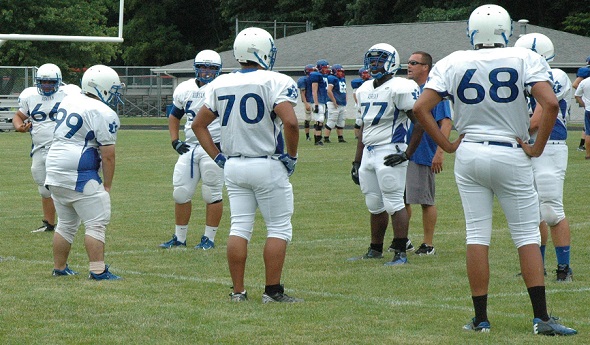
Coaches and players in Texas and Illinois adapted to new football practice limitations this fall, with the Texas policy focusing on contact, and the Illinois regulation emphasizing length of preseason practices.
Following are the main changes those states put in place heading into the 2013-14 season:
The University Interscholastic League, which governs school sports in Texas, put into writing that, “During the regular season and postseason, no football player is allowed to participate in more than ninety (90) minutes of full contact practice per week,” effective with the first day of practice this fall.
The complete policy follows:
For the purposes of the of rule, "full contact" is defined as football drills or live game simulations where "live action" occurs. Live action, as defined by USA Football, is contact at game speed where players execute full tackles at a competitive pace taking players to the ground. A team may continue to dress in full pads for practice, but may only participate in live action drills and game time simulations no more than ninety minutes per athlete per week. It is assumed that when players are in shells (shorts, shoulder pads, and helmets) no live action drills or simulations will occur. This rule is intended to limit live action drills and simulations and not the number of practices a team may participate in full pads. A team may participate in "air," "bags," "wrap," and "thud" drills and simulations at any point. These contact levels are defined below:
• Air - Players should run unopposed without bags or any opposition
• Bags - activity is executed against a bag, shield or pad to allow for a soft-contact surface, with or without the resistance of a teammate or coach standing behind the bag.
• Wrap - Drills run at full speed until contact, which is above the waist with the players remaining on their feet.
• Thud - Same as wrap but tempo is competitive with no pre-determined winner and the players are not tackling to the ground.
 The rule came to the UIL Legislative Council as a recommendation from the UIL Medical Advisory Committee, a permanent advisory committee to the Legislative Council which meets twice each year to discuss and review safety policies for UIL participants. The committee, which is made up of leading medical professionals in various specialties and includes representatives from the Texas High School Coaches Association, the Texas Girls Coaches Association, and the Texas State Athletic Trainer Association, unanimously recommended this limitation in full-contact football practice.
The rule formulates into a formal policy the existing actions of the majority of coaches across Texas, and most coaches have had to make few adjustments, if any. In fact, according to a story on statesman.com, the proposal caused more of an uproar on social media than from coaches.
“It’s not going to affect us in anyway,” Vandegrift HS coach Drew Sanders said in the story. “Most good coaches were way below that 90-minute amount already. Prior to legislation we still monitored it ourselves – the only change is now we have to keep up a log more publicly.”
Illinois put standards in place for its first 14 days of football practices, known as the state’s Preseason Football Acclimatization Practice Period. At the core of the policy is a three-hour practice limit for the first five days, during which teams can also conduct a one-hour walk-through.
 Teams must observe a minimum two hours rest between the practices and walk-throughs. Players may wear helmets only on the first two days, then helmets and shoulder pads for the next three. From days seven through 14 of the acclimatization period, schools may practice for a maximum of five hours per day, as long as that day is followed by a three-hour day, or an off day. During the five-hour days, no session can last more than three hours and must include a two-hour break between practices. Full pads may be worn for the final seven dates leading up to the first contest.
“This policy was the result of a collaborative effort between the IHSA Sports Medicine Advisory Committee and the Football Advisory Committee,” said SMAC committee member and University of Illinois Associate Professor of Orthopedic Surgery Dr. Preston M. Wolin. “The guidelines are based on the most recent scientific evidence, as well as the expertise of the coaches who will help implement them. Both committees believe the guidelines represent a significant positive contribution to the health of our athletes.”
“This new policy undoubtedly changes the way we, as coaches, approach preseason practice,” said Metamora HS coach Pat Ryan, who is a member of the FAC and a past President of the Illinois High School Football Coaches Association. “Coaches have to get more creative with when and how they schedule practices, as well what they do with their time. The proposals were strongly supported by both committees. It is a crucial final step to the process of being able to effectively prepare our teams in a safe manner. Change is always difficult, but the game is changing and we need to adapt to continue to put the safety of our players first.”
The IHSA offered multiple interactive online webinar meetings for high school coaches leading up to the start of practice where questions were answered, along with further clarifications on the policy and the science behind it.
“I think most coaches understood that changes were on the horizon,” said IHSA Executive Director Marty Hickman. “We wanted to be in a position to give our coaches as much information as possible to make sure they are comfortable with the new policy. Their input will be critical moving forward as we develop educational materials, like a best practices presentation. I commend our committees on a policy that is supported by medical experts, football coaches and school administrators.”
Pirates' Football Voice Ends 30-Year Run
November 12, 2019
By Tim Robinson
Special for Second Half
PINCKNEY — Bob Reason has been the voice of Pinckney High School football and basketball for more than 30 years.
 It’s his voice you heard over the public address system, good times and bad, through wins and losses.
He’s always played it down the middle, in the style of public address announcers at Michigan Stadium.
“I get excited when Pinckney scores,” he said in the Pinckney Stadium press box last week. ‘But I don’t want to take away from the athletes.”
Reason, a 1961 Pinckney graduate who moved back to the house he was born and grew up in during the mid-1980s, announced his last football game Oct. 11, Pinckney’s homecoming game.
Fittingly, it was against Dexter, where Reason lived for more than a decade and, with former Dreadnaughts athletic director Al Ritt, helped pass a bond issue in the 1970s that built a stadium now named for Ritt.
At 76, Reason decided it was time to retire.
“I just enjoyed doing it, but at 76, I feel it’s time,” he said.
He’ll still do Pinckney basketball for at least two more seasons. His son, Tom, is the boys coach and grandson Dylan is a junior.
“I’m going to try to sucker him into announcing for the girls program when my daughter is old enough to play,” Tom said, chuckling. “But he wants to sit in the stands, and sometimes it’s nice to sit there and be a grandpa.”
It will be a well-earned retirement for Reason, whose athletic career at Pinckney ended when he tore a knee ligament on the first play of his senior football season.
He became the Pirates public-address announcer after moving back to Pinckney from the Toledo area.
“One of his first games was announcing my brother’s games,” Tom Reason said. “I remember being a rug rat running around the stands. I thought it was pretty neat. When you’re a young one, you think your dad is the coolest dad in the world because his voice is coming out of the press box.
“To this day, my daughters love it. They always go up and visit him and he gives them candy. It’s a neat thing. I’ve been around Pinckney athletics for a long time, and it’s neat to hear his voice.”
Bob Reason has been active in the community too over the last 30-plus years. He’s served on the Pinckney athletic boosters board and spent a quarter-century running Saturday morning basketball programs at Pinckney, including enlisting varsity players as referees.
And it’s the athletes that kept bringing Bob Reason back to the microphone.
Well, that, and a slight bit of chicanery the last couple of years.
“He tried to retire, but I wouldn’t let him,” former Pinckney athletic director Tedd Bradley said.
“I was going to retire five years ago,” Reason said. “(Bradley) said, ‘OK, but we’ll have to find someone, so you have to do it this year. And then the next year, they didn’t find anyone.”
Current AD Brian Wardlow finally bent to Reason’s wishes this year, hiring Pat Allen, who worked the Pirates’ final home game against Jackson this season.
“There were a lot of people there (at homecoming), and people who had been around for decades got to hear one last game,” Wardlow said. “When I was in Pinckney, Bob was our football announcer, too, so he’s the only voice I’ve ever known in football and basketball.”
And, through his years working for Pinckney athletic programs, generations of Pinckney athletes know him and say hello.
“We went to Disney World as a family a few years ago, and three people came up to us. At Disney World,” Tom Reason said. “They come up and say, ‘Hey, Mr. Reason!’ We can’t go anywhere without someone knowing him.”
Bob Reason said part of the impetus toward retirement was his eyesight, which had been slowly failing due to cataracts the last couple of years. He credits his longtime spotter in the press box, Linda Lambert, with helping him credit the right athletes at the right time.
“Some of the teams that have played have white jerseys with white numbers outlined in black, and it’s hard to see the numbers,” he said. “I could not have done the games the last two years without her.”
The man in the PA booth, so calm with his delivery, is a Pinckney Pirate through and through.
Take the 1989 season, for example.
The Pirates had made the playoffs with an 8-1 record and had drawn a home game with East Grand Rapids in the first round. Below the “Welcome to Pinckney” sign outside of town, he and some co-conspirators hung a sign that said, “Welcome, East Grand Rapids. We’ve been waiting for you.”
East Grand Rapids won the game, 37-30 on a touchdown in the final minutes, and Reason went to Flint to see the Pioneers play Oxford in the next round.
“I had a Pinckney hat on,” Reason said, “and a guy from East Grand Rapids saw my hat and talked to me about the sign.”
The gentleman, as it turned out, was more than a little chapped about the sign.
“I said, ‘We just wanted to welcome you,’” Reason said, laughing at the memory.
After all these years, he said, the games and players all roll together in memory, but the lure of high school sports remains.
“I still think high school athletes give all they’ve got,” Reason said, “every game they play, regardless of position. Athletics is not just about winning. It’s about learning to play with your teammates, developing your skills, trying to be the best you can be and learning life lessons. I think one of the most important things high school athletics gives all of our kids is never to give up. Regardless of what happens in your life, there’s tomorrow, and never give up. Keep trying and keep working, and I think that carries forward into life itself.”
“He’s always super-complimentary about every kid who’s out there trying,” said Wardlow, who grew up in Pinckney and has been employed by the school district since 2002. “It’s important in a community like Pinckney to have that guy you can always count on, and the community knows what it’s going to get.”
Reason said he’s not going anywhere.
“I don’t have any interest in moving,” he said. “I talked about moving to Florida once. I said to my kids, ‘Do any of you want to buy the house? I’ll sell it for $500,000.’ I was joking, of course, and they said, ‘No, Dad. It’s too much. We’ll give you a dollar.’”
So Bob and his wife, Dorothy, are staying in Pinckney.
“The football team gave me a cushioned seat for the stands,” he said. ‘I’ll go to the home games. I love it. I like to watch the band play at halftime.”
Bradley, who retired in 2015, looks forward to attending games with his friend next fall.
“I will enjoy standing next to him at those games,” he said. “Bob is a tremendous gentlemen. He and his family are special people.”
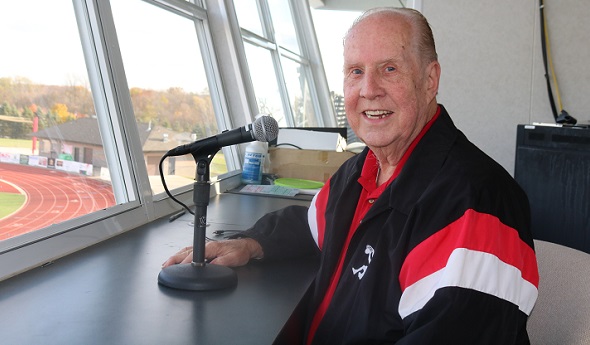
PHOTO: Longtime Pinckney announcer Bob Reason takes his familiar seat in the stadium’s press box. (Photo by Tim Robinson.)