

Talking Practice: Texas, Illinois Revise Policies
December 20, 2013
By Rob Kaminski
MHSAA benchmarks editor
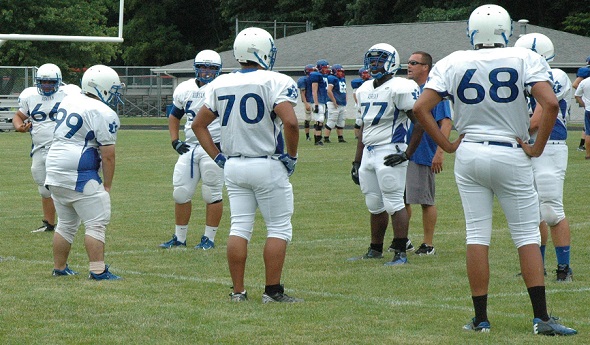
Coaches and players in Texas and Illinois adapted to new football practice limitations this fall, with the Texas policy focusing on contact, and the Illinois regulation emphasizing length of preseason practices.
Following are the main changes those states put in place heading into the 2013-14 season:
The University Interscholastic League, which governs school sports in Texas, put into writing that, “During the regular season and postseason, no football player is allowed to participate in more than ninety (90) minutes of full contact practice per week,” effective with the first day of practice this fall.
The complete policy follows:
For the purposes of the of rule, "full contact" is defined as football drills or live game simulations where "live action" occurs. Live action, as defined by USA Football, is contact at game speed where players execute full tackles at a competitive pace taking players to the ground. A team may continue to dress in full pads for practice, but may only participate in live action drills and game time simulations no more than ninety minutes per athlete per week. It is assumed that when players are in shells (shorts, shoulder pads, and helmets) no live action drills or simulations will occur. This rule is intended to limit live action drills and simulations and not the number of practices a team may participate in full pads. A team may participate in "air," "bags," "wrap," and "thud" drills and simulations at any point. These contact levels are defined below:
• Air - Players should run unopposed without bags or any opposition
• Bags - activity is executed against a bag, shield or pad to allow for a soft-contact surface, with or without the resistance of a teammate or coach standing behind the bag.
• Wrap - Drills run at full speed until contact, which is above the waist with the players remaining on their feet.
• Thud - Same as wrap but tempo is competitive with no pre-determined winner and the players are not tackling to the ground.
 The rule came to the UIL Legislative Council as a recommendation from the UIL Medical Advisory Committee, a permanent advisory committee to the Legislative Council which meets twice each year to discuss and review safety policies for UIL participants. The committee, which is made up of leading medical professionals in various specialties and includes representatives from the Texas High School Coaches Association, the Texas Girls Coaches Association, and the Texas State Athletic Trainer Association, unanimously recommended this limitation in full-contact football practice.
The rule formulates into a formal policy the existing actions of the majority of coaches across Texas, and most coaches have had to make few adjustments, if any. In fact, according to a story on statesman.com, the proposal caused more of an uproar on social media than from coaches.
“It’s not going to affect us in anyway,” Vandegrift HS coach Drew Sanders said in the story. “Most good coaches were way below that 90-minute amount already. Prior to legislation we still monitored it ourselves – the only change is now we have to keep up a log more publicly.”
Illinois put standards in place for its first 14 days of football practices, known as the state’s Preseason Football Acclimatization Practice Period. At the core of the policy is a three-hour practice limit for the first five days, during which teams can also conduct a one-hour walk-through.
 Teams must observe a minimum two hours rest between the practices and walk-throughs. Players may wear helmets only on the first two days, then helmets and shoulder pads for the next three. From days seven through 14 of the acclimatization period, schools may practice for a maximum of five hours per day, as long as that day is followed by a three-hour day, or an off day. During the five-hour days, no session can last more than three hours and must include a two-hour break between practices. Full pads may be worn for the final seven dates leading up to the first contest.
“This policy was the result of a collaborative effort between the IHSA Sports Medicine Advisory Committee and the Football Advisory Committee,” said SMAC committee member and University of Illinois Associate Professor of Orthopedic Surgery Dr. Preston M. Wolin. “The guidelines are based on the most recent scientific evidence, as well as the expertise of the coaches who will help implement them. Both committees believe the guidelines represent a significant positive contribution to the health of our athletes.”
“This new policy undoubtedly changes the way we, as coaches, approach preseason practice,” said Metamora HS coach Pat Ryan, who is a member of the FAC and a past President of the Illinois High School Football Coaches Association. “Coaches have to get more creative with when and how they schedule practices, as well what they do with their time. The proposals were strongly supported by both committees. It is a crucial final step to the process of being able to effectively prepare our teams in a safe manner. Change is always difficult, but the game is changing and we need to adapt to continue to put the safety of our players first.”
The IHSA offered multiple interactive online webinar meetings for high school coaches leading up to the start of practice where questions were answered, along with further clarifications on the policy and the science behind it.
“I think most coaches understood that changes were on the horizon,” said IHSA Executive Director Marty Hickman. “We wanted to be in a position to give our coaches as much information as possible to make sure they are comfortable with the new policy. Their input will be critical moving forward as we develop educational materials, like a best practices presentation. I commend our committees on a policy that is supported by medical experts, football coaches and school administrators.”
Schmitt Happily Home as St Johns Coach
By
Geoff Kimmerly
MHSAA.com senior editor
August 13, 2019
ST. JOHNS – The 50 or so students chanting “Schmitt! Schmitt! Schmitt!” during the earliest minutes of Monday morning know him mostly as a high school math teacher.
 Which makes sense – the oldest probably had just turned 3 when Andy Schmitt was locking down his local legend status as St. Johns’ history-making quarterback.
What they probably don’t remember, they’ve surely heard about – how he led unheralded St. Johns to the 2004 Division 3 championship game, its only appearance in an MHSAA Football Final, on the way to starring at Eastern Michigan University and earning a tryout from the Detroit Lions.
That fame he earned more than a decade ago still stands tall, just as the Redwings' first-year varsity head coach did by a few inches over the rest of his coaching staff and possibly all of his players as the team kicked off the 2019 season with a midnight practice on its home field.
While Schmitt’s experiences and successes surely could have led him down a variety of football coaching roads, he always was circling to come back home – with the hope of giving today's players opportunities to make memories like those that continue to resonate within him.
“It never mattered on opportunities. It was always a matter of trying to come back home,” said Schmitt late Sunday night, as St. Johns’ game clock behind him ticked down the seconds until football teams statewide were allowed to practice for the first time this fall. “My wife’s from here. I’m from here. I grew up with a lot of pride in this community. I saw myself, once I decided to get into education and coaching, I saw myself coming back to St. Johns.
"We had such a good experience playing here, made a couple of nice runs, and I just want to help this program do the same thing."
He began a busy journey as a mostly-unheralded high school junior in 2003. Unheralded, that is, until he led St. Johns to its first District football title that fall.
Schmitt then emerged the next season as the best from a historically-deep group of standout mid-Michigan quarterbacks, leading St. Johns to the Pontiac Silverdome. Although the Redwings lost that championship game to Lowell 38-17, Schmitt made a pair of long scrambling passes that helped St. Johns stay tied with the Red Arrows until the final minutes of the third quarter. And regardless of the defeat, the playoff run spoke volumes – Schmitt eventually was named Lansing State Journal All-Decade quarterback for the mid-Michigan area in 2010, prestige that lives on even for players who have seen him play only on YouTube.
“It’s all over the school. He’s got a banner in there, a picture in the weight room,” Redwings senior lineman Sam Hallead said. “It’s always there to motivate us.”
Schmitt went on to Eastern Michigan University, where after redshirting his first year he played 34 games with 30 starts before a knee injury ended his college career after the team’s third game of the 2009 season. All told, he threw for 5,867 yards and 33 touchdowns at EMU and holds four school passing records while ranking near the top in a number of other categories. He still shares the NCAA Division I record for single-game completions with 58 against Central Michigan in their 2008 meeting.
Schmitt came back from his injury to try out for the Lions in 2010, and then he turned toward his next career. He student taught at Williamston, then as a long-term substitute at Bay City John Glenn before taking his first fulltime teaching job at New Buffalo. Then it was on to Fowlerville and Ovid-Elsie Middle School before arriving back at St. Johns in 2015. Schmitt coached at all of the schools where he taught, and was a freshman coach the last three seasons under his former coach Dave Mariage, who retired from the head varsity job after last season. A week after Mariage resigned, Schmitt was promoted, and he’ll be surrounded this fall by all of the same staff – and with Mariage as his freshman coach.
It's where Schmitt always was meant to be, with qualities he began showing 20 years ago shining through.
“The same love of the game. The same enthusiasm. He loves the game, he knows the game, and he’s excited every day he comes out here,” Mariage said. “I didn’t know that’s what he was going to do (become a teacher and coach), but he’s a natural leader. He checks all the boxes. He’s going to do great.”
 Schmitt takes over a program that remains one of the most consistently successful in the Lansing area.
Mariage stepped away with a 124-72 record over his 19 seasons, and the Redwings haven’t finished below .500 for a season since 2005. They’ve won two more District titles since Schmitt graduated and are a regular league title contender.
St. Johns will begin its seventh season since building a football stadium after Schmitt starred on a field that certainly could be referred to as yesteryear. And Hallead said the varsity has 35 players out, with his class plenty familiar with the new coach after Schmitt coached them as freshmen.
Schmitt laughed when asked if his players know of his legendary status in town – “They don’t need to know” – but he admits there’s substantial buzz heading into this season. He’ll never forget how the community came out to support the team when he played, and that support was perhaps the heaviest driving force that brought he and his wife Teisha (Thelen), also a 2005 grad and three-sport standout, home again and home to stay.
“The amount of pride that I experienced going through the runs that we had junior and senior year, and again, watching this town come together and how supportive the town was, made football mean so much to me,” Schmitt said. “How a group of people can bring a lot of people together, seeing the support, seeing the pride made me want to come right back to St. Johns.
“This is home. There’s not going to be anywhere else. This is where we’re going to raise our kids. There’s no going anywhere from here.”
 Geoff Kimmerly joined the MHSAA as its Media & Content Coordinator in Sept. 2011 after 12 years as Prep Sports Editor of the Lansing State Journal. He has served as Editor of Second Half since its creation in Jan. 2012. Contact him at [email protected] with story ideas for the Barry, Eaton, Ingham, Livingston, Ionia, Clinton, Shiawassee, Gratiot, Isabella, Clare and Montcalm counties.
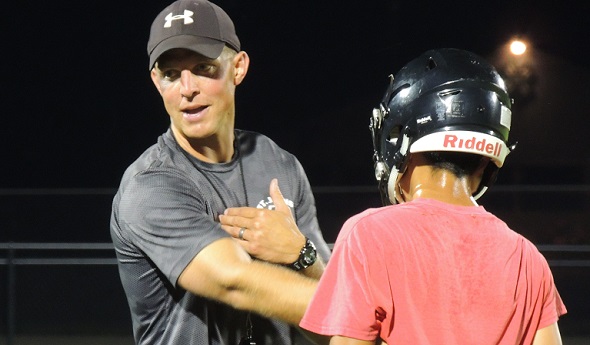
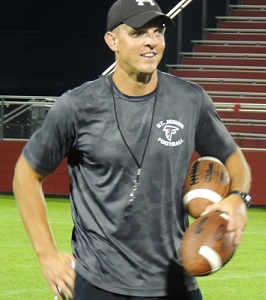
PHOTOS: (Top) St. Johns first-year head varsity coach Andy Schmitt works with his defensive backs during Monday morning’s “midnight madness” practice. (Middle) Schmitt formerly starred at quarterback for the Redwings, leading the program to its first District and Regional titles.