

Talking Practice: Texas, Illinois Revise Policies
December 20, 2013
By Rob Kaminski
MHSAA benchmarks editor
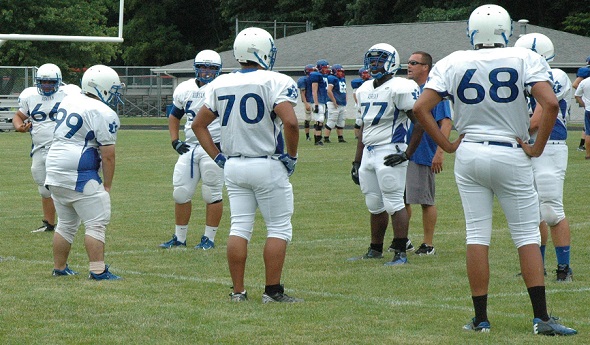
Coaches and players in Texas and Illinois adapted to new football practice limitations this fall, with the Texas policy focusing on contact, and the Illinois regulation emphasizing length of preseason practices.
Following are the main changes those states put in place heading into the 2013-14 season:
The University Interscholastic League, which governs school sports in Texas, put into writing that, “During the regular season and postseason, no football player is allowed to participate in more than ninety (90) minutes of full contact practice per week,” effective with the first day of practice this fall.
The complete policy follows:
For the purposes of the of rule, "full contact" is defined as football drills or live game simulations where "live action" occurs. Live action, as defined by USA Football, is contact at game speed where players execute full tackles at a competitive pace taking players to the ground. A team may continue to dress in full pads for practice, but may only participate in live action drills and game time simulations no more than ninety minutes per athlete per week. It is assumed that when players are in shells (shorts, shoulder pads, and helmets) no live action drills or simulations will occur. This rule is intended to limit live action drills and simulations and not the number of practices a team may participate in full pads. A team may participate in "air," "bags," "wrap," and "thud" drills and simulations at any point. These contact levels are defined below:
• Air - Players should run unopposed without bags or any opposition
• Bags - activity is executed against a bag, shield or pad to allow for a soft-contact surface, with or without the resistance of a teammate or coach standing behind the bag.
• Wrap - Drills run at full speed until contact, which is above the waist with the players remaining on their feet.
• Thud - Same as wrap but tempo is competitive with no pre-determined winner and the players are not tackling to the ground.
 The rule came to the UIL Legislative Council as a recommendation from the UIL Medical Advisory Committee, a permanent advisory committee to the Legislative Council which meets twice each year to discuss and review safety policies for UIL participants. The committee, which is made up of leading medical professionals in various specialties and includes representatives from the Texas High School Coaches Association, the Texas Girls Coaches Association, and the Texas State Athletic Trainer Association, unanimously recommended this limitation in full-contact football practice.
The rule formulates into a formal policy the existing actions of the majority of coaches across Texas, and most coaches have had to make few adjustments, if any. In fact, according to a story on statesman.com, the proposal caused more of an uproar on social media than from coaches.
“It’s not going to affect us in anyway,” Vandegrift HS coach Drew Sanders said in the story. “Most good coaches were way below that 90-minute amount already. Prior to legislation we still monitored it ourselves – the only change is now we have to keep up a log more publicly.”
Illinois put standards in place for its first 14 days of football practices, known as the state’s Preseason Football Acclimatization Practice Period. At the core of the policy is a three-hour practice limit for the first five days, during which teams can also conduct a one-hour walk-through.
 Teams must observe a minimum two hours rest between the practices and walk-throughs. Players may wear helmets only on the first two days, then helmets and shoulder pads for the next three. From days seven through 14 of the acclimatization period, schools may practice for a maximum of five hours per day, as long as that day is followed by a three-hour day, or an off day. During the five-hour days, no session can last more than three hours and must include a two-hour break between practices. Full pads may be worn for the final seven dates leading up to the first contest.
“This policy was the result of a collaborative effort between the IHSA Sports Medicine Advisory Committee and the Football Advisory Committee,” said SMAC committee member and University of Illinois Associate Professor of Orthopedic Surgery Dr. Preston M. Wolin. “The guidelines are based on the most recent scientific evidence, as well as the expertise of the coaches who will help implement them. Both committees believe the guidelines represent a significant positive contribution to the health of our athletes.”
“This new policy undoubtedly changes the way we, as coaches, approach preseason practice,” said Metamora HS coach Pat Ryan, who is a member of the FAC and a past President of the Illinois High School Football Coaches Association. “Coaches have to get more creative with when and how they schedule practices, as well what they do with their time. The proposals were strongly supported by both committees. It is a crucial final step to the process of being able to effectively prepare our teams in a safe manner. Change is always difficult, but the game is changing and we need to adapt to continue to put the safety of our players first.”
The IHSA offered multiple interactive online webinar meetings for high school coaches leading up to the start of practice where questions were answered, along with further clarifications on the policy and the science behind it.
“I think most coaches understood that changes were on the horizon,” said IHSA Executive Director Marty Hickman. “We wanted to be in a position to give our coaches as much information as possible to make sure they are comfortable with the new policy. Their input will be critical moving forward as we develop educational materials, like a best practices presentation. I commend our committees on a policy that is supported by medical experts, football coaches and school administrators.”
Lumen Repeat 'Club' Inducts Newest Class
November 24, 2017
By Geoff Kimmerly
Second Half editor
DETROIT – The challenge came one more time over text Thursday night, from a pair of assistant coaches who had something their players desperately wanted.
 Tony Panici and Tyler Aldridge were part of Jackson Lumen Christi’s repeat Division 5 champions in 2003 and 2004, and they had one question for today’s Titans: “Do you have what it takes to join the back-to-back club?”
“That really stuck with us,” Lumen Christi junior linebacker Nick Thomas said. “And I think it gave us that little edge to be able to come out and leave everything on the field, and just join that club.”
Panici and Aldridge – who also were part of the 2005 runner-up team – sent along photos of their championship rings as well. And now the program will need to mint another 80 or so more.
Indeed the Titans won their 10th championship Friday at Ford Field, for the second straight season in Division 6, completing their first repeat since Panici and Aldridge’s sophomore and junior years more than a decade ago. And Lumen Christi did it by holding off arguably the state’s most successful program of the last decade – five-time champion Ithaca – by holding on for a 40-34 win.
The Titans led by 20 midway through the fourth quarter before the Yellowjackets pulled to within six with 2:27 to play. Lumen Christi (12-1) was able to run off those final minutes but needed every last yard – securing the victory by getting two on a 4-and-1 dive by senior Kyle Minder with under a minute to play.
It was a symbolic way to end the final rally. The Yellowjackets (12-1) have won their five titles over the last eight seasons with offenses led by dynamic dual-threat quarterbacks, and made this run led by senior signal-caller Joey Bentley – who ended the fall with 2,144 yards and 31 touchdowns passing and 1,656 yards and 27 scores rushing.
Lumen Christi’s attack is far more old school, a grind-it-out style that this season headlined senior Sebastion Toland with Minder mostly blocking in front of him and behind a powerful offensive line. The Titans didn’t throw a pass during the second half Friday, aside from a two-point conversion try, mostly because they were able to follow up Ithaca’s defensive stops with long runs – Minder ripped off scoring sprints of four, 43 and 63 yards over the final two quarters, and Toland had an 80-yarder to make the lead 19 points just more than a minute into the fourth.
“The offensive line really came off the ball in the second half,” said longtime Lumen Christi coach Herb Brogan, who finished his 38th season running the program. “We felt all year long that offensive line was the strength of our team, and we’ve got some pretty good people to run behind them. I really thought they asserted themselves in the second half and took control of the line of scrimmage.”
The Titans ran for 514 yards on 67 carries, averaging 7.7 yards per attempt. The carries were the second most by one team in an MHSAA championship game.
Toland finished with 244 yards on 33 carries, and Minder had 206 on 23 attempts. Both made the MHSAA record book list for rushing yards in a Final, Toland’s total tying for seventh highest. He had 176 of those yards during the second half. Thomas also scored his team’s first touchdown on a 72-yard reverse.
 “They’re a fantastic team offensively, and we knew that. Our challenge was getting off the field,” Ithaca coach Terry Hessbrook said.
“Our defense is fast, but obviously we’re not very big. They asked me at halftime on TV what (Lumen’s) adjustment was going to be. And I said I expected a lot more power running game from them in the second half, and unfortunately that’s exactly what we got.”
A 51-yard touchdown run by Bentley gave Ithaca a 13-8 lead it carried into halftime. Lumen Christi swung the score 24 points to take a 31-12 advantage into the fourth quarter, but the Yellowjackets remained dangerous. Three of Bentley’s four touchdown passes came over the final 9:36.
He finished 11 of 21 passing for 240 yards and those four scores, and ran for 89 yards and one touchdown. Senior Adam Culp caught five passes for 70 yards and two of those scores.
“I’m glad the clock ran out when it did,” said Brogan, also the fifth winningest coach in MHSAA history with a 343-83 record. “They’re really explosive.”
Senior linebacker Ethan McCormick led Ithaca with 15 tackles, while senior nose guard Nathan Bellinger had 11 and senior linebacker Zach Hessbrook had 10.
The Yellowjackets have won 118 of their last 123 games.
“All I can say is this: When you coach a team, all you ask from them is that they play as hard as they can possibly play,” Terry Hessbrook said. “My kids do that. They do that for me, for my coaching staff.
“I told those guys at halftime, Jackson Lumen Christi has never a team like Ithaca High School, because we have no quitters. These kids, I’m so proud of them for it.”
Minder and Thomas both had six tackles to pace the Titans.
The MHSAA Playoffs are sponsored by the Michigan Army National Guard.
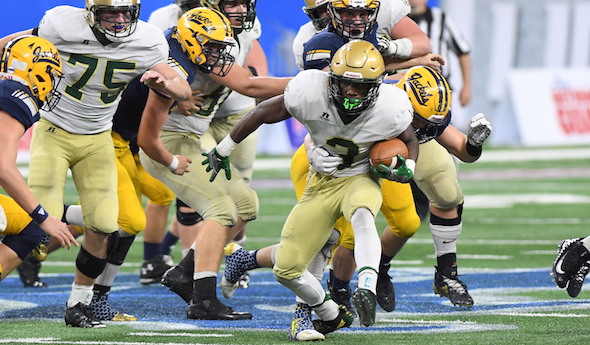
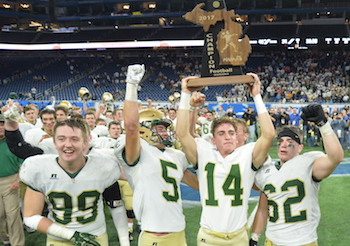
PHOTOS: (Top) Lumen Christi’s Sebastion Toland works to break away from a tackler during the Titans’ Division 6 Final win Friday. (Middle) From left: Cameron White, Joe Barrett, Luke Stanton and Hunter Richmond celebrate with the championship trophy.