

Talking Practice: Texas, Illinois Revise Policies
December 20, 2013
By Rob Kaminski
MHSAA benchmarks editor
Coaches and players in Texas and Illinois adapted to new football practice limitations this fall, with the Texas policy focusing on contact, and the Illinois regulation emphasizing length of preseason practices.
Following are the main changes those states put in place heading into the 2013-14 season:
The University Interscholastic League, which governs school sports in Texas, put into writing that, “During the regular season and postseason, no football player is allowed to participate in more than ninety (90) minutes of full contact practice per week,” effective with the first day of practice this fall.
The complete policy follows:
For the purposes of the of rule, "full contact" is defined as football drills or live game simulations where "live action" occurs. Live action, as defined by USA Football, is contact at game speed where players execute full tackles at a competitive pace taking players to the ground. A team may continue to dress in full pads for practice, but may only participate in live action drills and game time simulations no more than ninety minutes per athlete per week. It is assumed that when players are in shells (shorts, shoulder pads, and helmets) no live action drills or simulations will occur. This rule is intended to limit live action drills and simulations and not the number of practices a team may participate in full pads. A team may participate in "air," "bags," "wrap," and "thud" drills and simulations at any point. These contact levels are defined below:
• Air - Players should run unopposed without bags or any opposition
• Bags - activity is executed against a bag, shield or pad to allow for a soft-contact surface, with or without the resistance of a teammate or coach standing behind the bag.
• Wrap - Drills run at full speed until contact, which is above the waist with the players remaining on their feet.
• Thud - Same as wrap but tempo is competitive with no pre-determined winner and the players are not tackling to the ground.
 The rule came to the UIL Legislative Council as a recommendation from the UIL Medical Advisory Committee, a permanent advisory committee to the Legislative Council which meets twice each year to discuss and review safety policies for UIL participants. The committee, which is made up of leading medical professionals in various specialties and includes representatives from the Texas High School Coaches Association, the Texas Girls Coaches Association, and the Texas State Athletic Trainer Association, unanimously recommended this limitation in full-contact football practice.
The rule formulates into a formal policy the existing actions of the majority of coaches across Texas, and most coaches have had to make few adjustments, if any. In fact, according to a story on statesman.com, the proposal caused more of an uproar on social media than from coaches.
“It’s not going to affect us in anyway,” Vandegrift HS coach Drew Sanders said in the story. “Most good coaches were way below that 90-minute amount already. Prior to legislation we still monitored it ourselves – the only change is now we have to keep up a log more publicly.”
Illinois put standards in place for its first 14 days of football practices, known as the state’s Preseason Football Acclimatization Practice Period. At the core of the policy is a three-hour practice limit for the first five days, during which teams can also conduct a one-hour walk-through.
 Teams must observe a minimum two hours rest between the practices and walk-throughs. Players may wear helmets only on the first two days, then helmets and shoulder pads for the next three. From days seven through 14 of the acclimatization period, schools may practice for a maximum of five hours per day, as long as that day is followed by a three-hour day, or an off day. During the five-hour days, no session can last more than three hours and must include a two-hour break between practices. Full pads may be worn for the final seven dates leading up to the first contest.
“This policy was the result of a collaborative effort between the IHSA Sports Medicine Advisory Committee and the Football Advisory Committee,” said SMAC committee member and University of Illinois Associate Professor of Orthopedic Surgery Dr. Preston M. Wolin. “The guidelines are based on the most recent scientific evidence, as well as the expertise of the coaches who will help implement them. Both committees believe the guidelines represent a significant positive contribution to the health of our athletes.”
“This new policy undoubtedly changes the way we, as coaches, approach preseason practice,” said Metamora HS coach Pat Ryan, who is a member of the FAC and a past President of the Illinois High School Football Coaches Association. “Coaches have to get more creative with when and how they schedule practices, as well what they do with their time. The proposals were strongly supported by both committees. It is a crucial final step to the process of being able to effectively prepare our teams in a safe manner. Change is always difficult, but the game is changing and we need to adapt to continue to put the safety of our players first.”
The IHSA offered multiple interactive online webinar meetings for high school coaches leading up to the start of practice where questions were answered, along with further clarifications on the policy and the science behind it.
“I think most coaches understood that changes were on the horizon,” said IHSA Executive Director Marty Hickman. “We wanted to be in a position to give our coaches as much information as possible to make sure they are comfortable with the new policy. Their input will be critical moving forward as we develop educational materials, like a best practices presentation. I commend our committees on a policy that is supported by medical experts, football coaches and school administrators.”
Drive for Detroit: Playoff Week 3 Review
November 13, 2017
By Geoff Kimmerly
Second Half editor
A longtime observer of Michigan high school football had a hard time remembering a playoff weekend with as many close finishes as fans enjoyed Friday and Saturday.
 Start with the games in 11-player Division 1, where all four were decided by fourth-quarter scores or stops, and nail-biters dominated a weekend that saw 32 teams move on to 11-Player Regional Finals and the four finalists for 8-player championships book trips to Marquette’s Superior Dome.
We start with a brief glance below at all four 8-Player Semifinals and then move into all 32 11-player games. The MHSAA Playoffs are sponsored by the Michigan Army National Guard, and “Drive for Detroit” is sponsored by MI Student Aid.
8-Player Division 1
Central Lake 54, Stephenson 20
The Trojans (12-0) rode a ravenous rushing attack in a snowstorm to earn its first MHSAA championship game berth while also tying its program record for wins in a season. Central Lake plodded to more than 400 yards against a Stephenson defense that had given up only 16.7 points per game entering the day. The Eagles finished 9-3. Click for more from the Traverse City Record-Eagle.
Central Lake leads Stephenson 28-14 with 7:24 left in the first half. pic.twitter.com/1eXzSZKJVm
— Brandon Folsom (@folsombrandonj) November 11, 2017
Deckerville 52, Bellevue 18
Deckerville rattled off 44 straight points to earn a second straight trip to the MHSAA Finals. Bellevue led 12-8 early before the Eagles (11-1) went on their run against another otherwise-stellar defense – the Broncos (10-2) were giving up only 9.5 points per game entering the day and this season set a program record for wins. Click for more from the Huron Daily Tribune.
8-Player Division 2
Crystal Falls Forest Park 36, Pickford 34
Forest Park will add to its 13 championship game appearances as an 11-player program with its first in 8-player after handing Pickford its lone loss this season. The Trojans (10-2) last made a championship game in 2009 and moved to 8-player a year ago. They put up the most points Pickford (11-1) gave up in a game this season by 12. The Panthers fell in their second straight Semifinal but moved to 27-7 in three years of 8-player. Click for more from the Iron Mountain Daily News.
Portland St. Patrick 33, Kinde-North Huron 14
The Shamrocks are 53-12 since moving to 8-player in 2012, and in their first Semifinal since that first season finally broke through to earn a first championship game berth since 1997. St. Patrick (11-1) scored 21 points during the fourth quarter to pull away against a North Huron program that also was playing in its second 8-Player Semifinal and finished 10-2. Click for more from the Lansing State Journal.
TD Shamrocks. Isaiah Smith punches it in from the 1. Shamrocks take a 3 score lead, 27-8. 4:54 left in the game. pic.twitter.com/c2UXSydvQp
— Jake Atnip (@JakeAtnip) November 11, 2017
11-Player Division 1
West Bloomfield 28, Utica Eisenhower 25
Quarterback Bryce Veasley scored the winning touchdown with under a minute to play to send West Bloomfield (10-2) to its first MHSAA Semifinal in football. The Lakers edged an Eisenhower program much more familiar with this stage of the playoffs; the Eagles were playing for a third Regional title this decade and made the Semifinals a year ago. Eisenhower (11-1) had given up more than 20 points in a game to only one other opponent this fall. Click for more from the Oakland Press.
ICYMI: Watch the highlights from West Bloomfield's Regional Final win over Eisenhower! @wbhsTHESWAMP @wbhslakernation @19Bellamy @bry0e pic.twitter.com/nTP0CuKNgD
— STATE CHAMPS! (@statechampsnet) November 12, 2017
Other Regional Finals:
Clarkston 29, Holland West Ottawa 22 – The Wolves (10-2) scored 23 unanswered fourth-quarter points to win their second Regional title in four seasons and end West Ottawa’s winningest football season at 10-2.
Detroit Catholic Central 27, Canton 26 – The Shamrocks (8-4) stopped a Canton two-point conversion attempt with 34 seconds to play to win their fifth Regional title this decade while handing the Chiefs (10-2) their first loss since opening night.
Detroit Cass Tech 32, Clinton Township Chippewa Valley 26 – In maybe the most dramatic finish of all this weekend, Chippewa Valley (10-2) took the lead with 1:25 to play and Cass Tech (9-2) took it back as the clock ticked under 10 seconds to win an eighth straight Regional title.
11-Player Division 2
Livonia Franklin 31, Flushing 29
Franklin (10-2) clinched its second Regional title in three seasons on kicker Brad Gibson’s 27-yard field goal with 13 seconds to play. Flushing had taken the lead just more than a minute before with a two-point conversion after a late score. Flushing was playing for its first Regional title and finished 9-3, tying its most successful season (2014) since 1997. Click for more from the Observer & Eccentric.
@fhspatriots Game winner pic.twitter.com/88PlO3k2Ut
— Victor Rusnell (@victorhula) November 11, 2017
Other Regional Finals:
Grand Rapids Forest Hills Central 28, Traverse City Central 10 – Forest Hills Central (12-0) won its first football Regional title since 1995 with 28 unanswered points over the second and third quarters; Traverse City Central (8-4) was playing for its first Regional title since 1991.
Detroit Martin Luther King 55, Ypsilanti Lincoln 14 – The Crusaders (11-1) won their third straight Regional title and fifth in seven years while finishing the most successful playoff run ever for Lincoln (9-3), which hadn’t lost since an 0-2 start.
Warren DeLaSalle 14, Oak Park 7 – A last-minute touchdown gave DeLaSalle (10-2) its first Regional title since 2014 as both teams scored their fewest points since opening night; Oak Park (9-3) tied its most successful season after also going 9-3 in 2012.
11-Player Division 3
Riverview 36, Dearborn Divine Child 31
The Riverview dream season continues, this time after a close win over one of last season’s Division 3 semifinalists. The Pirates (11-1) won their first Regional title since 2002, with the reminder again that they went only 2-7 a year ago. Riverview led by 12 heading into the fourth quarter and held off Divine Child (10-2) during a late comeback attempt. Click for more from the Southgate News-Herald.
Other Regional Finals:
Muskegon 49, DeWitt 0 – The Big Reds (12-0) were great on offense as usual, but defensively this was the most impressive of their six shutouts this fall; DeWitt (10-2) was averaging 39 points per game entering the day.
Battle Creek Harper Creek 16, East Lansing 13 – The Beavers (12-0) scored all 16 of their points during the fourth quarter to clinch their first Regional title since 2012 and hand East Lansing (9-3) its first defeat this season since Week 3; the Trojans finished their best season since 2011.
Farmington Hills Harrison 34, Linden 21 – The Hawks (9-3) added to their inspired run with a first Regional title since 2014; Linden (9-3) was playing for its first Regional title but did finish its winningest season since 2012.
11-Player Division 4
River Rouge 21, Bloomfield Hills Cranbrook Kingswood 14
The Panthers (10-2) reached 10 victories for the fourth straight season and fifth in six seasons by clinching this third straight Regional title. River Rouge never broke away but did go ahead to stay midway through the fourth quarter to seal its closest win of the season (the two losses were by nine and seven). Cranbrook Kingswood (10-2) did cap its winningest season in program history. Click for more from the Southgate News-Herald.
Other Regional Finals:
Escanaba 39, Williamston 21 – The Eskymos (10-2) began pulling away during the first half on the way to their first Regional title since 1981; for Williamston (7-5), it was the only loss this season by more than seven points.
Grand Rapids Catholic Central 42, Belding 3 – GRCC (12-0) rode another giant dose of running back Nolan Fugate to its 18th straight win; Belding (9-3) ended its most successful season since 1998.
Edwardsburg 52, Lansing Sexton 30 –The Eddies (11-1) won their second straight Regional title with their fifth game over 50 points this season; Sexton (8-4) did become the first team to top 30 against Edwardsburg this fall.
11-Player Division 5
Grand Rapids West Catholic 28, Portland 26
The latest of frequent playoff meetings between these annual contenders turned out to be another classic as West Catholic (10-2) stopped a late two-point conversion attempt to secure the win – after also beating Portland by three last season on the way to winning the Division 5 title. The Raiders (10-2) fought back from two touchdowns down in the fourth quarter. Click for more from the Grand Rapids Press.
ICYMI: Watch the highlights from @GRWCatholic's 28-26 win over Portland for its 8th straight regional title! @GRWCFootball @WEST_is_BEST17 pic.twitter.com/sYz7xaoi4g
— STATE CHAMPS! (@statechampsnet) November 12, 2017
Other Regional Finals:
Reed City 46, Menominee 34 – The Coyotes (11-1) closed this weekend’s action in Saturday’s final game by claiming their first Regional title against a Menominee team playing in its ninth straight Regional Final; the Maroons, last season’s Division 5 runners-up, finished 8-4.
Saginaw Swan Valley 48, Muskegon Oakridge 14 – The Vikings (11-1) will play in their third Semifinal in nine years as Alex Fries threw three touchdown passes and ran for a fourth score; Oakridge (9-3) was playing for its first Regional title since 2013.
Frankenmuth 17, Algonac 7 – The Eagles (12-0) won their second straight Regional title and set a program record for wins by outlasting the Blue Water Area Conference champion Muskrats (10-2) in a defensive struggle; Frankenmuth held Algonac to 161 yards.
11-Player Division 6
Ithaca 33, Montague 23
Ithaca made a statement in a game pitting teams that have combined to win seven of the last nine Division 6 titles. Following quarterback Joey Bentley – 218 yards and four touchdowns rushing, one more touchdown passing – the Yellowjackets (12-0) led by 18 late before Montague added a final score. The Wildcats (11-1) did put up the most points Ithaca has given up this season – the Yellowjackets have now allowed only 101 over 12 games. Click for more from the Mount Pleasant Morning Sun.
ICYMI: Watch the highlights from Ithaca's Regional Final win over Montague on Saturday afternoon! @Coach_Burn @joey_sports @IHSPublications pic.twitter.com/w9WImG4c8Q
— STATE CHAMPS! (@statechampsnet) November 13, 2017
Other Regional Finals:
Traverse City St. Francis 33, Millington 26 – The Gladiators (11-1) hung on to win their second Regional title in three seasons as Millington (10-2) put up the most points St. Francis has given up this season – although the Gladiators also became just the second to score more than 30 on the Cardinals.
Jackson Lumen Christi 44, Watervliet 22 – The reigning Division 6 champion Titans (10-1) locked down a Watervliet offense that had scored at least 36 points every game and averaged 52 per game during the Panthers’ 11-0 start.
Warren Michigan Collegiate 32, Blissfield 6 – The Cougars (12-0) won their second Regional title in 10 seasons as a program, ending Blissfield’s first winning season since 2012 and winningest since 2009 at 7-5.
11-Player Division 7
Lake City 20, Breckenridge 18
Someone was going to celebrate a major accomplishment after this game. Lake City improved to 12-0, extending its program record for wins in claiming its first Regional title and with last year’s 2-7 finish becoming tougher to believe by the week. Breckenridge was 0-9 only three years ago and won its first playoff game just two weeks ago on the way to finishing 10-2 this fall. Click for more from the Cadillac News.
Other Regional Finals:
Pewamo-Westphalia 34, Elkton-Pigeon-Bay Port Laker 0 – The Pirates’ fifth shutout this season moved them to 11-1 and landed them their sixth Regional title in seven seasons; Laker (10-2) did contain P-W to its third-fewest points this fall.
Saugatuck 7, Cassopolis 6 – A go-ahead score with under three minutes to play pushed Saugatuck (9-3) just past the Rangers (10-2) for its first Regional title since 2010; Cassopolis had guarded that lead since the first quarter.
Madison Heights Madison 22, Monroe St. Mary Catholic Central 20 – Madison (12-0) will play in its first Semifinal since 2007 after coming back from two touchdowns down during the second half; the Falcons finished 7-5 after a 1-3 start this fall.
11-Player Division 8
Iron River West Iron County 35, Frankfort 20
West Iron’s first Regional title since 1977 came with a program record-setting 11th win as the Wykons haven’t lost since falling by two points on opening night. West Iron scored the first 22 points and locked down a Frankfort offense that had scored 45 per game entering the game. The Panthers finished 8-3 after making the Regional Finals for the third straight season. Click for more from the Iron Mountain Daily News.
Other Regional Finals:
Saginaw Nouvel 54, Lincoln Alcona 34 – Nouvel (12-0) picked the best time to score its most points in a game this season, coming off a District Final scare against Harbor Beach; the Panthers opened a 28-0 lead on the Tigers (9-3), who were playing in their first Regional Final.
Mendon 14, Climax-Scotts 6 – A week after stunning reigning champion Muskegon Catholic Central, Mendon (12-0) had to hold off the Panthers (9-3) for 2½ quarters to earn its first Regional title since 2011.
Ottawa Lake Whiteford 60, Clarkston Everest Collegiate 20 – Last season’s Division 8 runner-up Bobcats (12-0) clearly are intent on getting back to Ford Field; they finished this one on a 44-6 run to end the longest tournament run in the five-year history of Everest Collegiate (9-3).
Second Half’s weekly “Drive for Detroit” previews and reviews are powered by MI Student Aid, a part of the Student Financial Services Bureau located within the Michigan Department of Treasury. MI Student Aid encourages students to pursue postsecondary education by providing access to student financial resources and information, including various student financial assistance programs to help make college more affordable for Michigan students. MI Student Aid administers the state’s 529 savings programs (MET/MESP) and eight additional aid programs within its Student Scholarships and Grants division. Click for more information and connect with MI Student Aid on Facebook and Twitter @mistudentaid.
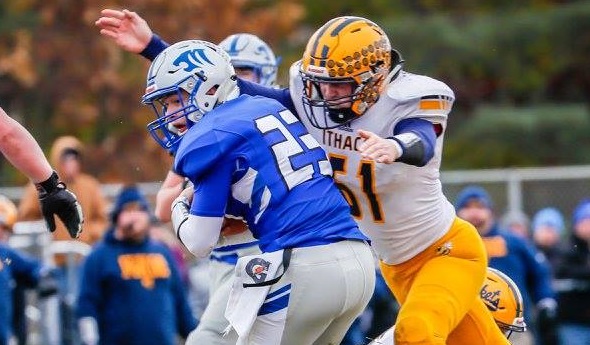
PHOTO: Ithaca’s Devon Smith (51) closes in on a Montague ball carrier during Saturday’s Division 6 Regional Final. (Photo by Tim Reilly.)