

Talking Practice: Texas, Illinois Revise Policies
December 20, 2013
By Rob Kaminski
MHSAA benchmarks editor
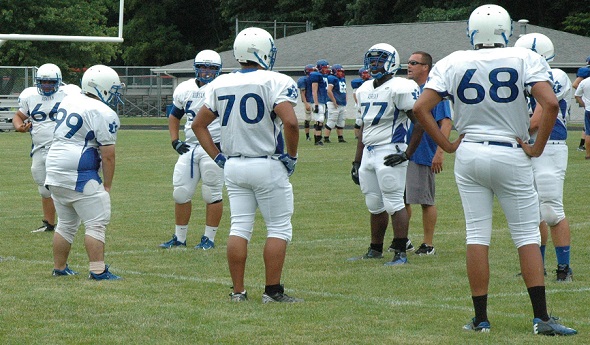
Coaches and players in Texas and Illinois adapted to new football practice limitations this fall, with the Texas policy focusing on contact, and the Illinois regulation emphasizing length of preseason practices.
Following are the main changes those states put in place heading into the 2013-14 season:
The University Interscholastic League, which governs school sports in Texas, put into writing that, “During the regular season and postseason, no football player is allowed to participate in more than ninety (90) minutes of full contact practice per week,” effective with the first day of practice this fall.
The complete policy follows:
For the purposes of the of rule, "full contact" is defined as football drills or live game simulations where "live action" occurs. Live action, as defined by USA Football, is contact at game speed where players execute full tackles at a competitive pace taking players to the ground. A team may continue to dress in full pads for practice, but may only participate in live action drills and game time simulations no more than ninety minutes per athlete per week. It is assumed that when players are in shells (shorts, shoulder pads, and helmets) no live action drills or simulations will occur. This rule is intended to limit live action drills and simulations and not the number of practices a team may participate in full pads. A team may participate in "air," "bags," "wrap," and "thud" drills and simulations at any point. These contact levels are defined below:
• Air - Players should run unopposed without bags or any opposition
• Bags - activity is executed against a bag, shield or pad to allow for a soft-contact surface, with or without the resistance of a teammate or coach standing behind the bag.
• Wrap - Drills run at full speed until contact, which is above the waist with the players remaining on their feet.
• Thud - Same as wrap but tempo is competitive with no pre-determined winner and the players are not tackling to the ground.
 The rule came to the UIL Legislative Council as a recommendation from the UIL Medical Advisory Committee, a permanent advisory committee to the Legislative Council which meets twice each year to discuss and review safety policies for UIL participants. The committee, which is made up of leading medical professionals in various specialties and includes representatives from the Texas High School Coaches Association, the Texas Girls Coaches Association, and the Texas State Athletic Trainer Association, unanimously recommended this limitation in full-contact football practice.
The rule formulates into a formal policy the existing actions of the majority of coaches across Texas, and most coaches have had to make few adjustments, if any. In fact, according to a story on statesman.com, the proposal caused more of an uproar on social media than from coaches.
“It’s not going to affect us in anyway,” Vandegrift HS coach Drew Sanders said in the story. “Most good coaches were way below that 90-minute amount already. Prior to legislation we still monitored it ourselves – the only change is now we have to keep up a log more publicly.”
Illinois put standards in place for its first 14 days of football practices, known as the state’s Preseason Football Acclimatization Practice Period. At the core of the policy is a three-hour practice limit for the first five days, during which teams can also conduct a one-hour walk-through.
 Teams must observe a minimum two hours rest between the practices and walk-throughs. Players may wear helmets only on the first two days, then helmets and shoulder pads for the next three. From days seven through 14 of the acclimatization period, schools may practice for a maximum of five hours per day, as long as that day is followed by a three-hour day, or an off day. During the five-hour days, no session can last more than three hours and must include a two-hour break between practices. Full pads may be worn for the final seven dates leading up to the first contest.
“This policy was the result of a collaborative effort between the IHSA Sports Medicine Advisory Committee and the Football Advisory Committee,” said SMAC committee member and University of Illinois Associate Professor of Orthopedic Surgery Dr. Preston M. Wolin. “The guidelines are based on the most recent scientific evidence, as well as the expertise of the coaches who will help implement them. Both committees believe the guidelines represent a significant positive contribution to the health of our athletes.”
“This new policy undoubtedly changes the way we, as coaches, approach preseason practice,” said Metamora HS coach Pat Ryan, who is a member of the FAC and a past President of the Illinois High School Football Coaches Association. “Coaches have to get more creative with when and how they schedule practices, as well what they do with their time. The proposals were strongly supported by both committees. It is a crucial final step to the process of being able to effectively prepare our teams in a safe manner. Change is always difficult, but the game is changing and we need to adapt to continue to put the safety of our players first.”
The IHSA offered multiple interactive online webinar meetings for high school coaches leading up to the start of practice where questions were answered, along with further clarifications on the policy and the science behind it.
“I think most coaches understood that changes were on the horizon,” said IHSA Executive Director Marty Hickman. “We wanted to be in a position to give our coaches as much information as possible to make sure they are comfortable with the new policy. Their input will be critical moving forward as we develop educational materials, like a best practices presentation. I commend our committees on a policy that is supported by medical experts, football coaches and school administrators.”
Hutchinson Makes Name at Divine Child
By
Tom Markowski
Special for Second Half
September 13, 2017
DEARBORN – Often, a child of a successful athlete has difficulty living up to that standard.
 To this point, that’s not the case with Aidan Hutchinson.
He plays a similar position as did his father Chris, an All-America defensive lineman at University of Michigan in 1992. But there are differences as well between father and son – although like his dad, Aidan also will head to Ann Arbor after he graduates from Dearborn Divine Child.
All Falcons fourth-year coach John Filiatraut knows is that he hit the lottery when the Hutchinsons decided Aidan would attend Divine Child – not that he didn’t see it coming, given Aidan’s mother, Melissa Hutchinson, and his two older sisters, Mia and Aria, all attended the Catholic school.
“They’re great people,” said Filiatraut, a 1986 Divine Child graduate. “It’s a treat. Coaches can complain and whine with the best of them. But we’re lucky to have Aidan.
“And Chris is not very intrusive. I was worried about that at the beginning. With his background, it would be easy to step in. We as coaches are trying to do things right here. (Chris) is committed to Aidan and for him to do this on his own, and not cast a shadow on Aidan.”
Coming off its winningest season (10-3) since 1985 and a Division 3 Semifinals berth in 2016, Divine Child is off to a 3-0 start this fall.
As for those differences between father and son, size is one. The elder Hutchinson was 6-foot-2 and weighed 221 pounds when he graduated from high school. His playing weight at U-M was 250. His son is 6-6 and weighs 255 pounds, and is considered one of the top prospects in the class of 2018. Aidan plays defensive end and tight end. His father was a defensive tackle.
Chris Hutchinson grew up in Houston and played football at Cypress Creek High before going on to University of Michigan, where he played four seasons and was named first team All-America as a senior defensive lineman in 1992. Chris Hutchinson said private school education was all new to him, but he couldn’t be more pleased with the educational – and now with his son – athletic experiences his family has enjoyed.
Not surprisingly, Aidan has accepted a scholarship offer to attend U-M. He did make unofficial visits to Notre Dame and Wisconsin, in addition to his interest in attending Penn State, but eventually U-M won out.
 And so far his senior season has unfolded as planned.
“We’re 3-0. It’s great,” he said. “Michigan is undefeated. We’re undefeated. It’s all great.”
Chris Hutchinson didn’t allow Aidan to play tackle football until he was in the seventh grade. Aidan did play flag football, and other sports like soccer, but his father held him out of the physical contact until he thought Aidan was ready.
“It was a big change for me,” Aidan said of playing tackle football. “I had to learn a lot because most of the other kids had been playing two or three years. It wasn’t too bad a transition. I just had to learn quickly.”
Despite his size, and his weight as an infant (11 pounds, one ounce), Aidan wasn’t a large child growing up. He weighed 135 pounds when he was in the eighth grade, then 160 as a freshman playing on the line on Divine Child’s junior varsity team. Over the next two years, he grew seven inches and added 70 pounds.
“I’ve been (growing) all through high school,” he said. “Am I done growing? I don’t think so, but I’m hoping I am.”
The answer is likely the former. Aidan just turned 17 last month (Aug. 9).
Though his size is a plus once he gets to college, there are times when it can work against him at the high school level.
“It’s different when you’re 6-6 going against a 6-foot kid,” Chris Hutchinson said. “You have to keep your head down, and stay low.”
Chris Hutchinson, who’s a doctor in the emergency room at Beaumont Hospital in Royal Oak, understands it’s not his place to coach his son from the sideline, even though, as the team physician, it’s his job to be on the sideline. He keeps a safe distance and allows Filiatraut and his staff do their jobs.
At home, it’s a different story. The two view film constantly to determine where improvements can be made.
“Thank God for Hudl,” Chris said. “I only focus on technique. When Aidan tells me they’re using a double team, I ask what type? There are different ways you can use a double team.
 “It’s important not to be that dad who coaches. There are way too many dads who do the coaching thing. The hardest thing for me is not to say something, and have him come to me. When they do ask, then you can go forward.”
Aidan is quick for his size, and he attributes much of that quickness and his ability to react quickly to the other sport he plays, lacrosse. He started playing lacrosse the same year he began playing tackle football, and to him they go hand in hand.
“It’s a ton of fun (playing lacrosse),” he said. “My whole group of friends play. All six of us started (on varsity) as freshmen, so we should be pretty good this year. There’s no question it helps me in football. One hundred percent. It helps with my hip movement, and in lacrosse it forces you to back pedal.”
Filiatraut said Hutchinson is a special part of a special team at Divine Child. Its quarterback, Theo Day, is one of the state’s best. Day led the Falcons to the Division 3 Semifinals last season and has committed to sing with Michigan State.
“Aidan gives great effort all of the time,” Filiatraut said. “Honestly, he’s on the shy side. He’s trying to figure it all out. He’s doing his best to be a vocal leader, but it’s not in his nature.
“He’s got a ton of want-to. He wants to be good, and to get better.”
 Tom Markowski is a columnist and directs website coverage for the State Champs! Sports Network. He previously covered primarily high school sports for the The Detroit News from 1984-2014, focusing on the Detroit area and contributing to statewide coverage of football and basketball. Contact him at [email protected] with story ideas for Oakland, Macomb and Wayne counties.
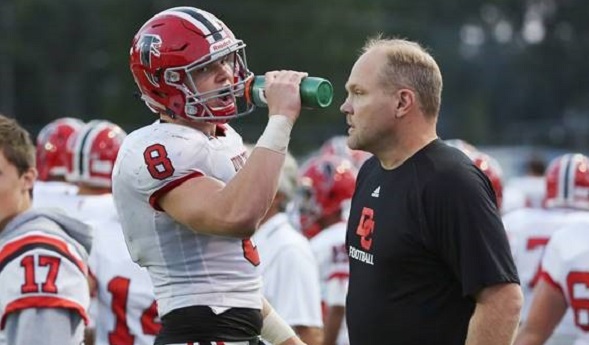
PHOTOS: (Top) Deaborn Divine Child’s Aidan Hutchinson grabs a water break while dad and team physician Chris Hutchinson keeps an eye on the field. (Middle) Hutchinson blocks against Benton Harbor during his team’s Week 1 win. (Below) Aidan, Chris, mom Melissa and U-M coach Jim Harbaugh take a photo after Aidan commits to sign with the Wolverines. (Photos courtesy of the Hutchinson family.)