

Talking Practice: Texas, Illinois Revise Policies
December 20, 2013
By Rob Kaminski
MHSAA benchmarks editor
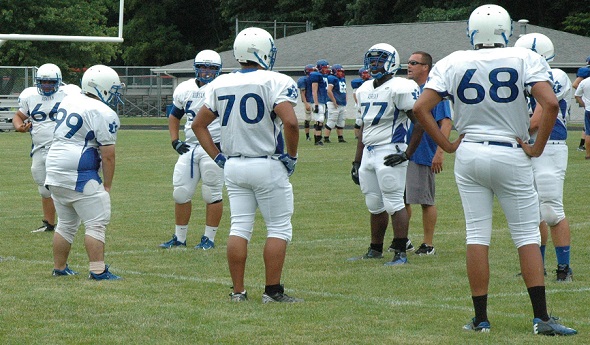
Coaches and players in Texas and Illinois adapted to new football practice limitations this fall, with the Texas policy focusing on contact, and the Illinois regulation emphasizing length of preseason practices.
Following are the main changes those states put in place heading into the 2013-14 season:
The University Interscholastic League, which governs school sports in Texas, put into writing that, “During the regular season and postseason, no football player is allowed to participate in more than ninety (90) minutes of full contact practice per week,” effective with the first day of practice this fall.
The complete policy follows:
For the purposes of the of rule, "full contact" is defined as football drills or live game simulations where "live action" occurs. Live action, as defined by USA Football, is contact at game speed where players execute full tackles at a competitive pace taking players to the ground. A team may continue to dress in full pads for practice, but may only participate in live action drills and game time simulations no more than ninety minutes per athlete per week. It is assumed that when players are in shells (shorts, shoulder pads, and helmets) no live action drills or simulations will occur. This rule is intended to limit live action drills and simulations and not the number of practices a team may participate in full pads. A team may participate in "air," "bags," "wrap," and "thud" drills and simulations at any point. These contact levels are defined below:
• Air - Players should run unopposed without bags or any opposition
• Bags - activity is executed against a bag, shield or pad to allow for a soft-contact surface, with or without the resistance of a teammate or coach standing behind the bag.
• Wrap - Drills run at full speed until contact, which is above the waist with the players remaining on their feet.
• Thud - Same as wrap but tempo is competitive with no pre-determined winner and the players are not tackling to the ground.
 The rule came to the UIL Legislative Council as a recommendation from the UIL Medical Advisory Committee, a permanent advisory committee to the Legislative Council which meets twice each year to discuss and review safety policies for UIL participants. The committee, which is made up of leading medical professionals in various specialties and includes representatives from the Texas High School Coaches Association, the Texas Girls Coaches Association, and the Texas State Athletic Trainer Association, unanimously recommended this limitation in full-contact football practice.
The rule formulates into a formal policy the existing actions of the majority of coaches across Texas, and most coaches have had to make few adjustments, if any. In fact, according to a story on statesman.com, the proposal caused more of an uproar on social media than from coaches.
“It’s not going to affect us in anyway,” Vandegrift HS coach Drew Sanders said in the story. “Most good coaches were way below that 90-minute amount already. Prior to legislation we still monitored it ourselves – the only change is now we have to keep up a log more publicly.”
Illinois put standards in place for its first 14 days of football practices, known as the state’s Preseason Football Acclimatization Practice Period. At the core of the policy is a three-hour practice limit for the first five days, during which teams can also conduct a one-hour walk-through.
 Teams must observe a minimum two hours rest between the practices and walk-throughs. Players may wear helmets only on the first two days, then helmets and shoulder pads for the next three. From days seven through 14 of the acclimatization period, schools may practice for a maximum of five hours per day, as long as that day is followed by a three-hour day, or an off day. During the five-hour days, no session can last more than three hours and must include a two-hour break between practices. Full pads may be worn for the final seven dates leading up to the first contest.
“This policy was the result of a collaborative effort between the IHSA Sports Medicine Advisory Committee and the Football Advisory Committee,” said SMAC committee member and University of Illinois Associate Professor of Orthopedic Surgery Dr. Preston M. Wolin. “The guidelines are based on the most recent scientific evidence, as well as the expertise of the coaches who will help implement them. Both committees believe the guidelines represent a significant positive contribution to the health of our athletes.”
“This new policy undoubtedly changes the way we, as coaches, approach preseason practice,” said Metamora HS coach Pat Ryan, who is a member of the FAC and a past President of the Illinois High School Football Coaches Association. “Coaches have to get more creative with when and how they schedule practices, as well what they do with their time. The proposals were strongly supported by both committees. It is a crucial final step to the process of being able to effectively prepare our teams in a safe manner. Change is always difficult, but the game is changing and we need to adapt to continue to put the safety of our players first.”
The IHSA offered multiple interactive online webinar meetings for high school coaches leading up to the start of practice where questions were answered, along with further clarifications on the policy and the science behind it.
“I think most coaches understood that changes were on the horizon,” said IHSA Executive Director Marty Hickman. “We wanted to be in a position to give our coaches as much information as possible to make sure they are comfortable with the new policy. Their input will be critical moving forward as we develop educational materials, like a best practices presentation. I commend our committees on a policy that is supported by medical experts, football coaches and school administrators.”
DCC, Rice Begin Following New Leaders
By
Tom Markowski
Special for Second Half
August 16, 2017
The Detroit Catholic League football coaching carousel took a few more turns during the offseason, with a pair of programs once led by two of the winningest coaches in state history welcoming new leaders for this fall.
 Two former understudies to those longtime mentors now find themselves with the top jobs directing programs that have combined to earn 18 MHSAA Finals championships.
Adam Korzeniewski, 43, is the new coach at Birmingham Brother Rice, replacing Dave Sofran, who replaced legendary coach Al Fracassa after the Warriors won their third consecutive Division 2 title in 2013.
Dan Anderson, 48, is the new coach at Detroit Catholic Central, taking over for recently-retired Tom Mach, who directed the Shamrocks to a Division 1 runner-up finish nine months ago.
“It is daunting,” Anderson said. “You question yourself. Would Tom have done that? You want to keep the tradition alive. I’m not Tom Mach. I can learn from him and put my stamp on it.”
He and Korzeniewski will seek to do so while navigating what continues to be one of the most competitive leagues in the state. Detroit Catholic Central (10), Brother Rice (8) and Orchard Lake St. Mary’s (7) have combined to amass 25 MHSAA football titles, while Warren DeLaSalle has added two more.
But when Mach announced his retirement from DCC in February, it continued a recent run of Catholic League Central programs passing the baton. Following the 2015 season Paul Verska – who led DeLaSalle to the 2014 Division 2 title – stepped down from the Pilots, and Mike Giannone left Macomb Dakota to fill Verska’s spot. Fracassa retired after the 2013 season with a record of 430-117-7 since starting at Royal Oak Shrine in 1960 and moving to Brother Rice in 1969; he holds Michigan’s record for most high school football coaching wins, while Mach is third with a record of 370-94 from 1976-2016.
St. Mary’s longtime leader George Porritt (256-71 since 1989) will enter this season as the league’s only coach with more than a year heading up the program at his school.
“I’m not a tight T (formation) guy. But I will run it right at you,” Anderson said in explaining a philosophical similarity to Mach. “And I do run some tight T plays. You can’t get rid of the wham. Tom’s philosophy was defense wins championships. That won’t change while I’m here.”
The wham is a basic run play into the middle of the line, a trademark of Mach’s offense. It’s simple but often effective. Anderson said he will install a multiple offense incorporating formations and plays from a variety of schemes as the Shamrocks look to add to last season's 13-1 run.
Anderson has been well-schooled, at Catholic Central and a number of high schools in Ohio where he grew up, played football and coached. He came to Catholic Central in 1999 as a freshmen coach. The next five seasons he was the head junior varsity coach. In 2005, he became a varsity assistant – and in 2007 he became the defensive coordinator.
Anderson played defensive end and offensive tackle at Archbishop Alter in Kettering, Ohio, located near Dayton. He earned a scholarship to University of Pittsburgh where he played guard and was a starter his junior and senior seasons.
Long before then, he knew he wanted to become a teacher and a coach. A junior high history teacher, who was also a coach, played a major role in Anderson becoming the person he is today.
“He coached me in CYO (Catholic Youth Organization),” Anderson said. “He made a big impression upon me. I was 12 or 13 years old, and I knew then I wanted to teach history and coach.
 “I love the game (of football). As soon as I got out of college (1992), I started coaching as a volunteer assistant at Penn Hills (Pa.).”
And he hasn’t stopped coaching since. After leaving Penn Hills, Anderson went to Pomfret, Maryland, located just outside of Washington, D.C., and coached three sports (baseball, basketball and football) at McDonough High. After two years, he went back to his alma mater and spent five years there, the last three as the head football coach. His wife at the time was transferred to General Motors in the Detroit area and, again, Anderson sent out applications and was hired by Catholic Central as a history teacher and football coach.
Anderson said he feels fortunate to be in this position. Learning and having mentors within a parochial school system prepared him for this opportunity and challenge.
“Mach, to me, was a heck of a mentor,” he said. “My high school coach, Ed Domstiz, was one of my mentors, too. And he’s still coaching.
“Tom was laid back. He didn’t take things too seriously. With all of the extracurricular things that go on now, he wanted football to remain a game. That bothered him, the kids jumping from one school to another. To me, high school was a great time, all of the friends that you made. When you move around you miss that.
“For Tom, it was more of his relationships with people. He had the Xs and Os, but it was about building men. That was always an emphasis. You had to develop them into great people. What you saw with Tom is what you got. It was refreshing.”
Though Korzeniewski isn’t directly replacing a legend, Fracassa’s shadow still looms over Brother Rice football; history doesn’t leave us that quickly. Expectations remain high for a program that won three straight Division 2 titles from 2011-13. The Warriors finished 7-4 last fall.
There’s an added unknown for Korzeniewski. He’s never been a head coach before. He’s coached for 17 seasons, including six as Fracassa’s defensive coordinator. The last two seasons Korzeniewski was the defensive coordinator at Birmingham Seaholm, working under his good friend Jim DeWald. The two were teammates at Western Michigan during the mid-1990s.
Korzeniewski’s approach is to keep things simple. He doesn’t see his job as having more pressure than most head coaching positions. As a coach, you teach. For the players, they learn.
“To me, it’s my job,” he said. “I go about it as I would anything else. To other people it would be different. I do my job every day.
“I didn’t come here thinking other people did this or that. It’s the kids. It goes back to why I got into coaching. You see the progress. It’s important to them that they get better. Football is important to them.”
Just as Anderson learned from his predecessor, Korzeniewski has borrowed much from Fracassa.
“I learned the importance of a team,” Korzeniewski said. “Nothing is more important than the team. And there’s something else. He made every player feel a part of the team. He had a way to make kids compete. I wish I could do that.
“What’s important to me is that things get taught and understood. You have to be demanding and supportive. (It’s) the action and reaction.”
Rest assured, both coaches will be watched as if through a microscopic lens. They understand that. They also understand they are heading into once-in-a-lifetime opportunities, and they’re going to make the most of them.
“I’m excited,” Anderson said. “We have a great group of kids. We have a great group of coaches and we’re going to enjoy each other’s company.”
 Tom Markowski is a columnist and directs website coverage for the State Champs! Sports Network. He previously covered primarily high school sports for the The Detroit News from 1984-2014, focusing on the Detroit area and contributing to statewide coverage of football and basketball. Contact him at [email protected] with story ideas for Oakland, Macomb and Wayne counties.
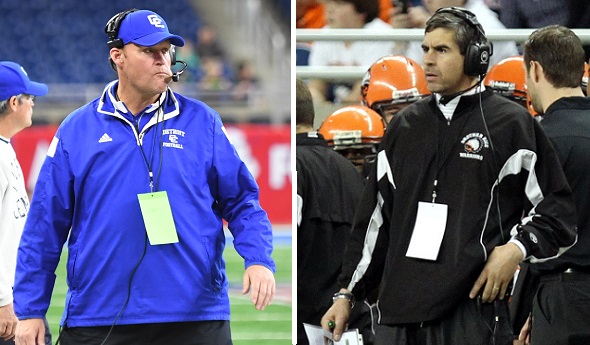
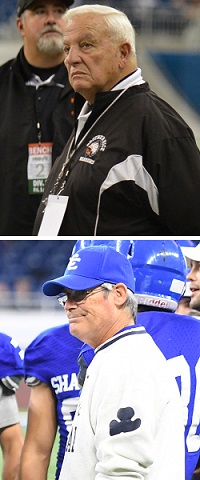
PHOTOS: (Top) Detroit Catholic Central's Dan Anderson (left), here coaching the defense during the 2016 Division 1 Final, and Brother Rice's Adam Korzeniewski, the Warriors' defensive coordinator during their 2012 Division 2 title run, are taking over top Detroit Catholic League programs this fall. (Middle) Former Brother Rice coach Al Fracassa (top) retired after the 2013 season, while DCC's Tom Mach stepped down in February.