

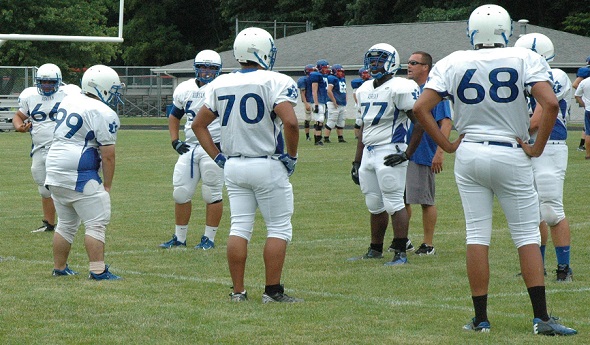
Talking Practice: Texas, Illinois Revise Policies
December 20, 2013
By Rob Kaminski
MHSAA benchmarks editor
Coaches and players in Texas and Illinois adapted to new football practice limitations this fall, with the Texas policy focusing on contact, and the Illinois regulation emphasizing length of preseason practices.
Following are the main changes those states put in place heading into the 2013-14 season:
The University Interscholastic League, which governs school sports in Texas, put into writing that, “During the regular season and postseason, no football player is allowed to participate in more than ninety (90) minutes of full contact practice per week,” effective with the first day of practice this fall.
The complete policy follows:
For the purposes of the of rule, "full contact" is defined as football drills or live game simulations where "live action" occurs. Live action, as defined by USA Football, is contact at game speed where players execute full tackles at a competitive pace taking players to the ground. A team may continue to dress in full pads for practice, but may only participate in live action drills and game time simulations no more than ninety minutes per athlete per week. It is assumed that when players are in shells (shorts, shoulder pads, and helmets) no live action drills or simulations will occur. This rule is intended to limit live action drills and simulations and not the number of practices a team may participate in full pads. A team may participate in "air," "bags," "wrap," and "thud" drills and simulations at any point. These contact levels are defined below:
• Air - Players should run unopposed without bags or any opposition
• Bags - activity is executed against a bag, shield or pad to allow for a soft-contact surface, with or without the resistance of a teammate or coach standing behind the bag.
• Wrap - Drills run at full speed until contact, which is above the waist with the players remaining on their feet.
• Thud - Same as wrap but tempo is competitive with no pre-determined winner and the players are not tackling to the ground.
 The rule came to the UIL Legislative Council as a recommendation from the UIL Medical Advisory Committee, a permanent advisory committee to the Legislative Council which meets twice each year to discuss and review safety policies for UIL participants. The committee, which is made up of leading medical professionals in various specialties and includes representatives from the Texas High School Coaches Association, the Texas Girls Coaches Association, and the Texas State Athletic Trainer Association, unanimously recommended this limitation in full-contact football practice.
The rule formulates into a formal policy the existing actions of the majority of coaches across Texas, and most coaches have had to make few adjustments, if any. In fact, according to a story on statesman.com, the proposal caused more of an uproar on social media than from coaches.
“It’s not going to affect us in anyway,” Vandegrift HS coach Drew Sanders said in the story. “Most good coaches were way below that 90-minute amount already. Prior to legislation we still monitored it ourselves – the only change is now we have to keep up a log more publicly.”
Illinois put standards in place for its first 14 days of football practices, known as the state’s Preseason Football Acclimatization Practice Period. At the core of the policy is a three-hour practice limit for the first five days, during which teams can also conduct a one-hour walk-through.
 Teams must observe a minimum two hours rest between the practices and walk-throughs. Players may wear helmets only on the first two days, then helmets and shoulder pads for the next three. From days seven through 14 of the acclimatization period, schools may practice for a maximum of five hours per day, as long as that day is followed by a three-hour day, or an off day. During the five-hour days, no session can last more than three hours and must include a two-hour break between practices. Full pads may be worn for the final seven dates leading up to the first contest.
“This policy was the result of a collaborative effort between the IHSA Sports Medicine Advisory Committee and the Football Advisory Committee,” said SMAC committee member and University of Illinois Associate Professor of Orthopedic Surgery Dr. Preston M. Wolin. “The guidelines are based on the most recent scientific evidence, as well as the expertise of the coaches who will help implement them. Both committees believe the guidelines represent a significant positive contribution to the health of our athletes.”
“This new policy undoubtedly changes the way we, as coaches, approach preseason practice,” said Metamora HS coach Pat Ryan, who is a member of the FAC and a past President of the Illinois High School Football Coaches Association. “Coaches have to get more creative with when and how they schedule practices, as well what they do with their time. The proposals were strongly supported by both committees. It is a crucial final step to the process of being able to effectively prepare our teams in a safe manner. Change is always difficult, but the game is changing and we need to adapt to continue to put the safety of our players first.”
The IHSA offered multiple interactive online webinar meetings for high school coaches leading up to the start of practice where questions were answered, along with further clarifications on the policy and the science behind it.
“I think most coaches understood that changes were on the horizon,” said IHSA Executive Director Marty Hickman. “We wanted to be in a position to give our coaches as much information as possible to make sure they are comfortable with the new policy. Their input will be critical moving forward as we develop educational materials, like a best practices presentation. I commend our committees on a policy that is supported by medical experts, football coaches and school administrators.”

Football Finals Protocols Announced
November 21, 2016
By Geoff Kimmerly
Second Half editor
To provide for the convenience and safety of spectators attending the Michigan High School Athletic Association 11-Player Football Finals – presented by the Michigan National Guard – at Ford Field in Detroit, Nov. 25 and 26, attendees are being advised of a variety of items related to transportation and security – including policies regulating types of bags allowed into the stadium.
Parking will be available in Ford Field facilities and lots to the east and north of the stadium and costs $6. A map identifying the designated Ford Field lot (4) and parking deck can be found on the Football page of the MHSAA Website. (There also are a number of privately-operated parking facilities close to Ford Field, but their pricing may differ.)
Fans also are advised that tailgating, including the setting up and use of grilling equipment, and the consumption of alcohol, is prohibited in Ford Field parking facilities and lots.
Gates A, B and G will be available for public entrance during the event. Ticket sales will begin near Gates A and G at 8 a.m. each day, and the building will open its doors to spectators at 9 a.m. Tickets must be paid for in cash only.
Tickets are priced at $10 and allow a fan to see all four games in a single day. Spectators leaving the stadium will be required to purchase another ticket for re-entry. Children under the age of 2 will be admitted without charge for this event. There will not be a public Will Call window.
Upon arrival in the building, fans will find their designated seating areas on the South side of the field if their team is the designated home team for their contest and on the North side for the designated visiting team. Home teams this weekend are Detroit Catholic Central, Walled Lake Western, Muskegon, Grand Rapids Catholic Central, Menominee, Maple City Glen Lake, Pewamo-Westphalia and Muskegon Catholic Central. Brightly lit video boards above the seating areas will display the names of the participating teams each day, and fans should sit on the side of the stadium where they see their school’s name. For general fans, the entire lower bowl of Ford Field will be open for the event.
Security measures also will be in place to help assure spectator safety. Fans will be subject to a visual search, and Ford Field personnel reserve the right to request patrons open their coats, bags and other item-carrying vessels for visual inspection and deny entrance to individuals who do not cooperate.
Items which fans will be prohibited from bringing into the building include, but are not limited to, the following:
• Purses larger than a clutch bag, coolers, briefcases, backpacks, cinch bags, grocery & paper bags, duffle bags, luggage of any kind, computer and camera bags and large camera cases.
• Aerosol cans (hairspray, mace, pepper spray, etc.)
• Animals (except service animals to aid guests with disabilities)
• Balloons (air or helium)
• Balls (beach balls, footballs, etc.)
• Banners or large flags
• Cameras with lenses longer than five inches. Selfie Sticks also are prohibited.
• Decals, stickers, confetti or glitter
• Electronic equipment including laptop computers, video recorders (hand-held video cameras are allowed), tripods and wearable video cameras including Go Pros.
• Fireworks
• Food, beverages or liquids (cans, bottles, boxes, flasks, etc.)
• Illegal substances
• Knives, pocket knives, box cutters, scissors, etc.
• Laser pointers
• Markers (permanent) and/or paint
• Noisemaking devices (bells, horns, kazoos, whistles, etc.)
• Objects that can be used as missiles or projectiles (sticks, bats, clubs, Frisbees, etc.)
• Seat cushions
• Strollers and infant car seats or carriers
• Umbrellas (large size)
• Weapons
The following items will be permitted after inspection:
• Small bags, purses and fanny packs that do not exceed 8½ inches by 14 inches by 10 inches. An exception will be made for medically necessary items after proper inspection at a gate designated for this purpose.
• Diaper bags (only if accompanied by a child)
• Binoculars and binoculars cases
• Cameras and small camera cases (lenses may not measure longer than five inches)
• Small radios (no larger than the size of a football and used with an earpiece)
• Small hand-held video cameras (but no tripods or extension cords)
• Small, compact umbrellas (must be placed securely under seat)
• Posters and signs without poles or sticks, or larger than what one person can hold.
The complete list of prohibited items can be found on the Ford Field Website at the bottom of the web page under Stadium Info, Policies. Prohibited items that are discovered during security inspections at stadium entrances must either be returned to the owner's vehicle or discarded. Items will not be held for later pickup.
Fans are reminded that all image taking (still and video) may be only for personal, non-commercial use.