

Talking Practice: Texas, Illinois Revise Policies
December 20, 2013
By Rob Kaminski
MHSAA benchmarks editor
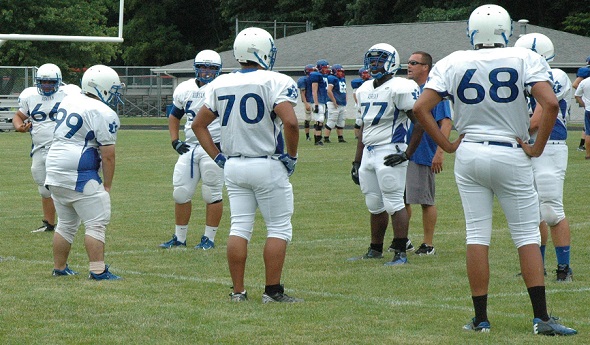
Coaches and players in Texas and Illinois adapted to new football practice limitations this fall, with the Texas policy focusing on contact, and the Illinois regulation emphasizing length of preseason practices.
Following are the main changes those states put in place heading into the 2013-14 season:
The University Interscholastic League, which governs school sports in Texas, put into writing that, “During the regular season and postseason, no football player is allowed to participate in more than ninety (90) minutes of full contact practice per week,” effective with the first day of practice this fall.
The complete policy follows:
For the purposes of the of rule, "full contact" is defined as football drills or live game simulations where "live action" occurs. Live action, as defined by USA Football, is contact at game speed where players execute full tackles at a competitive pace taking players to the ground. A team may continue to dress in full pads for practice, but may only participate in live action drills and game time simulations no more than ninety minutes per athlete per week. It is assumed that when players are in shells (shorts, shoulder pads, and helmets) no live action drills or simulations will occur. This rule is intended to limit live action drills and simulations and not the number of practices a team may participate in full pads. A team may participate in "air," "bags," "wrap," and "thud" drills and simulations at any point. These contact levels are defined below:
• Air - Players should run unopposed without bags or any opposition
• Bags - activity is executed against a bag, shield or pad to allow for a soft-contact surface, with or without the resistance of a teammate or coach standing behind the bag.
• Wrap - Drills run at full speed until contact, which is above the waist with the players remaining on their feet.
• Thud - Same as wrap but tempo is competitive with no pre-determined winner and the players are not tackling to the ground.
 The rule came to the UIL Legislative Council as a recommendation from the UIL Medical Advisory Committee, a permanent advisory committee to the Legislative Council which meets twice each year to discuss and review safety policies for UIL participants. The committee, which is made up of leading medical professionals in various specialties and includes representatives from the Texas High School Coaches Association, the Texas Girls Coaches Association, and the Texas State Athletic Trainer Association, unanimously recommended this limitation in full-contact football practice.
The rule formulates into a formal policy the existing actions of the majority of coaches across Texas, and most coaches have had to make few adjustments, if any. In fact, according to a story on statesman.com, the proposal caused more of an uproar on social media than from coaches.
“It’s not going to affect us in anyway,” Vandegrift HS coach Drew Sanders said in the story. “Most good coaches were way below that 90-minute amount already. Prior to legislation we still monitored it ourselves – the only change is now we have to keep up a log more publicly.”
Illinois put standards in place for its first 14 days of football practices, known as the state’s Preseason Football Acclimatization Practice Period. At the core of the policy is a three-hour practice limit for the first five days, during which teams can also conduct a one-hour walk-through.
 Teams must observe a minimum two hours rest between the practices and walk-throughs. Players may wear helmets only on the first two days, then helmets and shoulder pads for the next three. From days seven through 14 of the acclimatization period, schools may practice for a maximum of five hours per day, as long as that day is followed by a three-hour day, or an off day. During the five-hour days, no session can last more than three hours and must include a two-hour break between practices. Full pads may be worn for the final seven dates leading up to the first contest.
“This policy was the result of a collaborative effort between the IHSA Sports Medicine Advisory Committee and the Football Advisory Committee,” said SMAC committee member and University of Illinois Associate Professor of Orthopedic Surgery Dr. Preston M. Wolin. “The guidelines are based on the most recent scientific evidence, as well as the expertise of the coaches who will help implement them. Both committees believe the guidelines represent a significant positive contribution to the health of our athletes.”
“This new policy undoubtedly changes the way we, as coaches, approach preseason practice,” said Metamora HS coach Pat Ryan, who is a member of the FAC and a past President of the Illinois High School Football Coaches Association. “Coaches have to get more creative with when and how they schedule practices, as well what they do with their time. The proposals were strongly supported by both committees. It is a crucial final step to the process of being able to effectively prepare our teams in a safe manner. Change is always difficult, but the game is changing and we need to adapt to continue to put the safety of our players first.”
The IHSA offered multiple interactive online webinar meetings for high school coaches leading up to the start of practice where questions were answered, along with further clarifications on the policy and the science behind it.
“I think most coaches understood that changes were on the horizon,” said IHSA Executive Director Marty Hickman. “We wanted to be in a position to give our coaches as much information as possible to make sure they are comfortable with the new policy. Their input will be critical moving forward as we develop educational materials, like a best practices presentation. I commend our committees on a policy that is supported by medical experts, football coaches and school administrators.”
Drive for Detroit: Semifinals Preview
November 18, 2016
By Geoff Kimmerly
Second Half editor
Ford Field is only one more win away for 32 teams playing in MHSAA Semifinals on Saturday.
 Five of eight reigning champions are playing to get back. Twice as many teams are playing to reach the final round for the first time.
Below is a look at all 16 Semifinal games, powered by MI Student Aid. All games will be broadcast, four on FoxSportsDetroit.com and 12 on MHSAA.tv; click for the schedule. And stay connected all Saturday for scores as they come in on MHSAA.com.
Division 1
Romeo (9-3) vs. Detroit Catholic Central (12-0) at Howell Parker Middle School
Reigning Division 1 champion Romeo seemed out of the running for a return run with two losses over the first five weeks (although by just a combined three points) and then a big one in Week 8 to Macomb Dakota. But a defense that has given up more than 16 points only once since opening night has given up just 17 total over three playoff games. Leading rusher and receiver Kade Messner (617 yards/6 TDs rushing, 229 yards/1 TD receiving) averages 10 yards per carry. DCC fell to Romeo in a Regional Final last year, 40-29, but has churned out a perfect season to earn a rematch, with senior Nick Capatina (996 yards/13 TDs rushing) and junior Cameron Ryan (748/14) carrying a good chunk of the load.
Utica Eisenhower (12-0) vs. Detroit Cass Tech (12-0) at Troy Athens
The Eagles are making their first Semifinal appearance since 2011, when they fell to Cass Tech 6-3, and already have secured their winningest season since 2003. Junior quarterback Max Wittwer (1,574 yards/19 TDs passing, 768 yards/8 TDs rushing) and senior running back Jack Provencher (1,434 yards/24 TDs rushing) make it impossible for defenses to stack in trying to stop an offense that has scored at least 42 points in every playoff game. Cass Tech is more familiar with this round than most; this will be its seventh straight Semifinal. The Technicians feature some of the best-known playmakers in the state, including senior quarterback Rodney Hall (2,125 yards/22 TDs passing) and senior receiver Donovan People-Jones (889 yards/15 TDs receiving).
Division 2
Walled Lake Western (11-1) vs. Lowell (12-0) at Brighton
This is a rematch of a 2015 Semifinal won by Lowell 49-34 – and the Red Arrows also beat Western 42-35 in a 2011 Semifinal. The Warriors reaching their first MHSAA championship game since 1999 likely will rest in part on the arm of senior quarterback Johnny Tracy (2,050 yards/23 TDs passing) and senior receivers Kameron Ford (1,013 yards/12 TDs receiving) and Cody White (669 yards/9 TDs receiving, 443 yards/6 TDs rushing). Lowell also follows a talented quarterback, junior David Kruse (1,573 yards/8 TDs passing, 1,438 yards/23 TDs rushing), and his leading running back, senior Nate Stephens (1,402 yards/21 TDs.). And trust the Red Arrows are extra motivated to get back to Ford Field after watching last season’s title slip away to Detroit Martin Luther King on the final play of the game.
Birmingham Groves (11-1) vs. Detroit Martin Luther King (10-2) at Dearborn
The reigning champion Crusaders have lost only to Division 1 semifinalist Detroit Cass Tech, twice, and are playing in their fourth Semifinal in six seasons. After the sudden death of coach Dale Harvel in July, King has rallied behind new coach Ty Spencer and followed sophomore quarterback Dequan Finn (1,986 yards/33 TDs passing) with major contributions by senior running back Kevin Willis (1,003 yards/13 TDs rushing) and senior receiver Ambry Thomas (766 yards/13 TDs receiving) among many others. After making its first Regional Final since 2004, Groves is playing in its first Semifinal ever. The Falcons have given up more than 15 points only once since opening night and 25 total over three playoff games while getting balanced offensive power from senior quarterback Beau Kewley (909 yards/12 TDs passing) and senior running back Ernest Allen (924 yards/11 TDs rushing).
Division 3
Edwardsburg (12-0) vs. Muskegon (11-1) at East Kentwood
Edwardsburg will play its third Semifinal in seven seasons seeking its first championship game berth and coming off a two-point win over Chelsea, last season’s Division 3 runner-up. And this might be the most impressive team of the Eddies’ recent run. Edwardsburg gave up only 38 points over the first 10 weeks of the season before allowing 60 total over the last two; the Eddies also have run for 4,473 yards, led by juniors Nick Bradley (1,363 yards/18 TDs) and Kyle Shrider (843 yards/15 TDs). After making only the Regional Final last season, Muskegon is back in its fourth Semifinal over the last five years. The Big Reds already have set a program record with 634 points (52.8 per game) keyed by their dual quarterbacks – senior Kalil Pimpleton (714 yards/14 TDs passing, 1,314 yards/21 TDs rushing) and junior La’darius Jefferson (863 yards/9 TDs passing, 709 yards/15 TDs rushing).
Dearborn Divine Child (10-2) vs. Orchard Lake St. Mary’s (8-4) at West Bloomfield
This is the first meeting between these Detroit Catholic League contenders since 2008. The Falcons have built their strongest effort since 1985 with a six-game winning streak after suffering back-to-back losses in Weeks 5 and 6. Divine Child avenged one of those, to Division 7 semifinalist Detroit Loyola, in Week 9, and last week handed Allen Park its only loss of the season. Junior quarterback Theo Day has thrown for 1,508 yards and 21 touchdowns to lead the way. Reigning Division 3 champion St. Mary’s advanced to its seventh Semifinal in eight seasons with a comeback win at DeWitt last week. The Eaglets move the ball with junior running backs RaShawn Allen (1,833 yards/21 TDs rushing) and Ky’ren Cunningham (860 yards/13 TDs), who both average at least eight yards a carry.
Division 4
Hudsonville Unity Christian (10-2) vs. Grand Rapids Catholic Central (11-1) at Greenville
Unity Christian’s best season ever moves on to its first Semifinal, thanks to an overtime win over previously undefeated Benton Harbor last week. The Crusaders won’t be intimidated by the annually successful Cougars after navigating the Ottawa-Kent Conference Green, one of the most competitive leagues in the state this season. They cover a lot of ground with senior running back Parker Scholten (1,353 yards/14 TDs rushing) and senior quarterback Mitchell Dykstra (924/15). GRCC is making its first Semifinal appearance since winning Division 4 in 2010. But the Cougars have a chance to do some great things next year too with juniors the top playmakers this fall. Quarterback Jack Bowen has thrown for 2,329 yards and 24 touchdowns and running back Nolan Fugate is the leading rusher with 1,359 yards and 11 scores on the ground.
River Rouge (11-1) vs. Detroit Country Day (12-0) at Hazel Park
River Rouge just missed its first MHSAA championship a year ago, falling to Grand Rapids West Catholic by six in the Final, and hasn’t really been slowed this fall. The Panthers at one point shut out seven straight opponents and eight over nine games including the first of the playoffs, and they’ve gone over 600 points for the second season in a row led by senior quarterback Jairus Grissom (1,369 yards/18 TDs rushing, 1,967 yards/23 TDs passing). Country Day is playing its fourth Semifinal in five seasons seeking its first championship game berth since 2012. The Yellowjackets are incredibly balanced on offense, with a pair of quarterbacks (senior Steven Mann and sophomore Jalen Graham) both having success. But the defense stands out most; led by senior linebacker Kolin Demens, Country Day is giving up only 8.6 points per game and has allowed more than 14 only twice.
Division 5
Frankenmuth (11-1) vs. Menominee (11-1) at Northern Michigan’s Superior Dome
The Eagles have had only four sub-.500 finishes over the last 32 seasons, and 22 playoff appearances during that time. But they broke through again for their first Semifinal berth since 1997, handing Ithaca last week its first loss not in an MHSAA Final since 2008. Senior running back Kris Roche (1,005 yards/16 TDs rushing) and senior quarterback Jared Davis (922 yards/16 TDs rushing, 1,169 yards/11 TDs passing) give Frankenmuth multiple threats. As it has done for decades, Menominee is again trampling opponents, although lead back Keifer Rasner (1,372 yards/20 TDs rushing, 410 yards/3 TDs passing) was reportedly hurt two weeks ago and isn’t expected to play. Ethan Mileski (584 yards/5 TDs rushing, 1,066 yards/14 TDs passing) is another offensive standout to watch.
Algonac (11-1) vs. Grand Rapids West Catholic (10-2) at Battle Creek Harper Creek
Algonac’s best two seasons in program history have been this one and last, and they’ve taken the next step with their first Semifinal appearance. Senior quarterback Brendan Piper is a two-way threat, throwing for 1,086 yards and 13 touchdowns this fall and running for a team-high 903 yards and 14 scores. Three-time reigning champion West Catholic has had to play three road games this playoff run, but outscored those opponents by a combined 78-20. Veteran duo David Fox and Gaetano Vallone are again big reasons why; the senior running back sometimes quarterback Fox had thrown for 1,286 yards and 17 touchdowns and run for 689 yards and eight scores, while junior quarterback Vallone has thrown for 889 yards and seven TDs.
Division 6
Leroy Pine River (9-2) vs. Maple City Glen Lake (10-2) at Traverse City Thirlby Field
Pine River’s first run to a Semifinal has included a ninth win for the second time ever and first time since 1999. Senior quarterback Mason Powell has had quite a final campaign, bringing the Bucks back from 4-5 last season by throwing for 1,047 yards and 15 touchdowns and running for 1,259 yards and 17 scores. The Lakers have had a little more recent success but still are making their first Semifinal appearance since 1996. Junior running back Nick Apsey carries a lot of the load offensively and has scored 22 times. But the defense also has been outstanding, giving up more than 14 points only twice and 112 points total this fall.
Jackson Lumen Christi (10-2) vs. Millington (11-1) at Lansing Catholic
Lumen Christi is back in the Semifinals for the first time since winning Division 5 in 2009; the Titans have won nine straight games to get here. Running back Bo Bell was the star in last week’s Regional Final win over Napoleon, and all season as well; he’s run for 2,200 yards and 29 touchdowns. Quarterback Troy Kutcha has added 1,313 yards and 10 scores through the air and run for six touchdowns. Millington is playing in its fifth Semifinal and seeking to reach the championship round for the first time. Junior quarterback Bryce Bearss (2,212 yards/25 TDs passing) and senior running back Brady Payne (1,196 yards/14 TDs rushing) give the Cardinals a strong 1-2 punch as well.
Division 7
Ubly (12-0) vs. Pewamo-Westphalia (12-0) at Mount Pleasant
Reigning Division 7 runner-up Pewamo-Westphalia will face its third straight undefeated opponent after handing first and only losses to Saugatuck and Traverse City St. Francis the last two weeks. Senior running back Jared Smith fell short of 100 yards rushing last week for the first time since his sophomore year, but continues to inch toward the MHSAA career rushing record and now has 2,403 yards and 36 touchdowns on the ground this season and more than 8,000 yards rushing for his career. Ubly also is a recent visitor to the Finals, its last trip coming in 2008. The Bearcats have controlled the ball with a rumbling ground game as well; senior Derek Brown has run for 1,226 yards and 19 touchdowns and senior Jonathan Brandel has gained 980 yards and 15 scores rushing.
Detroit Loyola (10-2) vs. Cassopolis (11-1) at Jackson
Loyola is another regular in this round, playing in its fifth straight Semifinal. The Bulldogs have beaten a league champion every week of the playoffs this time, and Cassopolis would be the fourth. Loyola averages 34 running plays per game and brings three 1,000-yard rushers – Malcolm Mayes (1,240 yards/14 TDs), D’Anthony Robinson (1,208 yards/18 TDs) and quarterback Price Watkins (1,010 yards/8 TDs rushing, 659 yards/7 TDs passing). Cassopolis is playing in his first Semifinal after setting a program record for wins last week. The Rangers roll with a loaded backfield; senior quarterback Shane Los has thrown for 1,320 yards and 17 touchdowns, while junior Brandon Anderson has run for 956 yards and 11 touchdowns and scored six more receiving. Sophomore Tyrese Hunt-Thompson has run for 811 yards and 10 scores and is the leading receiver with 533 yards and five TDs.
Division 8
Muskegon Catholic Central (12-0) vs. St. Ignace (11-1) at Petoskey
This is a rematch both of last season’s Semifinal (33-20 MCC win) and Week 2 of this fall (Crusaders 21-6), as St. Ignace gave MCC easily its closest game this season. The Crusaders have won three straight Division 8 titles and after facing mostly bigger schools during the regular season have given up only seven points over three playoff games. Senior LaTommy Scott (820 yards/8 TDs rushing) has starred for a few seasons and is one of five who have rushed for at least 370 yards. The Saints attack in multiple ways; senior running back Mitchell Peterson has run for 1,275 yards and senior quarterback Steve Seccia has thrown for 1,530 and 23 touchdowns.
Ottawa Lake Whiteford (12-0) vs. Saginaw Michigan Lutheran Seminary (10-2) at Dearborn Edsel Ford
Whiteford’s best two seasons also were the last two, with the Bobcats winning 10 games for the first time in 2015 and this their second straight Semifinal. Whiteford has set school records with 545 points, 222 first downs, 552 carries and 3,729 rushing yards this fall. Leading the way are running back Jessie Kiefer (1,057 yards, 27 touchdowns rushing, 287 yards/5 TDs receiving) and freshman Conner Hoogendoorn (811 yards/15 TDs). Michigan Lutheran Seminary is playing in its second Semifinal in three seasons to reach its first championship game since 1986. The Cardinals have given up only 13 points over three playoff games and force an average of two turnovers per game. Senior Casey Williams is the main scorer with 24 touchdowns, with 19 on the ground (and 1,226 yards).
Second Half’s weekly “Drive for Detroit” previews are powered by MI Student Aid, a part of the Student Financial Services Bureau located within the Michigan Department of Treasury. MI Student Aid encourages students to pursue postsecondary education by providing access to student financial resources and information, including various student financial assistance programs to help make college more affordable for Michigan students. MI Student Aid administers the state’s 529 savings programs (MET/MESP) and eight additional aid programs within its Student Scholarships and Grants division. Click for more information and connect with MI Student Aid on Facebook and Twitter @mistudentaid.
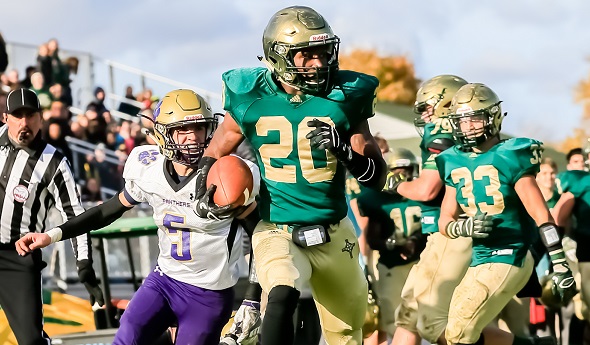
PHOTO: Muskegon Catholic Central's LaTommy Scott (20) breaks away for a touchdown against Frankfort in last week's Regional Final. (Photo by Tim Reilly.)