

Talking Practice: Texas, Illinois Revise Policies
December 20, 2013
By Rob Kaminski
MHSAA benchmarks editor
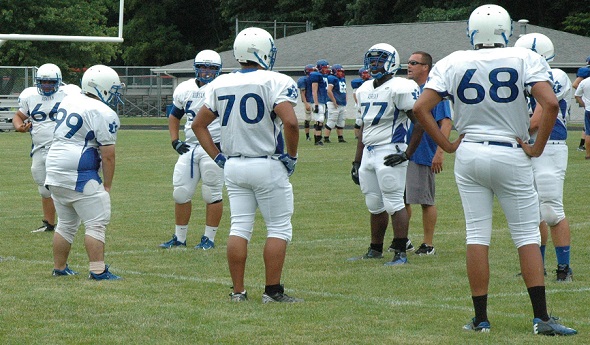
Coaches and players in Texas and Illinois adapted to new football practice limitations this fall, with the Texas policy focusing on contact, and the Illinois regulation emphasizing length of preseason practices.
Following are the main changes those states put in place heading into the 2013-14 season:
The University Interscholastic League, which governs school sports in Texas, put into writing that, “During the regular season and postseason, no football player is allowed to participate in more than ninety (90) minutes of full contact practice per week,” effective with the first day of practice this fall.
The complete policy follows:
For the purposes of the of rule, "full contact" is defined as football drills or live game simulations where "live action" occurs. Live action, as defined by USA Football, is contact at game speed where players execute full tackles at a competitive pace taking players to the ground. A team may continue to dress in full pads for practice, but may only participate in live action drills and game time simulations no more than ninety minutes per athlete per week. It is assumed that when players are in shells (shorts, shoulder pads, and helmets) no live action drills or simulations will occur. This rule is intended to limit live action drills and simulations and not the number of practices a team may participate in full pads. A team may participate in "air," "bags," "wrap," and "thud" drills and simulations at any point. These contact levels are defined below:
• Air - Players should run unopposed without bags or any opposition
• Bags - activity is executed against a bag, shield or pad to allow for a soft-contact surface, with or without the resistance of a teammate or coach standing behind the bag.
• Wrap - Drills run at full speed until contact, which is above the waist with the players remaining on their feet.
• Thud - Same as wrap but tempo is competitive with no pre-determined winner and the players are not tackling to the ground.
 The rule came to the UIL Legislative Council as a recommendation from the UIL Medical Advisory Committee, a permanent advisory committee to the Legislative Council which meets twice each year to discuss and review safety policies for UIL participants. The committee, which is made up of leading medical professionals in various specialties and includes representatives from the Texas High School Coaches Association, the Texas Girls Coaches Association, and the Texas State Athletic Trainer Association, unanimously recommended this limitation in full-contact football practice.
The rule formulates into a formal policy the existing actions of the majority of coaches across Texas, and most coaches have had to make few adjustments, if any. In fact, according to a story on statesman.com, the proposal caused more of an uproar on social media than from coaches.
“It’s not going to affect us in anyway,” Vandegrift HS coach Drew Sanders said in the story. “Most good coaches were way below that 90-minute amount already. Prior to legislation we still monitored it ourselves – the only change is now we have to keep up a log more publicly.”
Illinois put standards in place for its first 14 days of football practices, known as the state’s Preseason Football Acclimatization Practice Period. At the core of the policy is a three-hour practice limit for the first five days, during which teams can also conduct a one-hour walk-through.
 Teams must observe a minimum two hours rest between the practices and walk-throughs. Players may wear helmets only on the first two days, then helmets and shoulder pads for the next three. From days seven through 14 of the acclimatization period, schools may practice for a maximum of five hours per day, as long as that day is followed by a three-hour day, or an off day. During the five-hour days, no session can last more than three hours and must include a two-hour break between practices. Full pads may be worn for the final seven dates leading up to the first contest.
“This policy was the result of a collaborative effort between the IHSA Sports Medicine Advisory Committee and the Football Advisory Committee,” said SMAC committee member and University of Illinois Associate Professor of Orthopedic Surgery Dr. Preston M. Wolin. “The guidelines are based on the most recent scientific evidence, as well as the expertise of the coaches who will help implement them. Both committees believe the guidelines represent a significant positive contribution to the health of our athletes.”
“This new policy undoubtedly changes the way we, as coaches, approach preseason practice,” said Metamora HS coach Pat Ryan, who is a member of the FAC and a past President of the Illinois High School Football Coaches Association. “Coaches have to get more creative with when and how they schedule practices, as well what they do with their time. The proposals were strongly supported by both committees. It is a crucial final step to the process of being able to effectively prepare our teams in a safe manner. Change is always difficult, but the game is changing and we need to adapt to continue to put the safety of our players first.”
The IHSA offered multiple interactive online webinar meetings for high school coaches leading up to the start of practice where questions were answered, along with further clarifications on the policy and the science behind it.
“I think most coaches understood that changes were on the horizon,” said IHSA Executive Director Marty Hickman. “We wanted to be in a position to give our coaches as much information as possible to make sure they are comfortable with the new policy. Their input will be critical moving forward as we develop educational materials, like a best practices presentation. I commend our committees on a policy that is supported by medical experts, football coaches and school administrators.”
A Game for Every Fan: Playoffs Week 1
October 28, 2015
By Geoff Kimmerly
Second Half editor
This first week of the 41st MHSAA Football Playoffs will be filled with firsts and familiar faces.
Benton Harbor, Detroit Cesar Chavez Academy and Parma Western will take part in the first playoff games in their football programs’ histories. Ten more teams will be making their first postseason appearance in more than a decade.
Beal City will enjoy the playoffs for the 33rd time, most of any MHSAA school and one of 18 that have appeared in the tournament at least 25 seasons. Rockford will play in its 21st straight playoffs and Menominee in its 20th, those two enjoying the two longest active streaks. Eight of nine champions return from 2014 – and Clarkston, Grand Rapids West Catholic and Muskegon Catholic Central hope to be playing in five weeks for their third straight MHSAA titles.
But first things first – below are some of the most intriguing openers, all to be played Friday, unless noted. Keep up with the MHSAA Score Center all weekend as scores come in, and check out the Football Page for up-to-date pairings and scores by division.
Division 1
Clarkston (7-2) at Romeo (8-1)
A 1-2 start – albeit, with losses to eventual league champions Macomb Dakota and West Bloomfield – knocked Clarkston out of most conversations about the state’s elite this season, despite the Wolves coming off back-to-back Division 1 titles. But Clarkston won its next six games – including over playoff team Oak Park last week – and drew a Romeo team that started 8-0, beat Dakota by two touchdowns, but is coming off an unexpected three-point loss to Utica Eisenhower in Week 9.
Others that caught my eye: Grandville (6-3) at Rockford (6-3), Plymouth (6-3) at Northville (9-0), Ann Arbor Pioneer (6-3) at Belleville (8-1), Utica Eisenhower (6-3) at Clinton Township Chippewa Valley (7-2).
Division 2
Muskegon (7-2) at Traverse City Central (9-0)
Traverse City Central is undefeated for the first time since its Class A championship season of 1988, and at home, hosting a team with a few hours of road time ahead. And yet, it’s fair to assume most will consider the Trojans underdogs against a Muskegon program that has finished each of the last three seasons at Ford Field. The Big Reds are back in Division 2 after finishing Division 3 runner-up a year ago, and have lost only to Detroit Catholic Central and Muskegon Mona Shores – a possible opponent next week for the winner of this game.
Others that caught my eye: Midland (7-2) at Midland Dow (8-1). Farmington Hills Harrison (7-2) at Birmingham Groves (9-0), Lincoln Park (6-3) at Wyandotte Roosevelt (7-2), Detroit East English (7-2) at Warren DeLaSalle (6-3).
Division 3
Grand Rapids Christian (5-4) at East Grand Rapids (6-3)
The Pioneers held a 26-0 lead in the first matchup between these Ottawa-Kent Conference White rivals, in Week 6, before the Eagles outscored them 39-7 the rest of the way. The math worked out such that East Grand Rapids is the host this time after Christian qualified with an at-large bid, and it's fair to expect another close tilt between teams that have split their last eight meetings, including two during the playoffs.
Others that caught my eye: Haslett (6-3) at DeWitt (8-1), Parma Western (6-3) at Coldwater (9-0), Ortonville-Brandon (6-3) at Linden (7-2), Warren Fitzgerald (6-3) at Redford Thurston (5-4).
Division 4
Flint Powers Catholic (7-2) at Goodrich (7-2)
Both of these teams should be among the most prepared to up their games for the postseason. Powers quietly put together one of the most solid defensive performances in the state, giving up only 101 points total while shutting out four teams and finishing second to Division 2 contender Midland Dow in the Saginaw Valley League Blue. Goodrich emerged as one of five playoff teams from the seven-team Genesee Area Conference Red and played two more playoff teams nonleague, so it too is used to playoff-caliber competition.
Others that caught my eye: Dowagiac (6-3) at Benton Harbor (5-4), Big Rapids (6-3) at Escanaba (5-4), Detroit Denby (5-4) at Detroit Collegiate Prep (9-0), Harper Woods Chandler Park (6-3) at Detroit Country Day (8-1), Saturday.
Division 5
Marine City (6-3) at Almont (7-2)
With its proximity to Port Huron, it’s easy to forget that Marine City plays in the Macomb Area Conference Gold and not the Blue Water Area Conference, and actually has faced BWAC power Almont only once over the last 65 seasons – in a District Final a year ago. Both have deceiving records this time around; Marine City’s three losses were by a combined 12 points to three playoff teams, while Almont’s two defeats came by a combined 15 points to two playoff qualifiers (both fell to Algonac).
Others that caught my eye: Muskegon Oakridge (7-2) at Grand Rapids West Catholic (7-2), Hillsdale (6-3) at Buchanan (9-0), Clinton Township Clintondale (5-4) at Algonac (8-1), Harrison (7-2) at Kingsford (6-3), Saturday.
Division 6
Clinton (9-0) at Monroe St. Mary Catholic Central (8-1)
Division 6 might have the most intriguing set of opening games, topped by this matchup of the reigning champion Falcons against one of two undefeated teams that finds itself on the road this week. This is a rematch of last season’s District Final, won by St. Mary; in 2013 it was Clinton that reached Ford Field and finished runner-up in Division 6. St. Mary’s earned this home game with a schedule loaded with Class A and B teams, but that doesn’t mean Clinton doesn’t know how to ramp up for good competition – the Redskins are one of four playoff teams from the Tri-County Conference.
Others that caught my eye: Vassar (8-1) at Ithaca (9-0), Millington (8-1) at Sanford Meridian (9-0), Calumet (7-2) at Negaunee (7-2), Jackson Lumen Christi (6-3) at Vandercook Lake (8-1).
Division 7
Saugatuck (9-0) at Hesperia (9-0)
Matchups of undefeated teams in the first round are rare, but so is having three undefeated teams in the same District, which these two share with Pewamo-Westphalia. Hesperia is one of the incredible stories of this season. The Panthers, known best for their wrestling, were 1-8 a year ago and hadn’t made the playoffs since 2002 – but did have four 0-9 seasons during the drought. Only once this fall, in Week 4 against Morley-Stanwood, did an opponent come within 25 points of Hesperia. But Saugatuck has been both impressive and consistent on offense, scoring no fewer than 42 points in any game and beating their opponents by an average of 48.
Others that caught my eye: Flint Hamady (7-2) at Flint Beecher (6-2), Cass City (7-2) at Ubly (7-2), Concord (7-2) at Dansville (8-1), Harbor Springs (6-3) at Iron Mountain (6-3), Saturday.
Division 8
Mendon (5-4) at Climax-Scotts (9-0)
A first-round game between an at-large qualifier and an undefeated host is generally viewed as a slam dunk for the home team. But it’s doubtful anyone recently has considered Mendon and its eight straight seasons with at least 10 wins an easy out. The four losses this fall were all to playoff teams, three now playing in higher divisions. Climax-Scotts has seen its last four seasons end against the Hornets and is the last team that would take them lightly, even after giving up a total of only 27 points this season.
Others that caught my eye: Mount Pleasant Sacred Heart (6-3) at Muskegon Catholic Central (6-2), Bark River-Harris (7-2) at Munising (7-2), Ottawa Lake Whiteford (7-2) at Petersburg-Summerfield (7-2), Crystal Falls Forest Park (5-3) at Lake Linden-Hubbell (9-0), Saturday.
8-Player
Rapid River (6-3) at Engadine (7-2)
Engadine’s Week 5 62-30 win over Rapid River sent a shockwave through 8-player football, as it was Rapid River’s first regular-season loss since 2012. The Eagles still haven’t lost since Week 3, with only Stephenson coming reasonably close to taking a game. But the short history of 8-player football in this state has shown that this division allows more than any other for massive turnarounds between the regular-season and playoff meetings between teams – and Rapid River knows well the possibility this weekend after beating Cedarville 20-19 during the 2014 regular season and then falling to the Trojans 28-0 five weeks later in a Regional Final.
Others that caught my eye: Cedarville (7-2) at Owendale-Gagetown (9-0), Peck (7-2) at Deckerville (8-1).
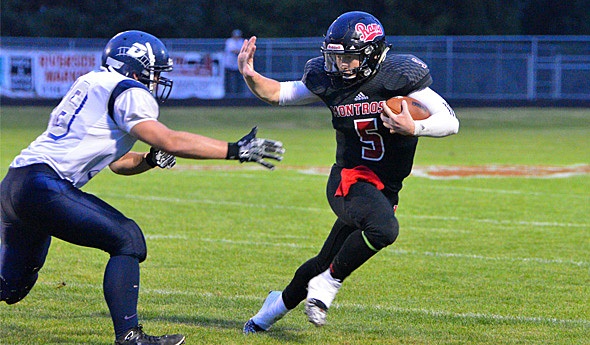
PHOTO: Montrose, carrying the ball, earned an at-large bid to its 23rd MHSAA Playoffs as one of five qualifiers from the Genesee Area Conference Red.