

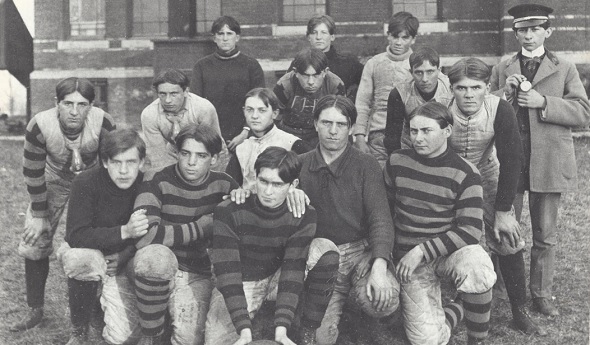
#TBT: 120 Years of Ithaca Football Wins
October 2, 2014
By Geoff Kimmerly
Second Half editor
The Ithaca football team has won 61 straight games dating to opening night 2010, a stretch that is the longest active streak in the U.S., second-longest in MHSAA history, longest to take place fully during the MHSAA playoff era, and three wins from cracking the the national all-time top 10 list.
But more than a century before the Yellowjackets began this era of invincibility, they were among those embracing the sport during its infancy in the late 1890s.
Research by the Ithaca Area Historical Society led to the uncovering of the above photo of the 1899 Ithaca High School football team and all but two of the players' names.
The Ithaca program has 376 victories dating back to the start of the 1950 season – and further research that is underway should show the team has well over 500 wins dating to its first team in 1895. Cadillac, with 512 victories, was 10th on Michigan high school football's all-time wins list heading into this season.
For some added perspective: The MHSAA was begun from a preceding organization during the 1924-25 school year. The first MHSAA playoffs were played in 1975. Ithaca's most recent varsity football loss came to Montague in a 2009 Division 6 Semifinal.

Summer Football Safety
June 23, 2017
Across the U.S. this summer, school-age football players are flocking to camps conducted by colleges and commercial interests. They get outfitted in full gear and launch themselves into drills and skills work.
Unlike the start of the interscholastic football season, the players usually do this without several days of acclimatization to avoid heat illness, and without limits on player-to-player contact to reduce head injuries.
Required precautions of the school season are generally ignored at non-school summer camps.
One notable exception to this foolish behavior is found in Michigan where the Michigan High School Athletic Association prohibits member schools’ student-athletes from using full equipment and participating in full-contact activities outside the high school football season. This is not a recent change; it’s been the MHSAA’s explicit policy for more than four decades.
And it’s a policy that has never been more in style and in favor than it is today.