

#TBT: Mill Thrills Again at Silverdome
By
Geoff Kimmerly
MHSAA.com senior editor
November 26, 2014
By Geoff Kimmerly
Second Half editor
Pontiac Silverdome 25 years ago served as the stage for one of the most exciting moments in MHSAA Football Finals history, appropriately performed by an athlete known as "Mill the Thrill."
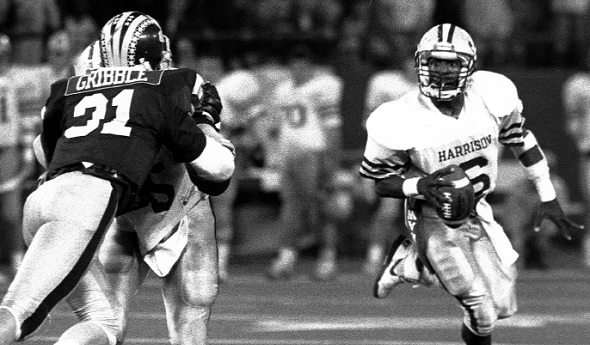
Mill Coleman, who later would star as a receiver at Michigan State University, scored on a 9-yard quarterback scramble with 1:34 to play to push Harrison even with DeWitt, 27-27. Steve Hill's extra point put the Hawks ahead to stay as they repeated as MHSAA champions.
Below is a "Finals Flashback" to that go-ahead scoring run, part of a collection of flashbacks that formerly ran during breaks at MHSAA football championship games. Click for the full box score from that game and playoff results from the entire 1989 Class B bracket.
The championship was the second of Harrison's now MHSAA-best 13. Coleman currently serves as an assistant coach for the Hawks.
PHOTO: Farmington Hills Harrison quarterback Mill Coleman looks for an opening as DeWitt's Travis Gribble works to get away from a blocker while in pursuit. (Photo courtesy of Gary Shook.)
QB Carving Place in Pittsford Tradition
August 31, 2018
By Doug Donnelly
Special for Second Half
PITTSFORD – There’s nothing quite like the return of high school football each new season to small towns in Michigan.
 There’s something about the way a town buzzes when students, parents and fans put on the spirit wear and make the journey to watch kids they’ve all known since they were born put on the helmet and play football against – usually – a neighboring school district.
Pittsford is one of those towns, and Jake Burger is one of those kids.
If it seems like Burger has been around Pittsford football forever, it’s because he has been around it for all of his life. He is two games into his senior year playing quarterback for the Wildcats – his third season as a starter – but his roots go much deeper. His grandfather, Bob Clement, coached at Pittsford for three decades. His father, Mike Burger, has been the head coach since 2010.
“I used to hang around the sidelines,” Jake said. “I’d be with my friends, and we’d be having fun. But, I wanted to be out there, to be on the field.”
These days, Burger’s grandfather usually watches games from above the Pittsford press box. His uncle, Frank Clement, another longtime Pittsford coach, is closer to the action as the Wildcats’ special teams coach. Burger’s cousin Jesse Clement is a senior linebacker. Burger’s dad – also a teacher, boys basketball coach and athletic director at Pittsford – calls the plays that Burger tries to execute on the field.
“Jake really understands the game,” Mike Burger said. “He grasps concepts quickly, and then is able to put them into action. He just wants to win, and winning with his buddies makes it that much more gratifying.”
Pittsford is coming off a 9-2 season in which it qualified for the playoffs for the 12th time in the last 14 seasons. The Wildcats are members of the Southern Central Athletic Association and reigning league champions after a year when four of the five teams in the conference reached the playoffs.
Pittsford is a community of about 1,500 people and has just 186 students in its high school. Nineteen play football including 11 seniors – an unusually large class.
“I think that helps a lot because we all have a lot of experience,” Jake Burger said. “We grew up together, playing football and basketball. We all just love sports.”
The Wildcats opened the 2018 season by shutting out 2017 playoff qualifier Morenci 28-0, and then shut out Petersburg-Summerfield 10-0 on Thursday. Burger – who also starts at safety – made a key play in the end zone late in the fourth quarter to stop a potential Summerfield touchdown.
“Early season wins are so important in getting to the playoffs,” Burger said. “I think we are going to have a really good year.”
Burger was a tight end in grade school but shifted to quarterback around fifth grade. He’s played the position ever since.
 “The coach moved me to quarterback,” he said. “I love the position. I like being the field general – sort of the coach on the field. I like how you get to make decisions on the fly. Hopefully, I make the right decisions.”
Burger’s decisions are usually spot-on. He was an honorable mention choice on last year’s Associated Press Division 7-8 all-state football team after throwing for more than 1,300 yards. He already holds several Wildcats records and entered Thursday’s game with 2,910 career passing yards.
At 6-foot-4, 195 pounds, Burger said he’s also not afraid to take on a would-be tackler. He has more than 1,000 career rushing yards.
“I’m not a traditional type of quarterback,” he said. “I like to pass the ball and move the ball downfield, but I’ll also run the ball. I usually don’t run out of bounds. I’m not going to juke anybody out. I’ll lower my shoulder and take on someone and try and fight for those extra yards.”
Burger grew up about five minutes from Pittsford, which is in Hillsdale County, only a few miles from the Ohio state line. The Wildcats won the 1996 Class DD championship under Clement. With the return of Burger and much of the offense and defense from last year’s playoff team, there are high hopes this season as well.
Mike Burger said it’s been a blessing to coach his son.
“Coaching your son is a tremendous experience,” he said. “I have had such a great time being able to be part of this process. Sure, it can be stressful at times with all the pressures that go with being a varsity coach and coach’s son, but it has been far more rewarding than I could ever had imagined.”
His son agrees.
“He’s always explained things to me,” Burger said of his dad. “It’s been great having him there with me. He’s a great coach. I’m grateful he is my coach.”
The two also have that bond during basketball season. This past spring, Jake developed a routine in which he would get to school by 6:30 a.m. to work on basketball, then go back to school at night to work on quarterback fundamentals. He played AAU basketball this summer and maintains a 3.7 grade-point average. He’s unsure of his college plans at this point but would entertain the idea of playing either sport at the next level – as long as the college he chooses “feels like home,” he said.
“Jake's work ethic is off the charts,” Mike Burger said. “He is a great example of someone who plays multiple sports rather than concentrate on one. I am not sure which sport he loves the most, but I can say he loves playing both games and he plays both with a real joy.”
For Jake Burger, being part of the hometown football and basketball teams seems second nature. He wouldn’t want it any other way. Cars start filing into Pittsford football games early on Friday nights, some fans hopeful for a spot in the front row overlooking the west end zone.
“For our first game, we had a ton of people in our stands,” he said. “It’s a great atmosphere in Pittsford, no matter what sport. For basketball games, the parents and fans will get into the game and cheer and the football games are loud with a lot of fans. It’s a great place to be around.”
 Doug Donnelly has served as a sports and news reporter and city editor over 25 years, writing for the Daily Chief-Union in Upper Sandusky, Ohio from 1992-1995, the Monroe Evening News from 1995-2012 and the Adrian Daily Telegram since 2013. He's also written a book on high school basketball in Monroe County and compiles record books for various schools in southeast Michigan. E-mail him at [email protected] with story ideas for Lenawee and Monroe counties.
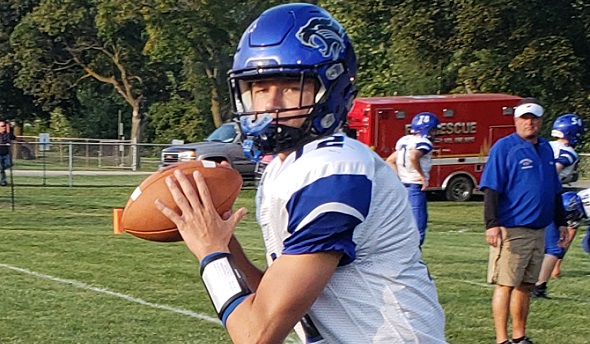
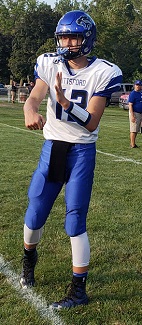
PHOTOS: (Top) Jake Burger prepares for Thursday’s game against Petersburg-Summerfield. (Middle) Burger follows through on a pregame pass. (Photos by Doug Donnelly.)