


#TBT: Searching for The Hinker Bell
September 28, 2017
By Geoff Kimmerly
Second Half editor
Menominee will host Escanaba on Friday in the 121st meeting between two of the Upper Peninsula’s largest high schools and proudest football programs – but with the trophy celebrating the game still missing after it first disappeared more than half a century ago.
The two teams from 1948-1962 played for the The Hinker Bell, a locomotive bell that hasn’t been seen since 1963.
A decade ago, Escanaba Daily Press sports editor (and now Second Half correspondent) Denny Grall wrote about a newfound search for The Hinker Bell. But the mystery continues, and Grall’s story below tells of many of the twists and turns that to that point that had come in trying to locate it.
ESCANABA — Another search is underway to find the Hinker Bell.
The former locomotive bell went to the winner of the Escanaba-Menominee football game for about 15 years but has been missing for more than 40 years. It came from a locomotive owned by the Bay de Noquet Company and used on the LS&I Railroad that operated in Delta and Menominee counties.
The locomotive was built in 1906 by Baldwin Locomotive Works in Philadelphia and the bell was believed to have been cast in the railroad foundry, according to a 1953 newspaper clipping.
In 1948, one of the locomotive owners presented the bell to his friend, John Hinker of Menominee, an ardent sports fan who donated materials for the press box at Menominee’s Walton Blesch Field.
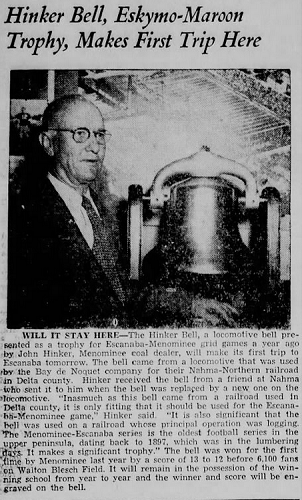 Hinker gave the bell to then Menominee coach Mickey McCormick and indicated proper use for the bell would be as an award for the gridiron rivalry.
Now Hinker’s great great nephew is trying to find the bell, which has not been seen since Escanaba’s current high school opened in 1963.
Tim Waters of Land O’ Lakes, Wis., who has launched the search, became interested by researching his family tree. “It is a big trophy (between 80 and 150 pounds by various estimates) and it is odd that it is missing,” Waters said in a recent telephone chat.
“One theory is that it is in somebody’s hunting camp or a home and they are using it as their own trophy,” said Waters.
“We have a pretty good investigation going on and all help is appreciated. If somebody does have it, we’re not looking to prosecute them. We’re just looking to get the darn thing back. Nobody will be in trouble.”
Waters refuted the old idea the bell was melted down. He has contacted numerous bell collectors, and they said a junk yard would have known it was worth a lot more than melted metal.
“The bell was not destroyed. We’ve come to that conclusion,” he said. “It was not put in a scrap yard.”
Waters contacted Coplan Iron and Metal of Escanaba and learned that bells were not melted or crushed and said the firm never accepted a bell with engravings matching the Hinker Bell.
Waters learned those businesses would sell them for the weight value to people who wanted them for yard ornaments/dinner bells, or to collectors.
“It is a treasure and it needs to be found,” said Waters.
Waters said the last known photo of the bell was with then EHS football coach Al Sigman and Esky players John Fisher and Phil Davidson in 1960. Escanaba beat Menominee from 1959-63 but could not find the bell in 1964 when the Maroons won. No one he has talked to remembers seeing the bell present at the first three games during the tenure of coach Jerry Cvengros.
The current Escanaba High School opened in 1963 and Bay de Noc Community College then occupied the old facility, which has since been demolished.
“Records indicate there was no report (of a missing bell) filed by Escanaba school district to the police department,” Waters said.
“The Hinker Bell is part of U.P. Michigan’s history, as is football and the railroads,” Waters said. “The people of Escanaba and Menominee deserve to have this trophy returned to their high schools.”
Waters, who has never seen an Escanaba or Menominee football game but is planning to rectify that omission this season, is hoping students at the two schools will join in the treasure hunt and talk about it with their parents and grandparents.
He has already contacted EHS athletic director Rob Ryan, who plans to thoroughly search the school basement.
He would like to find a photo of the bell to help collectors in their search. “Each bell was for a special locomotive,” said Waters.
“If they have a good picture we can pass it around and say we are looking for this bell. If they can pinpoint what this bell was on, they can help get the word out.”
He has also extended the search to the website at upfootball.com, which has generated interest but no bell. “If the bell is in the area still today, I don’t think it will take long to surface,” he said.
“If we don’t find this bell, we are going to try to make up a replacement as close as possible if the two schools are interested in that,” he said.
Waters is hoping that real estate agents, postal workers, delivery personnel, construction workers, etc., may have seen the bell during their travels and can help retrieve it.
1st & Goal: 2024 Week 3 Review
By
Geoff Kimmerly
MHSAA.com senior editor
September 16, 2024
What a difference a year can make.
 We are only one-third through the 2024 football regular season, and already several teams are outperforming how they finished a year ago – or are on the verge of doing so.
After a maximum of only three games played, 25 teams statewide have guaranteed they’ll finish with better records this fall than in 2023. Another 54 teams already have as many wins this fall as they had all of last season – and we note several of both groups below in this week’s review.
Bay & Thumb
HEADLINER Grand Blanc 22, Saginaw Heritage 21 Heritage’s emergence the last few seasons has made a powerful Saginaw Valley League Red even more competitive, and the title this season could be up for grabs until the end. Grand Blanc (2-1) sits atop the standings at 2-0 in league play thanks in part to Nate Szczembara blocking what would have been a winning Heritage field goal on this game’s last play. Click for more from WJRT.
Grand Blanc blocks the Saginaw Heritage game winning FG to win 22-21
Powered by @LawrenceTechU pic.twitter.com/5OG8hyT3oR— STATE CHAMPS! Michigan (@statechampsmich) September 14, 2024
Watch list Midland Dow 28, Mount Pleasant 7 After tough opening losses to two strong opponents, Dow (1-2) got its first win over another annual playoff qualifier, the reigning SVL Blue champion Oilers (1-2), who had defeated the Chargers 42-7 a year ago.
On the move Chesaning 47, New Lothrop 22 The reigning Mid-Michigan Activities Conference champion improved to 3-0 by doubling up last season’s league runner-up Hornets (1-2). Montrose 20, Durand 14 Staying the MMAC, Montrose (2-1) now might be Chesaning’s top challenger after defeating a Durand team (2-1) that was coming off a win over New Lothrop in Week 2. Frankenmuth 48, Alma 7 Frankenmuth (3-0) became the 14th program on record to reach 500 wins, this one making the Eagles 500-165-4 since the school opened in 1956.
Greater Detroit
HEADLINER Pontiac Notre Dame Prep 42, Grand Rapids Catholic Central 0 Notre Dame Prep already was considered among the elite in Division 5 this season, entering the weekend ranked No. 3 in the coaches poll. But the Fighting Irish (3-0) may now be the favorites after this stunning win over the top-ranked and reigning champion Cougars (2-1) – which followed NDP’s Week 2 victory over 2023 Division 7 champion Jackson Lumen Christi. Click for more from the Detroit News.
Check out the highlights of Notre Dame Prep's 42-0 victory over the defending Division 5 State Champs in Grand Rapids Catholic Central from September 13th, 2024. Powered by @reactiontech@NDPrep_Football pic.twitter.com/PKumIOSYkP
— STATE CHAMPS! Michigan (@statechampsmich) September 15, 2024
Watch list Rochester Adams 21, West Bloomfield 14 Ryland Watters scored twice during the second half and Adams (3-0) stopped West Bloomfield’s final rally six yards from a potential tying score to avenge a pair of losses to the Lakers (1-2) from a year ago, including in their District opener.
On the move Warren De La Salle Collegiate 38, Orchard Lake St. Mary’s 28 De La Salle (3-0) withstood a challenge from an improved St. Mary’s team (2-1) to set up this week’s meeting with reigning Catholic High School League Central champion Toledo Central Catholic. Detroit Catholic Central 45, Harper Woods 12 The Shamrocks (3-1) also continued to impress, scoring the most points that reigning Division 4 champion Harper Woods (1-2) had given up since 2021. Sterling Heights Stevenson 24, Clinton Township Chippewa Valley 7 After two straight sub-.500 seasons (although Stevenson did make the playoffs last year at 4-5), the Titans are 3-0 for the first time since 2009 after avenging a pair of losses to Chippewa Valley (1-2) from a year ago.
Mid-Michigan
HEADLINER Brighton 29, Northville 28 (2OT) Brighton (2-1) was another team to avenge a pair of 2023 losses during Week 3, after falling to Northville during both the regular season and Division 1 playoffs last fall. Northville (1-2) is the reigning Kensington Lakes Activities Association West champion, but the Bulldogs are one of three teams atop the standings early this fall thanks to winning this one on a double-overtime 2-point conversion. Click for more from the Livingston Daily Press & Argus.
Check out the highlights from Brighton in their 29-28 victory over Northville!@MHSAA | @godogs_football pic.twitter.com/apDaNSFfPw
— STATE CHAMPS! Michigan (@statechampsmich) September 14, 2024
Watch list Olivet 7, Lansing Sexton 0 The Eagles (2-1) bounced back from a Week 2 loss to Portland to avenge a 48-12 loss to Sexton (1-2) from a year ago – and pull within one more win of equaling last season’s victory total.
On the move Corunna 49, Ortonville Brandon 21 The Cavaliers (3-0) graduated some serious star power in the spring but just keep grinding, with this league-opening double-up of Brandon (2-1) extending their regular-season win streak to 12. East Lansing 38, Grand Ledge 21 East Lansing’s speed is immediately obvious and stunning, and the Trojans (2-1) bounced back from a Week 2 loss to Hudsonville by pulling away from the physical Comets (2-1) during the second half in front of an overflowing Homecoming crowd. Ithaca 35, Saginaw Michigan Lutheran Seminary 14 Ithaca (3-0) also gained an important early advantage with a league-opening win, as these two decided last year’s Tri-Valley Conference White title, won by the Yellowjackets.

Northern Lower Peninsula
HEADLINER McBain 29, Beal City 25 McBain (3-0) ended Beal City’s 21-game Highland Conference winning streak, which dated to the start of 2021 and included three wins over the Ramblers. The Aggies (2-1) had defeated McBain 48-7 last season on the way to winning league, District and Regional titles. Click for more from the Cadillac News.
Watch list Ogemaw Heights 12, Gladwin 7 It wouldn’t be stunning if this eventually ends up deciding the Jack Pine Conference Division 1 championship – and it also wouldn’t be stunning if these two end up meeting again in the playoffs, as Ogemaw Heights (3-0) entered the weekend ranked No. 5 in Division 5 and Gladwin (2-1) was No. 8.
On the move LeRoy Pine River 21, Lake City 6 Pine River (1-2) has won only five games combined over the last five seasons, but this one could provide a spark as it was the Bucks’ first over Lake City (1-2) since 2016. Cheboygan 30, Elk Rapids 23 Cheboygan (2-1) is one of the season’s early success stories, as the Chiefs already have bested last year’s 1-8 finish – and with another win can guarantee their most since 2019. Boyne City 45, Charlevoix 21 This was a major victory for Boyne City (2-1) heading into a loaded Northern Michigan Football League Legends schedule, as Charlevoix (1-2) is the reigning champion in the NMFL Leaders and Boyne finished third in the Leaders last season.
Southeast & Border
HEADLINER Hanover-Horton 49, Grass Lake 21 Hanover-Horton (3-0) continues to look like a team with promising possibilities this fall, and this win was notable for several reasons – it guaranteed the Comets will finish better than last year’s 2-7 record, avenged 32-22 and 28-6 losses to Grass Lake from last season, and came against a Warriors team (2-1) that has finished below .500 only once over the last 22 seasons, according to Michigan-Football.com. Click for more from the Jackson Citizen Patriot.
Watch list Jackson 28, Tecumseh 20 We’ll know more once the Southeastern Conference White schedule gets rolling – Jackson also started 4-1 last season and finished 4-5. But the Vikings are 3-0 after this league opener, and that’s included avenging last year’s loss to Monroe.
On the move Ottawa Lake Whiteford 44, Buchanan 16 This was a solid bounce-back for the Bobcats (2-1) after a Week 2 loss to Ida. Buchanan is 1-2 against an opening schedule of teams that are a combined 7-2. Hudson 16, Ida 8 After a reasonably close opening loss to still-undefeated Fowler, Hudson (2-1) has handed first defeats this season to Dowagiac and now the Bluestreaks (2-1). Michigan Center 14, Jonesville 6 Michigan Center (1-2) was another team with a difficult opening slate, but the Cardinals got on the board with this win over a Jonesville team (1-2) that finished Cascades Conference West runner-up a year ago.
Southwest Corridor
HEADLINER Constantine 31, Schoolcraft 29 (OT) Constantine (3-0) extended its winning streak in this rivalry to three with a second-straight by one score, stopping Schoolcraft’s 2-point conversion attempt in overtime to finish the victory. Schoolcraft (2-1) had pulled even with 1:09 to play in regulation after the teams traded leads five times. Click for more from the Kalamazoo Gazette.
Watch list Berrien Springs 28, Traverse City St. Francis 14 The Shamrocks (1-2) may have started 0-2 for the second season in a row, but they made a splash by handing the Gladiators (2-1) their first defeat of the season. This one could mean a lot later as well as Berrien Springs works to extend a decade-long playoff streak.
On the move Galesburg-Augusta 17, Allegan 14 With back-to-back wins over Cassopolis and now Allegan (2-1), Galesburg-August (2-1) has equaled its win total of a year ago. Lawton 27, Kalamazoo United 18 Lawton (2-1) was coming off a loss to St. Francis but found its footing in handing United (2-1) its first defeat. Niles 56, Three Rivers 6 Niles (2-1) opened its Wolverine Conference schedule with a 10th-straight league win and has scored at least 49 points in all 10.
Upper Peninsula
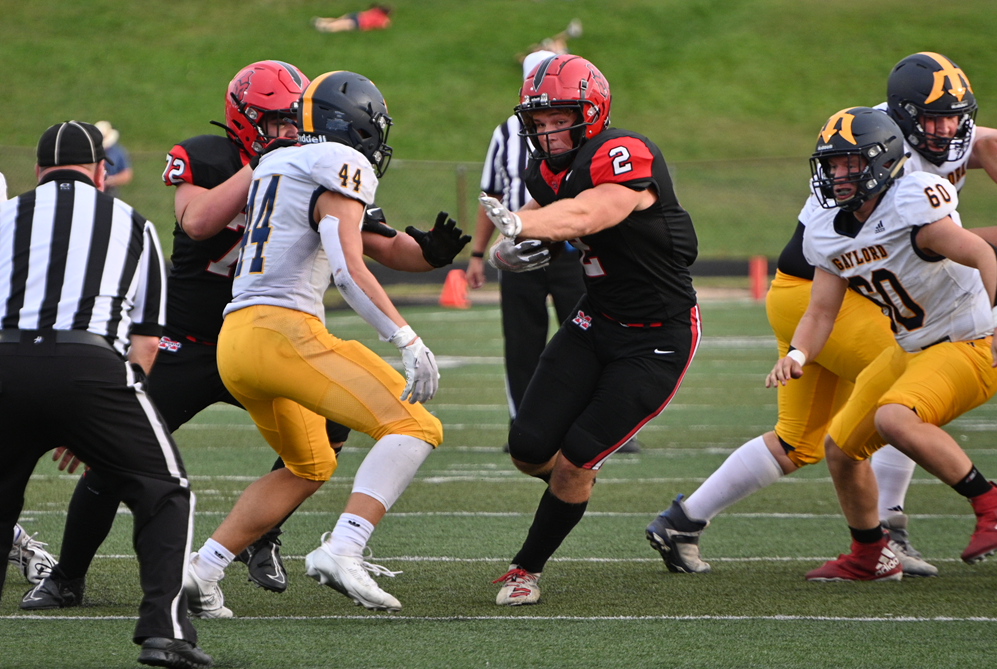
HEADLINER Marquette 30, Gaylord 0 Marquette’s opening statement on this season keeps getting louder, as the Sentinels are up to two losses avenged from a year ago – they fell to Gaylord 37-16 in 2023 – and they have yet to give up a point, outscoring their first three opponents by a combined 136-0. The most major test yet is coming up, as Marquette travels to Lowell this week. Click for more from the Marquette Mining Journal.
Ford Richardson finds Kyler Sager on 3rd down for a 99 yard TD.
Marquette moves to 3-0 with a 30-0 win over Gaylord tonight.
The Sentinels are now outscoring their opponents by 136-0 margin through 3 weeks. pic.twitter.com/EKyyj6aMAc— Jake Durant (@durant_jd) September 15, 2024
Watch list Gwinn 33, L’Anse 6 Gwinn (2-1) had only four wins over the last three seasons combined, and both last year against the same opponent. But the Modeltowners opened this fall by avenging a 2023 loss to Bridgeport and have now equaled last season’s total of two victories – with plenty of opportunities to add to that coming up.
On the move Negaunee 29, Calumet 0 The Miners (3-0) will head into this week’s major clash with Kingsford coming off their first shutout of the season having stopped a Copper Kings offense that had put up 80 points over two victories to start the fall. Houghton 38, Hancock 16 The Gremlins (1-2) have won three straight over their neighbors and will see Hancock (1-2) again in the regular-season finale. Menominee 58, Ishpeming Westwood 19 This early surge has played out almost identically to the start of last year’s run to the Division 7 championship game, as Menominee has scored a combined 170 points and given up just 25 over the first three weeks.
West Michigan
HEADLINER Grand Rapids South Christian 41, Grand Rapids West Catholic 38 The Sailors (3-0) will come barreling into the Ottawa-Kent Conference Green schedule this week after a second comeback win and this one against the No. 2-ranked team in Division 5. The Sailors trailed 24-14 at halftime before rallying and sending the Falcons to 1-2. Click for more from FOX 17.
Check out the highlights of South Christian's 41-38 win over West Catholic 41-38 on September 13, 2024. Powered by @CAM_Association @sailorsports | @SCsailorFB pic.twitter.com/e2Eyw5NAyD
— STATE CHAMPS! Michigan (@statechampsmich) September 15, 2024
Watch list East Kentwood 41, Caledonia 35 East Kentwood’s anticipated rise may be starting. The Falcons ended a three-game losing streak against Caledonia – and hadn’t scored in their previous two meetings with the Fighting Scots (2-1). East Kentwood (2-1) needs one more win to equal last season’s total.
On the move Grand Rapids Forest Hills Central 17, Grand Rapids Forest Hills Northern 14 This was the closest game these rivals have played since restarting their series, but FHC (3-0) prevailed again to make it 10 wins in 10 meetings since 2016. Hudsonville Unity Christian 44, Ada Forest Hills Eastern 20 Unity Christian (3-0) is on its way back up after winning just three games a year ago. FHE (2-1) had entered the weekend No. 4 in Division 4, one slot ahead of the Crusaders. Big Rapids 33, Reed City 14 This matchup played a big part in deciding the Central State Activities Association Gold title a year ago, and could again with reigning co-champion Big Rapids (2-1) in a good spot after handing Reed City (2-1) a first loss.
8-Player
HEADLINER Climax-Scotts 56, Adrian Lenawee Christian 35 Lenawee Christian (1-2) jumped out to a 14-0 lead, but Climax-Scotts (2-1) took over from there to avenge last season’s 56-16 Regional Final loss to the eventual Division 2 champion. Click for more from the Battle Creek Enquirer.
Watch list Ishpeming 50, Gaylord St. Mary 28 It’s been common to see traditionally strong 11-player programs move to 8-player and find immediate success, and Ishpeming looks like it could be the next. The Hematites were 7-4 in 11-player last season and are off to a 2-0 start with this win over playoff regular St. Mary (2-1).
On the move Crystal Falls Forest Park 42, Norway 20 The Trojans (3-0) ended a string of two straight losses to the Knights (2-1), and after falling to them 40-6 last season. Grand Rapids NorthPointe Christian 46, Bridgman 38 A week after Bridgman’s 35-game winning streak ended, NorthPointe (2-1) handed the Bees (1-2) a second-straight defeat, avenging last year’s 28-8 loss. Portland St. Patrick 56, Mount Pleasant Sacred Heart 49 The Shamrocks (3-0) had lost to Sacred Heart the last two seasons, including by just a point a year ago. Vestaburg 38, Carson City-Crystal 30 Vestaburg ended its 21-game losing streak, and against a league champion from 2023.
MHSAA.com's weekly “1st & Goal” previews and reviews are powered by MI Student Aid, a division within the Department of Lifelong Education, Advancement, and Potential (MiLEAP). MI Student Aid encourages students to pursue postsecondary education by providing access to student financial resources and information. MI Student Aid administers the state’s scholarship and grant programs that help make college Accessible, Affordable and Attainable for you. Click to connect with MI Student Aid and find more information on Facebook and Twitter @mistudentaid.
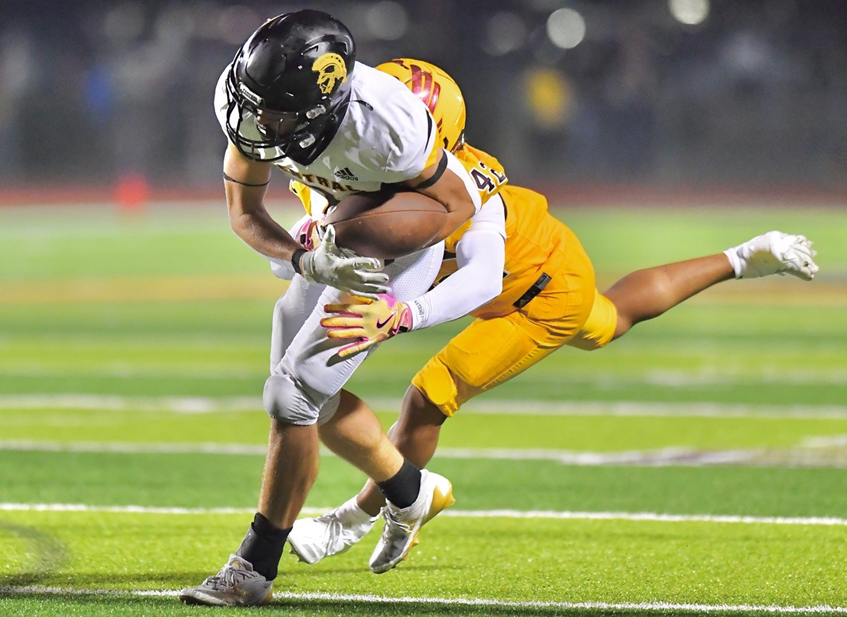
PHOTOS (Top) Marquette's Grant Simon (2) finds a hole to pick up several yards against Gaylord. (Middle) Suna Chami (13) breaks down the sideline during Dearborn's 28-13 win over Livonia Franklin. (Below) A Traverse City Central ball carrier works to secure possession during a 49-14 loss to Davison. (Top photo by Cara Kamps, middle photo by Douglas Bargerstock, below photo by Terry Lyons.)