


#TBT: Searching for The Hinker Bell
September 28, 2017
By Geoff Kimmerly
Second Half editor
Menominee will host Escanaba on Friday in the 121st meeting between two of the Upper Peninsula’s largest high schools and proudest football programs – but with the trophy celebrating the game still missing after it first disappeared more than half a century ago.
The two teams from 1948-1962 played for the The Hinker Bell, a locomotive bell that hasn’t been seen since 1963.
A decade ago, Escanaba Daily Press sports editor (and now Second Half correspondent) Denny Grall wrote about a newfound search for The Hinker Bell. But the mystery continues, and Grall’s story below tells of many of the twists and turns that to that point that had come in trying to locate it.
ESCANABA — Another search is underway to find the Hinker Bell.
The former locomotive bell went to the winner of the Escanaba-Menominee football game for about 15 years but has been missing for more than 40 years. It came from a locomotive owned by the Bay de Noquet Company and used on the LS&I Railroad that operated in Delta and Menominee counties.
The locomotive was built in 1906 by Baldwin Locomotive Works in Philadelphia and the bell was believed to have been cast in the railroad foundry, according to a 1953 newspaper clipping.
In 1948, one of the locomotive owners presented the bell to his friend, John Hinker of Menominee, an ardent sports fan who donated materials for the press box at Menominee’s Walton Blesch Field.
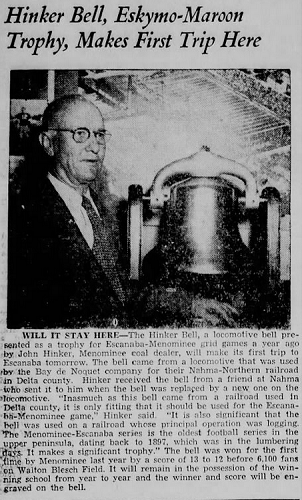 Hinker gave the bell to then Menominee coach Mickey McCormick and indicated proper use for the bell would be as an award for the gridiron rivalry.
Now Hinker’s great great nephew is trying to find the bell, which has not been seen since Escanaba’s current high school opened in 1963.
Tim Waters of Land O’ Lakes, Wis., who has launched the search, became interested by researching his family tree. “It is a big trophy (between 80 and 150 pounds by various estimates) and it is odd that it is missing,” Waters said in a recent telephone chat.
“One theory is that it is in somebody’s hunting camp or a home and they are using it as their own trophy,” said Waters.
“We have a pretty good investigation going on and all help is appreciated. If somebody does have it, we’re not looking to prosecute them. We’re just looking to get the darn thing back. Nobody will be in trouble.”
Waters refuted the old idea the bell was melted down. He has contacted numerous bell collectors, and they said a junk yard would have known it was worth a lot more than melted metal.
“The bell was not destroyed. We’ve come to that conclusion,” he said. “It was not put in a scrap yard.”
Waters contacted Coplan Iron and Metal of Escanaba and learned that bells were not melted or crushed and said the firm never accepted a bell with engravings matching the Hinker Bell.
Waters learned those businesses would sell them for the weight value to people who wanted them for yard ornaments/dinner bells, or to collectors.
“It is a treasure and it needs to be found,” said Waters.
Waters said the last known photo of the bell was with then EHS football coach Al Sigman and Esky players John Fisher and Phil Davidson in 1960. Escanaba beat Menominee from 1959-63 but could not find the bell in 1964 when the Maroons won. No one he has talked to remembers seeing the bell present at the first three games during the tenure of coach Jerry Cvengros.
The current Escanaba High School opened in 1963 and Bay de Noc Community College then occupied the old facility, which has since been demolished.
“Records indicate there was no report (of a missing bell) filed by Escanaba school district to the police department,” Waters said.
“The Hinker Bell is part of U.P. Michigan’s history, as is football and the railroads,” Waters said. “The people of Escanaba and Menominee deserve to have this trophy returned to their high schools.”
Waters, who has never seen an Escanaba or Menominee football game but is planning to rectify that omission this season, is hoping students at the two schools will join in the treasure hunt and talk about it with their parents and grandparents.
He has already contacted EHS athletic director Rob Ryan, who plans to thoroughly search the school basement.
He would like to find a photo of the bell to help collectors in their search. “Each bell was for a special locomotive,” said Waters.
“If they have a good picture we can pass it around and say we are looking for this bell. If they can pinpoint what this bell was on, they can help get the word out.”
He has also extended the search to the website at upfootball.com, which has generated interest but no bell. “If the bell is in the area still today, I don’t think it will take long to surface,” he said.
“If we don’t find this bell, we are going to try to make up a replacement as close as possible if the two schools are interested in that,” he said.
Waters is hoping that real estate agents, postal workers, delivery personnel, construction workers, etc., may have seen the bell during their travels and can help retrieve it.
1st & Goal: 2024 Week 2 Preview
By
Geoff Kimmerly
MHSAA.com senior editor
September 5, 2024
It’s only Week 2. We’re just getting started.
 But at least five games this week look likely to end up counted among the most notable of the regular season, statewide, when all is said and done Oct. 26. Another handful could eventually determine league championships, if past history holds again.
We’re back to our regular schedule, with six games played Thursday night, the great majority tonight and seven games set for Saturday. All listed below are today unless noted, and scores will be updated throughout the weekend on the MHSAA Scores page.
Bay & Thumb
Armada (1-0) at Croswell-Lexington (1-0) WATCH
The Blue Water Area Conference schedule begins tonight, and Croswell-Lexington owns a 19-game winning streak against Armada after claiming last year’s meeting 53-28. But the Tigers are coming off a third-straight winning season, and a third-straight victory last week over perennial power Marine City – and a historic Armada win tonight would throw a wrench into the Pioneers’ plans to take back the BWAC for the first time since 2021.
Keep an eye on these FRIDAY Haslett (0-1) at Fenton (1-0), Goodrich (0-1) at Linden (0-1) WATCH, Saginaw Heritage (1-0) at Midland Dow (0-1), SATURDAY Harbor Beach (1-0) at Marine City Cardinal Mooney (0-1).
Greater Detroit
Warren De La Salle Collegiate (1-0) at Detroit Martin Luther King (1-0)
This might be one of the most anticipated games statewide this year, not just one of the best of the week in Metro Detroit. The 2023 Division 2 runner-up Pilots began their pursuit of a fourth-straight trip to the Finals with a stunning defensive effort and 21-3 win over Davison last week. King is attempting to get back to the Finals this fall for the third time in four seasons after ending their run in the Division 3 Semifinals a year ago, and the Crusaders opened with a 25-21 win over Ohio powerhouse Cleveland Heights. King and De La Salle last faced each other in a 2017 Semifinal.
Keep an eye on these FRIDAY West Bloomfield (1-0) at Birmingham Groves (1-0) WATCH, Clarkston (0-1) at Southfield Arts & Technology (1-0) WATCH, Jackson Lumen Christi (1-0) at Pontiac Notre Dame Prep (1-0) WATCH, Muskegon Mona Shores (1-0) at River Rouge (1-0) WATCH.
Mid-Michigan
DeWitt (1-0) at Mason (1-0)
After falling to DeWitt five straight meetings over the eight seasons, Mason defeated the Panthers twice in 2023 – 42-23 during the regular season and 42-7 in a District Final – on the way to finishing Division 3 runner-up. The Bulldogs graduated nearly all of their starters from that run, but the new crew joined four-year starting quarterback Cason Carswell in downing Holt 26-7 to open this fall. DeWitt has nearly its entire lineup back from a year ago and also one of the top quarterbacks both in the Lansing area and statewide – Elliott Larner, who threw for four touchdowns and ran for four in the Panthers’ 69-42 win over Haslett.
Keep an eye on these FRIDAY Lansing Catholic (1-0) at Lansing Sexton (0-1) WATCH, Olivet (1-0) at Portland (1-0), Hastings (1-0) at Williamston (0-1) WATCH, Bath (0-1) at Pewamo-Westphalia (1-0) WATCH.
Northern Lower Peninsula
Kingsley (0-1) at Gaylord (0-1) WATCH
Forget for a minute that both fell in openers last week. Gaylord is coming off its best season since 2002 after finishing 11-1, and Kingsley is the reigning Division 6 champion with one of its two losses last fall in a 42-39 classic against the Blue Devils. Back to last week, Kingsley did lose 24-22 but it was a rematch of its 2023 Semifinal win over Reed City. Gaylord’s defeat came against longtime former league foe Traverse City West, but the defense that gave up only 14.5 points per game last season remained on point, allowing just six to the Titans.
Keep an eye on these FRIDAY Maple City Glen Lake (1-0) at Frankfort (1-0) WATCH, Boyne City (0-1) at Elk Rapids (1-0), Parma Western (1-0) at Traverse City Central (1-0) WATCH. SATURDAY Lawton (1-0) at Traverse City St. Francis (1-0) WATCH.
Southeast & Border
Saline (1-0) at Dexter (1-0)
The Southeastern Conference Red season also begins tonight, and with the matchup that eventually determined last year’s league championship. That went to Saline, thanks to a 41-25 victory over Dexter, and the Hornets opened last week by doubling up Brighton 41-20. The Dreadnaughts actually come into this rematch on a higher note than a year ago after edging Livonia Franklin 27-26 last week, avenging their 33-27 loss to Franklin from last season’s opener.
Keep an eye on these FRIDAY Whitmore Lake (1-0) at Ann Arbor Father Gabriel Richard (1-0), Addison (1-0) at Manchester (1-0) WATCH, Three Rivers (1-0) at Adrian (0-1) WATCH, Jonesville (1-0) at Napoleon (0-1).
Southwest Corridor
White Pigeon (1-0) at Buchanan (1-0) WATCH
More statewide fanfare should be given to White Pigeon’s fantastic run over the last three seasons, as the Chiefs went a combined 29-7 with three trips to Division 8 Regional Finals. They opened in dominant fashion 52-14 over Reading last week, but get a Buchanan team that also has been quietly solid with a combined 15-6 record over the last two seasons – and with two of last year’s defeats by seven points apiece. The Bucks opened last week with a 32-6 rumbling over Saugatuck, which avenged a 25-14 opening loss to the Trailblazers from a year ago.
Keep an eye on these FRIDAY St. Joseph (1-0) at Edwardsburg (1-0), Grand Rapids Forest Hills Central (1-0) at Portage Central (0-1) WATCH, Battle Creek Central (0-1) at Battle Creek Harper Creek (1-0), Midland (1-0) at Portage Northern (0-1) WATCH.
Upper Peninsula
Calumet (1-0) at Ishpeming Westwood (1-0) WATCH
Both of these teams are looking for bounce-back seasons, and off on the right foot. Calumet went 3-6 a year ago, its first sub-.500 finish since 2013, but opened with a 50-0 shutout of West Iron County last week. Westwood won once in 2023, its fewest victories since going 2-7 in 2016, but opened last week with a 36-12 win over Bark River-Harris, which finished 5-4 a year ago and defeated the Patriots 50-14 to start last season. Calumet defeated Westwood in last season’s matchup 42-22.
Keep an eye on these FRIDAY Hancock (1-0) at Menominee (1-0) WATCH, Iron Mountain (1-0) at Bark River-Harris (0-1) WATCH, Houghton (0-1) at Kingsford (1-0) WATCH, Gladstone (0-1) at Negaunee (1-0) WATCH.
West Michigan
Muskegon (0-1) at Rockford (1-0) WATCH
West Michigan has several intriguing matchups this week, especially in places with new coaches this fall. But this one always will rise to the highest level of statewide interest. Rockford won their season-opening clash last year 27-7, and Muskegon actually started last year 0-2 before winning 12 straight games and the Division 2 title. Both programs surely benefit greatly from these mega matchups early, and that’s key perspective as the Big Reds also opened this season with a loss, 28-13 to Zeeland West. Rockford is a combined 32-3 over the last three seasons and may be on the verge of something even bigger this fall after defeating Detroit Cass Tech 30-23 in their opener.
Keep an eye on these FRIDAY East Kentwood (1-0) at Byron Center (1-0), Grand Rapids South Christian (1-0) at East Grand Rapids (1-0) WATCH, Grand Rapids Forest Hills Northern (1-0) at Jenison (1-0), Caledonia (1-0) at Muskegon Reeths-Puffer (0-1) WATCH.
8-Player
Martin (1-0) at Bridgman (1-0)
With Martin the reigning two-time Division 1 champion, and Bridgman building a combined 35-game winning streak going back to 2020 (but with an enrollment too large to compete in the 8-player playoffs), it’s safe to say these have been two of the elite handful of teams in the state to start this decade. And their matchups have been must-see; Bridgman won 35-34 in 2022 and 14-12 last season. Although Bridgman also faces 2023 Division 1 runner-up Indian River Inland Lakes in Week 4, this could prove for both to be their biggest game of the regular season again.
Keep an eye on these FRIDAY Morrice (1-0) at Merrill (1-0) WATCH, Lake Linden-Hubbell (0-1) at Munising (1-0) WATCH. SATURDAY Newberry (0-1) vs. Climax-Scotts (0-1) at Gaylord, Marion (1-0) at Onekama (1-0) WATCH.
MHSAA.com's weekly “1st & Goal” previews and reviews are powered by MI Student Aid, a division within the Department of Lifelong Education, Advancement, and Potential (MiLEAP). MI Student Aid encourages students to pursue postsecondary education by providing access to student financial resources and information. MI Student Aid administers the state’s scholarship and grant programs that help make college Accessible, Affordable and Attainable for you. Click to connect with MI Student Aid and find more information on Facebook and Twitter @mistudentaid.
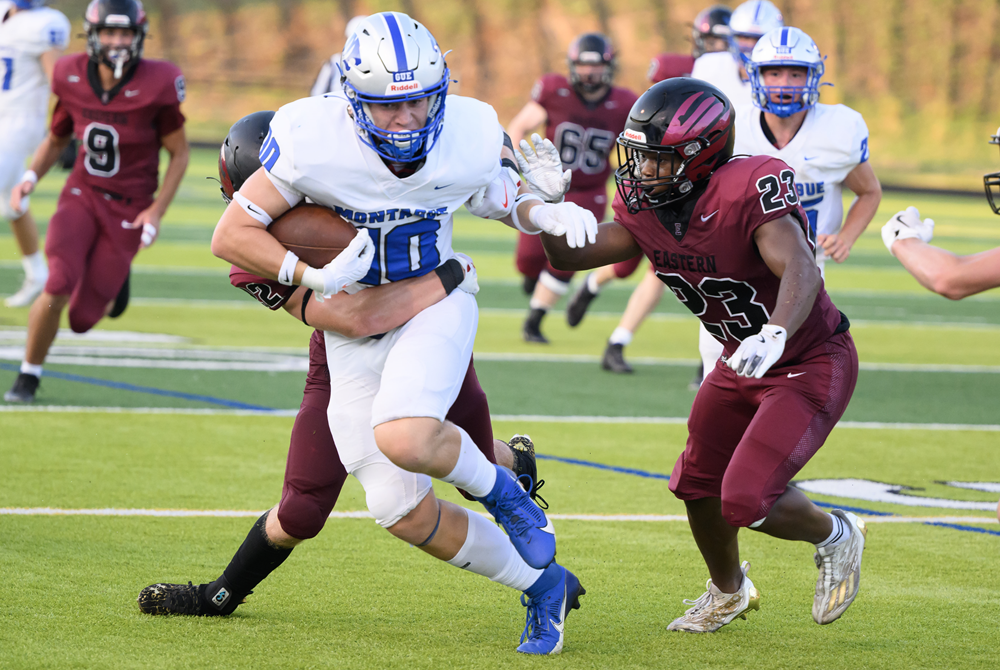
PHOTO A Montague ball carrier attempts to break free last week from multiple Forest Hills Eastern defenders, including Jordan Shabazz (23). FHE won the opener 48-7. (Photo by Michigan Sports Photo.)