


#TBT: Searching for The Hinker Bell
September 28, 2017
By Geoff Kimmerly
Second Half editor
Menominee will host Escanaba on Friday in the 121st meeting between two of the Upper Peninsula’s largest high schools and proudest football programs – but with the trophy celebrating the game still missing after it first disappeared more than half a century ago.
The two teams from 1948-1962 played for the The Hinker Bell, a locomotive bell that hasn’t been seen since 1963.
A decade ago, Escanaba Daily Press sports editor (and now Second Half correspondent) Denny Grall wrote about a newfound search for The Hinker Bell. But the mystery continues, and Grall’s story below tells of many of the twists and turns that to that point that had come in trying to locate it.
ESCANABA — Another search is underway to find the Hinker Bell.
The former locomotive bell went to the winner of the Escanaba-Menominee football game for about 15 years but has been missing for more than 40 years. It came from a locomotive owned by the Bay de Noquet Company and used on the LS&I Railroad that operated in Delta and Menominee counties.
The locomotive was built in 1906 by Baldwin Locomotive Works in Philadelphia and the bell was believed to have been cast in the railroad foundry, according to a 1953 newspaper clipping.
In 1948, one of the locomotive owners presented the bell to his friend, John Hinker of Menominee, an ardent sports fan who donated materials for the press box at Menominee’s Walton Blesch Field.
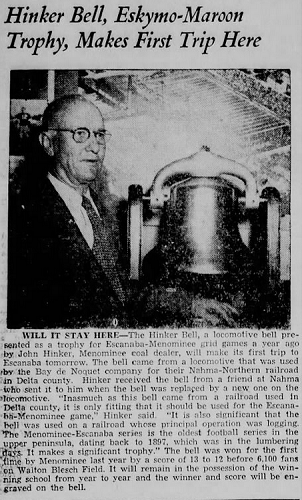 Hinker gave the bell to then Menominee coach Mickey McCormick and indicated proper use for the bell would be as an award for the gridiron rivalry.
Now Hinker’s great great nephew is trying to find the bell, which has not been seen since Escanaba’s current high school opened in 1963.
Tim Waters of Land O’ Lakes, Wis., who has launched the search, became interested by researching his family tree. “It is a big trophy (between 80 and 150 pounds by various estimates) and it is odd that it is missing,” Waters said in a recent telephone chat.
“One theory is that it is in somebody’s hunting camp or a home and they are using it as their own trophy,” said Waters.
“We have a pretty good investigation going on and all help is appreciated. If somebody does have it, we’re not looking to prosecute them. We’re just looking to get the darn thing back. Nobody will be in trouble.”
Waters refuted the old idea the bell was melted down. He has contacted numerous bell collectors, and they said a junk yard would have known it was worth a lot more than melted metal.
“The bell was not destroyed. We’ve come to that conclusion,” he said. “It was not put in a scrap yard.”
Waters contacted Coplan Iron and Metal of Escanaba and learned that bells were not melted or crushed and said the firm never accepted a bell with engravings matching the Hinker Bell.
Waters learned those businesses would sell them for the weight value to people who wanted them for yard ornaments/dinner bells, or to collectors.
“It is a treasure and it needs to be found,” said Waters.
Waters said the last known photo of the bell was with then EHS football coach Al Sigman and Esky players John Fisher and Phil Davidson in 1960. Escanaba beat Menominee from 1959-63 but could not find the bell in 1964 when the Maroons won. No one he has talked to remembers seeing the bell present at the first three games during the tenure of coach Jerry Cvengros.
The current Escanaba High School opened in 1963 and Bay de Noc Community College then occupied the old facility, which has since been demolished.
“Records indicate there was no report (of a missing bell) filed by Escanaba school district to the police department,” Waters said.
“The Hinker Bell is part of U.P. Michigan’s history, as is football and the railroads,” Waters said. “The people of Escanaba and Menominee deserve to have this trophy returned to their high schools.”
Waters, who has never seen an Escanaba or Menominee football game but is planning to rectify that omission this season, is hoping students at the two schools will join in the treasure hunt and talk about it with their parents and grandparents.
He has already contacted EHS athletic director Rob Ryan, who plans to thoroughly search the school basement.
He would like to find a photo of the bell to help collectors in their search. “Each bell was for a special locomotive,” said Waters.
“If they have a good picture we can pass it around and say we are looking for this bell. If they can pinpoint what this bell was on, they can help get the word out.”
He has also extended the search to the website at upfootball.com, which has generated interest but no bell. “If the bell is in the area still today, I don’t think it will take long to surface,” he said.
“If we don’t find this bell, we are going to try to make up a replacement as close as possible if the two schools are interested in that,” he said.
Waters is hoping that real estate agents, postal workers, delivery personnel, construction workers, etc., may have seen the bell during their travels and can help retrieve it.

Century of School Sports: Fall to Finish with 50th Football Championships
By
Geoff Kimmerly
MHSAA.com senior editor
September 4, 2024
We’ve only just begun to celebrate the MHSAA’s 100th anniversary – a “Century of School Sports” dating back to our start Dec. 13, 1924.
This celebration just happens to coincide with another major milestone this fall – the 50th season of MHSAA Football Playoffs.
After decades of football champions being determined by media polls, the MHSAA offered its first postseason for football in 1975 – 16 teams qualified to compete across Class A, B, C and D. Livonia Franklin, Dearborn Divine Child, Ishpeming and Crystal Falls Forest Park, respectively, hoisted those first championship trophies.
The first year’s Finals were played at Central Michigan University and Western Michigan University, two games at each site, before moving to the Pontiac Silverdome the following season – the home for MHSAA football championships until their move to Ford Field in 2005.
Meanwhile, the playoff field grew to 32 teams – eight per class – in 1977, and again to 64 teams over four classes in 1985. Classes AA, BB, CC and DD were added in 1990, bringing the number of 11-player football championships to its current eight. The 11-player field and format expanded one more time in 1999, doubling to 256 teams total – 32 per division – with a fifth week of postseason games bringing the playoff schedule to its current five weeks.
As more small schools began to have difficulty sustaining their programs during the first decade of the 2000s, the 8-player format began to grow with the first playoffs for that division in 2011. The 8-player bracket was split into two divisions in 2017.
Football remains the most played sport in this state, and its playoffs the most attended MHSAA postseason tournament. As of this writing, an estimated 35,000 athletes representing 601 varsity teams are vying for championships this 2024 season. This year's Finals are Nov. 23 for 8-player and Nov. 29-30 for 11-player.
Now, for the fun facts:
- A total of 24 teams have qualified for the MHSAA Football Playoffs at least 30 of the first 49 seasons. Beal City and Crystal Falls Forest Park lead the way with 38 qualifying seasons, followed by Mendon with 37 and Fowler and Traverse City St. Francis with 36. Forest Park and Mendon’s totals include appearances in both the 11 and 8-player brackets. Farmington Hills Harrison remains tied for seventh on the list with 34 postseason appearances despite closing at the end of the 2018-19 school year. NOTE: The totals above do not include the 2020 season, when all schools were entered into the tournament as the regular season was shortened due to COVID-19.
- Rockford has the longest overall and active streaks of qualifying for the playoffs at 28 straight seasons, again not counting 2020 when all teams were added to the bracket. Forest Park at 26 seasons, Jackson Lumen Christi at 25 and Muskegon at 23 seasons are the next four on the overall and active streak lists (Muskegon is tied on the overall list with Felch North Dickinson’s run from 1991-2013).
- Farmington Hills Harrison still has the most appearances in 11-Player Finals, with 18, but with Detroit Catholic Central just one back and Lumen Christi with 16. Lumen Christi has won the last two Division 7 titles to move into a tie for the lead on the total 11-player championship list with 13, the same number won by Harrison during its mighty history.
- On the 8-player side, Powers North Central leads with five appearances in Finals and five championships having won all of them.
- The Jets also own the longest championship streak in 8-player, with three straight titles from 2020-22. Grand Rapids West Catholic from 2013-17, Harrison from 1997-2001 and East Grand Rapids from 2006-10 all have won five 11-player championships in a row, with eight more 11-player programs having won at least three consecutive titles.
This is but a glance at the playoffs’ past. MHSAA historian Ron Pesch has written several exceptional pieces on the MHSAA Football Playoffs for MHSAA.com, and these are a few of our favorites:
- “Culmination of Ideas, Cooperation Lead to Creation of MHSAA Football Playoffs”
- “Farwell Silverdome; Our Memories Live On”
- “Football Finals: Top 10 of the first 15 Years”
You also can check out a list of all-time playoff qualifiers and 11 and 8-Player Finals records by visiting the MHSAA Football Record Book.
Previous "Century of School Sports" Spotlights
Aug. 28: Let the Celebration Begin - Read
PHOTOS Clockwise from top left: (1) Oxford’s Carl Reaves (5) breaks a tackle during Oxford’s 20-13 overtime win over Grand Rapids Kenowa Hills in Class BB in 1992. (2) A Crystal Falls Forest Park ball carrier is wrapped up by a New Lothrop tackler during New Lothrop’s 34-13 win in Division 8 in 2006. (3) Muskegon and Detroit Martin Luther King players collide during the Crusaders’ 41-25 victory in Division 3 in 2018. (4) Schoolcraft’s Paul Garrison (75) applies the pressure during his team’s 42-7 win over Frankfort in Class D in 1988. (5) A Farmington Hills Harrison ball carrier pushes toward the end zone against Midland Dow in 1976; Dow would prevail 36-27.