


#TBT: Searching for The Hinker Bell
September 28, 2017
By Geoff Kimmerly
Second Half editor
Menominee will host Escanaba on Friday in the 121st meeting between two of the Upper Peninsula’s largest high schools and proudest football programs – but with the trophy celebrating the game still missing after it first disappeared more than half a century ago.
The two teams from 1948-1962 played for the The Hinker Bell, a locomotive bell that hasn’t been seen since 1963.
A decade ago, Escanaba Daily Press sports editor (and now Second Half correspondent) Denny Grall wrote about a newfound search for The Hinker Bell. But the mystery continues, and Grall’s story below tells of many of the twists and turns that to that point that had come in trying to locate it.
ESCANABA — Another search is underway to find the Hinker Bell.
The former locomotive bell went to the winner of the Escanaba-Menominee football game for about 15 years but has been missing for more than 40 years. It came from a locomotive owned by the Bay de Noquet Company and used on the LS&I Railroad that operated in Delta and Menominee counties.
The locomotive was built in 1906 by Baldwin Locomotive Works in Philadelphia and the bell was believed to have been cast in the railroad foundry, according to a 1953 newspaper clipping.
In 1948, one of the locomotive owners presented the bell to his friend, John Hinker of Menominee, an ardent sports fan who donated materials for the press box at Menominee’s Walton Blesch Field.
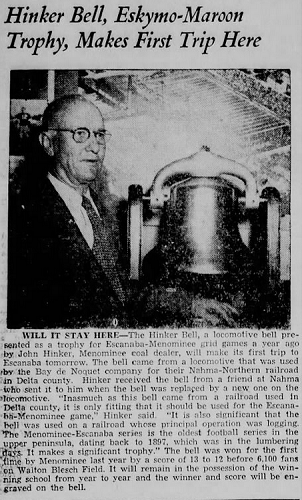 Hinker gave the bell to then Menominee coach Mickey McCormick and indicated proper use for the bell would be as an award for the gridiron rivalry.
Now Hinker’s great great nephew is trying to find the bell, which has not been seen since Escanaba’s current high school opened in 1963.
Tim Waters of Land O’ Lakes, Wis., who has launched the search, became interested by researching his family tree. “It is a big trophy (between 80 and 150 pounds by various estimates) and it is odd that it is missing,” Waters said in a recent telephone chat.
“One theory is that it is in somebody’s hunting camp or a home and they are using it as their own trophy,” said Waters.
“We have a pretty good investigation going on and all help is appreciated. If somebody does have it, we’re not looking to prosecute them. We’re just looking to get the darn thing back. Nobody will be in trouble.”
Waters refuted the old idea the bell was melted down. He has contacted numerous bell collectors, and they said a junk yard would have known it was worth a lot more than melted metal.
“The bell was not destroyed. We’ve come to that conclusion,” he said. “It was not put in a scrap yard.”
Waters contacted Coplan Iron and Metal of Escanaba and learned that bells were not melted or crushed and said the firm never accepted a bell with engravings matching the Hinker Bell.
Waters learned those businesses would sell them for the weight value to people who wanted them for yard ornaments/dinner bells, or to collectors.
“It is a treasure and it needs to be found,” said Waters.
Waters said the last known photo of the bell was with then EHS football coach Al Sigman and Esky players John Fisher and Phil Davidson in 1960. Escanaba beat Menominee from 1959-63 but could not find the bell in 1964 when the Maroons won. No one he has talked to remembers seeing the bell present at the first three games during the tenure of coach Jerry Cvengros.
The current Escanaba High School opened in 1963 and Bay de Noc Community College then occupied the old facility, which has since been demolished.
“Records indicate there was no report (of a missing bell) filed by Escanaba school district to the police department,” Waters said.
“The Hinker Bell is part of U.P. Michigan’s history, as is football and the railroads,” Waters said. “The people of Escanaba and Menominee deserve to have this trophy returned to their high schools.”
Waters, who has never seen an Escanaba or Menominee football game but is planning to rectify that omission this season, is hoping students at the two schools will join in the treasure hunt and talk about it with their parents and grandparents.
He has already contacted EHS athletic director Rob Ryan, who plans to thoroughly search the school basement.
He would like to find a photo of the bell to help collectors in their search. “Each bell was for a special locomotive,” said Waters.
“If they have a good picture we can pass it around and say we are looking for this bell. If they can pinpoint what this bell was on, they can help get the word out.”
He has also extended the search to the website at upfootball.com, which has generated interest but no bell. “If the bell is in the area still today, I don’t think it will take long to surface,” he said.
“If we don’t find this bell, we are going to try to make up a replacement as close as possible if the two schools are interested in that,” he said.
Waters is hoping that real estate agents, postal workers, delivery personnel, construction workers, etc., may have seen the bell during their travels and can help retrieve it.
St. Patrick Immediately Sets Tone On Way to Claiming 1st Title Since 1992
By
Jason Juno
Special for MHSAA.com
November 22, 2025
MARQUETTE — Portland St. Patrick has been no stranger to the MHSAA Finals since moving to 8-player football, but the Shamrocks had come up short of a title in three appearances since 2017.
They were back in the Division 2 championship game Saturday, and again facing a team from the Upper Peninsula, just like the other three times. But this time, St. Patrick made it clear from the opening kick it had no intention of going back below the Mackinac Bridge without the championship trophy.
The Shamrocks rode the momentum from a fast start and blanked Felch North Dickinson 53-0 at the Superior Dome.
“It means a lot,” St. Patrick senior back Brady Leonard said with the trophy in his hand. “Having a couple classes before us come here and not be able to finish the job, it was not just for our team, but it was for everyone that came and wasn’t able to finish it.”
Aiden Fandel set the tone when he took the opening kick to the Nordics’ 3-yard line. Jerryd Scheurer ran three yards on the first play from scrimmage, and Leonard ran in the conversion for an 8-0 lead just 20 seconds into the game.
 “It was huge, just to flip the field position right away was a big deal,” St. Patrick coach Patrick Russman said.
The Shamrocks scored two more times during the first quarter, taking advantage of excellent field position.
St. Patrick’s Tyler Thelen blocked a punt to set up its next score. The Shamrocks took over at the North Dickinson 9, and Charlie Thelen caught a four-yard pass from Scheurer on the second play of the drive for a 14-0 lead.
The Nordics went for it on fourth-and-1 at their own 29 on the ensuing possession, but they were stuffed for no gain, giving St. Patrick the ball not far from the red zone.
Leonard ran eight yards for the touchdown and a 20-0 lead with 5:34 still left in the first quarter.
What a start.
"It was very important," Leonard said. "We knew if we came off hot, we knew that we'd be able to punch them in the mouth and we'd get off to the start that we normally have.”
The Shamrocks scored two more times in the first half, both on runs by Hudson King, who led with 120 yards on 10 carries. His 30-yarder came just seven seconds into the second quarter, and his 21-yard rush gave them a 33-0 lead that held until halftime.
The Nordics drove into St. Patrick territory twice in the period. The first stalled at the 44 when the game was still within reach at 26-0. The second got all the way to the 24, but incomplete passes on third and fourth downs gave St. Patrick the ball back with four seconds on the first-half clock.
North Dickinson just couldn’t overcome that start, or the talent level of the Shamrocks.
“We’ve been punched in the mouth before, but they’re way better,” Nordics coach Mike Christian said. “They were just so much better than us today. They’re bigger, faster, stronger. We just couldn’t get anything going.”
 The second half proved to be more of the same. St. Patrick reached the end zone three more times, on short runs by Caleb Pline and two players listed as linemen, Logan Krieger and Nick Pung.
St. Patrick finished a perfect 13-0, and went unbeaten even with a tough schedule. Russman said the Shamrocks started off with tough Mid-State Activities Conference foes Merrill and Morrice. They ended the regular season with a win over eventual Division 1 runner-up Blanchard Montabella. Their playoff run included wins over Mendon, ranked No. 1 in the final media poll of the season, and last year’s Division 1 champion, Deckerville.
“We didn’t have any time to not be ready this year,” Russman said. “We’ve had a pretty good run of some very quality football teams throughout the stretch of the year. They didn’t give us any rest, so the kids did a good job of getting ready each week. Sometimes you slip, and these guys didn’t slip.”
He credited the team’s chemistry for the special season. The practices were superb all year. And they of course had some really good players.
“Our line has been working hard and they just continued to grind it out today, and our backs finished plays on the offensive end,” Russman said. “We’ve been trying to get a faster and faster defense each week, and I think they’ve really done that and accepted that challenge.”
St. Patrick’s last Finals win came when it was playing 11-player football in 1992, in Class D. North Dickinson was seeking its first championship but had to settle for its second runner-up finish (11-player, Class D, 1998).
The Nordics’ 17-game winning streak came to an end. They finished at 12-1 this year after winning their final five games last season.
North Dickinson canceled its varsity season in 2023, announcing at the time that it would play a JV schedule with only four upperclassmen on the roster. Two years later, the Nordics made it to the final game.
“My seniors would have been sophomores then,” Christian said. “I didn’t want to throw them into that right away. This is kind of what we were aiming for when we did that.”
It all worked out. Missing the playoffs last year proved to be a good motivator as well.
“They really put the extra work in,” he said. “They’re such great kids, and they worked their tails off all summer and I’m just so proud of them.”
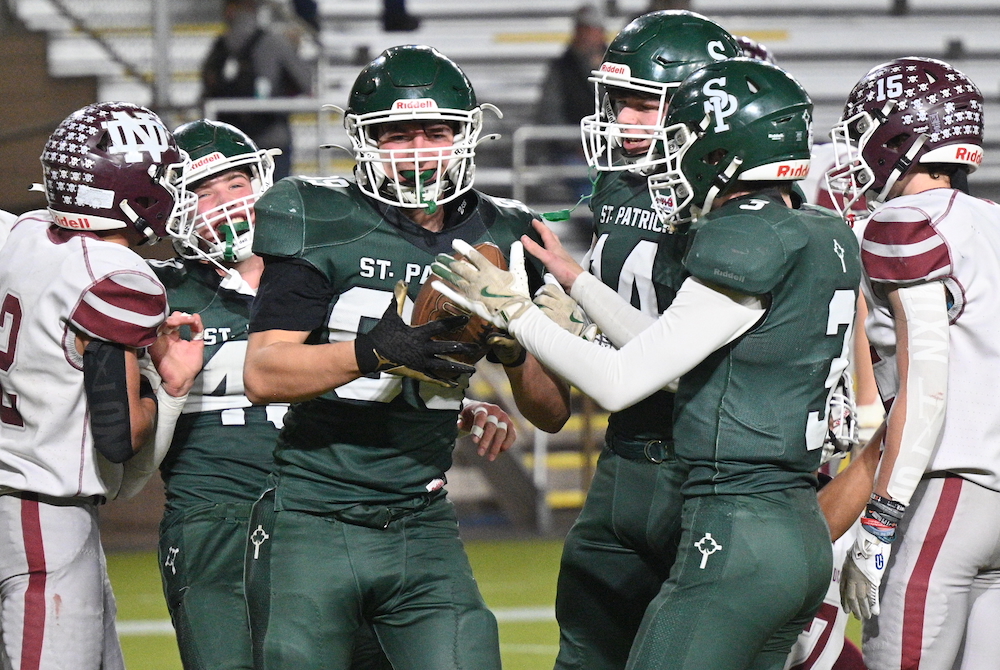
PHOTOS (Top) Portland St. Patrick players celebrate a touchdown Saturday at Superior Dome. (Middle) North Dickinson quarterback Brady Jungwirth (15) works to pull away from a tackler. (Below) The Shamrocks’ Charlie Thelen (12) goes high to pull in a pass. (Click for more from Cara Kamps.)