


#TBT: Searching for The Hinker Bell
September 28, 2017
By Geoff Kimmerly
Second Half editor
Menominee will host Escanaba on Friday in the 121st meeting between two of the Upper Peninsula’s largest high schools and proudest football programs – but with the trophy celebrating the game still missing after it first disappeared more than half a century ago.
The two teams from 1948-1962 played for the The Hinker Bell, a locomotive bell that hasn’t been seen since 1963.
A decade ago, Escanaba Daily Press sports editor (and now Second Half correspondent) Denny Grall wrote about a newfound search for The Hinker Bell. But the mystery continues, and Grall’s story below tells of many of the twists and turns that to that point that had come in trying to locate it.
ESCANABA — Another search is underway to find the Hinker Bell.
The former locomotive bell went to the winner of the Escanaba-Menominee football game for about 15 years but has been missing for more than 40 years. It came from a locomotive owned by the Bay de Noquet Company and used on the LS&I Railroad that operated in Delta and Menominee counties.
The locomotive was built in 1906 by Baldwin Locomotive Works in Philadelphia and the bell was believed to have been cast in the railroad foundry, according to a 1953 newspaper clipping.
In 1948, one of the locomotive owners presented the bell to his friend, John Hinker of Menominee, an ardent sports fan who donated materials for the press box at Menominee’s Walton Blesch Field.
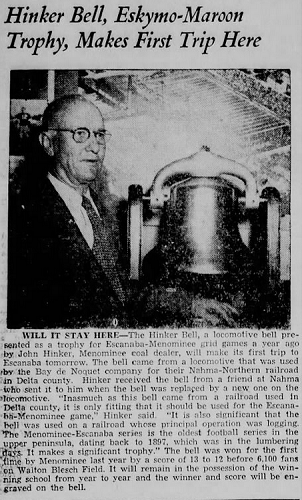 Hinker gave the bell to then Menominee coach Mickey McCormick and indicated proper use for the bell would be as an award for the gridiron rivalry.
Now Hinker’s great great nephew is trying to find the bell, which has not been seen since Escanaba’s current high school opened in 1963.
Tim Waters of Land O’ Lakes, Wis., who has launched the search, became interested by researching his family tree. “It is a big trophy (between 80 and 150 pounds by various estimates) and it is odd that it is missing,” Waters said in a recent telephone chat.
“One theory is that it is in somebody’s hunting camp or a home and they are using it as their own trophy,” said Waters.
“We have a pretty good investigation going on and all help is appreciated. If somebody does have it, we’re not looking to prosecute them. We’re just looking to get the darn thing back. Nobody will be in trouble.”
Waters refuted the old idea the bell was melted down. He has contacted numerous bell collectors, and they said a junk yard would have known it was worth a lot more than melted metal.
“The bell was not destroyed. We’ve come to that conclusion,” he said. “It was not put in a scrap yard.”
Waters contacted Coplan Iron and Metal of Escanaba and learned that bells were not melted or crushed and said the firm never accepted a bell with engravings matching the Hinker Bell.
Waters learned those businesses would sell them for the weight value to people who wanted them for yard ornaments/dinner bells, or to collectors.
“It is a treasure and it needs to be found,” said Waters.
Waters said the last known photo of the bell was with then EHS football coach Al Sigman and Esky players John Fisher and Phil Davidson in 1960. Escanaba beat Menominee from 1959-63 but could not find the bell in 1964 when the Maroons won. No one he has talked to remembers seeing the bell present at the first three games during the tenure of coach Jerry Cvengros.
The current Escanaba High School opened in 1963 and Bay de Noc Community College then occupied the old facility, which has since been demolished.
“Records indicate there was no report (of a missing bell) filed by Escanaba school district to the police department,” Waters said.
“The Hinker Bell is part of U.P. Michigan’s history, as is football and the railroads,” Waters said. “The people of Escanaba and Menominee deserve to have this trophy returned to their high schools.”
Waters, who has never seen an Escanaba or Menominee football game but is planning to rectify that omission this season, is hoping students at the two schools will join in the treasure hunt and talk about it with their parents and grandparents.
He has already contacted EHS athletic director Rob Ryan, who plans to thoroughly search the school basement.
He would like to find a photo of the bell to help collectors in their search. “Each bell was for a special locomotive,” said Waters.
“If they have a good picture we can pass it around and say we are looking for this bell. If they can pinpoint what this bell was on, they can help get the word out.”
He has also extended the search to the website at upfootball.com, which has generated interest but no bell. “If the bell is in the area still today, I don’t think it will take long to surface,” he said.
“If we don’t find this bell, we are going to try to make up a replacement as close as possible if the two schools are interested in that,” he said.
Waters is hoping that real estate agents, postal workers, delivery personnel, construction workers, etc., may have seen the bell during their travels and can help retrieve it.

1st & Goal: 2023 Week 2 Preview
By
Geoff Kimmerly
MHSAA.com senior editor
August 31, 2023
While opening weekend is always going to be among the most highly-anticipated every football season, Week 2 this fall could provide quite an encore.
 This weekend’s schedule statewide leads off with a trio of massive matchups that include teams from the Grand Rapids and/or Muskegon areas, with perhaps the top two teams in both the Lansing area and entire Upper Peninsula also set to face off and a possible Flint-area league championship also potentially being previewed for the second-straight season.
Four games were scheduled to be played Wednesday, with 241 today, 53 on Friday and two Saturday. Broadcasts of several will be available on MHSAA.tv with subscription, and come back all weekend to the MHSAA Scores page for results as they come in.
Here’s a look at some of those matchups that jump off the page most:
Bay & Thumb
Linden (1-0) at Goodrich (1-0), Thursday
Three of four meetings between these two over the last four seasons has been decided by six points or fewer. They met twice last season, first in a Flint Metro League non-divisional tune-up – won by Goodrich 6-0 – and then in the league championship game after both won their divisions, with the Martians prevailing again 21-0. After going separate ways a second time, Goodrich ended up in the Division 4 Final and finished runner-up, and Linden reached a Regional Final in Division 3.
Keep an eye on these THURSDAY Richmond (1-0) at Croswell-Lexington (1-0), Ithaca (1-0) at Standish-Sterling (0-1), Cass City (1-0) at Harbor Beach (1-0). FRIDAY Traverse City Central (1-0) at Lapeer (1-0).
Greater Detroit
Rochester (1-0) at Rochester Adams (1-0), Thursday
Look past that Adams has won this matchup 26 times in a row, and the rivalry has had a different vibe of late as Rochester has continued to improve. The Highlanders won both meetings last year, 34-18 in Week 2 but also 28-14 in a Division 1 District Final while facing the Falcons in the playoffs for the second time in three seasons. Rochester High has strung together three straight winning seasons and lost last week by just a point, 22-21, to Utica while Adams opened with a 22-8 win over Orchard Lake St. Mary’s.
Keep an eye on these THURSDAY West Bloomfield (1-0) at Birmingham Groves (1-0), Detroit Loyola (1-0) at Warren Michigan Collegiate (1-0). FRIDAY Hastings (1-0) at Pontiac Notre Dame Prep (1-0), Clarkston (0-1) at Southfield Arts & Technology (1-0).
Mid-Michigan
Mason (1-0) at DeWitt (1-0), Thursday
These two both were one more win away from giving Ford Field an all-Capital Area Activities Conference Division 3 Final last season, as they both finished with losses in Semifinals on the opposite sides of the bracket. They may be mid-Michigan’s top two teams this season. DeWitt again is a favorite in the CAAC Blue and showed plenty of mettle in coming back to defeat Haslett in their opener 27-17. Mason returns nearly its entire starting lineup from last year’s 12-1 run and opened last week with a 52-14 win over Holt, a Division 1 playoff team last fall.
Keep an eye on these THURSDAY Hudsonville (1-0) at East Lansing (0-1), Portland (1-0) at Olivet (0-1), Lansing Sexton (1-0) at Lansing Catholic (1-0), Fenton (1-0) at Haslett (0-1).
Northern Lower Peninsula
Frankfort (1-0) at Maple City Glen Lake (1-0), Thursday
These two frequent league title contenders didn’t determine any championships last year, but Frankfort did win their matchup 22-6 to finish runner-up in the Northern Michigan Football League Legacy. Both teams opened with wins last week, Frankfort in the Legacy 38-8 over Mancelona, and the Lakers 34-18 nonleague over Manton. After a mostly-dominating 20-teens, Glen Lake has had a few tough seasons of late – but winning this matchup would be a nice boost as first-year coach Jesse Smith establishes his program.
Keep an eye on these THURSDAY Hudson (1-0) at Benzie Central (1-0), Johannesburg-Lewiston (1-0) at East Jordan (1-0), Gaylord (1-0) at Kingsley (1-0). FRIDAY Elk Rapids (0-1) at Boyne City (1-0).
Southeast & Border
Riverview (1-0) at Carleton Airport (1-0), Thursday
Riverview was able to clinch the outright Huron League title last season in part because of an 18-13 win over Airport in Week 7, with the Jets going on to tie for second. This matchup could be part of the equation again, especially after Airport claimed an impressive 31-10 win last week over Gibraltar Carlson – winner of nine games both of the last two seasons – and Pirates more than doubled up Detroit Renaissance to run their regular-season winning streak to 29.
Keep an eye on these THURSDAY Whitehall (1-0) at Tecumseh (1-0), Detroit Country Day (1-0) at Parma Western (1-0). FRIDAY Edwardsburg (0-1) at Chelsea (0-1), Dexter (0-1) at Saline (1-0).
Southwest Corridor
Traverse City St. Francis (1-0) at Lawton (1-0), Friday
This season’s Gladiators picked up some key experience on the fly last week with a 41-40 overtime win over Charlevoix as they work to replace many of last year’s leaders who took the team to a Division 7 runner-up finish and along the way defeated Lawton 42-7 in Week 8. The Blue Devils were in a similar spot a year ago as the 2021 Division 7 runner-up and rebounded from the St. Francis defeat to win a District title before falling by just a point to eventual champion Jackson Lumen Christi in the Regional. St. All four teams mentioned here are in Division 7 this fall, and Lawton opened with a 51-20 win last week over Benton Harbor.
Keep an eye on these THURSDAY Schoolcraft (1-0) at Centreville (0-1), Delton Kellogg (1-0) at Parchment (1-0), Niles (1-0) at Stevensville Lakeshore (0-1). FRIDAY Battle Creek Harper Creek (1-0) at Battle Creek Central (0-1)
Upper Peninsula
Negaunee (1-0) at Gladstone (1-0), Thursday
The conversation went back and forth last season about which of these two was the Upper Peninsula’s best team until Negaunee won their first meeting 24-6 in Week 7, and the Miners wrapped that up again with an 18-12 Regional win on the way to finishing Division 6 runner-up. It’s too early to have that conversation yet this year, but judging by last week’s results – Gladstone won 36-7 over Marquette and Negaunee doubled up Ishpeming 32-16 – both may be in the conversation again.
Keep an eye on these THURSDAY Bark River-Harris (1-0) at Iron Mountain (1-0), Cadillac (0-1) at Escanaba (1-0), Menominee (1-0) at Hancock (1-0), Kingsford (1-0) at Houghton (0-1).
West Michigan
Warren De La Salle Collegiate (0-1) at Muskegon (0-1), Friday
As noted, there are some monster matchups on the west side of the state this weekend – see below for others – but it’s hard not to dive into this one even though both fell in season openers last week. Both also finished last season at Ford Field – De La Salle as repeat Division 2 champion and Muskegon as Division 3 runner-up. The Pilots were leading Davison last week before storms forced their game to finish up the next day and the Cardinals prevailed 31-26. The Big Reds, meanwhile, took on another Division 1 contender in Rockford and lost 27-7 in a game that also no doubt will pay off in experience and playoff points.
Keep an eye on these THURSDAY Portage Central (1-0) at Grand Rapids Forest Hills Central (1-0). FRIDAY River Rouge (0-1) at Grand Rapids Catholic Central (0-1), East Grand Rapids (1-0) at Grand Rapids South Christian (1-0), Rockford (1-0) at Muskegon Mona Shores (1-0).
8-Player
Posen (1-0) at Rogers City (1-0), Friday
Rogers City was the North Star League Big Dipper champion last season, and Posen was the Little Dipper runner-up, and the Hurons claimed their Week 3 meeting 12-6. Both are coming off big season-opening wins last week, with Posen nearly doubling up a Pellston program that’s had a nice run of success most of the last half-decade. But this matchup likely will tell us much more about both teams, especially relative to the 18-1 regular-season run Rogers City has put together since the start of 2021.
Keep an eye on these THURSDAY Merrill (1-0) at Morrice (1-0), Lake Linden-Hubbell (1-0) at Indian River Inland Lakes (1-0), Colon (0-1) at Mendon (1-0), Munising (0-1) at Newberry (1-0).
Second Half’s weekly “1st & Goal” previews and reviews are powered by MI Student Aid, a part of the Office of Postsecondary Financial Planning located within the Michigan Department of Treasury. MI Student Aid encourages students to pursue postsecondary education by providing access to student financial resources and information. MI Student Aid administers the state’s 529 college savings programs (MET/MESP), as well as scholarship and grant programs that help make college Accessible, Affordable and Attainable for you. Connect with MI Student Aid at www.michigan.gov/mistudentaid and find more information on Facebook and X (Twitter) @mistudentaid.
PHOTO A St. Clair Shores Lakeview ball carrier works to break a tackle during last week’s 28-0 win over Warren Woods Tower. (Photo by Chris Mudd/National Photo Scout.)