


#TBT: Searching for The Hinker Bell
September 28, 2017
By Geoff Kimmerly
Second Half editor
Menominee will host Escanaba on Friday in the 121st meeting between two of the Upper Peninsula’s largest high schools and proudest football programs – but with the trophy celebrating the game still missing after it first disappeared more than half a century ago.
The two teams from 1948-1962 played for the The Hinker Bell, a locomotive bell that hasn’t been seen since 1963.
A decade ago, Escanaba Daily Press sports editor (and now Second Half correspondent) Denny Grall wrote about a newfound search for The Hinker Bell. But the mystery continues, and Grall’s story below tells of many of the twists and turns that to that point that had come in trying to locate it.
ESCANABA — Another search is underway to find the Hinker Bell.
The former locomotive bell went to the winner of the Escanaba-Menominee football game for about 15 years but has been missing for more than 40 years. It came from a locomotive owned by the Bay de Noquet Company and used on the LS&I Railroad that operated in Delta and Menominee counties.
The locomotive was built in 1906 by Baldwin Locomotive Works in Philadelphia and the bell was believed to have been cast in the railroad foundry, according to a 1953 newspaper clipping.
In 1948, one of the locomotive owners presented the bell to his friend, John Hinker of Menominee, an ardent sports fan who donated materials for the press box at Menominee’s Walton Blesch Field.
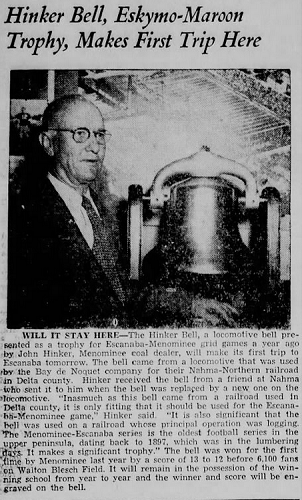 Hinker gave the bell to then Menominee coach Mickey McCormick and indicated proper use for the bell would be as an award for the gridiron rivalry.
Now Hinker’s great great nephew is trying to find the bell, which has not been seen since Escanaba’s current high school opened in 1963.
Tim Waters of Land O’ Lakes, Wis., who has launched the search, became interested by researching his family tree. “It is a big trophy (between 80 and 150 pounds by various estimates) and it is odd that it is missing,” Waters said in a recent telephone chat.
“One theory is that it is in somebody’s hunting camp or a home and they are using it as their own trophy,” said Waters.
“We have a pretty good investigation going on and all help is appreciated. If somebody does have it, we’re not looking to prosecute them. We’re just looking to get the darn thing back. Nobody will be in trouble.”
Waters refuted the old idea the bell was melted down. He has contacted numerous bell collectors, and they said a junk yard would have known it was worth a lot more than melted metal.
“The bell was not destroyed. We’ve come to that conclusion,” he said. “It was not put in a scrap yard.”
Waters contacted Coplan Iron and Metal of Escanaba and learned that bells were not melted or crushed and said the firm never accepted a bell with engravings matching the Hinker Bell.
Waters learned those businesses would sell them for the weight value to people who wanted them for yard ornaments/dinner bells, or to collectors.
“It is a treasure and it needs to be found,” said Waters.
Waters said the last known photo of the bell was with then EHS football coach Al Sigman and Esky players John Fisher and Phil Davidson in 1960. Escanaba beat Menominee from 1959-63 but could not find the bell in 1964 when the Maroons won. No one he has talked to remembers seeing the bell present at the first three games during the tenure of coach Jerry Cvengros.
The current Escanaba High School opened in 1963 and Bay de Noc Community College then occupied the old facility, which has since been demolished.
“Records indicate there was no report (of a missing bell) filed by Escanaba school district to the police department,” Waters said.
“The Hinker Bell is part of U.P. Michigan’s history, as is football and the railroads,” Waters said. “The people of Escanaba and Menominee deserve to have this trophy returned to their high schools.”
Waters, who has never seen an Escanaba or Menominee football game but is planning to rectify that omission this season, is hoping students at the two schools will join in the treasure hunt and talk about it with their parents and grandparents.
He has already contacted EHS athletic director Rob Ryan, who plans to thoroughly search the school basement.
He would like to find a photo of the bell to help collectors in their search. “Each bell was for a special locomotive,” said Waters.
“If they have a good picture we can pass it around and say we are looking for this bell. If they can pinpoint what this bell was on, they can help get the word out.”
He has also extended the search to the website at upfootball.com, which has generated interest but no bell. “If the bell is in the area still today, I don’t think it will take long to surface,” he said.
“If we don’t find this bell, we are going to try to make up a replacement as close as possible if the two schools are interested in that,” he said.
Waters is hoping that real estate agents, postal workers, delivery personnel, construction workers, etc., may have seen the bell during their travels and can help retrieve it.
1st & Goal: 2021 11-Player Semifinals Review
By
Geoff Kimmerly
MHSAA.com senior editor
November 22, 2021
The 11-Player Football Finals field is set. Ford Field, here we come.
 After crisscrossing the Lower Peninsula on Saturday for Semifinals, all vehicles will be pointed toward downtown Detroit this weekend – including parades from a few communities we’ll be seeing for the first time.
Belleville, Warren Michigan Collegiate and Lawton, welcome to a Thanksgiving week like no other. The other 13 teams that will be making the trip Friday and Saturday have been to this point before – including three just 10 months ago – and surely they’d agree this trip to Detroit will be unforgettable.
Below is a glance at how all 16 took the final step to earn the opportunity.
(We’ll review Saturday’s 8-Player Finals – won by Adrian Lenawee Christian and Powers North Central – during a look back at all 10 football championship games next week.)
Division 1
Belleville 40, Sterling Heights Stevenson 26
In their fourth-straight Semifinal, the Tigers (12-1) earned their first Finals trip. Freshman quarterback Bryce Underwood threw three touchdown passes and ran for one more as Belleville scored the most points Stevenson (10-3) had allowed in a game since a Week 1 loss to Rockford. Click for more from the Detroit Free Press.
Belleville freshman quarterback Bryce Underwood (@BryceUnderwoo16) with three touchdown passes in the win over Sterling Hts. Stevenson in the Division 1 Football Semifinal.
TD Receptions:@deshaun3lee
Jalen Johnson@trev_joness@JermainCrowell
#StateChamps X @hungryhowies pic.twitter.com/qgjKwAp8Ao— STATE CHAMPS! Michigan (@statechampsmich) November 21, 2021
Rochester Adams 40, Grand Blanc 20
Adams (13-0) won a matchup of undefeated teams to reach the Finals for the first time since 2003, showing its defensive might again in shutting down a Bobcats offense that averaged 42 points per game entering the day. Grand Blanc finished its longest tournament run and winningest season at 12-1. Click for more from the Oakland Press.
Rochester Adams (@R_AdamsFootball) Junior LB Tait Picot (@PicotTait) with the pick six in the 40-20 semifinal win over Grand Blanc.#StateChamps X @LTUAthletics pic.twitter.com/uM809Q72RC
— STATE CHAMPS! Michigan (@statechampsmich) November 21, 2021
Division 2
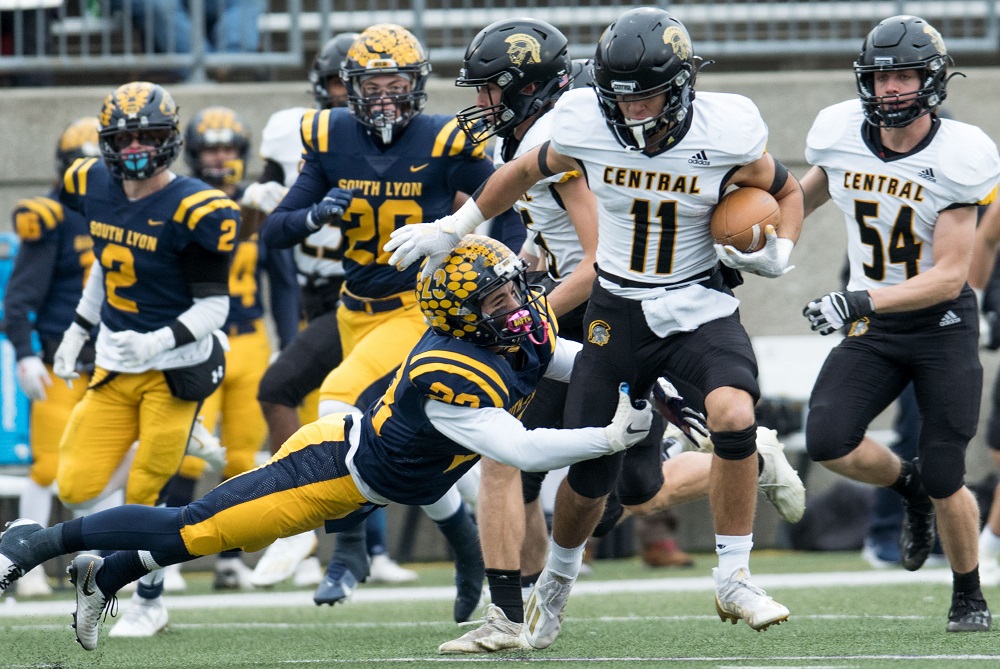
Traverse City Central 56, South Lyon 20
The Trojans (12-1) earned their first Finals trip since 1988. Central took a 42-7 lead into halftime as Josh Burnham scored three touchdowns, and blocked a field goal attempt too. South Lyon (12-1) was making its first Semifinal appearance since 2004. Click for more from the Traverse City Record-Eagle.
Here's the first half highlights of the Traverse City Central vs. South Lyon | Division 2 Football Semifinal. @JoshuaBurnham20 @carson_bourdo
🎥WBPN-TV#StateChamps X @MHSAA pic.twitter.com/mZv7GwuY2y— STATE CHAMPS! Michigan (@statechampsmich) November 21, 2021
Warren De La Salle Collegiate 49, Livonia Franklin 14
The Pilots (12-0) will play in their fourth Division 2 Final in five seasons, with an opportunity to finish undefeated for the first time during the playoff era. Junior quarterback Brady Drogosh threw for two touchdowns and ran for two more, including a 73-yarder. Franklin finished 7-6 after entering the playoffs 4-5. Click for more from the Macomb Daily.
De La Salle QB Brady Drogosh ran for 2 touchdowns of 55 and 73 yards in the 49-14 win over Livonia Franklin this afternoon. @DLSPilots @DLSFootball_MI @BDrogosh #StateChamps x @DMC_Rehab pic.twitter.com/We2HYxCR8V
— STATE CHAMPS! Michigan (@statechampsmich) November 20, 2021
Division 3
Detroit Martin Luther King 46, Mason 7
The Crusaders (12-1) advanced to their fourth Final in six seasons and first since 2019. While topping 40 points for the seventh time in 11 games played on the field, King also lowered its playoff points-allowed average to 9.5 with a second-straight game giving up a single score. Mason completed its winningest season, and longest playoff run, at 10-3. Click for more from the Detroit Free Press.
Our Mr. Football candidate Dante Moore (@dantemoore05) with another touchdown pass in the 1st quarter, this one to Joseph Williams (@elite_joe1) as Detroit King (@DetKingFootball) went onto beat Mason in the Division 3 Semifinal. #StateChamps X @hungryhowies pic.twitter.com/tQ7heMFVty
— STATE CHAMPS! Michigan (@statechampsmich) November 20, 2021
DeWitt 43, St. Joseph 7
The Panthers (12-1) will return to Ford Field with an opportunity to repeat as Division 3 champions. DeWitt built a 29-0 halftime lead, as quarterback Ty Holtz threw three first-half touchdown passes, including 69 and 40-yarders to Tommy McIntosh. St. Joseph (8-5) was playing in its first Semifinal since 2007 after entering the postseason 5-4. Click for more from the Lansing State Journal.
Our Mr. Football candidate Ty Holtz (@tyholtz_) from DeWitt (@dewittathletics) connected with the @BadgerFootball commit Tommy McIntosh for two touchdowns in the win over St. Joseph on Saturday.
🎥https://t.co/duQnD6Kq0j#StateChamps X @MHSAA pic.twitter.com/mJfhLTbGoV— STATE CHAMPS! Michigan (@statechampsmich) November 21, 2021
Division 4
Chelsea 30, Freeland 27
For the second straight week, Chelsea came up with a big play at the end to advance. This time it was a near-goal line stand to stop a Freeland offense that had gotten two rushing and two passing touchdowns from quarterback Bryson Huckaby. The Falcons finished a second-straight Semifinal run 11-2. Click for more from the Ann Arbor News.
Freeland 4th and 3 on the four yard line with 48 seconds left and the Chelsea defense comes through with the stop. They measure for the first down and it’s just short. @ChelseaFB_SEC @ChelseaBulldogs #StateChamps X @MHSAA pic.twitter.com/n9FaLNOUwc
— STATE CHAMPS! Michigan (@statechampsmich) November 20, 2021
Hudsonville Unity Christian 58, Edwardsburg 8
The Crusaders (13-0) moved into second all-time for scoring in one season at 751 points with their 11th game putting up more than 50, and with a defensive showing to match – Edwardsburg (12-1) entered the game averaging 53 points per. Unity’s Abraham Rappuhn scored three first-half touchdowns, including an 81-yarder. Click for more from FOX 17.
Jason Hutton (@jhutt5) brings you the highlights of the Unity Christian (@UCSaders) vs. Edwardsburg | Division 4 Football Semifinal from this afternoon.
🎥WXMI-TV#StateChamps X @hungryhowies pic.twitter.com/Gn6lwANE1M— STATE CHAMPS! Michigan (@statechampsmich) November 21, 2021
Division 5
Grand Rapids Catholic Central 35, Frankenmuth 0
The rematch of last season’s Division 5 championship game saw Grand Rapids Catholic Central (13-0) go up 21-0 midway through the first quarter. Cougars quarterback John Passinault ran for three touchdowns and threw for the other two. Frankenmuth finished 12-1, its only losses the last two seasons to GRCC. Click for more from the Grand Rapids Press.
Jason Hutton (@jhutt5) brings you the highlights of the Grand Rapids Catholic Central (@GRCC_CougarsFB) vs. Frankenmuth | Division 5 Football Semifinal from this afternoon.
🎥WXMI-TV#StateChamps X @LTUAthletics pic.twitter.com/bbgNJTr4jY— STATE CHAMPS! Michigan (@statechampsmich) November 21, 2021
Marine City 27, Portland 7
The Mariners (13-0) are headed back to Ford Field for the first time since 2013 after another dominating defensive performance – they haven’t given up more than 14 points in a game, and lowered their per game defensive average to 9.1 allowed per contest. The Raiders finished 10-3. Click for more from the Port Huron Times-Herald.
Marine City Junior QB Jeff Heaslip connects with Sophomore Parker Atkinson on the 38-yard score to put the Mariners up 7-0 over Portland!@marine_high @MCGoBlack @mariner_mc @jeffery_heaslip #StateChamps X @MIArmyGuard pic.twitter.com/La2ivg7nzF
— STATE CHAMPS! Michigan (@statechampsmich) November 20, 2021
Division 6
Lansing Catholic 18, Standish-Sterling 7
The Cougars will be returning to Ford Field seeking a second championship in three seasons to go with a 2019 title in Division 5. The Cougars (12-1) matched defense with defense, scoring their second-fewest points this fall but holding Standish-Sterling to a tie for the latter’s lowest output. The Panthers finished 10-3, making an incredible jump from last season’s 1-6 record. Click for more from the Lansing State Journal.
Lansing Catholic (@lansingcatholic) junior Nic Gruber with two touchdown runs as the Cougars went onto beat Standish-Sterling in the Division 6 Football Semifinal on Saturday afternoon. @lchscougarsport
🎥WILX-TV#StateChamps X @MHSAA pic.twitter.com/T7wd5QKzNK— STATE CHAMPS! Michigan (@statechampsmich) November 21, 2021
Warren Michigan Collegiate 36, Michigan Center 29
Michigan Collegiate (11-2) earned its first trip to the Finals, thanks in part to a series of big plays by Deion Black on both sides of the ball. The teams were tied after three quarters, and traded scores in the fourth with the Cougars reaching the end zone last. Michigan Center finished 11-2, setting a program record for wins. Click for more from MLive-Detroit.
Deion Black (@de1on_) was getting it down on both sides of the ball for @MCisFamily.#StateChamps x @DMC_Rehab pic.twitter.com/igt03bLpJE
— STATE CHAMPS! Michigan (@statechampsmich) November 21, 2021
Division 7
Lawton 21, Jackson Lumen Christi 20
The Blue Devils are headed to the Finals for the first time after following up a memorable Regional Final win with perhaps an even more unforgettable Semifinal finish. Landon Motter’s two-point conversion with 46 seconds to play put Lawton (13-0) up for good. The Blue Devils had jumped out to a 13-0 first-half lead but found themselves trailing Lumen Christi (11-2) by a point heading into the fourth quarter. Click for more from the Kalamazoo Gazette.
Jason Hutton (@jhutt5) brings you the highlights of the Lawton vs. Lumen Christi | Division 7 Football Semifinal from this afternoon.
🎥WXMI-TV#StateChamps X @MIArmyGuard pic.twitter.com/iOGNcOoa6b— STATE CHAMPS! Michigan (@statechampsmich) November 21, 2021
Pewamo-Westphalia 28, Traverse City St. Francis 21
The Pirates (13-0) will have a chance to win a second Division 7 title in three years after holding off last season’s runner-up St. Francis (12-1). The teams were tied 14-14 heading into the final quarter, and P-W’s defense was able to slow St. Francis’ offense for most of it, for the game holding the Gladiators to their fewest points this season and well below their average of 50 per game. Click for more from the Lansing State Journal.
Jason Hutton (@jhutt5) brings you the highlights of the Pewamo-Westphalia (@PWGRIDIRON) vs. Traverse City St. Francis | Division 7 Football Semifinal from this afternoon.
🎥WXMI-TV#StateChamps X @hungryhowies pic.twitter.com/lzElUyi71e— STATE CHAMPS! Michigan (@statechampsmich) November 21, 2021
Division 8
Beal City 12, Ubly 7
The Aggies (12-1) will return to the Finals for the second time in three seasons thanks to the latest of a string of strong defensive showings. Beal City lowered its points-allowed average to 8.3 per game by stopping an Ubly offense that had averaged 45 per game entering Saturday. The Bearcats (12-1) were last season’s Division 8 runners-up up. Click for more from the Mount Pleasant Morning Sun.
Beal City got on the board 1st. Senior Cade Block refuses to go down, plowing through defenders and diving into the end zone to give the Aggies a 6-0 lead over Ubly. @BealCityAggieFB @bcaggieathletic @BlockheadCade#StateChamps x @LTUAthletics pic.twitter.com/AaXuabW00N
— STATE CHAMPS! Michigan (@statechampsmich) November 20, 2021
Hudson 28, Ottawa Lake Whiteford 22
The Tigers (13-0) advanced to their first championship game since 2010 relying again on an excellent defense to slow down a Whiteford offense averaging 51 points per game, but also on the legs of Bronson Marry – who ran for four second-half touchdowns as Hudson came all the way back from a 22-0 halftime deficit. It was the only loss to an in-state opponent this fall for the Bobcats (11-2). Click for more from the Adrian Daily Telegram.
Bronson Marry had four rushing touchdowns in the 2nd half as Hudson (@hudson_schools) went onto beat Ottawa Lake Whiteford in the Division 8 Football Semifinal. #StateChamps X @MHSAA pic.twitter.com/FqM5w3CKVv
— STATE CHAMPS! Michigan (@statechampsmich) November 21, 2021
Second Half’s weekly “1st & Goal” previews and reviews are powered by MI Student Aid, a part of the Office of Postsecondary Financial Planning located within the Michigan Department of Treasury. MI Student Aid encourages students to pursue postsecondary education by providing access to student financial resources and information. MI Student Aid administers the state’s 529 college savings programs (MET/MESP), as well as scholarship and grant programs that help make college Accessible, Affordable and Attainable for you. Connect with MI Student Aid at www.michigan.gov/mistudentaid and find more information on Facebook and Twitter @mistudentaid.
PHOTO Traverse City Central's Carson Bourdo (11) tries to break away from a South Lyon defender during Saturday's Division 2 Semifinal win. (Photo by Jamie McNinch.)