


#TBT: Searching for The Hinker Bell
September 28, 2017
By Geoff Kimmerly
Second Half editor
Menominee will host Escanaba on Friday in the 121st meeting between two of the Upper Peninsula’s largest high schools and proudest football programs – but with the trophy celebrating the game still missing after it first disappeared more than half a century ago.
The two teams from 1948-1962 played for the The Hinker Bell, a locomotive bell that hasn’t been seen since 1963.
A decade ago, Escanaba Daily Press sports editor (and now Second Half correspondent) Denny Grall wrote about a newfound search for The Hinker Bell. But the mystery continues, and Grall’s story below tells of many of the twists and turns that to that point that had come in trying to locate it.
ESCANABA — Another search is underway to find the Hinker Bell.
The former locomotive bell went to the winner of the Escanaba-Menominee football game for about 15 years but has been missing for more than 40 years. It came from a locomotive owned by the Bay de Noquet Company and used on the LS&I Railroad that operated in Delta and Menominee counties.
The locomotive was built in 1906 by Baldwin Locomotive Works in Philadelphia and the bell was believed to have been cast in the railroad foundry, according to a 1953 newspaper clipping.
In 1948, one of the locomotive owners presented the bell to his friend, John Hinker of Menominee, an ardent sports fan who donated materials for the press box at Menominee’s Walton Blesch Field.
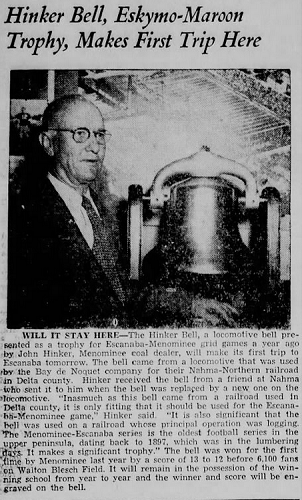 Hinker gave the bell to then Menominee coach Mickey McCormick and indicated proper use for the bell would be as an award for the gridiron rivalry.
Now Hinker’s great great nephew is trying to find the bell, which has not been seen since Escanaba’s current high school opened in 1963.
Tim Waters of Land O’ Lakes, Wis., who has launched the search, became interested by researching his family tree. “It is a big trophy (between 80 and 150 pounds by various estimates) and it is odd that it is missing,” Waters said in a recent telephone chat.
“One theory is that it is in somebody’s hunting camp or a home and they are using it as their own trophy,” said Waters.
“We have a pretty good investigation going on and all help is appreciated. If somebody does have it, we’re not looking to prosecute them. We’re just looking to get the darn thing back. Nobody will be in trouble.”
Waters refuted the old idea the bell was melted down. He has contacted numerous bell collectors, and they said a junk yard would have known it was worth a lot more than melted metal.
“The bell was not destroyed. We’ve come to that conclusion,” he said. “It was not put in a scrap yard.”
Waters contacted Coplan Iron and Metal of Escanaba and learned that bells were not melted or crushed and said the firm never accepted a bell with engravings matching the Hinker Bell.
Waters learned those businesses would sell them for the weight value to people who wanted them for yard ornaments/dinner bells, or to collectors.
“It is a treasure and it needs to be found,” said Waters.
Waters said the last known photo of the bell was with then EHS football coach Al Sigman and Esky players John Fisher and Phil Davidson in 1960. Escanaba beat Menominee from 1959-63 but could not find the bell in 1964 when the Maroons won. No one he has talked to remembers seeing the bell present at the first three games during the tenure of coach Jerry Cvengros.
The current Escanaba High School opened in 1963 and Bay de Noc Community College then occupied the old facility, which has since been demolished.
“Records indicate there was no report (of a missing bell) filed by Escanaba school district to the police department,” Waters said.
“The Hinker Bell is part of U.P. Michigan’s history, as is football and the railroads,” Waters said. “The people of Escanaba and Menominee deserve to have this trophy returned to their high schools.”
Waters, who has never seen an Escanaba or Menominee football game but is planning to rectify that omission this season, is hoping students at the two schools will join in the treasure hunt and talk about it with their parents and grandparents.
He has already contacted EHS athletic director Rob Ryan, who plans to thoroughly search the school basement.
He would like to find a photo of the bell to help collectors in their search. “Each bell was for a special locomotive,” said Waters.
“If they have a good picture we can pass it around and say we are looking for this bell. If they can pinpoint what this bell was on, they can help get the word out.”
He has also extended the search to the website at upfootball.com, which has generated interest but no bell. “If the bell is in the area still today, I don’t think it will take long to surface,” he said.
“If we don’t find this bell, we are going to try to make up a replacement as close as possible if the two schools are interested in that,” he said.
Waters is hoping that real estate agents, postal workers, delivery personnel, construction workers, etc., may have seen the bell during their travels and can help retrieve it.
Reading Reaches Next Level with Repeat
November 29, 2019
By Geoff Kimmerly
Second Half editor
DETROIT – An arduous playoff road over the last five weeks pushed Reading up against some of the most established football programs in Michigan high school history.
Pre-District opponent Mendon is tied for 10th with 12 MHSAA Finals football titles. Semifinal foe Fowler has won seven championships. Those two, Cassopolis and Adrian Lenawee Christian all were state-ranked during the regular season. Friday’s championship game opponent Beal City was not, but is tied for the most playoff appearances in MHSAA history with 35 over the 45-year history of the tournament.
Reading made its 25th playoff appearance this fall, an impressive feat on its own. But by winning a second straight Division 8 championship – after last year’s first in school history – the Rangers launched their program into that group of the most revered.
They concluded this chapter with a 33-6 win over the Aggies on Friday at Ford Field, extending an incredible run while allowing a star-studded senior class to leave its personal imprint on what Reading has accomplished.
“I really think we left a mark in the playoff book,” Rangers senior Hunter Midtgard said. “Just because we came through last year, we had a really good team, and then we came through this year and we wanted to prove a point that this was our team and we wanted to leave a legacy. We just wanted to finish the job.”
Reading finished this fall 13-1, winning 13 straight after a 14-0 opening loss to Pewamo-Westphalia, which will play Saturday for a third Division 7 title in four years. The Rangers are 27-1 over the last two seasons.
Not that the senior class needed motivation after making a major contribution to last season’s title run. But coach Rick Bailey emphasized that those seniors shouldn’t feel like reigning champions, and instead pursue making their own impact – and the P-W loss threw kindling on that message.
“We worked hard over the summer, but that first loss … kinda lit a fire in us and told us what it took to make it back here, so we really wanted it,” Reading senior lineman Nick Affholter said.
“Also, I thought it was great, because it was our team this year,” said senior linebacker/tight end – and Nick’s twin – Ben Affholter. “We got to be seniors and we got to be leaders, and that drove us to win it as our team.”
Friday’s matchup with the Aggies (12-2) was set up to be strength on strength – especially considering the two starting quarterbacks together combined for only about 1,500 yards passing this fall.
The game stayed within a score until midway through the third quarter, when Reading began to show it was stronger in the long run.
The Rangers scored the final 19 points, all on runs, and outgained Beal City on the ground 260-42. Reading also had 10.5 tackles for loss, with Ben Affholter leading with 4.5.
 Beal City senior quarterback Jack Schafer was able to counter with 115 yards and a touchdown passing, completing five of nine attempts. But Rangers junior Porter Mauk also made the most of his six attempts, connecting on scoring passes for his team’s first two touchdowns.
“I think their up front gave us fits,” Beal City coach Brad Gross said. “Number 44 in the middle (Ben Affholter) obviously was stunting, and we didn’t do a very good job of picking him up. But I’m sure that kid is an all-state football player. … They’re big, bigger than we are, and also a lot faster than you think they are.”
Reading finished the season having given up 103 points, or 7.4 per game. Lenawee Christian (21) was the only team to score more than 18. Ben Affholter finished with 10 tackles total Friday, and brother Nick had eight. The Rangers recovered two fumbles and snagged an interception.
Senior Elijah Strine ran for 73 yards and a touchdown and Midtgard added 68 yards and a score on the ground and a 40-yard touchdown reception. Senior Jayson Scoville caught an 18-yard touchdown pass to open the scoring with 3:21 left in the first quarter. Sophomore Matthew Stewart added a 12-yard touchdown run with 13 seconds to play.
Schafer connected with junior T.J. Maxon on a 56-yard touchdown pass two minutes into the second quarter for Beal City’s lone points. Senior linebacker Seth Schafer had 14 tackles and junior linebacker Ethan Locke had 10.
The Aggies made their eighth appearance in an MHSAA Final, and first since 2013. They had finished below .500 the last two seasons, including 2-7 a year ago, before mounting arguably the strongest comeback in the state this fall.
“I think they fit right in there with the best (in school history),” said Gross, who quarterbacked the 1994 team to the Class D title. “I can’t ask for anything more from these guys, starting from last year at the end of the year. It didn’t start in June; it started last year, in November. These kids made a commitment to be there and get things done, and that’s what they did.”
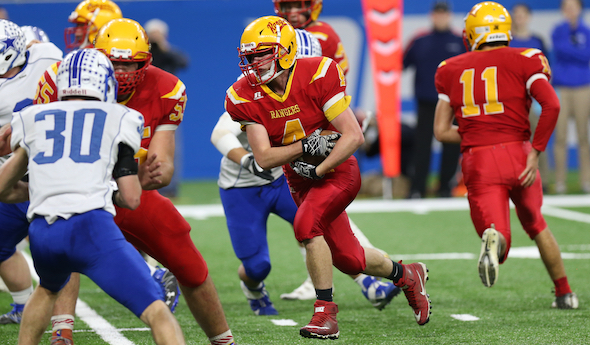
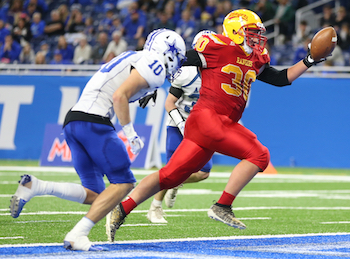
PHOTOS: (Top) Reading’s Roger Hill rushes into Beal City’s defense Saturday at Ford Field. (Middle) The Rangers’ Elijah Strine (30) stretches into the end zone just ahead of Beal City’s Logan Chilman.