


#TBT: Searching for The Hinker Bell
September 28, 2017
By Geoff Kimmerly
Second Half editor
Menominee will host Escanaba on Friday in the 121st meeting between two of the Upper Peninsula’s largest high schools and proudest football programs – but with the trophy celebrating the game still missing after it first disappeared more than half a century ago.
The two teams from 1948-1962 played for the The Hinker Bell, a locomotive bell that hasn’t been seen since 1963.
A decade ago, Escanaba Daily Press sports editor (and now Second Half correspondent) Denny Grall wrote about a newfound search for The Hinker Bell. But the mystery continues, and Grall’s story below tells of many of the twists and turns that to that point that had come in trying to locate it.
ESCANABA — Another search is underway to find the Hinker Bell.
The former locomotive bell went to the winner of the Escanaba-Menominee football game for about 15 years but has been missing for more than 40 years. It came from a locomotive owned by the Bay de Noquet Company and used on the LS&I Railroad that operated in Delta and Menominee counties.
The locomotive was built in 1906 by Baldwin Locomotive Works in Philadelphia and the bell was believed to have been cast in the railroad foundry, according to a 1953 newspaper clipping.
In 1948, one of the locomotive owners presented the bell to his friend, John Hinker of Menominee, an ardent sports fan who donated materials for the press box at Menominee’s Walton Blesch Field.
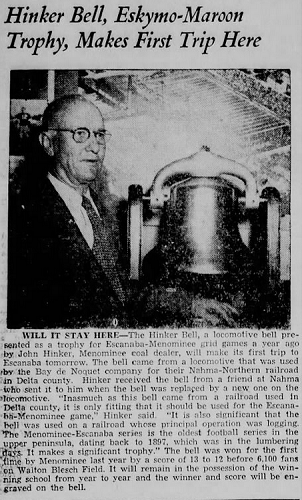 Hinker gave the bell to then Menominee coach Mickey McCormick and indicated proper use for the bell would be as an award for the gridiron rivalry.
Now Hinker’s great great nephew is trying to find the bell, which has not been seen since Escanaba’s current high school opened in 1963.
Tim Waters of Land O’ Lakes, Wis., who has launched the search, became interested by researching his family tree. “It is a big trophy (between 80 and 150 pounds by various estimates) and it is odd that it is missing,” Waters said in a recent telephone chat.
“One theory is that it is in somebody’s hunting camp or a home and they are using it as their own trophy,” said Waters.
“We have a pretty good investigation going on and all help is appreciated. If somebody does have it, we’re not looking to prosecute them. We’re just looking to get the darn thing back. Nobody will be in trouble.”
Waters refuted the old idea the bell was melted down. He has contacted numerous bell collectors, and they said a junk yard would have known it was worth a lot more than melted metal.
“The bell was not destroyed. We’ve come to that conclusion,” he said. “It was not put in a scrap yard.”
Waters contacted Coplan Iron and Metal of Escanaba and learned that bells were not melted or crushed and said the firm never accepted a bell with engravings matching the Hinker Bell.
Waters learned those businesses would sell them for the weight value to people who wanted them for yard ornaments/dinner bells, or to collectors.
“It is a treasure and it needs to be found,” said Waters.
Waters said the last known photo of the bell was with then EHS football coach Al Sigman and Esky players John Fisher and Phil Davidson in 1960. Escanaba beat Menominee from 1959-63 but could not find the bell in 1964 when the Maroons won. No one he has talked to remembers seeing the bell present at the first three games during the tenure of coach Jerry Cvengros.
The current Escanaba High School opened in 1963 and Bay de Noc Community College then occupied the old facility, which has since been demolished.
“Records indicate there was no report (of a missing bell) filed by Escanaba school district to the police department,” Waters said.
“The Hinker Bell is part of U.P. Michigan’s history, as is football and the railroads,” Waters said. “The people of Escanaba and Menominee deserve to have this trophy returned to their high schools.”
Waters, who has never seen an Escanaba or Menominee football game but is planning to rectify that omission this season, is hoping students at the two schools will join in the treasure hunt and talk about it with their parents and grandparents.
He has already contacted EHS athletic director Rob Ryan, who plans to thoroughly search the school basement.
He would like to find a photo of the bell to help collectors in their search. “Each bell was for a special locomotive,” said Waters.
“If they have a good picture we can pass it around and say we are looking for this bell. If they can pinpoint what this bell was on, they can help get the word out.”
He has also extended the search to the website at upfootball.com, which has generated interest but no bell. “If the bell is in the area still today, I don’t think it will take long to surface,” he said.
“If we don’t find this bell, we are going to try to make up a replacement as close as possible if the two schools are interested in that,” he said.
Waters is hoping that real estate agents, postal workers, delivery personnel, construction workers, etc., may have seen the bell during their travels and can help retrieve it.
Adrian Football's 'Storyteller' Koehn Begins 52nd Season on Radio Waves
By
Doug Donnelly
Special for MHSAA.com
September 3, 2025
John Koehn used to collect Sports Illustrated covers – with good reason.
 Koehn, 74, has been a sports broadcaster at WLEN, a 3,000-watt station at 103.9 on the FM dial in Lenawee County for more than 50 years. If you are at a football or basketball game where Koehn is broadcasting, chances are you will see a “WLEN” banner hanging nearby.
That banner has been in some unique settings.
“We used to collect Sports Illustrated covers because every once in a while, someone would take a photo and I’d be in the background with the WLEN banner doing the game,” Koehn said. “Over the years we had six or seven Sports Illustrated covers that popped up like that. We went all over back then.”
Koehn broadcast University of Michigan football and basketball games for two decades for WLEN, bringing the action home to listeners in Lenawee County long before the days of streaming services or Internet radio. He did live play-by-play at The Spectrum in Philadelphia when Michigan battled Indiana University in the NCAA men’s basketball championship game in 1976.
“That’s always been my favorite Michigan team ever,” Koehn said.
His favorite thing to broadcast – and the one that has stuck the longest – is Adrian High School football. Koehn did his first Maples football game in 1974 and has done almost every Adrian game since, live on the air. Last week he kicked off his 52nd year doing Maples football when Adrian defeated Dundee 21-0 at Maple Stadium.
“I’ve only missed a handful of games,” he said. “I had a wedding once, and I think another time or two I was sick. I thought I was going to do this maybe three or four years. Here I am. On and on it went.”
Joel Przygodski is the Adrian head football coach. Before that he was an assistant for several seasons and got to know Koehn. Now, they do a weekly pregame coaches show together.
“John has been an important part of the Adrian football community,” Przygodski said. “Friends and families of the program have had the pleasure of hearing his voice call our games for a long time. I enjoy our weekly conversations during the season, and we always seem to talk about players and teams from the past.”
Koehn’s voice is familiar to sports fans in Adrian and Lenawee County. In addition to broadcasting Maples football, he also does at least one county high school basketball game a week and still broadcasts live a handful of baseball and softball games every spring.
“Spring sports are tougher,” he said. “Games get canceled, and it becomes difficult to make them up. The weather outside is unpredictable.”
Koehn grew up in Adrian and played football for the Maples in 1967 and 1968. His father, also John Koehn, held various jobs in the county, including teaching a class at Adrian College.
“He was working on his MBA and teaching at Adrian College,” Koehn said. “For his senior business thesis class, he assigned his students a semester project to research the feasibility of starting an FM radio station in Adrian. He gave them all good grades and used the information to start the station.”
His father was granted the license for 103.9 FM in 1965.
“I was in high school, but I was here when it all started,” Koehn said. “I was pushing a broom and that kind of stuff.”
Adrian had an AM radio station at the time, but the FM station was new.
“The first few years we just gave away FM radios and FM car converters so that people could get the signal,” Koehn said.
One of the first things his father did was form a small network of five stations to broadcast University of Michigan football and basketball games.
 “When we started, Michigan allowed any station to broadcast as long as they paid the fees,” Koehn said. “There were at least seven stations. Our station started doing Michigan in 1965 when they went on the air. They were able to do that until the mid-1980s before they went to (WJR) network.”
Koehn, who graduated from Notre Dame, never intended to get into broadcasting. He was at an Adrian basketball game when it happened.
“My first game was a basketball game,” he said. “I just went to help out. I was there, doing stats, and the second half started and the general manager who was doing the game said, ‘Here,’ and handed me the microphone. I got handed a soapbox.”
His dad also launched an FM station in Monroe, 98.3, and gave famed WJR host Paul W. Smith his first radio job.
“My dad knew all about big radio,” Koehn said. “He always said the only way we are going to survive is to make it local, local, local.”
For Adrian, University of Michigan football and basketball was local. He put a lot of miles on his car.
“Back in the day, Michigan basketball played games on Thursdays and Saturdays,” he said. “I remember one weekend, on a Thursday morning, I drove to Madison, Wisconsin, to do a Michigan basketball game. I drove home after the game, got home probably 6 a.m., got some sleep, did a high school game Friday night, and Saturday afternoon I went up to Ann Arbor to do Michigan-Indiana and did a high school game Saturday night. I didn’t have much in the way of pipes by then.”
He also was part of the MHSAA broadcasting network for years.
“I was probably doing 80 basketball games a season back then and driving everywhere,” he said.
During his broadcasts, Koehn keeps his own running stats and often refers back to them throughout his coverage. At halftime, he gives halftime stats, such as leading rushers in football, and tracks things like penalties and first downs.
Koehn said he is an Adrian fan for every game – except when the Maples are playing another local team.
“I’m a fan,” he said. “The only time I’m not is when Adrian is playing another county school. You have to be nonpartisan with that.”
The radio stations have remained in the family. WLEN and 96.5 The Cave, an all-sports format station in Adrian, are owned by his late father’s trust. The other two stations in Adrian, 95.3 FM and WABJ – an AM radio station that was around when WLEN was created – are owned by John’s sister Julie. All four stations are housed in one building in downtown Adrian.
Koehn, who is married, has two children, three grandchildren and three great-grandchildren. His bucket list is to broadcast a hockey game.
While he waits to do that, Koehn remains hooked on broadcasting Adrian football.
“You get to be a little crazy,” he said. “You get into doing the games. We are telling stories and creating memories for people. I’ve had people come up to me and say, ‘Oh, I remember that one game. I was listening. That was one heck of a game.’ It’s all linked to some other memory outside of the football game. Basically, I’m a storyteller – a partisan storyteller.”
 Doug Donnelly has served as a news and sports reporter at the Adrian Daily Telegram and the Monroe News for 30 years, including 10 years as city editor in Monroe. He's written a book on high school basketball in Monroe County and compiles record books for various schools in southeast Michigan. He is now publisher and editor of The Blissfield Advance, a weekly newspaper. E-mail him at [email protected] with story ideas for Jackson, Washtenaw, Hillsdale, Lenawee and Monroe counties.
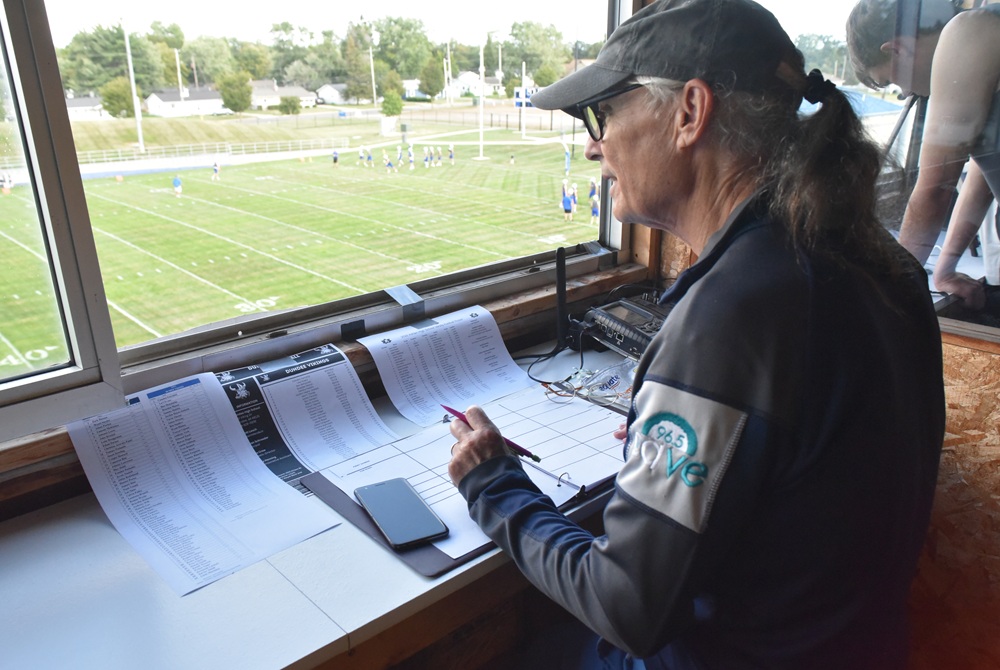
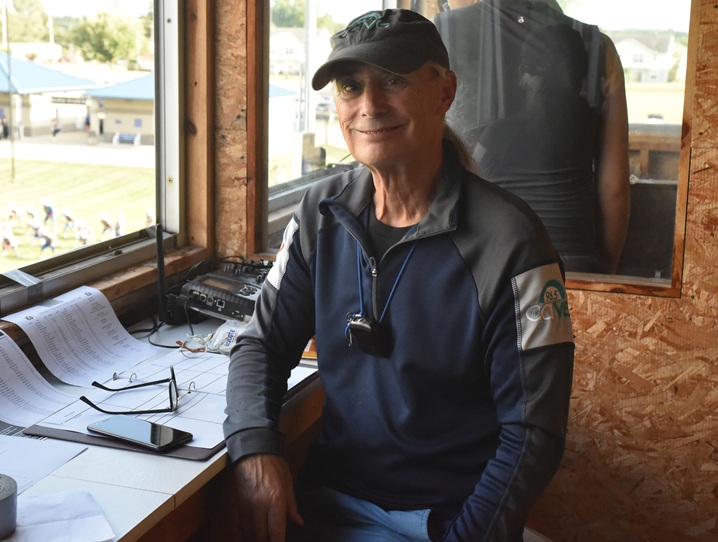
PHOTOS John Koehn begins his 52nd season as the voice of Adrian High School football, broadcasting last week from Maple Stadium. (Photos by Deloris Clark-Cheaney.)