

Thank Roosevelt for Football Weekends
December 20, 2013
By Rob Kaminski
MHSAA benchmarks editor
The next time you find yourself immersed in a tense crosstown football rivalry on a Friday night followed by a Saturday pilgrimage to the nearest college campus and a Sunday afternoon with a remote and your favorite snacks and beverages, take a moment to consider what the weekend would be like if it weren’t for Teddy Roosevelt.
The man who became our 26th President shortly after the turn of the 20th Century following the assassination of William McKinley in 1901 was a football fan like you. Maybe more so.
Today’s game of football has reached a critical crossroads. Player size and speed have increased across the board. Savage use of equipment as weapons rather than protective gear has been glorified on television networks and social media. Leaders of the game at all levels have recognized the need for change, employing new rules and widespread educational efforts to aid in preserving the sport.
History, as they say, is repeating itself.
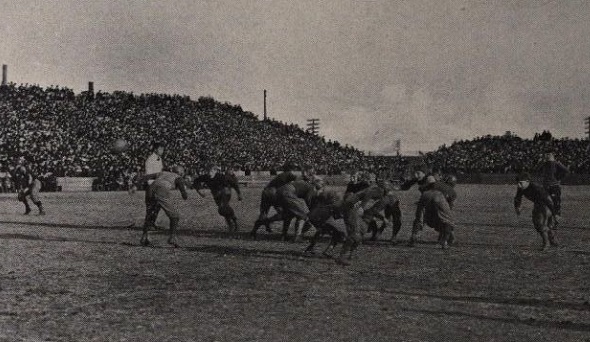
In an ironic twist, it was Roosevelt who saved the then-brutally violent game of football from itself more than 100 years ago. Yes, the same “Rough and Ready Teddy” who led the charge up San Juan Hill during the Spanish-American War and often sparred in the boxing ring while in office from 1901-09 opined that football was becoming so gruesome that he delivered an ultimatum: clean up the game or it would be outlawed.
The Chicago Tribune reported that in 1904 alone, there were 18 football deaths and 159 serious injuries, mostly among prep school players. Football deaths suffered by younger players were reported on a nearly weekly basis, as outraged citizens called on colleges and high schools to banish football outright.
In stepped Roosevelt, who called head coaches and representatives from Harvard, Yale and Princeton – college powers at the time – to the White House in 1905 urging them to eliminate excessive violence and set an example of fair play for the rest of the country. When the casualties actually rose by one during the ensuing season, Roosevelt reacted with greater resolve and convened leading football authorities for the purpose of authoring drastic rules changes. What emerged was an intercollegiate conference which was the predecessor of the NCAA.
Among the most effective changes for the 1906 season were the legalization of the forward pass, the elimination of mass formations, and the creation of a neutral zone. Football fatalities fell to 11 in each of the next two seasons, and severe injuries fell drastically.
Thanks to the introduction of protective equipment and ever-evolving rules changes, football during the 100-plus years to follow has become an exponentially safer game. Yet, the game’s leaders always will need to adjust and react to scrutiny that comes with the territory.
So, as the game once again undergoes rules modifications in the name of safety, give a tip of the cap to President Roosevelt while you enjoy college bowl season and the NFL playoffs and begin to think ahead to the first high school practice of 2014.
GR Catholic Central Unveils New Home
By
Dean Holzwarth
Special for MHSAA.com
August 23, 2016
GRAND RAPIDS – Former Grand Rapids Catholic Central football player and current assistant coach Kyle Shelton didn’t know if he would ever see the day – the day when the football program would have a place to call home.
 And it wasn’t until he witnessed shovels digging dirt that Shelton knew it was going to become a reality.
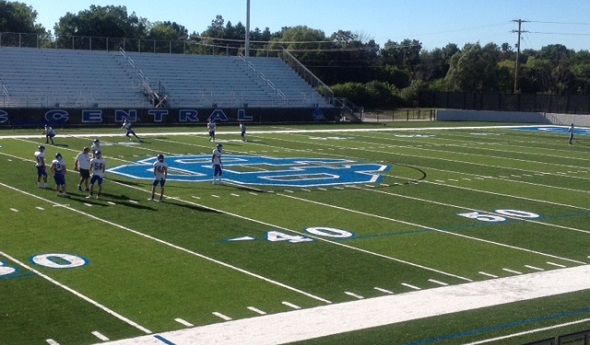
Cougar Stadium was unveiled to the community over this past weekend, the crown jewel of a nearly $10-million project at the Cougar Athletic Trails (CAT) athletic complex.
“It’s long overdue, that’s for sure,” said Shelton, a 1999 Catholic Central graduate. “It’s nice from a functional standpoint, having a surface always ready for practice, which we haven’t had in the past, and to have all of our teams in one spot, which we haven’t been able to do.
“From a teaching standpoint, we have brand new team rooms where we can watch film, and that’s just the football side of things.”
Cougars senior running back Antonio Strong may be biased, but ranks his new digs among the tops in the area.
“It’s one of the best complexes around, and I think one of the best in the state,” he said. “It felt like it was meant to be.”
Last week, the CAT was re-dedicated and blessed. It was the first of several events throughout the weekend to celebrate the facility’s re-opening.
Several thousand people braved severe weather Saturday to attend the first Catholic Central Hall of Fame induction while getting a glimpse of the new turf field and surrounding amenities.
“This place is amazing,” fifth-year Cougars varsity football coach Todd Kolster said. 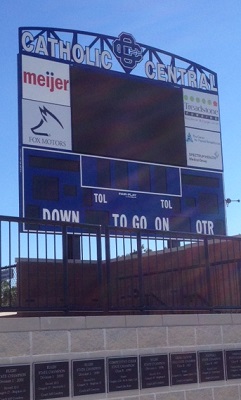 “I think it’s second to none, and it shined pretty brightly on Saturday night when the weather was bad. We had probably over 3,000 here during a tornado getting ready to hit just to see the place.
“It’s just awesome for our community to have a place to call home. It’s awesome for our kids to call this home.”
While a majority of football programs boast home stadiums or fields, Catholic Central has never been among them.
The school is celebrating its 110th birthday this season, and this is the first time in school history it will have a place to call its own.
For more than a century, Catholic Central has had to travel and play its home games at other venues.
Houseman Field in downtown Grand Rapids was where the Cougars played a majority of their “home games.” In recent years, they’ve had to travel to surrounding schools, including Grand Rapids Christian and Ada Forest Hills Eastern, to play.
It will be an entirely new experience for the Cougars when they host East Grand Rapids on Friday to open the 2016 season.
“We don’t have to get on a bus to play football,” Kolster said with a smile. “It will be different in how it impacts our schedule. What do we do for a home game now? Before we didn’t have much time. It was school, then we went to chapel, and then we came out here for a walk-through before getting on a bus and leaving. That was every week.”
The freshmen and junior varsity football teams played at the complex in past years on a makeshift field, but the varsity didn’t due to lack of lights and space.
Last season during construction, all three teams were bused to games.
“There wasn’t a single time last year that we didn’t get on a bus to play a football game,” Shelton said. “Last year was trying in that respect. Game days, (it) now saves us a good hour in travel time to a football game.
“We finally have a place to call home. We have a home that we can take pride and hopefully a tough environment for teams who come here and play. A home-field advantage so to speak, something we’ve never had.”
Catholic Central athletic director Trevor Hinshaw remains awestruck by the sight of the school’s decorated surroundings.
“It’s unbelievable, and I get goose bumps every time I walk out here,” Hinshaw said. “It’s a pretty amazing facility, and we are beyond blessed to call it home. To have no more home games on the road will be weird, but I think we will get used to it quickly and come to appreciate our new reality.”
 The tradition of Catholic Central was not forgotten in the process. A plaza honoring legendary football coach Ted Sowle sits on the concourse, as do plaques commemorating past MHSAA championships.
Other influential people in the community from days past also are recognized throughout the stadium.
“It’s important that our kids understand the traditions that came before them and the people that came before them to make this happen,” Kolster said. “I’ve talked to guys that I’ve coached, and they’re sad they don’t get to play here, but excited for the guys who are and for the future of our school. Those guys laid the foundation for us to play here.”
Friday night will mark another historic date in school history, and the players are eagerly anticipating the opportunity to play their first “home game.”
“I’m looking forward to it a lot,” Strong said. “I’ve been waiting for this all year.”
“It’s going to be live here,” senior cornerback Mike Brown added.
Hinshaw said the undertaking of hosting the first game involves a lot of logistics, but he hopes to cherish the moment.
“Ultimately, I want to make sure that through the stress I find time to enjoy the experience as well,” he said.
 Dean Holzwarth covered primarily high school sports for the Grand Rapids Press and MLive for 16 years and more recently served as sports editor of the Ionia Sentinel and as a sports photojournalist for WZZM. Contact him at[email protected] with story ideas for Allegan, Kent and Ottawa counties.
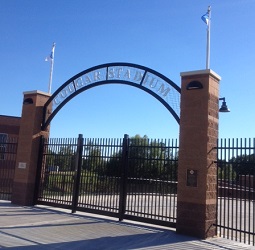
PHOTOS: (Top) Players work out on the freshly-completed Cougar Stadium turf. (Middle) The stadium scoreboard overlooks plaques dedicated to past GRCC champions. (Below) Gates will open for a varsity game for the first time Friday. (Photos by Dean Holzwarth.)