

Thank Roosevelt for Football Weekends
December 20, 2013
By Rob Kaminski
MHSAA benchmarks editor
The next time you find yourself immersed in a tense crosstown football rivalry on a Friday night followed by a Saturday pilgrimage to the nearest college campus and a Sunday afternoon with a remote and your favorite snacks and beverages, take a moment to consider what the weekend would be like if it weren’t for Teddy Roosevelt.
The man who became our 26th President shortly after the turn of the 20th Century following the assassination of William McKinley in 1901 was a football fan like you. Maybe more so.
Today’s game of football has reached a critical crossroads. Player size and speed have increased across the board. Savage use of equipment as weapons rather than protective gear has been glorified on television networks and social media. Leaders of the game at all levels have recognized the need for change, employing new rules and widespread educational efforts to aid in preserving the sport.
History, as they say, is repeating itself.
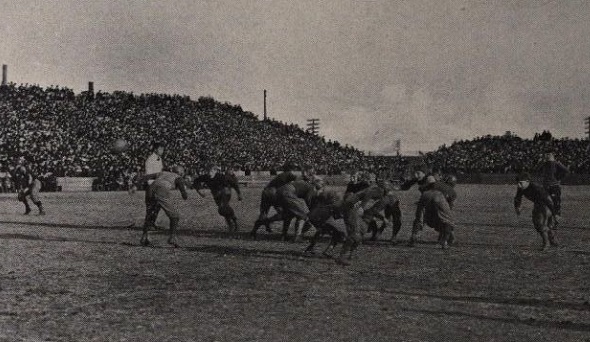
In an ironic twist, it was Roosevelt who saved the then-brutally violent game of football from itself more than 100 years ago. Yes, the same “Rough and Ready Teddy” who led the charge up San Juan Hill during the Spanish-American War and often sparred in the boxing ring while in office from 1901-09 opined that football was becoming so gruesome that he delivered an ultimatum: clean up the game or it would be outlawed.
The Chicago Tribune reported that in 1904 alone, there were 18 football deaths and 159 serious injuries, mostly among prep school players. Football deaths suffered by younger players were reported on a nearly weekly basis, as outraged citizens called on colleges and high schools to banish football outright.
In stepped Roosevelt, who called head coaches and representatives from Harvard, Yale and Princeton – college powers at the time – to the White House in 1905 urging them to eliminate excessive violence and set an example of fair play for the rest of the country. When the casualties actually rose by one during the ensuing season, Roosevelt reacted with greater resolve and convened leading football authorities for the purpose of authoring drastic rules changes. What emerged was an intercollegiate conference which was the predecessor of the NCAA.
Among the most effective changes for the 1906 season were the legalization of the forward pass, the elimination of mass formations, and the creation of a neutral zone. Football fatalities fell to 11 in each of the next two seasons, and severe injuries fell drastically.
Thanks to the introduction of protective equipment and ever-evolving rules changes, football during the 100-plus years to follow has become an exponentially safer game. Yet, the game’s leaders always will need to adjust and react to scrutiny that comes with the territory.
So, as the game once again undergoes rules modifications in the name of safety, give a tip of the cap to President Roosevelt while you enjoy college bowl season and the NFL playoffs and begin to think ahead to the first high school practice of 2014.
MCC Follows 'Big #77' in 3-Peat Attempt
November 4, 2015
By Tom Kendra
Special for Second Half
Jacob Holt will be in the middle of the action, guaranteed, when two great football traditions collide Saturday afternoon in Beal City.
Holt is a four-year starter up front for Muskegon Catholic Central, which ventures toward the middle of the mitten to Beal City in its quest for a third consecutive MHSAA Division 8 championship.
 “We know we have to play our best or it will be our last game,” said Holt (6-foot, 245), a senior guard and defensive end for the Crusaders, who were ranked No. 1 in Division 8 in the final Associated Press state poll. “This is a completely different team than the past two years, but our motivation is to uphold the MCC tradition.”
Holt brings a wealth of size, talent and, perhaps most importantly, experience into Saturday’s showdown. He has started nearly 48 games for MCC over the past four years – leading his team to the Semifinals in 2012, starting all 14 games each of the next two years for back-to-back championship teams, and all nine games this year for the 7-2 Crusaders.
Holt is a force on an offensive line which is very good, but not quite the wrecking machine of a year ago.
MCC lost three players off last year’s offensive line who earned some form of all-state recognition – Jaeden MacPherson (now at Ferris State), Michael Caughey (Benedictine in Atchison, Kan.) and Lamar Jordan (St. Francis in Joliet, Ill.).
The new line showed its youth in this season’s opening game at perennial Division 5 powerhouse Muskegon Oakridge. The Eagles rolled to a 31-0 halftime lead and, eventually, a 45-26 victory, snapping MCC’s 26-game winning streak.
Since that game, the Crusaders’ line has come of age behind Holt, who will likely go down as one of the best pulling guards to ever play for veteran MCC line coach and defensive coordinator Mike Ribecky.
“Jacob is just really coordinated and skilled for his size,” said third-year MCC coach Steve Czerwon, whose team has won seven of its last eight games, with its only loss during that stretch coming Week 8 at Detroit Country Day, the top-ranked team in Division 4. “We try to take advantage of that in different ways. We pull him quite a bit and he has played about 20 snaps this season at fullback.”
 In his normal position at guard, Holt anchors the strong right side of the Crusaders’ line, which also includes monstrous junior tackle Brock Johnson (6-1, 280) and senior tight end Nate Jones, who made his 50th consecutive varsity start in last week’s 49-7 win over visiting Mount Pleasant Sacred Heart.
Also missing off those back-to-back championship winners is quarterback Nick Holt, Jacob’s older brother and the unquestioned leader of those powerhouse teams. The Holts also made up the battery of MCC’s MHSAA championship baseball team this spring, with Nick on the pitcher’s mound and Jacob at catcher.
“It’s been weird not having him around this fall,” said Jacob of his older brother, who is now a freshman at Hope College, where he is a pitcher on the baseball team. “I miss riding home with him after every game and every practice and just going over everything. We still text all the time, but it’s not the same.”
Nick Holt had to make a difficult choice between playing baseball or football in college, and Jacob will soon face the same agonizing decision. Among the schools pursuing him in football are Saginaw Valley State, Wayne State, Northwood, Mount Union (Ohio) and Hope, while he is actively being recruited in baseball by Kalamazoo College, Aquinas College and Hope.
Stepping into Nick Holt’s big shoes at the quarterback spot is senior Christian Martinez, who has assumed a more traditional ball distribution role – getting the ball to junior running backs Logan Helton and LaTommy Scott, as well as his favorite aerial target in junior Walker Christoffersen.
Holt gives much of the credit for his success to his parents, Mike and Cathi Holt, who raised their two sons to be both competitive and humble in everything they do.
“My dad has been my coach ever since I was a little kid,” said Jacob, 17, who has a 3.88 GPA and scored a 27 on his ACT. “He taught me how to be a man. The big thing with him was, win or lose, we weren’t going to be poor sports.”
Mike Holt, now in his 16th year as a science teacher at MCC, has influenced more than just his two sons for the Crusaders’ football program. Holt is the Crusaders’ middle school head football coach and, along with former MCC great and Northern Illinois Hall of Famer Frank Lewandoski, has played a big part in the development of the program’s players for the past six years.
This fall, the school district took it a step further with the formation of the Muskegon Catholic Central Youth Football Club, which was organized by current MCC School Board President Andy Riegler, who quarterbacked the Crusaders to a Class C championship in 1990. Czerwon called the club’s first season “hugely successful.”
 Those kinds of efforts at the lower levels help explain MCC’s continued success, despite steadily declining enrollment over the past 35 years.
“We’re blessed to have quality coaches at the middle school and the youth levels, who really care about the kids,” said Czerwon, who boasts a gaudy 33-4 record in his three years as head coach.
MCC first broke through in the football playoffs as a Class B school, winning MHSAA titles in 1980 and 1982. The Crusaders won three Class C championships in the 1990s and have won five titles in either Division 7 or Division 8 during the first 15 seasons the 2000s.
With a current enrollment of 177 students, MCC is a Class D school in size, but the standards and expectations for the football program have remained as high as ever.
Many of those young kids aspire to someday be like Jacob Holt, big No. 77, who sets a great example for them both on and off the field.
Holt will need to be at his best against a Beal City program that knows all about physical football and playing in November.
While the Crusaders boast 10 MHSAA titles in the playoff era, Beal City has the edge over MCC and every other team in the state with 33 playoff appearances. Farmington Hills Harrison is second with 32, followed by Crystal Falls Forest Park and Fowler with 31. Muskegon Catholic is eighth with 27 playoff appearances.
Beal City (9-1), which was ranked sixth in the final AP Division 8 poll with its only loss coming Week 5 against Evart, will seek to avenge a 35-12 loss to MCC in the 2013 Division 8 championship game at Ford Field in Detroit.
While the two schools are known for football success, their biggest rivalry in recent years has been on the baseball diamond. Beal City knocked off MCC in Division 4 Regional Finals in 2013 and 2014, with the Crusaders getting the upper hand this past spring.
On Saturday, the two schools will meet on the gridiron for a Division 8 District championship.
“We’ve gotten to know Beal City really well,” said Holt, an all-Lakes 8 Conference lineman the past two years. “It’s a chance for us to show how far we’ve come this year. We lost 18 seniors last year, so it hasn’t always been smooth, but I think we’re playing our best right now.”
 Tom Kendra worked 23 years at The Muskegon Chronicle, including five as assistant sports editor and the final six as sports editor through 2011. E-mail him at [email protected] with story ideas for Muskegon, Oceana, Mason, Lake, Oceola, Mecosta and Newaygo counties.
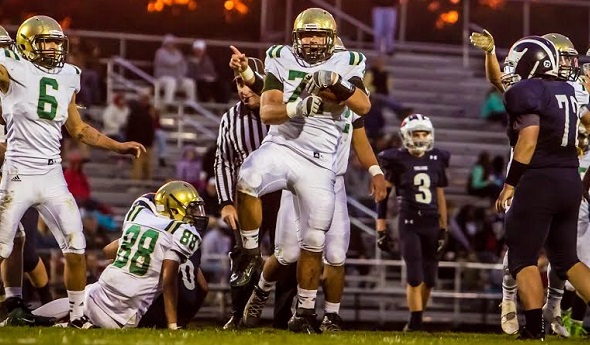
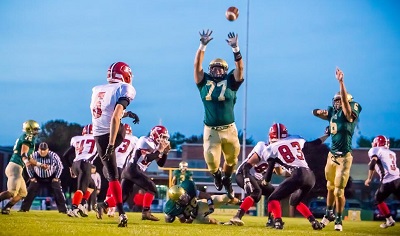
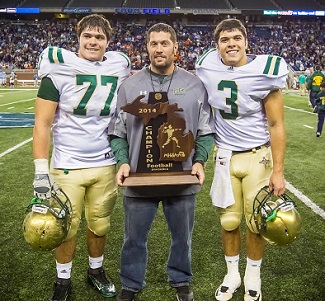
PHOTOS: (Top) Jacob Holt recovers a fumble during MCC's dramatic, come-from-behind, 29-26 victory over host Fruitport on Oct. 2. (Middle) Holt shows his athletic ability, leaping high and nearly blocking this punt in a 49-14 victory over visiting Fremont at Kehren Stadium. (Below) Mike Holt, a Muskegon Catholic Central teacher and middle school football coach, is flanked by his sons, junior Jacob (77) and senior Nicholas (3), after MCC defeated Munising last year for its second consecutive MHSAA Division 8 championship. (Photos by Tim Reilly.)