

Thank Roosevelt for Football Weekends
December 20, 2013
By Rob Kaminski
MHSAA benchmarks editor
The next time you find yourself immersed in a tense crosstown football rivalry on a Friday night followed by a Saturday pilgrimage to the nearest college campus and a Sunday afternoon with a remote and your favorite snacks and beverages, take a moment to consider what the weekend would be like if it weren’t for Teddy Roosevelt.
The man who became our 26th President shortly after the turn of the 20th Century following the assassination of William McKinley in 1901 was a football fan like you. Maybe more so.
Today’s game of football has reached a critical crossroads. Player size and speed have increased across the board. Savage use of equipment as weapons rather than protective gear has been glorified on television networks and social media. Leaders of the game at all levels have recognized the need for change, employing new rules and widespread educational efforts to aid in preserving the sport.
History, as they say, is repeating itself.
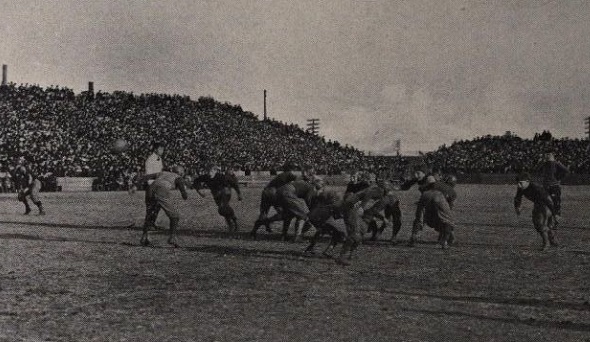
In an ironic twist, it was Roosevelt who saved the then-brutally violent game of football from itself more than 100 years ago. Yes, the same “Rough and Ready Teddy” who led the charge up San Juan Hill during the Spanish-American War and often sparred in the boxing ring while in office from 1901-09 opined that football was becoming so gruesome that he delivered an ultimatum: clean up the game or it would be outlawed.
The Chicago Tribune reported that in 1904 alone, there were 18 football deaths and 159 serious injuries, mostly among prep school players. Football deaths suffered by younger players were reported on a nearly weekly basis, as outraged citizens called on colleges and high schools to banish football outright.
In stepped Roosevelt, who called head coaches and representatives from Harvard, Yale and Princeton – college powers at the time – to the White House in 1905 urging them to eliminate excessive violence and set an example of fair play for the rest of the country. When the casualties actually rose by one during the ensuing season, Roosevelt reacted with greater resolve and convened leading football authorities for the purpose of authoring drastic rules changes. What emerged was an intercollegiate conference which was the predecessor of the NCAA.
Among the most effective changes for the 1906 season were the legalization of the forward pass, the elimination of mass formations, and the creation of a neutral zone. Football fatalities fell to 11 in each of the next two seasons, and severe injuries fell drastically.
Thanks to the introduction of protective equipment and ever-evolving rules changes, football during the 100-plus years to follow has become an exponentially safer game. Yet, the game’s leaders always will need to adjust and react to scrutiny that comes with the territory.
So, as the game once again undergoes rules modifications in the name of safety, give a tip of the cap to President Roosevelt while you enjoy college bowl season and the NFL playoffs and begin to think ahead to the first high school practice of 2014.
'Lapeer Through and Through,' Schmidt Surpasses Half-Century in Coaching
By
Paul Costanzo
Special for MHSAA.com
April 2, 2025
Manny Schmidt still wants to be at track practice.
 After 50-plus years coaching in Lapeer, the man they call Coach Manny has not lost his love for helping student-athletes – and at this rate, he might go another 50.
“I told my wife years ago that the first day I don’t feel like going to practice, that I’d rather be somewhere else, that’s the day I’m done,” Schmidt said. “And it hasn’t happened yet. Obviously, you have bad days and things like that. But track, and right now practice, it just keeps me going.”
Schmidt, who is the head boys track & field coach at Lapeer, began coaching track as an assistant in 1974, and has remained there – and Lapeer East, then back at Lapeer when the schools merged back together – ever since. On Friday, April 11, he will be honored at an event at Lightning Rounds in Lapeer for his years of service to Lapeer athletes. The event begins at 7:30 p.m., following the Lapeer Lightning Co-Ed Relays.
“Manny has been a staple of Lapeer Athletics through many different renditions over the years,” Lapeer athletic director Shad Spilski said. “His willingness to help student-athletes grow and achieve their goals is all he wants out of his athletes. Manny spends, and has spent, countless hours over several decades providing athletes multiple opportunities to hone their skills. He not only coaches, but he is one of Lapeer athletes’ biggest fans and supporters. You will always find him at other sporting events cheering on athletes and his coaching colleagues. He truly is Lapeer through and through.”
Schmidt came to Lapeer to teach English in December of 1972 after graduating from Western Michigan University. He had attended high school at St. Joseph Catholic, and was unfamiliar with Lapeer.
But it didn’t take long for him to fall in love with the school community after receiving the assignment.
“Almost immediately,” he said. “I started in December; the teacher had left and I got the job in December. Three days later, they had a staff Christmas party that I got invited to, and all of my close friends over the years, many of them, I guess, I met at that party.”
Coaching was always something Schmidt wanted to do. He played basketball and ran track in high school, and had a basketball coach who made a big impact on his life. He wanted to do the same for others.
In the spring of 1974, during his first full year of teaching English at Lapeer, he got that chance as the assistant track coach. He has since coached cross country – working to start the Lapeer East girls program in the 1990s – junior varsity football and middle school basketball. He also served as a basketball official for more than 30 years.
“I just liked being part of it,” he said.
 Throughout his five decades coaching track, Schmidt has worked with athletes in every event. While middle and long distance are what he’s long enjoyed coaching, he’s currently working with the Lapeer throwers and high jumpers, as head cross country coaches Russ Reitz and Bill Spruytte are also coaching track.
“In our program, we have four of us (Schmidt, Reitz, Spruytte and Anthony Merlo), and we all have equal voice, we all coach together,” Schmidt said. “On any given day, and that’s the nice thing, I could be with anything. I could be with the hurdlers.”
This past year, Schmidt returned to the Lapeer cross country staff as an assistant, saying he was honored that the current coaches respected him enough to call him back.
But for them, it was an honor to have him.
“Working with Manny is like having access to decades of knowledge,” said fellow cross country assistant Christine Cerny. “It is such a privilege to be able to draw from that and learn from that myself. It’s so awesome to be able to coach alongside him after he has coached my kids.”
During his time, Schmidt has coached multiple generations of Lapeer families, including his own. His children Corrinne and Jennifer both ran for him, as did his grandchildren Morgan, Mason and Colton.
And by his side the entire time has been his wife, Val, who worked as a scorekeeper during meets.
“When I started coaching, she would be the person at all our home cross country meets and all our home track meets who sat there and kept track by hand,” Schmidt said. “Probably the happiest person with this new technology is my wife – now she doesn’t have to do it. When we have invites, she’ll do medals and stuff like that.”
Technological changes have been abundant for high school athletes over the past five decades, not just in competition but outside of it. Schmidt recalls returning to Lapeer from away meets and having athletes line up at the school’s two payphones to call their parents.
“Now, when we get back, everyone has called home and their rides are there waiting,” Schmidt said.
Throughout his time, Schmidt has done plenty of winning and coached several athletes who have moved on to compete at the college level. But the relationships he’s created are what he values most.
“Nobody’s luckier than I am with where I taught and where I coached, and who I’ve coached with over the years,” Schmidt said. “You have to look forward to going to work, and I hate to use the word ‘work’ with coaching. It is, I guess. But there’s just so much good with it.”
 Paul Costanzo served as a sportswriter at The Port Huron Times Herald from 2006-15, including three years as lead sportswriter, and prior to that as sports editor at the Hillsdale Daily News from 2005-06. He can be reached at [email protected] with story ideas for Genesee, Lapeer, St. Clair, Sanilac, Huron, Tuscola, Saginaw, Bay, Arenac, Midland and Gladwin counties.
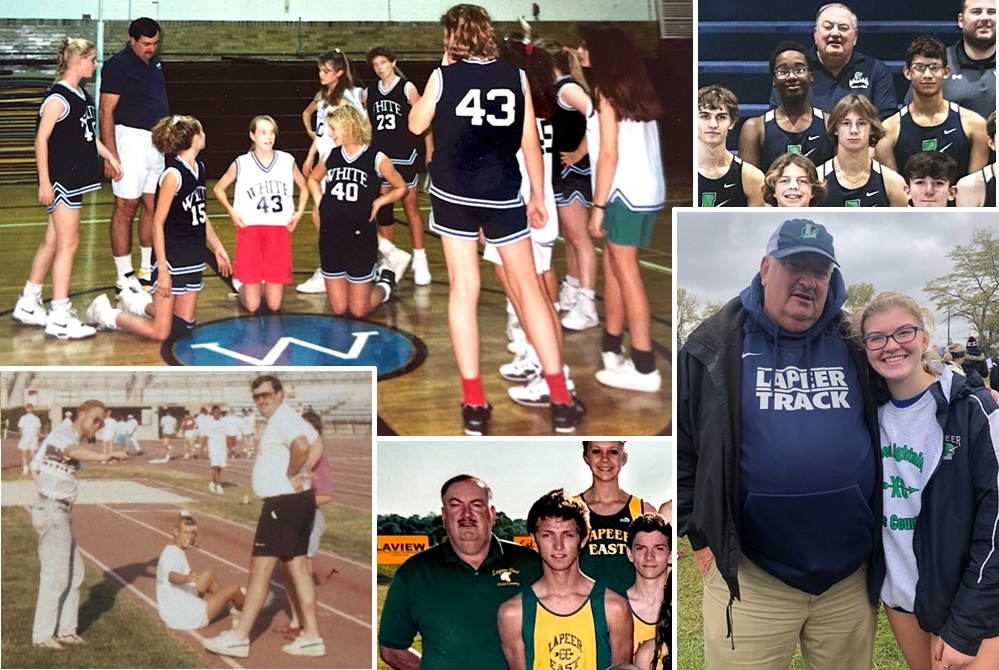
PHOTOS (Top) Clockwise from the top left: (1) Manny Schmidt (standing, second from left) coaches the Lapeer White Junior High girls basketball team. (2) Schmidt, top middle, takes a photo with Lapeer’s boys track & field team last spring. (3) Schmidt, left, has coached three of his grandchildren including Morgan Turk. (4) Schmidt, far left, takes a photo with the 2011 Lapeer East cross country teams. (5) Schmidt, standing far right, coaches Michelle Brundage during the 1991 Meet of Champions. (Middle) Schmidt looks on during an event. (Photos provided by the Lapeer athletic department.)