

Thank Roosevelt for Football Weekends
December 20, 2013
By Rob Kaminski
MHSAA benchmarks editor
The next time you find yourself immersed in a tense crosstown football rivalry on a Friday night followed by a Saturday pilgrimage to the nearest college campus and a Sunday afternoon with a remote and your favorite snacks and beverages, take a moment to consider what the weekend would be like if it weren’t for Teddy Roosevelt.
The man who became our 26th President shortly after the turn of the 20th Century following the assassination of William McKinley in 1901 was a football fan like you. Maybe more so.
Today’s game of football has reached a critical crossroads. Player size and speed have increased across the board. Savage use of equipment as weapons rather than protective gear has been glorified on television networks and social media. Leaders of the game at all levels have recognized the need for change, employing new rules and widespread educational efforts to aid in preserving the sport.
History, as they say, is repeating itself.
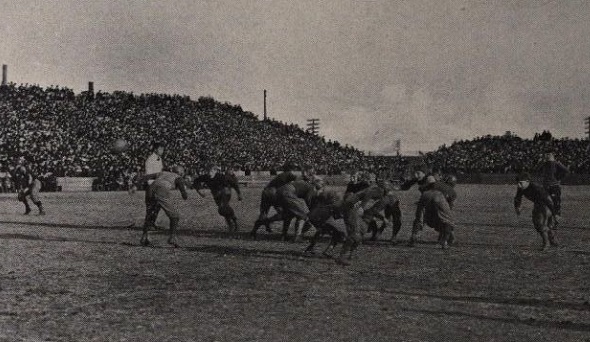
In an ironic twist, it was Roosevelt who saved the then-brutally violent game of football from itself more than 100 years ago. Yes, the same “Rough and Ready Teddy” who led the charge up San Juan Hill during the Spanish-American War and often sparred in the boxing ring while in office from 1901-09 opined that football was becoming so gruesome that he delivered an ultimatum: clean up the game or it would be outlawed.
The Chicago Tribune reported that in 1904 alone, there were 18 football deaths and 159 serious injuries, mostly among prep school players. Football deaths suffered by younger players were reported on a nearly weekly basis, as outraged citizens called on colleges and high schools to banish football outright.
In stepped Roosevelt, who called head coaches and representatives from Harvard, Yale and Princeton – college powers at the time – to the White House in 1905 urging them to eliminate excessive violence and set an example of fair play for the rest of the country. When the casualties actually rose by one during the ensuing season, Roosevelt reacted with greater resolve and convened leading football authorities for the purpose of authoring drastic rules changes. What emerged was an intercollegiate conference which was the predecessor of the NCAA.
Among the most effective changes for the 1906 season were the legalization of the forward pass, the elimination of mass formations, and the creation of a neutral zone. Football fatalities fell to 11 in each of the next two seasons, and severe injuries fell drastically.
Thanks to the introduction of protective equipment and ever-evolving rules changes, football during the 100-plus years to follow has become an exponentially safer game. Yet, the game’s leaders always will need to adjust and react to scrutiny that comes with the territory.
So, as the game once again undergoes rules modifications in the name of safety, give a tip of the cap to President Roosevelt while you enjoy college bowl season and the NFL playoffs and begin to think ahead to the first high school practice of 2014.
Forest Park Meets Expectations, Adds to Tradition with 5th Championship
By
John Vrancic
Special for MHSAA.com
December 5, 2024
MARQUETTE — They came. They saw. They conquered.
 The Crystal Falls Forest Park Trojans did what they set out to do this season, earning their first MHSAA Finals title in seven years in a 42-20 triumph over the Morrice Orioles in the Nov. 30 8-player Division 2 championship game at Northern Michigan University’s Superior Dome.
Forest Park sits fourth all-time with 15 championship game appearances over the 50 years of MHSAA Football Playoffs. This was the program’s first championship since winning Division 2 in 2017 and came after six straight seasons of reaching the postseason but losing during the first or second round.
“My brother (Kevin) and I been talking about this since we were little,” Trojans sophomore quarterback Vic Guiliani said. “When (Morrice) got within 35-20, we just had to keep our foot on the pedal. They responded very well, but we kept our composure.
“It’s crazy motivation. Every year you lose a lot of good seniors, but we still have the heart. We want to get back here.”
The victory enabled the Trojans to finish 12-1. Their only loss took place in a regular-season finale Oct. 25 when they dropped a 45-34 decision to Powers North Central.
That defeat cost Forest Park the Great Lakes Eight Conference West championship. But the Trojans stormed back to avenge it with a 34-12 win over the Jets two weeks later to clinch a Regional title.
“There were a lot of little things,” sophomore running back Dax Huuki recalled of the first North Central matchup. “That was our worst game of the season, but that was probably the best thing that happened to us. That was a nice little reality check, but we weren’t going to put up with it. Everyone on the team really wanted this. That’s what got us here. Our seniors told us what we needed to do and ‘we’re not going to take a play off.’ They held us accountable.”
 Forest Park’s successes in the championship game against Morrice were consistent with what the Trojans did well all season. Huuki ran 19 times for 136 yards and two touchdowns, finishing this fall with 162 carries, 1,560 yards and 22 scores on the ground. The team’s 291 rushing yards total for the game pushed the Trojans to 4,004 for the season – but Giuliani also completed all four of his passes for 60 yards, giving him 968 for the season and pushing the team total to an importantly complementary 1,049. Seniors Grayson Sundell (918 yards/18 TDs rushing) and Nick Stephens (11 TDs) were among other top runners for the Trojans.
Seven players started on both sides of the ball, and holding Morrice to just 194 yards of total offense fell in line with the team’s average of 201 average yards allowed entering the game.
After giving up 45 points to North Central in Week 9, the Trojans gave up a combined 56 over four playoff games.
“We definitely felt the sting of losing in our last regular-season game,” Forest Park coach Brian Fabbri said. “Five turnovers and 10 penalties didn’t help.
“It feels great to be state champions. I know how it feels to walk off the field on the other side. I experienced that twice. It’s not a good feeling.”
Fabbri became the fourth coach in Forest Park history to win one of the program’s five overall championships. He also played on a pair of Trojans teams that finished Finals runners-up in 2004 and 2005.
He’ll graduate seven of the 23 players on the postseason roster, including also two-way starters Matthew Showers, Brody Starr, Nate Bradish and Kevin Giuliani. The 6-foot-5, 270-pound Giuliani had made the all-state second team as a junior and will continue as an offensive lineman at Michigan Tech.
“Expectations were very high,” Fabbri said. “Our senior leadership was amazing. They kept us in the game.”
 John Vrancic has covered high school sports in the Upper Peninsula since joining the Escanaba Daily Press staff in 1985. He is known most prominently across the peninsula for his extensive coverage of cross country and track & field that frequently appears in newspapers from the Wisconsin border to Lake Huron. He received the James Trethewey Award for Distinguished Service in 2015 from the Upper Peninsula Sportswriters and Sportscasters Association.
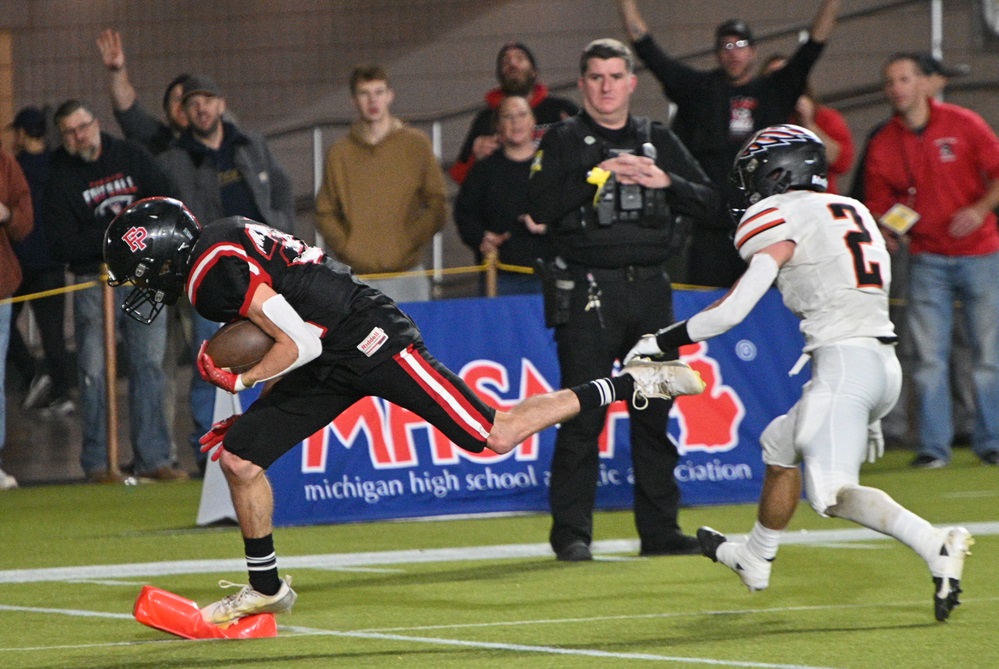
PHOTOS Forest Park’s Nik Stephens (22) gets to the pylon for one of his three touchdowns Nov. 23 at Northern Michigan University. (Middle) The Trojans’ seniors take a photo with the program’s fifth championship trophy. (Photos by Cara Kamps.)