

Thank Roosevelt for Football Weekends
December 20, 2013
By Rob Kaminski
MHSAA benchmarks editor
The next time you find yourself immersed in a tense crosstown football rivalry on a Friday night followed by a Saturday pilgrimage to the nearest college campus and a Sunday afternoon with a remote and your favorite snacks and beverages, take a moment to consider what the weekend would be like if it weren’t for Teddy Roosevelt.
The man who became our 26th President shortly after the turn of the 20th Century following the assassination of William McKinley in 1901 was a football fan like you. Maybe more so.
Today’s game of football has reached a critical crossroads. Player size and speed have increased across the board. Savage use of equipment as weapons rather than protective gear has been glorified on television networks and social media. Leaders of the game at all levels have recognized the need for change, employing new rules and widespread educational efforts to aid in preserving the sport.
History, as they say, is repeating itself.
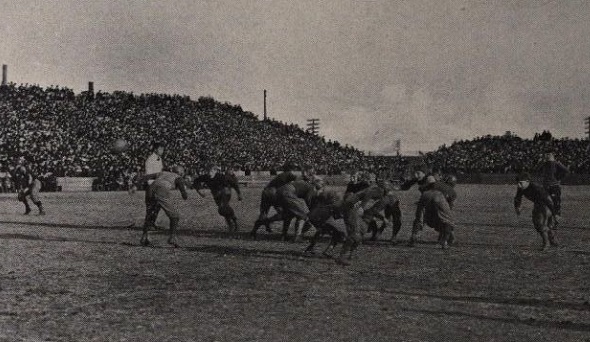
In an ironic twist, it was Roosevelt who saved the then-brutally violent game of football from itself more than 100 years ago. Yes, the same “Rough and Ready Teddy” who led the charge up San Juan Hill during the Spanish-American War and often sparred in the boxing ring while in office from 1901-09 opined that football was becoming so gruesome that he delivered an ultimatum: clean up the game or it would be outlawed.
The Chicago Tribune reported that in 1904 alone, there were 18 football deaths and 159 serious injuries, mostly among prep school players. Football deaths suffered by younger players were reported on a nearly weekly basis, as outraged citizens called on colleges and high schools to banish football outright.
In stepped Roosevelt, who called head coaches and representatives from Harvard, Yale and Princeton – college powers at the time – to the White House in 1905 urging them to eliminate excessive violence and set an example of fair play for the rest of the country. When the casualties actually rose by one during the ensuing season, Roosevelt reacted with greater resolve and convened leading football authorities for the purpose of authoring drastic rules changes. What emerged was an intercollegiate conference which was the predecessor of the NCAA.
Among the most effective changes for the 1906 season were the legalization of the forward pass, the elimination of mass formations, and the creation of a neutral zone. Football fatalities fell to 11 in each of the next two seasons, and severe injuries fell drastically.
Thanks to the introduction of protective equipment and ever-evolving rules changes, football during the 100-plus years to follow has become an exponentially safer game. Yet, the game’s leaders always will need to adjust and react to scrutiny that comes with the territory.
So, as the game once again undergoes rules modifications in the name of safety, give a tip of the cap to President Roosevelt while you enjoy college bowl season and the NFL playoffs and begin to think ahead to the first high school practice of 2014.
Zeeland West Reigns Again as Hendricks Sets Pace with Record-Setting Day
By
Paul Costanzo
Special for MHSAA.com
November 30, 2024
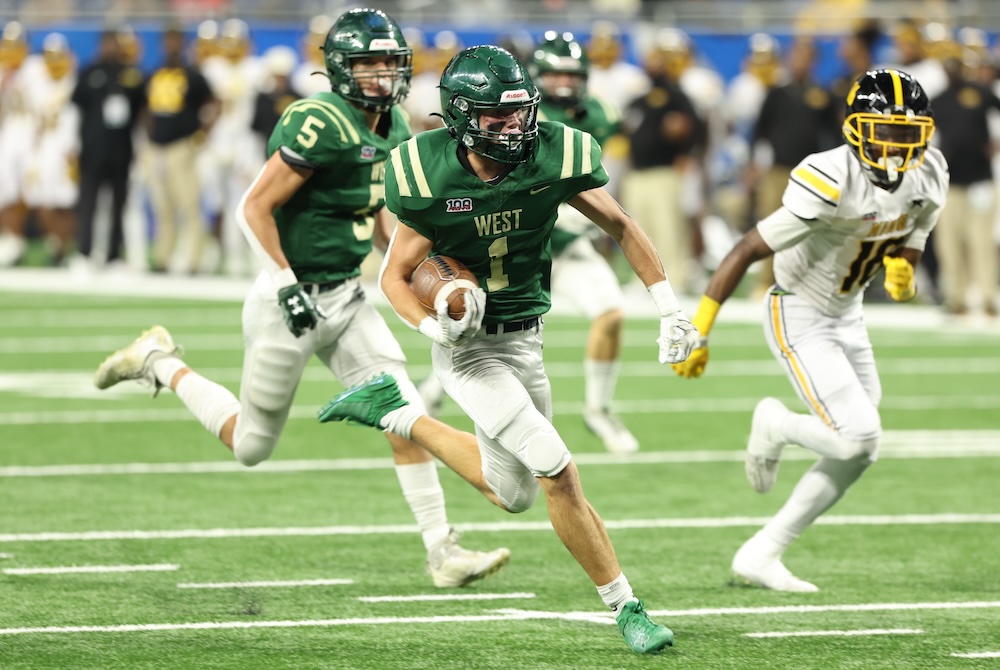
DETROIT – Keaton Hendricks put his name atop the MHSAA Football Finals record book Saturday, scoring six touchdowns to lead Zeeland West to a 42-22 Division 3 victory against Detroit Martin Luther King.
But following his record-setting performance, the senior back made sure to rattle off the names of as many teammates as he could while dispersing the credit.
“The performance couldn’t have gone without my offensive line, they blocked things up perfectly,” Hendricks said. “Even the backs, Isaac (VanderZwaag), Jonah (Leslie), Brody (Maas) or Brandon (Holman), they carried out their fakes tremendously, and that’s what led to the scores. Also Trey (Sloothaak) on those beautiful throws. He just dropped it right in there.”
Hendricks finished with 129 yards and three TDs on the ground, and had three catches for 25 yards and three scores.
He passed Chelsea’s Lucas Hanifan (Division 4, 2021), Grand Rapids Catholic Central’s Nolan Fugate (Division 4, 2017), Saginaw Nouvel’s Bennett Lewis (Division 7, 2011) and Ithaca’s Alex Niznak (Division 6, 2010) who had shared the record with five total touchdowns in a Finals game.
 His three receiving TDs are tied for second most in a Finals game with 10 others.
“Honestly, I had no idea until everyone started coming up and screaming at me,” Hendricks said. “I was like, ‘What’s going on?’ When they told me, I was just in shock. But once again, shout out to everybody.”
The title is the fifth in program history for Zeeland West, and first since 2015.
“It’s good to be 5-for-5,” Zeeland West coach John Shillito said. “Before I got here, I was 0-for-3. It’s been good in Zeeland for me. I’m just real proud of these guys. The five is big, but for this group of kids, it’s theirs.”
The Dux (13-1) never trailed, and held at least a two-score lead for much of the game. That had a lot to do with an opportunistic defense, which forced three turnovers, including two in the red zone. But anytime King did break through, it couldn’t find a way to back it up by stopping Zeeland West’s powerful T-formation run game.
“It was very difficult to prepare for that style of offense in four days,” King coach Terel Patrick said. “We have not seen it in probably six years. We went back and looked at some things, I wish we would have had a little bit more time, but nevertheless, hats off. They executed the (heck) out of that offense today. We also had two turnovers in the red zone, and you have to be able to match them possession for possession.”
Zeeland West rushed for 327 yards in the game, averaging seven per carry. It wasn’t just Hendricks, as Sloothaak added 124 yards on 12 carries, and VanderZwaag had 54 yards on his 10 carries.
Much of the damage was done in the first half, as the Dux rushed for 194 yards during the opening 24 minutes. Hendricks had 104 yards and three touchdowns (49, 14 and 30 yards) on nine carries in the first half.
He also had a six-yard touchdown reception on a play that wasn’t designed for him. Sloothaak, the quarterback, rolled and looked to his left, but with all options covered, he made a last-second glance to his right, where Hendricks was all alone. The senior then sprinted untouched into the end zone.
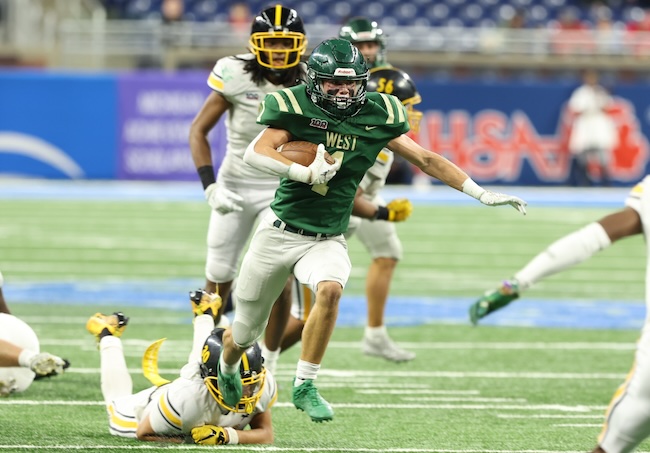 Hendricks scored on a very similar play early in the third quarter, this one coming from 11 yards out and stretching the lead to three scores at 34-14.
“They were supposed to go to Isaac,” Sloothaak said with a laugh. “Coach has been telling us in practice for a few weeks now, we have to be prepared for that, and Keaton executed that well.
The final score was on purpose, as Hendricks set the record with an eight-yard reception from Sloothaak midway through the third quarter.
“I thought I had the film on fast forward, because he’s got some speed,” Patrick said. “Speed is speed. That kid is fast in every league. He outran some angles today and proved he’s a really good football player. I would like to see kids like him get more chances at the next level. That kid’s a ballplayer. I’m glad he was able to get that exposure today on a really big stage, and hopefully he can parlay that into a college scholarship.”
Despite Hendricks’ heroics and its own mistakes, King managed to remain in shouting distance thanks to a pair of second-quarter touchdowns.
The first was set up by a fumble recovery deep in Zeeland West territory, as Michael Dukes scored on a five-yard run.
The second came as the first half clock expired, with Daryl Flemister finding David Calmese for a 10-yard score. Flemister’s two-point conversion run made the score 28-14 heading into the second half.
But shouting distance was as close as King would get. Dukes would score again, on a 14-yard run midway through the third quarter.
He finished with 93 yards rushing on 14 carries. Flemister rushed for 77 yards and was 10-of-18 for 111 yards through the air. Kristian Wheeler led the King defense with nine tackles, while Gregory Keller had eight.
Sloothaak and Tyler Bauman each had six tackles to lead Zeeland West, with Sloothaak also forcing a fumble near the goal line. Hendricks also forced a fumble, while Maas had an interception.
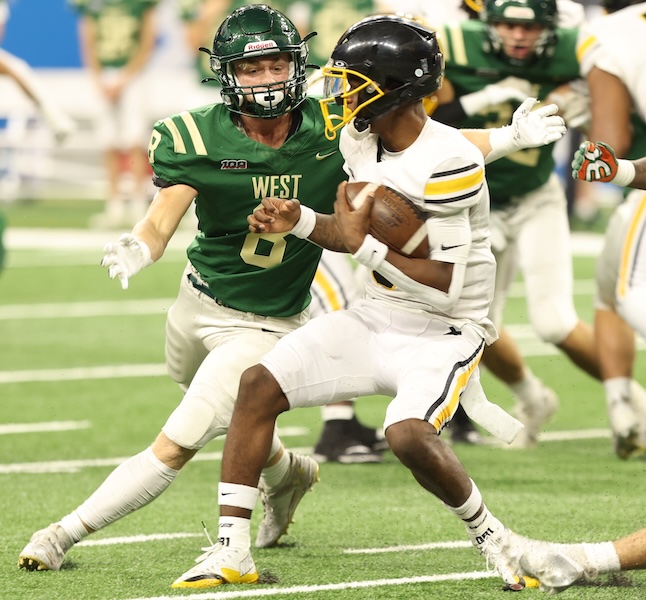
PHOTOS (Top) Zeeland West’s Keaton Hendricks (1) breaks into the open field during his team’s Division 3 championship win. (Middle) The Dux’ Brody Maas (8) closes in on a tackle. (Below) Hendricks pulls away as King’s Kyle Ruff (30) pursues. (Photos by Hockey Weekly Action Photos.)