

Thank Roosevelt for Football Weekends
December 20, 2013
By Rob Kaminski
MHSAA benchmarks editor
The next time you find yourself immersed in a tense crosstown football rivalry on a Friday night followed by a Saturday pilgrimage to the nearest college campus and a Sunday afternoon with a remote and your favorite snacks and beverages, take a moment to consider what the weekend would be like if it weren’t for Teddy Roosevelt.
The man who became our 26th President shortly after the turn of the 20th Century following the assassination of William McKinley in 1901 was a football fan like you. Maybe more so.
Today’s game of football has reached a critical crossroads. Player size and speed have increased across the board. Savage use of equipment as weapons rather than protective gear has been glorified on television networks and social media. Leaders of the game at all levels have recognized the need for change, employing new rules and widespread educational efforts to aid in preserving the sport.
History, as they say, is repeating itself.
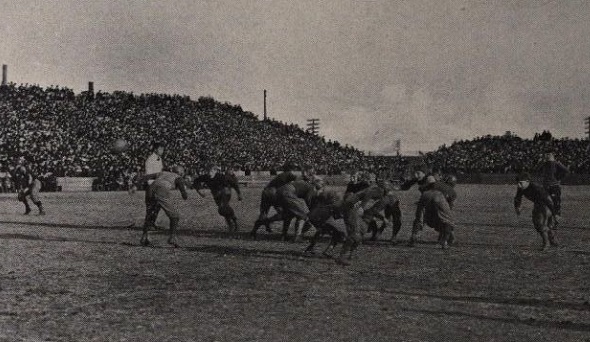
In an ironic twist, it was Roosevelt who saved the then-brutally violent game of football from itself more than 100 years ago. Yes, the same “Rough and Ready Teddy” who led the charge up San Juan Hill during the Spanish-American War and often sparred in the boxing ring while in office from 1901-09 opined that football was becoming so gruesome that he delivered an ultimatum: clean up the game or it would be outlawed.
The Chicago Tribune reported that in 1904 alone, there were 18 football deaths and 159 serious injuries, mostly among prep school players. Football deaths suffered by younger players were reported on a nearly weekly basis, as outraged citizens called on colleges and high schools to banish football outright.
In stepped Roosevelt, who called head coaches and representatives from Harvard, Yale and Princeton – college powers at the time – to the White House in 1905 urging them to eliminate excessive violence and set an example of fair play for the rest of the country. When the casualties actually rose by one during the ensuing season, Roosevelt reacted with greater resolve and convened leading football authorities for the purpose of authoring drastic rules changes. What emerged was an intercollegiate conference which was the predecessor of the NCAA.
Among the most effective changes for the 1906 season were the legalization of the forward pass, the elimination of mass formations, and the creation of a neutral zone. Football fatalities fell to 11 in each of the next two seasons, and severe injuries fell drastically.
Thanks to the introduction of protective equipment and ever-evolving rules changes, football during the 100-plus years to follow has become an exponentially safer game. Yet, the game’s leaders always will need to adjust and react to scrutiny that comes with the territory.
So, as the game once again undergoes rules modifications in the name of safety, give a tip of the cap to President Roosevelt while you enjoy college bowl season and the NFL playoffs and begin to think ahead to the first high school practice of 2014.
Pontiac Notre Dame Prep Welcomes Frantic Fun of 1st Trip to Football Finals
By
Keith Dunlap
Special for MHSAA.com
November 29, 2024
Betty Wroubel has never been so happy to have a bit of chaos and unfamiliar busyness descend upon her and the athletic department at Pontiac Notre Dame Prep this week.
 An administrator at the school for 45 years — dating back to the days when it was known as Pontiac Catholic — Wroubel and her colleagues always wondered what things would be like if the football program ever made a state championship game.
This week, all that dreaming turned into reality as the Fighting Irish advanced to Saturday’s Division 5 Final against Frankenmuth. As expected, it’s been frantic.
Phone calls and emails from alumni and other school officials have come in droves, hoping there is room on the sideline for them even when there are limited spots available.
“I think the most difficult part has been telling people no,” said Notre Dame Prep associate athletic director Aaron Crouse.
There have been several phone calls placed to fellow administrators or other coaches who have been there to inquire about all the little things not normally thought about.
Should we have the team go down Friday to check out those games in order to get more familiar with the environment?
Is it best to gather up a bus to transport students down, or just send the link to tickets and tell everyone they are on their own?
Of course, trying to figure out such logistics has been a labor of love.
“They are good problems to have,” Wroubel said. “I’ll take these problems. It’s exciting and worth it.”
While the athletic administrators have felt the energy in their offices, the same can’t quite be said for the Notre Dame Prep team itself.
There were no classes during the week due to Thanksgiving break, so the buzz of making a football Final for the first time wasn’t really felt in the hallways.
The advantage to that though is that the Notre Dame Prep players have pretty much been able to focus on football, and given the season the Fighting Irish have had, they don’t really need any more perks to be at their best.
Notre Dame Prep enters with an 11-1 record, its only loss coming in the regular-season finale against Hudsonville Unity Christian.
 The Fighting Irish recorded wins over perennial powers Jackson Lumen Christi and Grand Rapids Catholic Central, and bigger Oakland Activities Association schools such as Troy and Ferndale.
In his 11th year leading the program, Pat Fox also will coach in a Final for the first time after more than three decades in that role on a high school sideline.
Fox has several mentors who have helped guide him along the way, including former Rockford and current Newaygo head coach Ralph Munger, former Chelsea head coach Brad Bush and former Saginaw Arthur Hill head coach Jim Eurick.
Fox had planned on chatting more with Munger and Bush this week about the logistics of making a Final.
Regarding his team, Fox said getting this far is especially rewarding since he has been in the same building with many of his players for over a decade and has watched them grow up.
“My quarterback, I remember seeing him in the building when he was a little toddler,” Fox said.
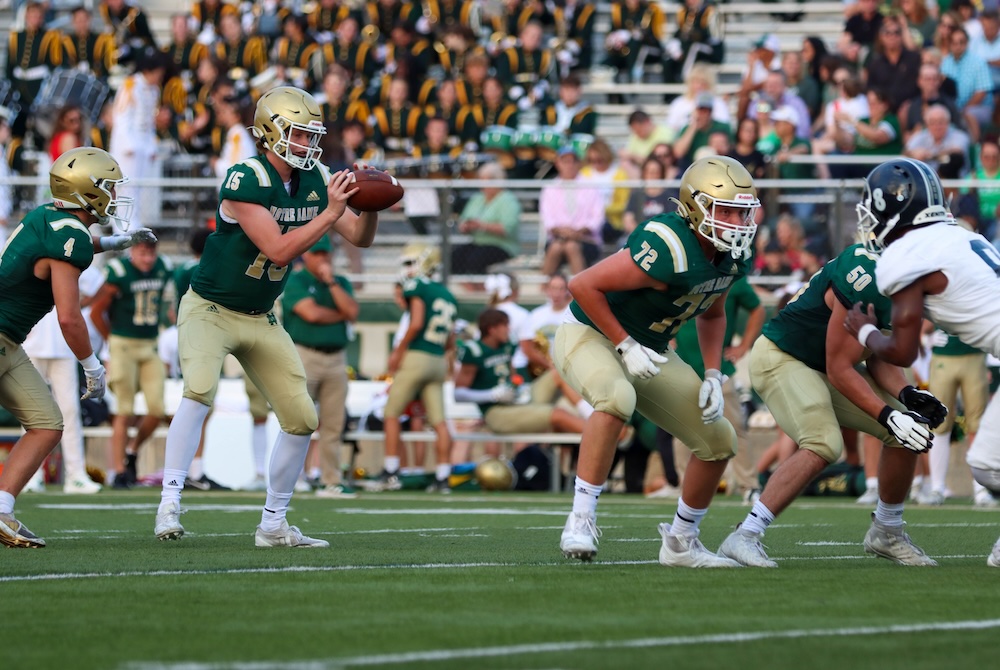
That quarterback is junior Sam Stowe, who Fox credited with sticking with the program and waiting for his turn instead of trying to transfer for more playing time as a freshman or sophomore.
Stowe and Notre Dame Prep have been rewarded greatly for that patience, as he has thrown for more than 2,500 yards and 38 touchdowns, and has a completion percentage of 72 percent going into Saturday.
The Fighting Irish also have a core of six players who have been starters the past three years: WR/LB Billy Collins, DL/RB Drew Heimbuch, WR/LB Mike Wiebelhaus, WR/DB Joey Decasas, OL/LB Luca Gasperoni and OL/DL Jake Gartin.
Fox also said junior LB Brody Sink has developed into a Division I college prospect with his play this year.
“They’ve been through a lot of wars and have been great,” Fox said. “We have really good team speed.”
Wroubel and Crouse said they and other school officials “saw this coming” with how the program was trending up and being built right over the years. But the reality of what was happening didn’t fully set in until the fourth quarter of a Semifinal win over Flat Rock.
“Administrators were crying out there,” Wroubel said.
Come Saturday, the Notre Dame Prep community hopes there will be more tears in celebration of the program’s first state championship.
 Keith Dunlap has served in Detroit-area sports media for more than two decades, including as a sportswriter at the Oakland Press from 2001-16 primarily covering high school sports but also college and professional teams. His bylines also have appeared in USA Today, the Washington Post, the Detroit Free Press, the Houston Chronicle and the Boston Globe. He served as the administrator for the Oakland Activities Association’s website from 2017-2020. Contact him at [email protected] with story ideas for Oakland, Macomb and Wayne counties.
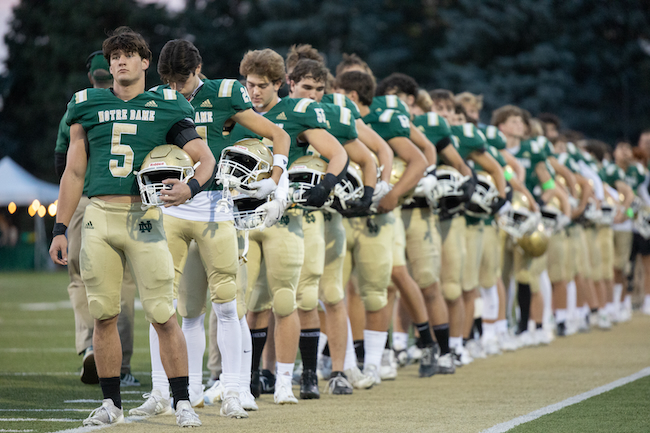
PHOTOS (Top) Notre Dame Prep quarterback Sam Stowe (15) takes a snap against Detroit Central during a 49-14 Week 1 win. (Middle) The Fighting Irish, including Drew Heimbuch (5), line up before a game. (Photos courtesy of the Pontiac Notre Dame Prep athletic department.)