

Thank Roosevelt for Football Weekends
December 20, 2013
By Rob Kaminski
MHSAA benchmarks editor
The next time you find yourself immersed in a tense crosstown football rivalry on a Friday night followed by a Saturday pilgrimage to the nearest college campus and a Sunday afternoon with a remote and your favorite snacks and beverages, take a moment to consider what the weekend would be like if it weren’t for Teddy Roosevelt.
The man who became our 26th President shortly after the turn of the 20th Century following the assassination of William McKinley in 1901 was a football fan like you. Maybe more so.
Today’s game of football has reached a critical crossroads. Player size and speed have increased across the board. Savage use of equipment as weapons rather than protective gear has been glorified on television networks and social media. Leaders of the game at all levels have recognized the need for change, employing new rules and widespread educational efforts to aid in preserving the sport.
History, as they say, is repeating itself.
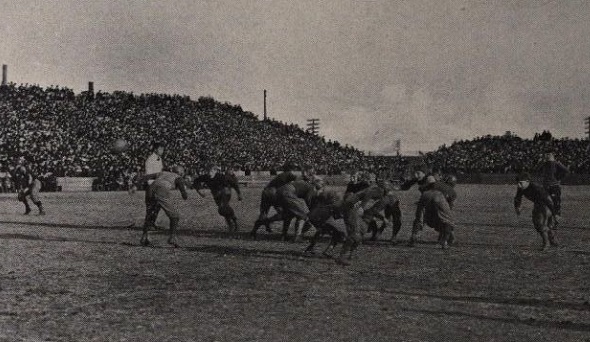
In an ironic twist, it was Roosevelt who saved the then-brutally violent game of football from itself more than 100 years ago. Yes, the same “Rough and Ready Teddy” who led the charge up San Juan Hill during the Spanish-American War and often sparred in the boxing ring while in office from 1901-09 opined that football was becoming so gruesome that he delivered an ultimatum: clean up the game or it would be outlawed.
The Chicago Tribune reported that in 1904 alone, there were 18 football deaths and 159 serious injuries, mostly among prep school players. Football deaths suffered by younger players were reported on a nearly weekly basis, as outraged citizens called on colleges and high schools to banish football outright.
In stepped Roosevelt, who called head coaches and representatives from Harvard, Yale and Princeton – college powers at the time – to the White House in 1905 urging them to eliminate excessive violence and set an example of fair play for the rest of the country. When the casualties actually rose by one during the ensuing season, Roosevelt reacted with greater resolve and convened leading football authorities for the purpose of authoring drastic rules changes. What emerged was an intercollegiate conference which was the predecessor of the NCAA.
Among the most effective changes for the 1906 season were the legalization of the forward pass, the elimination of mass formations, and the creation of a neutral zone. Football fatalities fell to 11 in each of the next two seasons, and severe injuries fell drastically.
Thanks to the introduction of protective equipment and ever-evolving rules changes, football during the 100-plus years to follow has become an exponentially safer game. Yet, the game’s leaders always will need to adjust and react to scrutiny that comes with the territory.
So, as the game once again undergoes rules modifications in the name of safety, give a tip of the cap to President Roosevelt while you enjoy college bowl season and the NFL playoffs and begin to think ahead to the first high school practice of 2014.
Century of School Sports: Connection at Heart of Coaches Advancement Program
By
Geoff Kimmerly
MHSAA.com senior editor
November 19, 2024
As we believe that educational athletics are an extension of the academic classroom, it’s important to recognize as well that coaches – similar to teachers during the school day – are another first point of contact for more than 170,000 high school athletes and thousands more who play middle school sports in Michigan.
For two decades, the MHSAA’s Coaches Advancement Program has served as an avenue to provide our coaches with a variety of tools to assist in working through issues they encounter daily while building up their teams and building these relationships.
Past Executive Director John E. “Jack” Roberts, when writing about the CAP program in 2017, noted “the thousands of dollars and hours that the MHSAA devotes to CAP demonstrates this organization’s belief that nothing – absolutely nothing – is more important in the process of educational athletics than the quality of the coach-athlete connection.”
That commitment and dedication to the coach-athlete connection continues as the MHSAA moves through its 100th anniversary year.
Through the end of the 2023-24 school year, coaches had completed 41,167 sessions within the eight-level program since its creation for the 2004-05 school year. Counting this past weekend’s CAP 1 and 2 courses taught at Detroit Henry Ford, another 1,167 sessions have been completed since the start of the 2024-25 educational year.
The CAP program is broken into nine levels, each addressing a set of topics:
- CAP 1: Coaches Make the Difference, The Coach as Teacher, Sports Medicine and First Aid.
- CAP 2: Effective Communication, Legal Responsibilities, Psychology of Coaching.
- CAP 3: Additional Coaching Responsibilities, Effectively Working with Parents, Managing Time and Energy.
- CAP 4: Understanding Athletic Development, Strength and Conditioning, Preparing for Success.
- CAP 5: Healthy Living, Teaching Emotional Toughness, Resolving Conflicts in Athletics.
- CAP 6, 7, 8 & 9: Current Issues and Topics in Educational Athletics.
Those who complete the program receive a level of certification after their first 12 hours (completing CAP 1 and 2). Through this past school year, 2,295 individuals have advanced through CAP 5 – earning them themselves CAP Masters Certification. From that group, 476 have advanced through CAP 6, 100 through CAP 7 and 87 through CAP 8, with the first class to complete that module in 2015-16. CAP 9 was created this fall.
Perhaps just as notably, 20,960 individuals have completed CAP 1 over the last two decades. Completion of either CAP 1 or CAP 2 became a requirement for first-year varsity head coaches beginning with the 2016-17 school year, and predictably numbers have climbed since that time with 12,515 completing CAP 1 over the last eight school years.
The program is constructed and coordinated by MHSAA Assistant Director Kathy Vruggink Westdorp, who joined the MHSAA staff in 2004 after several years as a principal, athletic director, teacher and coach in Grand Rapids and Forest Hills public schools. She lives the program’s philosophy of providing CAP training “anytime, anywhere” across the state, and over just the last five months CAP 1 alone has been delivered at 19 schools plus during 14 dates at the MHSAA office in East Lansing. Flint Kearsley isn’t on the list of CAP 1 hosts this year, but instead welcomed in 45 students for a CAP 5 session in early August.
Additionally, colleges and universities in Michigan are licensed to present up to five levels through their undergraduate or graduate studies, and eight are scheduled to do so again this school year.
The faculty for 2024-25 includes well-known leaders in Michigan educational athletics, officiating and sports medicine. Instructors include past and present athletic directors, principals, officials, coaches, college professors, athletic trainers, leaders from the Michigan Interscholastic Athletic Administrators Association (MIAAA) and MHSAA staff.
For more information, see the Coaches Advancement Program page.
Previous "Century of School Sports" Spotlights
Nov. 12: Good Sports are Winners Then, Now & Always - Read
Nov. 5: MHSAA's Home Sweet Home - Read
Oct. 29: MHSAA Summits Draw Thousands to Promote Sportsmanship - Read
Oct. 23: Cross Country Finals Among MHSAA's Longest Running - Read
Oct. 15: State's Storytellers Share Fall Memories - Read
Oct. 8: Guided by 4 S's of Educational Athletics - Read
Oct. 1: Michigan Sends 10 to National Hall of Fame - Read
Sept. 25: MHSAA Record Books Filled with 1000s of Achievements - Read
Sept. 18: Why Does the MHSAA Have These Rules? - Read
Sept. 10: Special Medals, Patches to Commemorate Special Year - Read
Sept. 4: Fall to Finish with 50th Football Championships - Read
Aug. 28: Let the Celebration Begin - Read
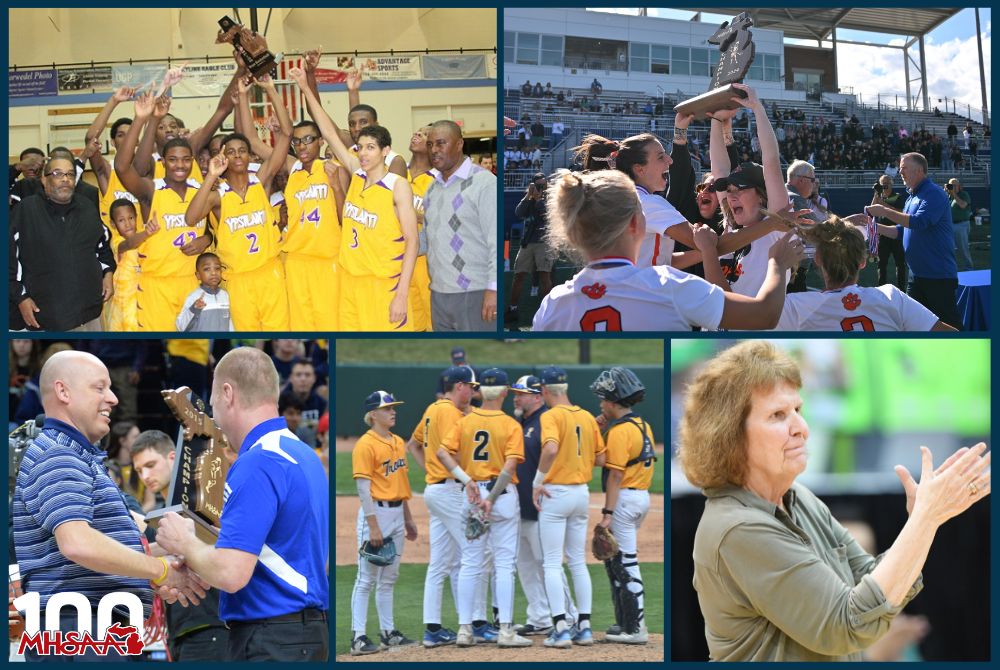
PHOTOS Clockwise from top left: (1) Former Ypsilanti Community and current Wayne Memorial boys basketball coach Steve Brooks (far right) celebrates with a trophy-winning team. (2) Brighton girls lacrosse coach Ashton Peters raises the Division 1 championship trophy in the spring. (3) Pontiac Notre Dame Prep volleyball coach Betty Wroubel applauds during pre-match introductions. (4) Trenton baseball coach Todd Szalka (middle) huddles on the mound during last season's Division 2 Semifinals. (5) Past Calumet athletic director Sean Jacques (left) passes the Class C championship trophy to his girls basketball coach in 2015. All five have received levels of CAP certification.