

Thank Roosevelt for Football Weekends
December 20, 2013
By Rob Kaminski
MHSAA benchmarks editor
The next time you find yourself immersed in a tense crosstown football rivalry on a Friday night followed by a Saturday pilgrimage to the nearest college campus and a Sunday afternoon with a remote and your favorite snacks and beverages, take a moment to consider what the weekend would be like if it weren’t for Teddy Roosevelt.
The man who became our 26th President shortly after the turn of the 20th Century following the assassination of William McKinley in 1901 was a football fan like you. Maybe more so.
Today’s game of football has reached a critical crossroads. Player size and speed have increased across the board. Savage use of equipment as weapons rather than protective gear has been glorified on television networks and social media. Leaders of the game at all levels have recognized the need for change, employing new rules and widespread educational efforts to aid in preserving the sport.
History, as they say, is repeating itself.
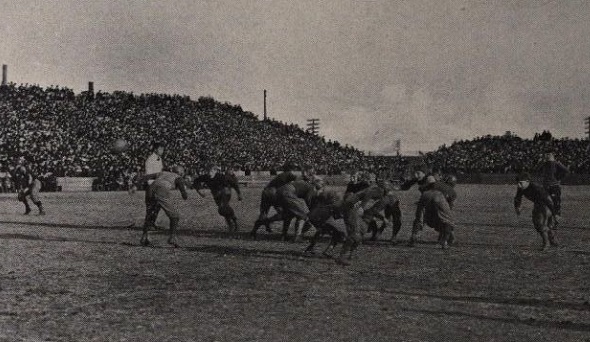
In an ironic twist, it was Roosevelt who saved the then-brutally violent game of football from itself more than 100 years ago. Yes, the same “Rough and Ready Teddy” who led the charge up San Juan Hill during the Spanish-American War and often sparred in the boxing ring while in office from 1901-09 opined that football was becoming so gruesome that he delivered an ultimatum: clean up the game or it would be outlawed.
The Chicago Tribune reported that in 1904 alone, there were 18 football deaths and 159 serious injuries, mostly among prep school players. Football deaths suffered by younger players were reported on a nearly weekly basis, as outraged citizens called on colleges and high schools to banish football outright.
In stepped Roosevelt, who called head coaches and representatives from Harvard, Yale and Princeton – college powers at the time – to the White House in 1905 urging them to eliminate excessive violence and set an example of fair play for the rest of the country. When the casualties actually rose by one during the ensuing season, Roosevelt reacted with greater resolve and convened leading football authorities for the purpose of authoring drastic rules changes. What emerged was an intercollegiate conference which was the predecessor of the NCAA.
Among the most effective changes for the 1906 season were the legalization of the forward pass, the elimination of mass formations, and the creation of a neutral zone. Football fatalities fell to 11 in each of the next two seasons, and severe injuries fell drastically.
Thanks to the introduction of protective equipment and ever-evolving rules changes, football during the 100-plus years to follow has become an exponentially safer game. Yet, the game’s leaders always will need to adjust and react to scrutiny that comes with the territory.
So, as the game once again undergoes rules modifications in the name of safety, give a tip of the cap to President Roosevelt while you enjoy college bowl season and the NFL playoffs and begin to think ahead to the first high school practice of 2014.
Hickey Joins Notable Coaching Crew as Adams Completes 2024 Soccer Sweep
By
Keith Dunlap
Special for MHSAA.com
November 14, 2024
When New Year’s Eve comes this year and the ball drops to welcome in 2025, Rochester Adams boys and girls soccer coach Josh Hickey might be hesitant to celebrate this year coming to an end.
 It’s not that he won’t be excited for the new year. It’s just that it might be impossible to top 2024 from a coaching perspective.
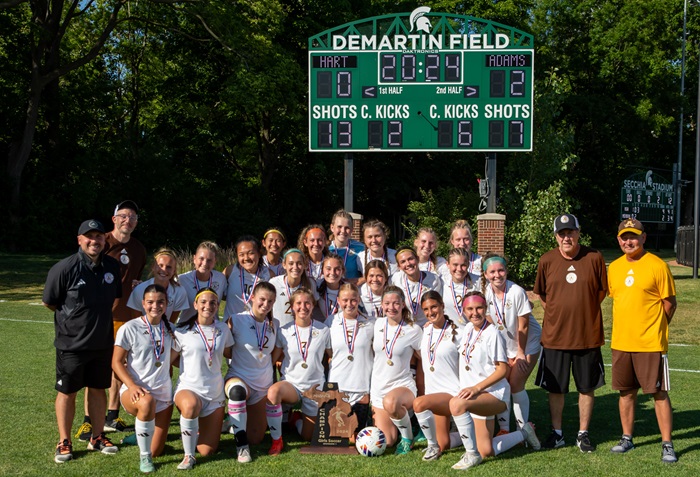
In June, Hickey made history when he helped guide the Adams girls to the Division 1 championship with a 2-0 win over Hartland.
He joined the list of soccer coaches in state history who have led both boys and girls programs to Finals championships, a group that includes Barry Brodsky of Bloomfield Hills Marian/Brother Rice, Randy Heethuis of Hudsonville Unity Christian, Brian Guggemos of Okemos, Ken Johnson of Salem, Brian O’Leary of Novi, Tim Storch of Troy Athens and Clark Udell of Grand Rapids Forest Hills Central.
“That’s good company to keep, that’s for sure,” Hickey said in praising those other coaches who have pulled off the feat.
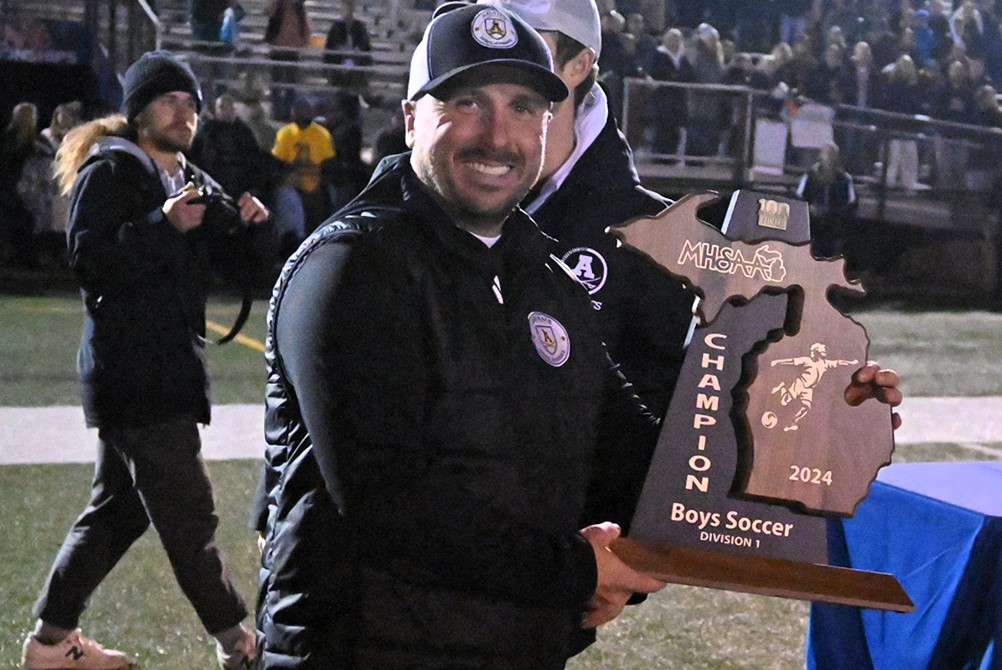
Earlier this month, the Adams boys followed in the footsteps of their classmates from this spring, defeating Byron Center in the Division 1 Final, 2-0, to win the program’s second Division 1 title over the last three years. Adams downed Rockford in the 2022 Final, also by a 2-0 score.
Adams also won girls and boys Division 1 soccer titles during the same calendar year in 1999, but with those teams led by separate coaches.
Hickey said while each team had talent and players all came from great soccer backgrounds and families, the two championship runs were quite different.
“With the girls, I would imagine nobody picked us necessarily to go that far, especially at the beginning of the season,” he said. “Throughout the year, the girls were just super resilient. The expectation wasn’t there.”
It was a far different element once the fall started and the boys took the field, given there was a solid core of returnees and also five MLS Next academy players who decided to experience high school soccer for their senior year, including eventual Mr. Soccer Award winner Alex Rosin.
 “With the boys, we had to battle through all those expectations,” Hickey said. “There is something with your mental toughness to see if the kids can even handle that pressure. They handled it better than I thought they would. It was never a concern or issue.
“The girls came in and just wanted a good year and then ended up having the most success they could ever imagine. The boys came in telling me they wanted to win the whole thing from day one.”
On Oct. 30 – when the Adams boys team defeated Saline in their Semifinal (2-1 in penalty kicks) – it just so happened to be the same day the girls team got its championship rings.
“Some of the girls came and showed us during lunch and throughout the day,” Rosin said. “It just gave us extra motivation. We had to win two more, and we successfully did. At the time, we wanted it so bad and we saw them wear the rings at school. It made us want it even more.”
For the record, Rosin said playing high school soccer — even if it was just for one year — was an experience he’ll never forget.
“Hickey played me at every position,” Rosin said. “It was a good experience to learn the game in a different way. Just kind of push myself and test myself every day. Different positions and trying to become the best player I can be.
“One thing I’ll take away is the memories and new bonds I made with my teammates. It was something incredible.”
Despite the boys season being over, Hickey said the transition to girls season will wait a bit. There is still the matter of the postseason banquet to attend to, as well as championship celebrations such as meeting the mayor of Rochester Hills and marching in the downtown Rochester Christmas parade.
But once the celebrations slow down and the holidays come to end, all attention will turn to the girls season and the run for a repeat next spring.
The Adams girls program has never won consecutive Finals titles, but should be well-equipped to give it a go.
“A lot of players come back from the starting group,” Hickey said. “We also had girls waiting in the wings waiting to play. We’re excited for it.”
While it will be difficult for Hickey and Adams soccer to say farewell to 2024, there clearly is a lot to look forward to for 2025 as well.
 Keith Dunlap has served in Detroit-area sports media for more than two decades, including as a sportswriter at the Oakland Press from 2001-16 primarily covering high school sports but also college and professional teams. His bylines also have appeared in USA Today, the Washington Post, the Detroit Free Press, the Houston Chronicle and the Boston Globe. He served as the administrator for the Oakland Activities Association’s website from 2017-2020. Contact him at [email protected] with story ideas for Oakland, Macomb and Wayne counties.
PHOTOS (Top) Rochester Adams soccer coach Josh Hickey shows the Division 1 championship trophy after his boys team defeated Byron Center on Nov. 2 at Grand Ledge High School. (Middle) Hickey, far left, takes his spot in the team photo after Adams’ girls won the Division 1 title in June at Michigan State’s DeMartin Stadium.