

Thank Roosevelt for Football Weekends
December 20, 2013
By Rob Kaminski
MHSAA benchmarks editor
The next time you find yourself immersed in a tense crosstown football rivalry on a Friday night followed by a Saturday pilgrimage to the nearest college campus and a Sunday afternoon with a remote and your favorite snacks and beverages, take a moment to consider what the weekend would be like if it weren’t for Teddy Roosevelt.
The man who became our 26th President shortly after the turn of the 20th Century following the assassination of William McKinley in 1901 was a football fan like you. Maybe more so.
Today’s game of football has reached a critical crossroads. Player size and speed have increased across the board. Savage use of equipment as weapons rather than protective gear has been glorified on television networks and social media. Leaders of the game at all levels have recognized the need for change, employing new rules and widespread educational efforts to aid in preserving the sport.
History, as they say, is repeating itself.
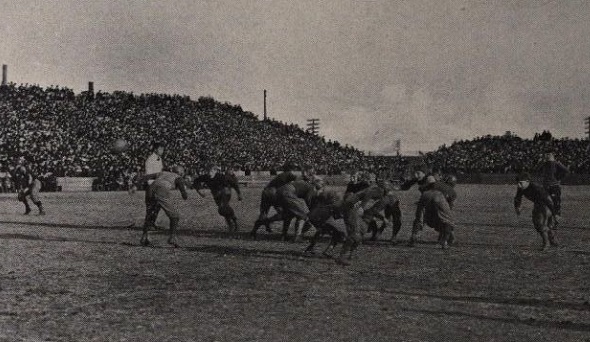
In an ironic twist, it was Roosevelt who saved the then-brutally violent game of football from itself more than 100 years ago. Yes, the same “Rough and Ready Teddy” who led the charge up San Juan Hill during the Spanish-American War and often sparred in the boxing ring while in office from 1901-09 opined that football was becoming so gruesome that he delivered an ultimatum: clean up the game or it would be outlawed.
The Chicago Tribune reported that in 1904 alone, there were 18 football deaths and 159 serious injuries, mostly among prep school players. Football deaths suffered by younger players were reported on a nearly weekly basis, as outraged citizens called on colleges and high schools to banish football outright.
In stepped Roosevelt, who called head coaches and representatives from Harvard, Yale and Princeton – college powers at the time – to the White House in 1905 urging them to eliminate excessive violence and set an example of fair play for the rest of the country. When the casualties actually rose by one during the ensuing season, Roosevelt reacted with greater resolve and convened leading football authorities for the purpose of authoring drastic rules changes. What emerged was an intercollegiate conference which was the predecessor of the NCAA.
Among the most effective changes for the 1906 season were the legalization of the forward pass, the elimination of mass formations, and the creation of a neutral zone. Football fatalities fell to 11 in each of the next two seasons, and severe injuries fell drastically.
Thanks to the introduction of protective equipment and ever-evolving rules changes, football during the 100-plus years to follow has become an exponentially safer game. Yet, the game’s leaders always will need to adjust and react to scrutiny that comes with the territory.
So, as the game once again undergoes rules modifications in the name of safety, give a tip of the cap to President Roosevelt while you enjoy college bowl season and the NFL playoffs and begin to think ahead to the first high school practice of 2014.
1st & Goal: 2024 Playoffs Week 2 Review
By
Geoff Kimmerly
MHSAA.com senior editor
November 11, 2024
If at first you don’t succeed … wait until the playoffs?
 That became the storyline for some of the most intriguing rematches during District title weekend for 11-player football and Regional championship weekend for 8-player brackets.
Of 72 MHSAA playoff games total, 23 were rematches from the regular season. A total of 15 teams won both the first meeting and the second – but that means eight teams that lost before advanced this time around, and plenty shaking up brackets in major ways.
11-Player Division 1
HEADLINER Macomb Dakota 41, Utica Eisenhower 14 Dakota’s only loss this season was Week 7 to Eisenhower, 21-14. But the Cougars (10-1) avenged in a big way with Brady Hamby reaching the end zone four times to lead the team to a District title after these two shared the Macomb Area Conference Red championship. Click for more from the Macomb Daily.
Check out the highlights of Macomb Dakota's win over Utica Eisenhower in the Division 1 District Final on November 8th, 2024.
Powered by @LawrenceTechU
Recruit YOURSELF and support your own dreams with an athletic scholarship from Lawrence Technological University!
Click the… pic.twitter.com/TWUdvefVkG— STATE CHAMPS! Michigan (@statechampsmich) November 9, 2024
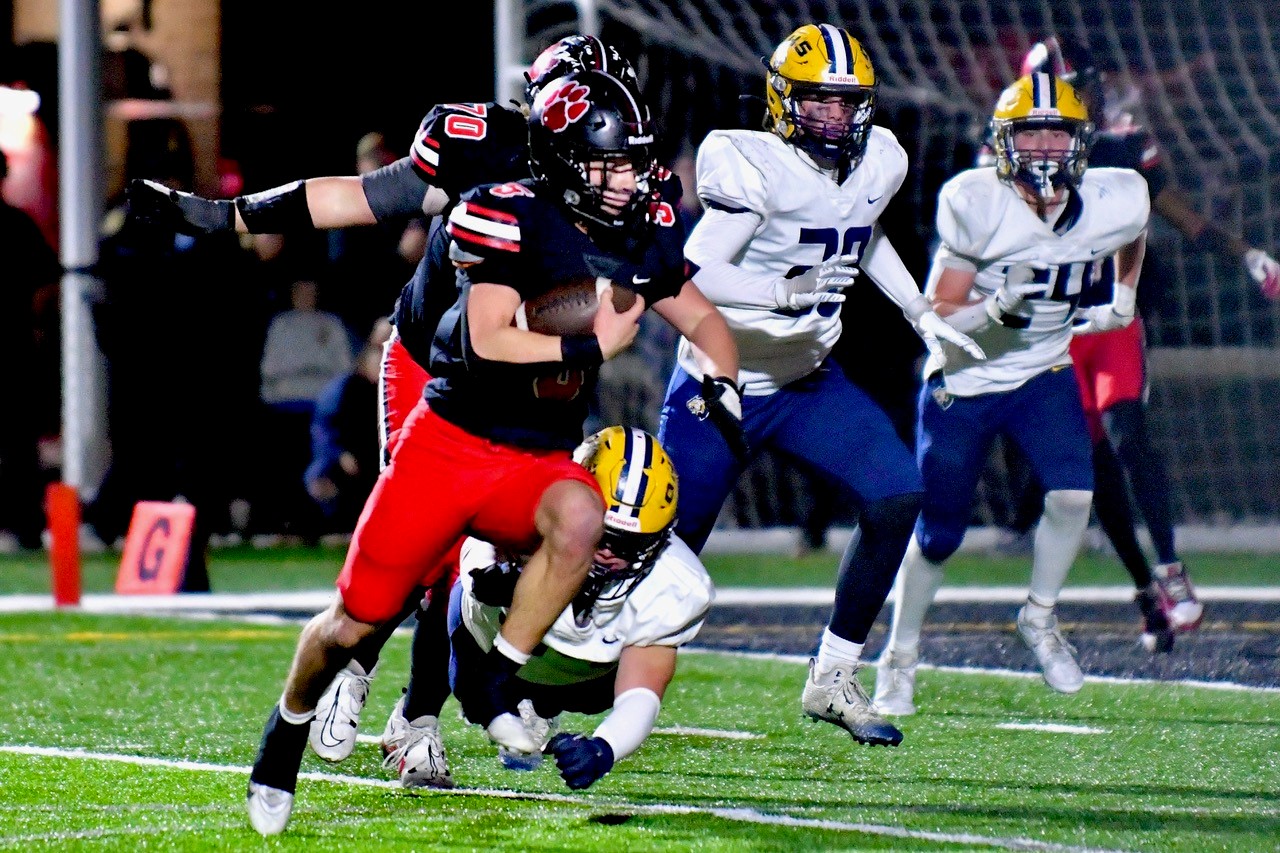
District Digest Howell 35, Brighton 33 Justin Jones broke Howell’s single-season records for rushing yards and touchdowns, adding 225 and four, respectively, as the Highlanders (11-0) held off the rival Bulldogs (8-3) in a rematch from Week 8. Hudsonville 19, Grandville 16 The Eagles (10-1) also had to hold on in a rematch from the regular season, adding this to a Week 7 victory over Grandville (6-5). Grand Blanc 29, Oxford 7 Grand Blanc (9-2) won this clash of league champions to secure its first District title since 2021 and end Oxford’s season at 7-4, its winningest since 2018.
11-Player Division 2
HEADLINER Byron Center 30, Muskegon Mona Shores 23 Byron Center (10-1) was only slightly behind Mona Shores (9-2) on the final Division 2 playoff points list, and with this win moves ahead as the highest-ranked team on their side of the bracket. Mona Shores had won their Week 4 meeting 14-12. Click for more from FOX 17.
Check out the highlights of the thrilling Division 2 @MHSAA District Final between Byron Center and Muskegon Mona Shores. Byron Center won 30-23 and will face Portage Central in the regional final. 🎥 WXMI-TV@ByronCenterFB | @RemiMonaghan pic.twitter.com/9EZELJuOgX
— STATE CHAMPS! Michigan (@statechampsmich) November 9, 2024
District Digest East Lansing 50, Dexter 49 East Lansing scored and connected on a 2-point conversion pass with no time left on the clock to claim a third-straight District title and end Dexter’s season at 10-1. Saginaw Heritage 17, Midland 7 This was another rematch reversal, as Heritage (8-3) avenged its 28-13 loss to Midland (9-2) from Week 7. Warren De La Salle Collegiate 35, Grosse Pointe South 21 De La Salle (8-2) clinched a fifth-straight District title by handing Grosse Pointe South (10-1) its only defeat.
11-Player Division 3
HEADLINER Zeeland West 42, St. Joseph 0 West (10-1) ran its District championship streak to three and has outscored its two playoff opponents by a combined 74-6 after posting its first shutout of this season. St. Joseph (9-2) was averaging 36 points per game entering the matchup. Click for more from the Holland Sentinel.
District Digest River Rouge 20, Riverview 14 Rouge (6-4) has won four straight after opening 2-4 and claimed this District title by defeating the same two opponents as a year ago, Southgate Anderson and then Riverview (9-2). Grand Rapids Forest Hills Central 28, Coopersville 17 The reigning Division 3 champion Rangers (9-2) earned a rematch with Zeeland West, which won their first meeting in Week 6. Coopersville finished 7-4. Petoskey 38, Mount Pleasant 10 The Northmen (11-0) extended their record-setting season by reaching 11 wins for the first time with their first District title since 2014. Mount Pleasant finished 6-5.
11-Player Division 4
HEADLINER Grand Rapids South Christian 35, Hudsonville Unity Christian 28 In perhaps the upset of the weekend, South Christian avenged a 50-21 loss to Unity (10-1) from Week 7, moving to 7-4 while toppling what was the top team on the Division 4 playoff points list heading into the postseason. Unity led by one at halftime and pulled within one again with 8:21 to play before the Sailors finished the win. Click for more from Michigan Sports Radio.
District Digest Haslett 24, Chelsea 9 The Vikings (8-3) went to Chelsea (8-3) and brought home a District title for the second season in a row, this time adding to a seven-game winning streak to earn a Regional Final rematch with Goodrich. Goodrich 27, Freeland 21 The Martians pulled ahead by two touchdowns with 2:13 to play and held off Freeland’s late comeback attempt to clinch a third-straight District title. The Falcons finished 9-2 after also falling to Goodrich in a District Final last year. Macomb Lutheran North 43, Croswell-Lexington 42 (OT) Lutheran North (10-1) clinched a second-straight District championship and reached 10 wins for the first time, ending Croswell-Lexington’s run at 7-4.
11-Player Division 5
HEADLINER Grand Rapids Catholic Central 21, Grand Rapids West Catholic 18 A late blocked punt and a go-ahead touchdown pass gave Catholic Central (7-4) a ninth-straight District championship with this third-straight playoff win over its rival. West Catholic (7-4) also saw its 2023 season end against the Cougars in a Regional Final. Click for more from the Grand Rapids Press.
Highlights of Grand Rapids Catholic Central's 21-18 win over West Catholic in the Division 5 District Final on November 8th, 2024. Catholic Central will play Kalamazoo United in the regional final next week. Powered by @MIArmyGuard @GRCC_CougarsFB pic.twitter.com/Y7gv3L2mF8
— STATE CHAMPS! Michigan (@statechampsmich) November 10, 2024
District Digest Gladwin 28, Ogemaw Heights 19 Gladwin (8-3) not only avenged last year’s District opener loss but also a 12-7 Week 3 defeat this fall to Ogemaw Heights (9-2). Frankenmuth 37, Belding 7 The undefeated Eagles’ defense continued to shine, this time slowing down a Belding offense that was averaging 46.5 points per game entering the weekend. The Black Knights finished 9-2. Armada 63, Hazel Park 0 Armada (10-1) claimed its first District championship in this sport, also reaching double-digit wins for the first time, while Hazel Park (7-4) capped its first winning season since 2017 and winningest since 2010.
11-Player Division 6
HEADLINER Boyne City 21, Kingsley 15 The reigning champion is out as Boyne City (9-2) avenged its most recent loss, 26-20 to Kingsley (8-3) from Week 4 in what also was a rematch of two of the three champions from the Northern Michigan Football League Legends. The District title was Boyne’s first since 2014. Click for more from the Petoskey News-Review.
District Digest Newaygo 35, Central Montcalm 34 Newaygo (9-2) claimed its first District title since 2012, thanks in part to stopping Central Montcalm (9-2) on a 2-point conversion attempt after a fourth-quarter touchdown. The Hornets finished their winningest campaign since 1999, according to Michigan-Football.com. Lansing Catholic 31, Ovid-Elsie 28 Lansing Catholic (8-3) finished a run through the elite from the Mid-Michigan Activities Conference, with this win over the runner-up Marauders (8-3) following the District-opening victory over MMAC champion Chesaning. Marine City 38, Warren Michigan Collegiate 28 Marine City (9-2) claimed its first District title since 2021, handing Michigan Collegiate (9-2) its first loss since Week 1. Michigan Collegiate had entered the postseason third on the Division 6 playoff-points average list, and Marine City was fourth.
11-Player Division 7
HEADLINER Menominee 35, Traverse City St. Francis 32 (OT) Menominee (10-1) emerged with arguably its best win this fall as it works to return to Ford Field this month. The Maroons had played only one other single-digit game this season – a two-point Week 8 loss to Kingsford – but held on to get to overtime and then get past the Gladiators (7-4). Click for more from the Escanaba Daily Press.
District Digest Pewamo-Westphalia 17, Ithaca 14 The Pirates (9-2) are repeat District champions as they improved to 3-2 in one-score games this fall, while Ithaca finished 10-1 after its second-straight perfect regular season. North Muskegon 27, McBain 7 The Norsemen (10-1) also finished a second-straight District title run, this one by locking down a McBain offense that was averaging 42 points per game entering the weekend. The Ramblers finished 9-2. Hudson 30, Union City 7 The Tigers (10-1) won their first District title since 2021 with a fifth-straight game holding the opponent to single-digit scoring — and this time while also putting up the most points Union City (9-2) allowed this fall, its winningest since 2011.
11-Player Division 8
HEADLINER Harbor Beach 37, Clarkston Everest Collegiate 7 As this season has rolled on, Harbor Beach (11-0) has been more and more impressive. Since a two-point win Week 1 over Cass City, the Pirates haven’t let an opponent closer than 30 points – and Everest (9-2) was arguably its toughest challenge to date, scoring 36 points per game and giving up just under eight before Harbor Beach sailed through. Click for more from the Huron Daily Tribune.
District Digest Iron Mountain 21, East Jordan 18 Iron Mountain (11-0) emerged from its closest challenge this fall to earn a Regional rematch with Beal City, which defeated the Mountaineers a year ago. East Jordan finished 8-3. Reading 30, Springport 29 This was another regular season loss avenged, as Reading (7-4) continued to rebound from last season’s rare sub-.500 finish and after falling 28-24 to Springport in Week 6. Beal City 21, Maple City Glen Lake 14 A second-straight District trophy didn’t come easily for the Aggies (9-2), who went on the road and defeated a league champion that at 9-2 finished its best season since 2019.
8-Player Division 1
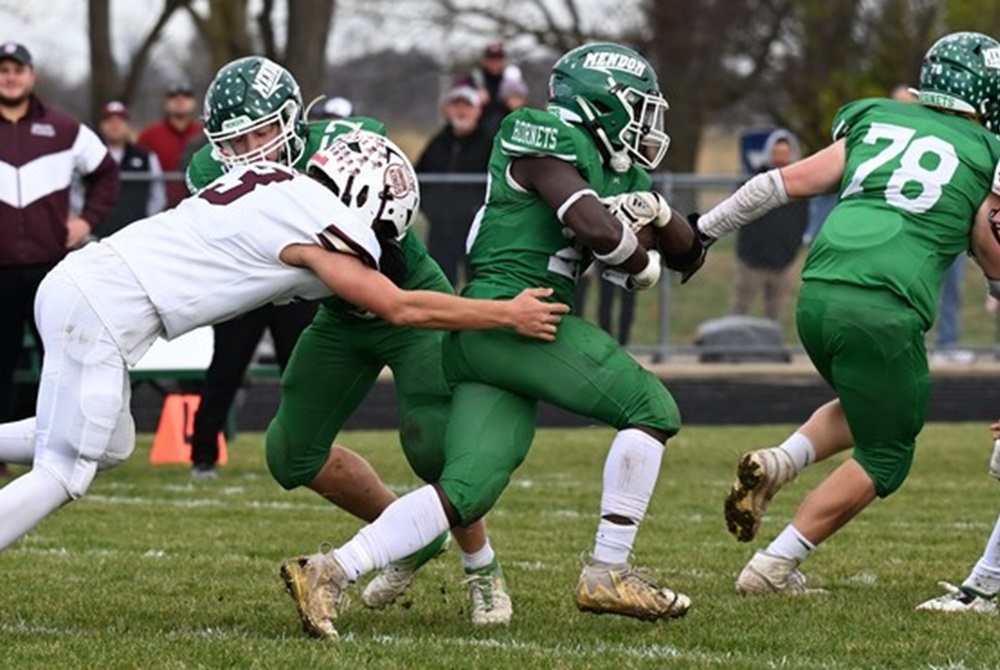
HEADLINER Mendon 26, Martin 22 There will be a new Division 1 champion. Martin’s two-year reign came to an end as J.T. Lux ran in the winning score for Mendon (10-1) with two seconds to play. He finished with 147 yards at more than 10 per carry and also had an 84-yard touchdown run during the third quarter – although Martin (9-2) did take the lead during the fourth quarter, setting up Lux’s final heroics. Click for more from the Sturgis Journal.
Regional Roundup Indian River Inland Lakes 32, Alcona 26 Inland Lakes (11-0) played only its second single-digit game this season and its closest to date, but held strong to repeat as a Regional champion and end Alcona’s season at 9-2 with both losses by eight or fewer points. Deckerville 40, Kingston 6 Deckerville (11-0) added to a 44-0 win over Kingston (8-3) from Week 7 to repeat as a Regional title winner. Pickford 44, Ishpeming 6 The Panthers (11-0) also finished a season sweep with a Regional title, having already defeated Ishpeming 65-14 in Week 4. The Hematites ended their first 8-player season 6-3.
8-Player Division 2
HEADLINER Crystal Falls Forest Park 34, Powers North Central 12 In perhaps one the most defining short-range turnarounds of the playoffs so far, Forest Park (10-1) bounced back from losing a league-deciding matchup 45-34 to North Central in Week 9 – and to claim a first Regional title since the Trojans won Division 2 in 2017. The Jets finished 9-2, one win better than a year ago. Click for more from MyUPNow.
Regional Roundup Onekama 48, Au Gres-Sims 44 After four tough seasons during which Onekama won a combined eight games, the Portagers are 10-1 and returning to the Semifinals for the first time since 2018 – and after avenging a 52-30 loss to Au Gres-Sims (9-2) from a year ago. Morrice 46, Mount Pleasant Sacred Heart 14 The Orioles (10-1) eliminated a league opponent for the second time in two playoff games and this time to win a second Regional title in three seasons. Sacred Heart finished 7-4. Britton Deerfield 60, Pittsford 26 The Patriots (10-1) set a program record for wins with their first Regional championship, handing Pittsford a second defeat after also downing the Wildcats (8-3) in their season opener.
MHSAA.com's weekly “1st & Goal” previews and reviews are powered by MI Student Aid, a division within the Department of Lifelong Education, Advancement, and Potential (MiLEAP). MI Student Aid encourages students to pursue postsecondary education by providing access to student financial resources and information. MI Student Aid administers the state’s scholarship and grant programs that help make college Accessible, Affordable and Attainable for you. Click to connect with MI Student Aid and find more information on Facebook and Twitter @mistudentaid.
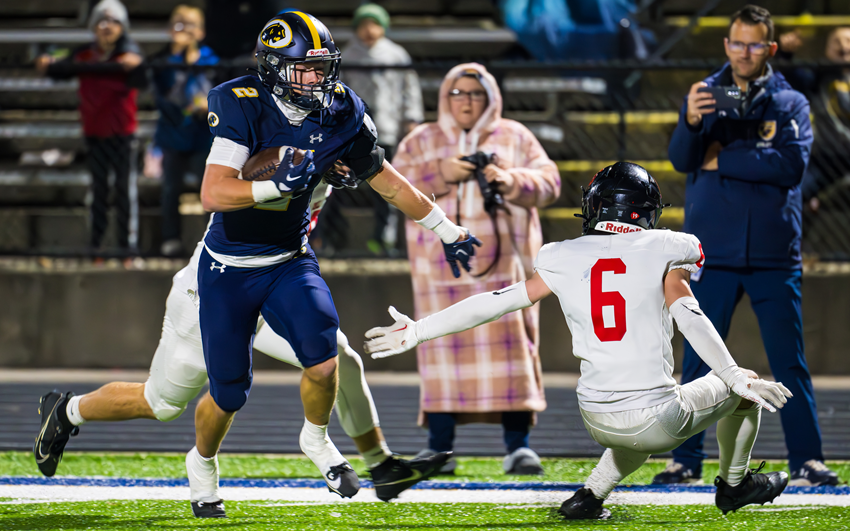
PHOTOS (Top) Mendon’s J.T. Lux (23) follows a blocker and pulls away from a Martin defender during his team’s Regional Final win. (Middle) DeWitt’s Traverse Moore (2) eludes a Lowell defender during the Panthers’ 49-35 win in Division 3. (Below) Grand Blanc’s Nik Lemons (5) finds the edge as Oxford tacklers pursue. (Top photo by Gary Shook/GSPHOTO. DeWitt/Lowell photo by L.C. Arreguin/Team Arreguin Photos. Grand Blanc/Oxford photo by Terry Lyons.)