

Thank Roosevelt for Football Weekends
December 20, 2013
By Rob Kaminski
MHSAA benchmarks editor
The next time you find yourself immersed in a tense crosstown football rivalry on a Friday night followed by a Saturday pilgrimage to the nearest college campus and a Sunday afternoon with a remote and your favorite snacks and beverages, take a moment to consider what the weekend would be like if it weren’t for Teddy Roosevelt.
The man who became our 26th President shortly after the turn of the 20th Century following the assassination of William McKinley in 1901 was a football fan like you. Maybe more so.
Today’s game of football has reached a critical crossroads. Player size and speed have increased across the board. Savage use of equipment as weapons rather than protective gear has been glorified on television networks and social media. Leaders of the game at all levels have recognized the need for change, employing new rules and widespread educational efforts to aid in preserving the sport.
History, as they say, is repeating itself.
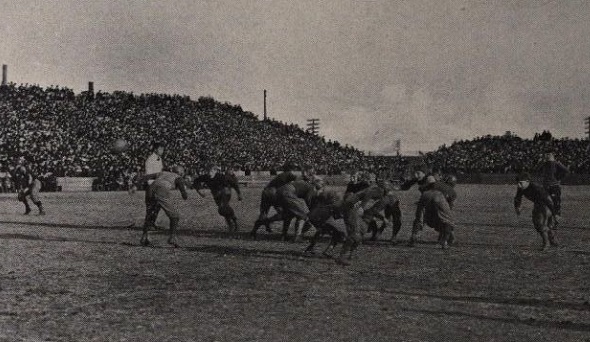
In an ironic twist, it was Roosevelt who saved the then-brutally violent game of football from itself more than 100 years ago. Yes, the same “Rough and Ready Teddy” who led the charge up San Juan Hill during the Spanish-American War and often sparred in the boxing ring while in office from 1901-09 opined that football was becoming so gruesome that he delivered an ultimatum: clean up the game or it would be outlawed.
The Chicago Tribune reported that in 1904 alone, there were 18 football deaths and 159 serious injuries, mostly among prep school players. Football deaths suffered by younger players were reported on a nearly weekly basis, as outraged citizens called on colleges and high schools to banish football outright.
In stepped Roosevelt, who called head coaches and representatives from Harvard, Yale and Princeton – college powers at the time – to the White House in 1905 urging them to eliminate excessive violence and set an example of fair play for the rest of the country. When the casualties actually rose by one during the ensuing season, Roosevelt reacted with greater resolve and convened leading football authorities for the purpose of authoring drastic rules changes. What emerged was an intercollegiate conference which was the predecessor of the NCAA.
Among the most effective changes for the 1906 season were the legalization of the forward pass, the elimination of mass formations, and the creation of a neutral zone. Football fatalities fell to 11 in each of the next two seasons, and severe injuries fell drastically.
Thanks to the introduction of protective equipment and ever-evolving rules changes, football during the 100-plus years to follow has become an exponentially safer game. Yet, the game’s leaders always will need to adjust and react to scrutiny that comes with the territory.
So, as the game once again undergoes rules modifications in the name of safety, give a tip of the cap to President Roosevelt while you enjoy college bowl season and the NFL playoffs and begin to think ahead to the first high school practice of 2014.
1st & Goal: 2024 Playoffs Week 2 Preview
By
Geoff Kimmerly
MHSAA.com senior editor
November 8, 2024
One week gone, half the 288-team field remaining, and matchups that much more competitive with trophies on the line.
 The first hardware of this season’s MHSAA Football Playoffs will be awarded this weekend, as 64 teams will earn 11-player District championships and eight will celebrate 8-player Regional titles.
Games are tonight unless noted. Tickets for both 11 and 8-player rounds this weekend cost $7, and more than 60 of the 72 games to be played will be streamed live on the NFHS Network. Scores and pairings will be updated all weekend at MHSAA.com.
11-Player Division 1
Saline (7-3) at Belleville (9-1)
These two have collided in the playoffs the last two seasons, Belleville winning last year’s District Final matchup 65-14 and in 2022 by a 62-44 count. The Tigers bounced back from their Week 9 one-point loss to Howell with a 68-0 win over Ann Arbor Pioneer last week, and Saline is here after downing Northville 37-7. Counting on-field scores from three forfeit losses to start the season, the Hornets have allowed just under eight points per game this fall – and no more than seven since Week 4. But they’ll get their greatest challenge again from a Tigers team averaging nearly 44 ppg.
Keep an eye on these FRIDAY Utica Eisenhower (8-2) at Macomb Dakota (9-1), Clarkston (7-3) at Rochester Adams (8-2), Oxford (7-3) at Grand Blanc (8-2).
11-Player Division 2
Byron Center (9-1) at Muskegon Mona Shores (9-1)
Their first meeting, in Week 4, was an Ottawa-Kent Conference Green opener and ended up deciding that league’s championship for Mona Shores with a 14-12 win. The Sailors’ defeat came two weeks ago, to Toledo Central Catholic by just a point 14-13. Otherwise, since that first matchup, Mona Shores has posted three shutouts and won its remaining league games by an average of nearly 35 points per, while Byron Center won its four other league games by just under 22 ppg including 17-14 over Muskegon High – which Shores defeated by 15.
Keep an eye on these FRIDAY Birmingham Seaholm (7-3) at Birmingham Groves (10-0), Warren De La Salle Collegiate (7-2) at Grosse Pointe South (10-0), Saginaw Heritage (7-3) at Midland (9-1).
11-Player Division 3
Zeeland West (9-1) at St. Joseph (9-1)
This will be their second District Final matchup in three years; West won in 2022 36-18. The Dux actually are playing for a third-straight District title and in their ninth playoff games over the last three seasons with a 6-2 record across that string and both losses by seven or fewer points. St. Joseph – which did defeat Zeeland West in 2021 during a Semifinal run – lost only to Mattawan this season and had nonleague wins over eventual playoff teams Niles and Edwardsburg, while West’s loss came to still-undefeated Hudsonville Unity Christian with nonleague wins over playoff qualifiers Grand Rapids West Catholic and Whitehall.
Keep an eye on these FRIDAY Coopersville (7-3) at Grand Rapids Forest Hills Central (8-2), River Rouge (5-4) at Riverview (9-1), Mount Pleasant (6-4) at Petoskey (10-0).
11-Player Division 4
Freeland (9-1) at Goodrich (9-1)
A 21-20 Week 8 loss to Frankenmuth is all that has separated Freeland from an undefeated run so far, and Goodrich shares that opponent having fallen to the Eagles 22-0 in their season opener. The Martians have scored at last 42 points in every game since and given up only 7.3 per game over their last nine. Freeland has given up more than 20 points two other times this fall, but scored more than 50 points both times to win those matchups – including 51-21 last weekend over Lake Fenton, which Goodrich defeated 62-0 in Week 3.
Keep an eye on these FRIDAY Edwardsburg (7-3) at Niles (9-1), Hastings (9-1) at Portland (10-0), Dearborn Divine Child (7-3) at Harper Woods (7-3).
11-Player Division 5
Belding (9-1) at Frankenmuth (10-0)
In addition to Freeland and Goodrich (noted above), Frankenmuth also has turned away a challenge from Gladwin among teams playing for District titles tonight. But Belding is a dangerous foe riding a nine-game winning streak since losing its opener to Division 4 Ionia. The Black Knights rocked the O-K Silver, winning their league games on average by 42 points per, and opened the playoffs with a 52-30 win over Saginaw Swan Valley – which Frankenmuth defeated similarly 63-27 in Week 2.
Keep an eye on these FRIDAY Grand Rapids Catholic Central (6-4) at Grand Rapids West Catholic (7-3), Corunna (8-2) at Pontiac Notre Dame Prep (8-1), Berrien Springs (7-3) at Kalamazoo United (8-2).
11-Player Division 6
Marine City (8-2) vs. Warren Michigan Collegiate (9-1) at Warren Lincoln, Saturday
Warren Michigan Collegiate also is riding a nine-game winning streak since falling 27-24 to Clarkston Everest Collegiate in Week 1. The Cougars will carry a 42-point-per-game average and four straight games reaching 50 into this matchup. Marine City has reached 50 three of its last four games as well, with its only defeats in the season opener to Division 5 Armada – by a point – and 39-20 in Week 6 to Division 4 Marysville.
Keep an eye on these FRIDAY Standish-Sterling (7-3) at Reed City (8-2), Central Montcalm (9-1) at Newaygo (8-2), Ida (9-1) at Jackson Lumen Christi (9-1).
11-Player Division 7
Traverse City St. Francis (7-3) at Menominee (9-1), Saturday
Both of these teams have trips to Ford Field once over the last two seasons – St. Francis as Division 7 runner-up in 2022 and Menominee as the same a year ago. The Maroons are in a District Final for the fifth time in six seasons after rebounding from their lone loss by outscoring Bark River Harris and Houghton Lake by a combined 103-6 over the last two weeks. St. Francis lost two of its last three games, but started the playoffs with a 41-16 win over Charlevoix.
Keep an eye on these FRIDAY Pewamo-Westphalia (8-2) at Ithaca (10-0), Union City (9-1) at Hudson (9-1), McBain (9-1) at North Muskegon (9-1).
11-Player Division 8
Harbor Beach (10-0) at Clarkston Everest Collegiate (9-1)
This is part of one of the most competitive Regionals in the state, regardless of division, as Harbor Beach opened last week against reigning champion Ubly and Everest has won four straight District titles – and with the winner this weekend facing either undefeated Fowler or surging Saginaw Michigan Lutheran Seminary next week. Harbor Beach blanked the Bearcats 35-0 and has two straight shutouts and five total this season. Everest has four including last week’s against Burton Bentley – a bounce-back from a 17-14 loss to Division 4 Macomb Lutheran North to close the regular season.
Keep an eye on these FRIDAY Saugatuck (7-3) at Decatur (9-1), Manchester (8-2) at Riverview Gabriel Richard (8-1), Beal City (8-2) at Maple City Glen Lake (9-1).
8-Player Division 1
Martin (8-1) at Mendon (9-1), Saturday
Whichever team emerges from this side of the bracket to reach the Superior Dome will have conquered an incredible road. Both are one-score losses from undefeated this fall and avenged their regular-season losses last week – with the winner of this matchup to see either undefeated Deckerville or surging Kingston in a Semifinal. The key matchup may be Mendon’s rushing attack – playing the lead role for an offense scoring 65 points per game – vs. Martin’s defense that has allowed at least 20 points six times but more than 24 only once.
Other Regional Finals FRIDAY Indian River Inland Lakes (10-0) at Alcona (9-1), Kingston (8-2) at Deckerville (10-0). SATURDAY Ishpeming (7-2) at Pickford (10-0).
8-Player Division 2
Powers North Central (9-1) at Crystal Falls Forest Park (9-1)
Just two weeks ago, North Central finished a Great Lakes Eight Conference West title run with a 45-34 win over the Trojans. Jets senior Lane Gorzinski ran for 234 yards and five touchdowns and threw for 169 and another score as his team scored more points than Forest Park gave up over their other four league games combined (33). The Trojans bounced back with a 60-0 win over Bellaire last week, while North Central enjoyed a 58-0 shutout of Gaylord St. Mary.
Other Regional Finals FRIDAY Pittsford (8-2) at Britton Deerfield (9-1), Onekama (9-1) at Au Gres-Sims (9-1), SATURDAY Mount Pleasant Sacred Heart (7-3) at Morrice (9-1).
MHSAA.com's weekly “1st & Goal” previews and reviews are powered by MI Student Aid, a division within the Department of Lifelong Education, Advancement, and Potential (MiLEAP). MI Student Aid encourages students to pursue postsecondary education by providing access to student financial resources and information. MI Student Aid administers the state’s scholarship and grant programs that help make college Accessible, Affordable and Attainable for you. Click to connect with MI Student Aid and find more information on Facebook and Twitter @mistudentaid.
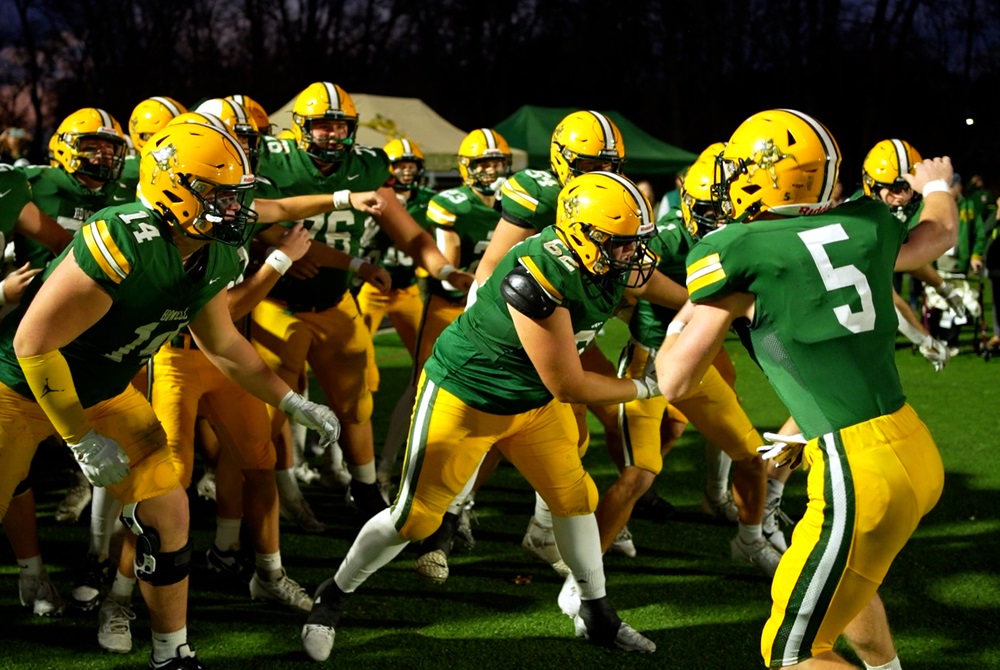
PHOTO Howell players huddle in anticipation of taking the field before their Week 9 win over Belleville. (Photo courtesy of State Champs! Sports Network.)