

Thank Roosevelt for Football Weekends
December 20, 2013
By Rob Kaminski
MHSAA benchmarks editor
The next time you find yourself immersed in a tense crosstown football rivalry on a Friday night followed by a Saturday pilgrimage to the nearest college campus and a Sunday afternoon with a remote and your favorite snacks and beverages, take a moment to consider what the weekend would be like if it weren’t for Teddy Roosevelt.
The man who became our 26th President shortly after the turn of the 20th Century following the assassination of William McKinley in 1901 was a football fan like you. Maybe more so.
Today’s game of football has reached a critical crossroads. Player size and speed have increased across the board. Savage use of equipment as weapons rather than protective gear has been glorified on television networks and social media. Leaders of the game at all levels have recognized the need for change, employing new rules and widespread educational efforts to aid in preserving the sport.
History, as they say, is repeating itself.
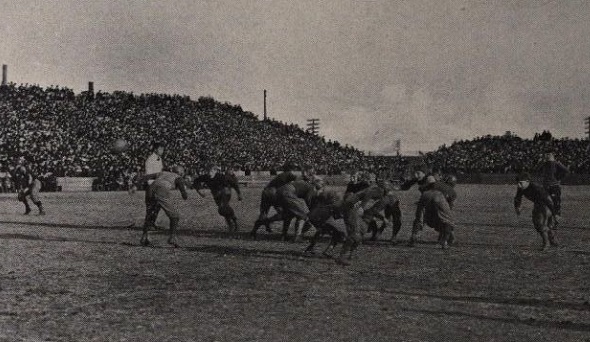
In an ironic twist, it was Roosevelt who saved the then-brutally violent game of football from itself more than 100 years ago. Yes, the same “Rough and Ready Teddy” who led the charge up San Juan Hill during the Spanish-American War and often sparred in the boxing ring while in office from 1901-09 opined that football was becoming so gruesome that he delivered an ultimatum: clean up the game or it would be outlawed.
The Chicago Tribune reported that in 1904 alone, there were 18 football deaths and 159 serious injuries, mostly among prep school players. Football deaths suffered by younger players were reported on a nearly weekly basis, as outraged citizens called on colleges and high schools to banish football outright.
In stepped Roosevelt, who called head coaches and representatives from Harvard, Yale and Princeton – college powers at the time – to the White House in 1905 urging them to eliminate excessive violence and set an example of fair play for the rest of the country. When the casualties actually rose by one during the ensuing season, Roosevelt reacted with greater resolve and convened leading football authorities for the purpose of authoring drastic rules changes. What emerged was an intercollegiate conference which was the predecessor of the NCAA.
Among the most effective changes for the 1906 season were the legalization of the forward pass, the elimination of mass formations, and the creation of a neutral zone. Football fatalities fell to 11 in each of the next two seasons, and severe injuries fell drastically.
Thanks to the introduction of protective equipment and ever-evolving rules changes, football during the 100-plus years to follow has become an exponentially safer game. Yet, the game’s leaders always will need to adjust and react to scrutiny that comes with the territory.
So, as the game once again undergoes rules modifications in the name of safety, give a tip of the cap to President Roosevelt while you enjoy college bowl season and the NFL playoffs and begin to think ahead to the first high school practice of 2014.
Country Day Two-Time Champ Moore Building Perennial Winner at Harvard
By
Keith Dunlap
Special for MHSAA.com
July 16, 2026
Carrie Moore says her high school sports experience in Michigan has “left a lifetime impression on me.”
 Back in the early 2000s, Moore certainly had a fulfilling one while starring as a two-sport standout at Detroit Country Day.
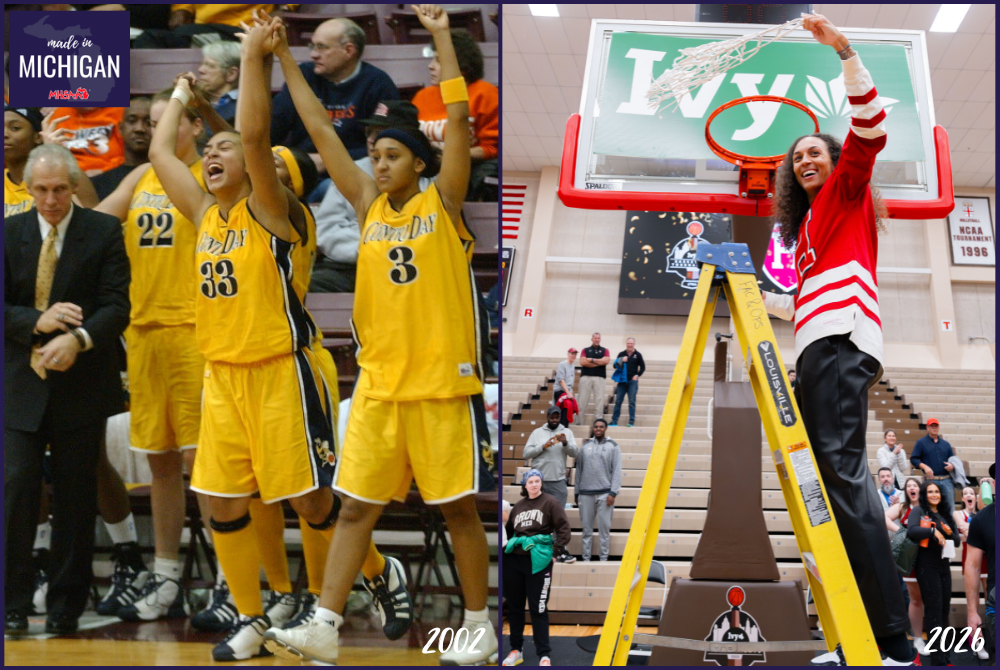
In basketball, she was a four-year varsity performer for legendary head coach Frank Orlando, helping guide Country Day to Class B titles in 1999 as a freshman and 2002 as a senior. During the latter, she was a first-team all-state performer and scored a team-high 18 points in a Semifinal win over Flint Powers Catholic.
Moore also was a standout soccer player on that Country Day varsity powerhouse for three years.
“Who I am as a leader, as a competitor, and a team player is because of what I learned about the process in high school as a student-athlete,” Moore said. “The pursuit of excellence isn’t always easy, but I learned at such a young age that I can do hard things. I was challenged because I was surrounded by the best on the court and in the classroom, but ultimately it brought out the best version of myself and I was so prepared for what came next after graduation.”
Make no mistake about it, Moore has continued to do great things since graduating from Country Day in 2003.
She is currently the head women’s basketball coach at Harvard, where she just completed her fourth season and has amassed an 80-41 record with the Crimson. This past season, she helped guide her team to a 20-12 record and the Women’s Basketball Invitational Tournament.
Moore was a terrific college player at Western Michigan, finishing as the school’s all-time scoring leader with 2,216 points and earning Mid-American Conference Player of the Year in 2007 after averaging 25.4 points per game. But she initially wasn’t planning on being a coach once her time at Western was over.
After playing one season professionally in Poland and then being cut twice by WNBA teams during training camp, Moore had an opportunity to join the coaching staff at Princeton in 2010.
From there, the coaching bug bit her, so to speak.
“Being a part of that program allowed me to see the lasting impact I could have on young women in growing them as people and players, and ultimately, give back to the game that gave me so much,” Moore said.
Moore was on the staff for two seasons at Princeton, and then moved on to Creighton, where she spent five years as an assistant coach.
Following a second stint as an assistant coach at Princeton that lasted four years, Moore moved on to North Carolina, where she spent two years as an assistant coach and recruiting coordinator for the program.
 A native of Lathrup Village, Moore then briefly returned to her home state for the 2021-22 season, serving as an assistant coach and recruiting coordinator for University of Michigan’s team that went 25-7.
After that season, the opportunity at Harvard came about, and Moore has proved she can be successful running a program as well.
In her first season, Moore set a program record for most wins by a first-year head coach (20). Two years later, she guided the Crimson to its first Ivy League Tournament title and back to the NCAA Tournament for the first time in 18 years.
Even to this day, Moore is influenced by her time at Country Day and in Michigan. She speaks regularly to Orlando, picking his brain for advice or an answer to any other question that might come up.
“I keep in touch with Coach O as often as I can,” Moore said. “He reaches out after big wins or tough losses and always reassures his belief in me as a leader of young women. His mantra ‘Believe It’ is living on within our program at Harvard, and I hope he feels deeply connected to it because of it. I will always honor him in any way that I can, as he has shaped me greatly as a human and coach.”
Moore hasn’t had a player from her home state on her Harvard roster. But she said Michigan is an important recruiting area, and she’s keeping an eye out for prospects.
“I’m very hopeful that it will happen one day,” Moore said.
2026 Made In Michigan
July 9: Multi-Sport Career at TC West Helps Gillis Thrive as Pro in Game She Once Left Behind - Report
July 2: Inspired by Home, Eager to Give Back, Spencer Hosts Hoop City Alumni Games - Report
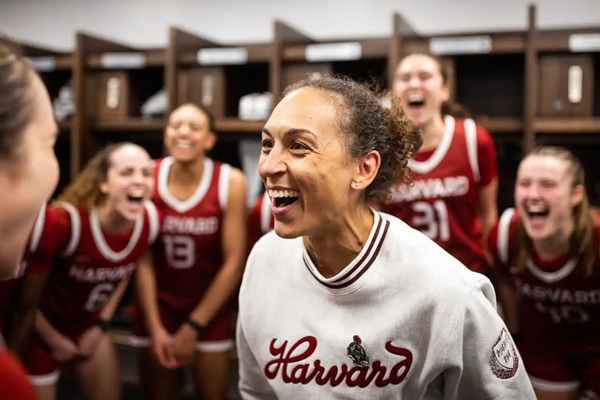
PHOTOS (Top) At left, Detroit Country Day’s Carrie Moore (33) celebrates with her teammates at the end of a Class B Semifinal win over Flint Powers Catholic in 2002. At right, Moore holds up the net after making the last cut this past season to celebrate Harvard’s Ivy League Tournament championship. (Middle) Moore enjoys a moment with her Crimson players. (Harvard photos courtesy of the Harvard athletic department.)