

Thank Roosevelt for Football Weekends
December 20, 2013
By Rob Kaminski
MHSAA benchmarks editor
The next time you find yourself immersed in a tense crosstown football rivalry on a Friday night followed by a Saturday pilgrimage to the nearest college campus and a Sunday afternoon with a remote and your favorite snacks and beverages, take a moment to consider what the weekend would be like if it weren’t for Teddy Roosevelt.
The man who became our 26th President shortly after the turn of the 20th Century following the assassination of William McKinley in 1901 was a football fan like you. Maybe more so.
Today’s game of football has reached a critical crossroads. Player size and speed have increased across the board. Savage use of equipment as weapons rather than protective gear has been glorified on television networks and social media. Leaders of the game at all levels have recognized the need for change, employing new rules and widespread educational efforts to aid in preserving the sport.
History, as they say, is repeating itself.
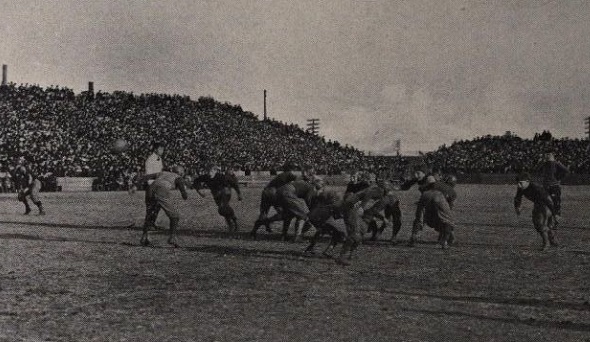
In an ironic twist, it was Roosevelt who saved the then-brutally violent game of football from itself more than 100 years ago. Yes, the same “Rough and Ready Teddy” who led the charge up San Juan Hill during the Spanish-American War and often sparred in the boxing ring while in office from 1901-09 opined that football was becoming so gruesome that he delivered an ultimatum: clean up the game or it would be outlawed.
The Chicago Tribune reported that in 1904 alone, there were 18 football deaths and 159 serious injuries, mostly among prep school players. Football deaths suffered by younger players were reported on a nearly weekly basis, as outraged citizens called on colleges and high schools to banish football outright.
In stepped Roosevelt, who called head coaches and representatives from Harvard, Yale and Princeton – college powers at the time – to the White House in 1905 urging them to eliminate excessive violence and set an example of fair play for the rest of the country. When the casualties actually rose by one during the ensuing season, Roosevelt reacted with greater resolve and convened leading football authorities for the purpose of authoring drastic rules changes. What emerged was an intercollegiate conference which was the predecessor of the NCAA.
Among the most effective changes for the 1906 season were the legalization of the forward pass, the elimination of mass formations, and the creation of a neutral zone. Football fatalities fell to 11 in each of the next two seasons, and severe injuries fell drastically.
Thanks to the introduction of protective equipment and ever-evolving rules changes, football during the 100-plus years to follow has become an exponentially safer game. Yet, the game’s leaders always will need to adjust and react to scrutiny that comes with the territory.
So, as the game once again undergoes rules modifications in the name of safety, give a tip of the cap to President Roosevelt while you enjoy college bowl season and the NFL playoffs and begin to think ahead to the first high school practice of 2014.
Martin Brings LA Marathon Championship Experience Home as Jackson High Coach
By
Doug Donnelly
Special for MHSAA.com
April 23, 2026
Nathan Martin has the best possible example a coach can give when it comes to the old phrase, “It’s never over, until it’s over.”
Last month, the Jackson cross country head coach and track assistant captured national attention when he miraculously came from behind to win the Los Angeles Marathon.
The winning margin was one hundredth (0.01) of a second.
“I didn’t really know if I won,” said Martin. “I tried not to get too emotional or celebrate too much. Then people around me started confirming it.”
Martin, 36, was running his race when, with about five miles to go, he had a surge and passed the pack he was with to get comfortably into second place.
“There was only one guy to catch at that point; he was so far ahead,” Martin said. “I couldn’t even see him. At that point, it was like, ‘Okay, let’s push, let’s finish, be strong, and all that kind of stuff.”
Slowly, the leader came into focus.
“Within the last mile, I’d say, he came into view,” Martin said. “By 800 meters to go I thought I had a serious shot to try and win.
“I made one final surge. That last 800 was super painful. I was thinking to myself maybe I’ll catch him, maybe I won’t, but I definitely wanted to make sure I crossed that finish line with no regrets, knowing I left everything out there.”
As he and the leader, Michael Kimani Kamau of Kenya, approached the finish, the crowed braced for the finish.
“It was the last 50 to 80 meters where the true opportunity to win presented itself and I took full advantage of it,” Martin said. “When I crossed the line, it was so close. I was trying to hold back the excitement and emotions and all of that kind of stuff. People started confirming it, and it was surreal. I just started absorbing the moment and everything going on.”
He credits his own coach, James McCurdy, with preparing him with everything from the right nutrition to handling the Los Angeles heat to the running strategy.”
“It was painful, but I still had something left in the tank,” he said. “If the race would have been a couple miles longer, I would have been okay (to finish).”
Martin finished with a personal best time of 2 hours, 11 minutes, 16.5 seconds. It was the closest finish in LA Marathon history.
“It was pretty special,” Martin said.
Martin was born in Chicago Heights, Ill., and moved with his family to Three Rivers before he started school. He began running in middle school and competed throughout high school. He ran the mile in high school and the 5K in college.
“I had a lot of success in my running journey,” he said. “Eventually, my coach thought I had what it takes to run a marathon.”
It wanted until late in his college career at Spring Arbor University that Martin ran his first marathon. He was 23.
“I won the 10K, then 36 hours later I won the marathon,” he said. “My coach was like, ‘Okay, you need to do this.’”
Martin is now a professional runner and has sponsors. He was at the Boston Marathon on Monday making appearances and connecting with people in the running community.
After college he began substitute teaching while trying to advance his running career. That’s when he launched his coaching career.
“There was a year where I was substitute teaching and going to races to try and place well,” he said. “By year two or three, I was coaching and I’ve continued that on.”
Martin said coaching is rewarding, “Especially seeing a kid overcome some kind of challenge.
“It’s being able to use my experiences to give back,” he added. “I want to help kids along their running journey. Even if they don’t become a big-time runner, I hope the types of lessons they learn, they can apply in life.
“Just see them be able to fight through something makes me feel like I am making a positive impact in the world.”
Martin has run fewer than 20 marathons in his life. “If you are training at an insanely high level, you usually look at doing one, maybe two or three a year,” he said.
He has taken some time away from marathon training recently as he’s made several national appearances.
And an assistant at Jackson this year, he said he’s noticed a buzz around the distance runners.
“There’s way more interest in distance running,” he said. “Normally they give me my two minutes of fame, then they are back to being high school students. This has been different. They’ve made me feel like definitely I’ve done something.”
He will begin ramping up his training and plans on competing in a half marathon soon, then has set his sights on either the New York or Chicago Marathon.
“It’s been pretty cool,” he said of the running community in Jackson. “They’ve been showing me a lot of love, and they are super proud. If I did Chicago, I imagine I would get a chunk of people down to watch. I’ve had so many people supporting me. It’s a really good feeling.”
Doug Donnelly has served as a news and sports reporter at the Adrian Daily Telegram and the Monroe News for 30 years, including 10 years as city editor in Monroe. He's written a book on high school basketball in Monroe County and compiles record books for various schools in southeast Michigan. He is now publisher and editor of The Blissfield Advance, a weekly newspaper. E-mail him at [email protected] with story ideas for Jackson, Washtenaw, Hillsdale, Lenawee and Monroe counties.
PHOTOS (Top) Nathan Martin, middle with clipboard, coaches his Jackson distance runners. (Middle) Martin poses for a photo with a community award he received from the school. (Photos courtesy of Nathan Martin.)