

Thank Roosevelt for Football Weekends
December 20, 2013
By Rob Kaminski
MHSAA benchmarks editor
The next time you find yourself immersed in a tense crosstown football rivalry on a Friday night followed by a Saturday pilgrimage to the nearest college campus and a Sunday afternoon with a remote and your favorite snacks and beverages, take a moment to consider what the weekend would be like if it weren’t for Teddy Roosevelt.
The man who became our 26th President shortly after the turn of the 20th Century following the assassination of William McKinley in 1901 was a football fan like you. Maybe more so.
Today’s game of football has reached a critical crossroads. Player size and speed have increased across the board. Savage use of equipment as weapons rather than protective gear has been glorified on television networks and social media. Leaders of the game at all levels have recognized the need for change, employing new rules and widespread educational efforts to aid in preserving the sport.
History, as they say, is repeating itself.
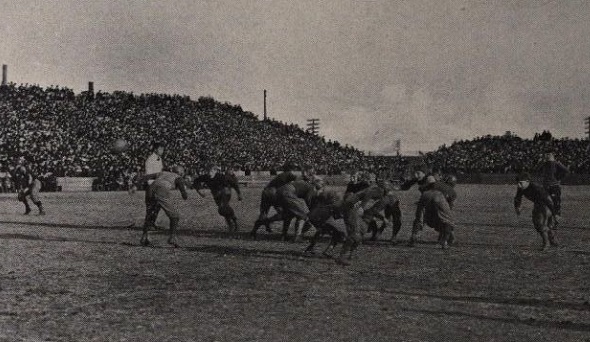
In an ironic twist, it was Roosevelt who saved the then-brutally violent game of football from itself more than 100 years ago. Yes, the same “Rough and Ready Teddy” who led the charge up San Juan Hill during the Spanish-American War and often sparred in the boxing ring while in office from 1901-09 opined that football was becoming so gruesome that he delivered an ultimatum: clean up the game or it would be outlawed.
The Chicago Tribune reported that in 1904 alone, there were 18 football deaths and 159 serious injuries, mostly among prep school players. Football deaths suffered by younger players were reported on a nearly weekly basis, as outraged citizens called on colleges and high schools to banish football outright.
In stepped Roosevelt, who called head coaches and representatives from Harvard, Yale and Princeton – college powers at the time – to the White House in 1905 urging them to eliminate excessive violence and set an example of fair play for the rest of the country. When the casualties actually rose by one during the ensuing season, Roosevelt reacted with greater resolve and convened leading football authorities for the purpose of authoring drastic rules changes. What emerged was an intercollegiate conference which was the predecessor of the NCAA.
Among the most effective changes for the 1906 season were the legalization of the forward pass, the elimination of mass formations, and the creation of a neutral zone. Football fatalities fell to 11 in each of the next two seasons, and severe injuries fell drastically.
Thanks to the introduction of protective equipment and ever-evolving rules changes, football during the 100-plus years to follow has become an exponentially safer game. Yet, the game’s leaders always will need to adjust and react to scrutiny that comes with the territory.
So, as the game once again undergoes rules modifications in the name of safety, give a tip of the cap to President Roosevelt while you enjoy college bowl season and the NFL playoffs and begin to think ahead to the first high school practice of 2014.

Longtime Crew Leader Harrelson Begins 32nd Season on Chains, Amid Cancer Fight
By
Tom Spencer
Special for MHSAA.com
September 11, 2026
First down! Move the chains.
 As a member of the Suttons Bay chain gang, Jim Harrelson doesn’t know how many more times he’ll follow the referee crew’s direction on the Norsemen sideline. Similarly, he has no idea how many times he’s already moved the chains.
But, in the meantime, every time he does, it will undoubtedly be a school record. An unofficial record of course, but a well-earned and appreciated achievement nonetheless.
Harrelson stepped on the field Wednesday night sporting a down marker for the 32nd straight year. This time, it was for the Norse’s middle school contest with Onekama. Harrelson was joined by Curt Murphy and Dave Faught. Mike Gordon, another regular member of the crew, was also on hand to celebrate Harrelson’s 32nd season.
Wednesday’s chain gang team was organized – no surprise – by Harrelson. It’s something he’s done on a volunteer basis for Suttons Bay the last 16 years.
Harrelson’s crews have staffed middle school, junior varsity and varsity football games, including the home contests during the Norsemen’s three straight seasons from 2019-21 that culminated in three trips to 8-Player Division 1 Finals. Harrelson, Faught, Murphy and Gordon are in their 10th season working together.
“The chain gang was always his baby, and he was always able to go find other people to help him out,” said Doug Periard, a long-time member of the Norse football coaching staff and former school athletic director. “Somehow he managed to get some of those who might not have done much in football, to suddenly come on board and enjoy doing it.”
Harrelson, who last spring retired from a coaching career spanning 35 years, has no intentions of letting anything get in the way of holding the down marker for the Norsemen.
 “I've always loved sports, and being a part of the chain gang was always big part of it,” Harrelson said. “The ADs didn’t have to worry about it, knowing it was taken care of.”
Jamie Hawkins, Suttons Bay’s principal and current athletic director, was on hand for Wednesday’s kickoff as well. Hawkins, one of the administrators who has relied on Harrelson, believes the community owes Harrelson a huge thank you, acknowledging he has marked more first downs than anyone could ever comprehend.
“Jim’s years as a coach and chain gang chief are an amazing commitment to our student-athletes, our football program, and the entire Suttons Bay community,” said Hawkins. “His time, energy, and passion have been a part of countless Friday nights and memories for generations of Norsemen.”
Harrelson, now 82, is battling cancer for the second time in his life. He was first diagnosed with colorectal cancer in 2010. Early this year, he was told cancer had returned.
Working with doctors and his wife of 53 years, Brenda, Harrelson picked a six-week treatment plan this summer timing it so he could return to the sidelines for the first football game. He’s awaiting word from his medical team on the outcome of the most recent treatment.
“I haven't let it dominate my life – everybody's going to have trials and tribulations no matter what,” Harrelson said of his cancer return. “Cancer is something that thousands of people find themselves having to deal with, and I'm pretty proud I've been able to function pretty much as normal as could be even though it’s obviously right there in front of me.”
Harrelson’s coaching journey began in 1991 with softball, drawn into the role as his children made their way through the Suttons Bay school system. He went on to serve as an assistant and head volleyball coach from 1996 through 2004.
Eventually he served as an assistant or head coach for Suttons Bay in golf, cross country and track.
 Among the highlights of his time on the volleyball bench was helping guide the 2001 squad all the way to the MHSAA Finals, where the team earned a runner-up finish in Class C.
A short while ago, Harrelson was honored with the Don Lukens Legacy Award at the Traverse City Record-Eagle John Lober Honor Roll Meet for his coaching of student-athletes from all four Leelanau County schools – Maple City Glen Lake, Leland, Lake Leelanau St. Mary’s and Northport (with some of that coaching was made possible through the schools becoming a part of a co-op with Suttons Bay).
Much of Harrelson’s coaching was on a purely volunteer basis – even while serving as a head coach responsible for running an entire program.
Now, Harrelson’s favorite thing is watching his grandchildren grow and compete in sports, while admiring his adult children’s great parenting.
Harrelson points to his first grandchild’s birth 15 years ago as a prime motivator during the first cancer round. The Harrelsons have seven grandchildren now, one of whom was playing volleyball Wednesday night for Suttons Bay’s middle school team – with Grandma in the stands.
And while he’s remembered fondly by Leelanau athletes and athletic directors for his coaching commitment and success, Harrelson has only one thought for his family legacy.
“I just hope if I’m remembered for anything by my grandchildren and my kids is that I handled cancer pretty well without letting it affect me in any way, shape, or form in how I behave, how I coach or whatever,” Harrelson said. “I am pretty doggone proud of the fact that I've been able to put that on the table and still be able to function.”
Periard already views Harrelson as a great student-athlete advocate and solution finder.
“It was an incredible amount of time he put in doing the stuff he did and how much he loved it,” recalled Periard. “Cross country, track, whatever he was called upon, he was there to help out. He's a jack of all trades, a great kids guy at heart.”
 Harrelson’s first paid coaching job was as an assistant for track in 2006. At the time he was hired by Cody Ingils, then the Suttons Bay athletic director and now a senior assistant director for the MHSAA.
Harrelson asked Inglis a decade ago to delivery his eulogy someday upon the veteran coach’s passing.
“Jim also always wanted the best for kids at every turn, and he wanted to be a positive force in kids’ lives – and I think Jim's ultimate takeaway is he met the kids where they were and tried to make sure that they got better,” Inglis said. “Jim was able to work with elite athletes, and he was able to work with kids that had never done that sport before. And that was the beauty of his coaching, is that it applied to anybody and everybody because of his positive way of dealing with kids.”
Harrelson, who points to track as his favorite sport to coach because of the camaraderie, is ready to keep moving the down marker as he battles the return of cancer.
“What I've been experiencing is part of who I am,” Harrelson said. “It’s just the cards I've been dealt. I just want to do it with class if I can.”
 Tom Spencer is a longtime MHSAA-registered basketball and soccer official, and former softball and baseball official, and he also has coached in the northern Lower Peninsula area. He previously has written for the Saginaw News, Bay County Sports Page and Midland Daily News. He can be reached at [email protected] with story ideas for Manistee, Wexford, Missaukee, Roscommon, Ogemaw, Iosco, Alcona, Oscoda, Crawford, Kalkaska, Grand Traverse, Benzie, Leelanau, Antrim, Otsego, Montmorency, Alpena, Presque Isle, Cheboygan, Charlevoix and Emmet counties.
PHOTOS (Top) Suttons Bay football chain gang leader Jim Harrelson plants his down marker on the sideline during Wednesday’s middle school game with Onekama. (2) Harrelson shakes hands with referee Ed Blough. (3) Harrelson stands for a photo with Suttons Bay principal and athletic director Jamie Hawkins, far left, past athletic director and longtime coach Doug Periard, far right, and his chain gang of (from left) Dave Faught, Curt Murphy and Mike Gordon. (4) Harrelson enjoys a break in the shade. (Top and sitting photos by Meredith McNabb Photography. Others by Tom Spencer.)