

Thank Roosevelt for Football Weekends
December 20, 2013
By Rob Kaminski
MHSAA benchmarks editor
The next time you find yourself immersed in a tense crosstown football rivalry on a Friday night followed by a Saturday pilgrimage to the nearest college campus and a Sunday afternoon with a remote and your favorite snacks and beverages, take a moment to consider what the weekend would be like if it weren’t for Teddy Roosevelt.
The man who became our 26th President shortly after the turn of the 20th Century following the assassination of William McKinley in 1901 was a football fan like you. Maybe more so.
Today’s game of football has reached a critical crossroads. Player size and speed have increased across the board. Savage use of equipment as weapons rather than protective gear has been glorified on television networks and social media. Leaders of the game at all levels have recognized the need for change, employing new rules and widespread educational efforts to aid in preserving the sport.
History, as they say, is repeating itself.
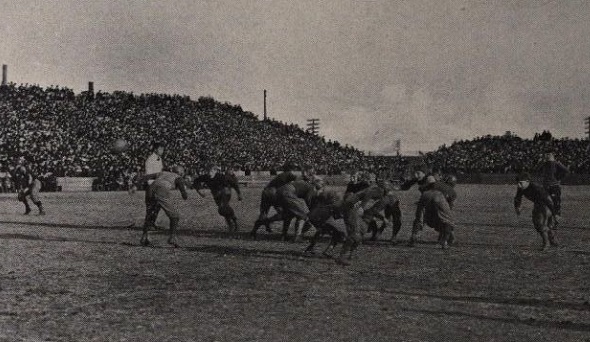
In an ironic twist, it was Roosevelt who saved the then-brutally violent game of football from itself more than 100 years ago. Yes, the same “Rough and Ready Teddy” who led the charge up San Juan Hill during the Spanish-American War and often sparred in the boxing ring while in office from 1901-09 opined that football was becoming so gruesome that he delivered an ultimatum: clean up the game or it would be outlawed.
The Chicago Tribune reported that in 1904 alone, there were 18 football deaths and 159 serious injuries, mostly among prep school players. Football deaths suffered by younger players were reported on a nearly weekly basis, as outraged citizens called on colleges and high schools to banish football outright.
In stepped Roosevelt, who called head coaches and representatives from Harvard, Yale and Princeton – college powers at the time – to the White House in 1905 urging them to eliminate excessive violence and set an example of fair play for the rest of the country. When the casualties actually rose by one during the ensuing season, Roosevelt reacted with greater resolve and convened leading football authorities for the purpose of authoring drastic rules changes. What emerged was an intercollegiate conference which was the predecessor of the NCAA.
Among the most effective changes for the 1906 season were the legalization of the forward pass, the elimination of mass formations, and the creation of a neutral zone. Football fatalities fell to 11 in each of the next two seasons, and severe injuries fell drastically.
Thanks to the introduction of protective equipment and ever-evolving rules changes, football during the 100-plus years to follow has become an exponentially safer game. Yet, the game’s leaders always will need to adjust and react to scrutiny that comes with the territory.
So, as the game once again undergoes rules modifications in the name of safety, give a tip of the cap to President Roosevelt while you enjoy college bowl season and the NFL playoffs and begin to think ahead to the first high school practice of 2014.
1st & Goal: 2021 Week 8 Preview
By
Geoff Kimmerly
MHSAA.com senior editor
October 15, 2021
Some weeks during football season need little introduction. Week 8 this fall qualifies.

By Sunday, the majority of the state’s leagues will have their champions. By Sunday, we also will have a much clearer picture of every team’s chances of making the playoffs with one more regular-season game to go.
Below is a look at many of Friday and Saturday’s matchups that will play parts in determining both.
Bay & Thumb
Lapeer (6-1) at Grand Blanc (7-0)
The Lightning are coming off a solid 37-27 nonleague win over Midland Dow with Saginaw Valley League Red leader Grand Blanc up this week and reigning champion Davison next to finish the regular season. Lapeer likely must defeat both to clinch a third league championship over the last four seasons, but Grand Blanc already has a Davison win and a similarly close one over Dow to match – and closes with winless Saginaw United. That Week 4 win was Grand Blanc’s first over the Cardinals since joining the SVL in 2018, and another tonight would be Grand Blanc’s first victory over Lapeer during the same stretch.
Keep an eye on these FRIDAY Elkton-Pigeon-Bay Port Laker (5-2) at Bad Axe (7-0), Mount Pleasant (7-0) at Bay City Western (6-1), Essexville Garber (5-2) at Frankenmuth (7-0), Durand (5-2) at Montrose (5-2).
Greater Detroit
Detroit Martin Luther King (6-1) vs. Detroit Cass Tech (5-2) at Detroit Northwestern
These two are lined up for a second regular-season meeting for the second season in a row, this one to decide the Detroit Public School League Blue championship after King won the PSL Division 1 title. King did so thanks to winning the first matchup in Week 3, 41-34, and the Crusaders are sitting comfortably in the No. 2 spot in Division 3 playoff points. Cass Tech sits in a much more uncertain spot in Division 1, making this matchup about much more than a championship. The Technicians currently are in the playoff field, but 30th out of 32 teams in Division 1.
Keep an eye on these FRIDAY Croswell-Lexington (6-1) at Armada (6-1), Royal Oak Shrine (4-3) at Clarkston Everest Collegiate (6-1), Dearborn Fordson (6-1) at Dearborn (5-2), Detroit Central (7-0) vs. Detroit Pershing (5-2) at Detroit Northwestern.
Mid-Michigan
Canton (5-2) at Hartland (6-1)
These two and Howell are tied for first in the Kensington Lakes Activities Association West with tonight’s games the last on the league schedule. The Eagles are relative newcomers to this level of late-season anticipation, having guaranteed their first overall winning record since 2015, and they are a one-point Week 3 loss to Brighton from being undefeated. Canton is the reigning league champ and more of a regular in these sorts of games – but also lost to Howell 41-21 in Week 2, whereas Hartland downed the Highlanders 29-7 in Week 6. Canton defeated Brighton 35-32 in Week 6. Howell plays at Brighton tonight.
Keep an eye on these FRIDAY Howell (6-1) at Brighton (4-3), East Lansing (4-3) at Grand Ledge (6-1), Millington (7-0) at Ithaca (5-2), Cadillac (5-2) at Portland (6-1).
Northern Lower Peninsula
Bloomfield Hills Brother Rice (5-2) at Traverse City Central (6-1)
Central again loaded up this season’s nonleague schedule, which in addition to its perfect run through the Big North Conference has the Trojans sitting in the No. 6 spot in Division 2. They also haven’t had a game closer than 32 points since falling to Division 3 top-ranked DeWitt in the season opener. Of course, Brother Rice is another formidable challenge – the Warriors are No. 10 in Division 3 with notable wins over Macomb Dakota and Orchard Lake St. Mary’s and a five-point loss to Division 2 No. 1 Warren De La Salle Collegiate. Central and Brother Rice played each other in 2016 and 2017 – both Rice wins, but by a combined 11 points.
Keep an eye on these FRIDAY Mancelona (5-1) at Charlevoix (6-1), McBain (4-3) at Manton (3-4), Hopkins (3-4) at Frankfort (6-1), Harbor Springs (1-6) at East Jordan (5-2).
Southeast & Border
Addison (7-0) at Napoleon (5-2)
Last week’s Michigan Center 12-7 win over Napoleon took a bit of thunder out of this matchup, but it still will have plenty of impact in multiple ways. Addison can clinch the Cascades Conference championship outright, which would be the Panthers’ third straight, but a Napoleon win would create a three-way shared title with these two and Michigan Center. As noted a few times this season, the Pirates have bounced way back after going 1-6 last year and a combined 3-13 over the last two, but they remain in a tough spot for playoff qualification at No. 37 in Division 6 with two games to play.
Keep an eye on these FRIDAY St. Joseph (5-2) at Chelsea (7-0), Parma Western (5-2) at Jackson Lumen Christi (6-1), Petersburg Summerfield (5-2) at Ottawa Lake Whiteford (6-1), Dexter (5-2) at Saline (7-0).
Southwest Corridor
Kalamazoo United (5-2) at Constantine (7-0)
Constantine is one of the best teams we haven’t talked about enough this season, sitting No. 3 in Division 6 and up to a combined 24-5 over the last three seasons while coming off a 2020 run to the Semifinals. The Falcons have won every game by double digits this fall, but United is likely at least the top in-state team Constantine will see this regular season. Both are undefeated in Southwestern Athletic Conference Lakeshore play, with United able to clinch the title outright and Constantine able to clinch a share with one more league game left. United sits No. 16 in Division 5, its only losses to Division 4 and 3 teams that are both 6-1.
Keep an eye on these FRIDAY Stevensville Lakeshore (6-1) at Battle Creek Lakeview (4-3), Reading (5-2) at Homer (5-2), Paw Paw (5-2) at Vicksburg (6-1), Portage Central (5-2) at Battle Creek Central (3-4).
Upper Peninsula
Ishpeming Westwood (6-1) at Bark River-Harris (5-2)
Bark River-Harris will face Ishpeming in a Week 9 winner-take-all matchup for the Western Peninsula Athletic Conference Iron title, but first will meet the West-PAC Copper-leading Patriots in a game that won’t impact league standings but may impact if the Broncos continue into the postseason. They’re currently in at No. 28 in Division 8, and the Division 7 Patriots are the strongest opponent they’ll have seen so far. Westwood is ranked No. 10 in its division and has clinched a share of the Copper title with a chance to win it outright against Negaunee in Week 9.
Keep an eye on these FRIDAY Hancock (4-3) at Calumet (5-2), Ishpeming (3-3) at Iron Mountain (4-3), Traverse City West (6-1) at Marquette (5-2), Houghton (4-3) at Negaunee (6-1).
West Michigan
Grand Rapids Catholic Central (7-0) at Cedar Springs (6-1)
These two are tied for first in the Ottawa-Kent Conference Gold with two games to play and the winner tonight clinching a share of the league title. Grand Rapids Catholic Central would be earning a seventh-straight league championship, and the Division 5 top-ranked Cougars also are carrying a 30-game winning streak. But Cedar Springs also has done its work well to get here, sitting No. 11 in Division 3 with its only loss to Division 1 top-ranked Rockford. GRCC won last season’s meeting 42-28.
Keep an eye on these FRIDAY Byron Center (6-1) at Grand Rapids Forest Hills Central (6-1), Montague (6-1) at Whitehall (6-1), Coopersville (5-2) at Hudsonville Unity Christian (7-0), Centreville (6-1) at Muskegon Catholic Central (6-1).
8-Player
Peck (5-2) at Kinde North Huron (7-0)
North Huron earned a share of the North Central Thumb League Stripes championship last week and can lock up a repeat outright title. But Peck will be loaded with motivation stretching past a possible championship share. One more win this season will guarantee the Pirates’ best record since 2015 and would break a streak of eight straight losses to the Warriors, who defeated Peck during both the regular season and playoffs the last two years.
Keep an eye on these FRIDAY Rogers City (7-0) at Mio (6-1), Marion (6-1) at Vestaburg (5-2), Colon (6-1) at Climax-Scotts (5-2). SATURDAY Crystal Falls Forest Park (7-0) at Lake Linden-Hubbell (5-2).
Second Half’s weekly “1st & Goal” previews and reviews are powered by MI Student Aid, a part of the Office of Postsecondary Financial Planning located within the Michigan Department of Treasury. MI Student Aid encourages students to pursue postsecondary education by providing access to student financial resources and information. MI Student Aid administers the state’s 529 college savings programs (MET/MESP), as well as scholarship and grant programs that help make college Accessible, Affordable and Attainable for you. Connect with MI Student Aid at www.michigan.gov/mistudentaid and find more information on Facebook and Twitter @mistudentaid.
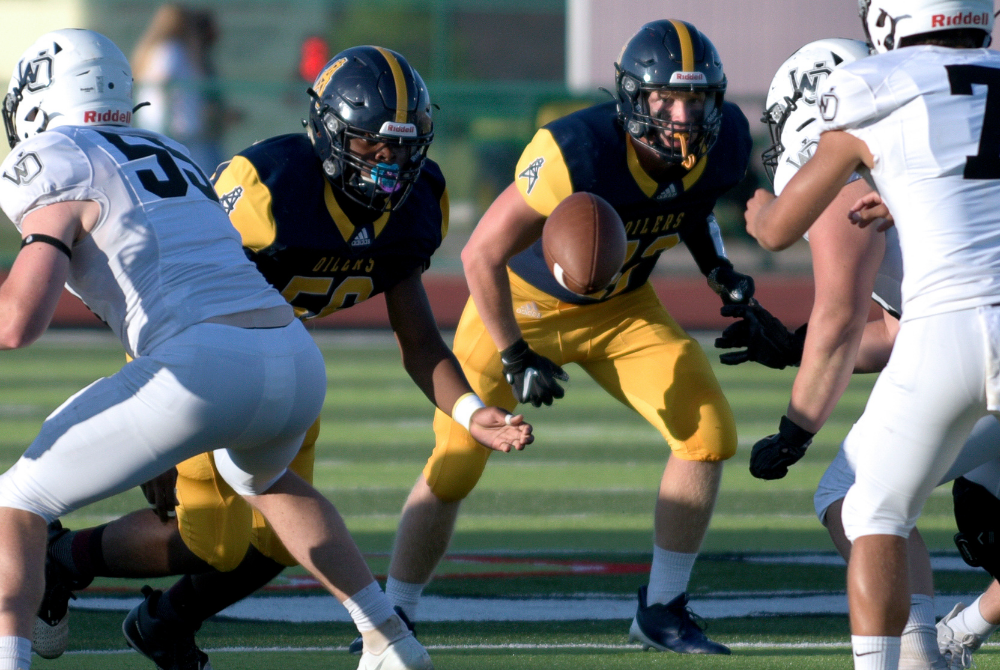
PHOTO Mount Pleasant, here on defense against Holland West Ottawa during a Week 2 win, is among teams that can clinch a league championship this weekend. (Click for more from High School Sports Scene.)